



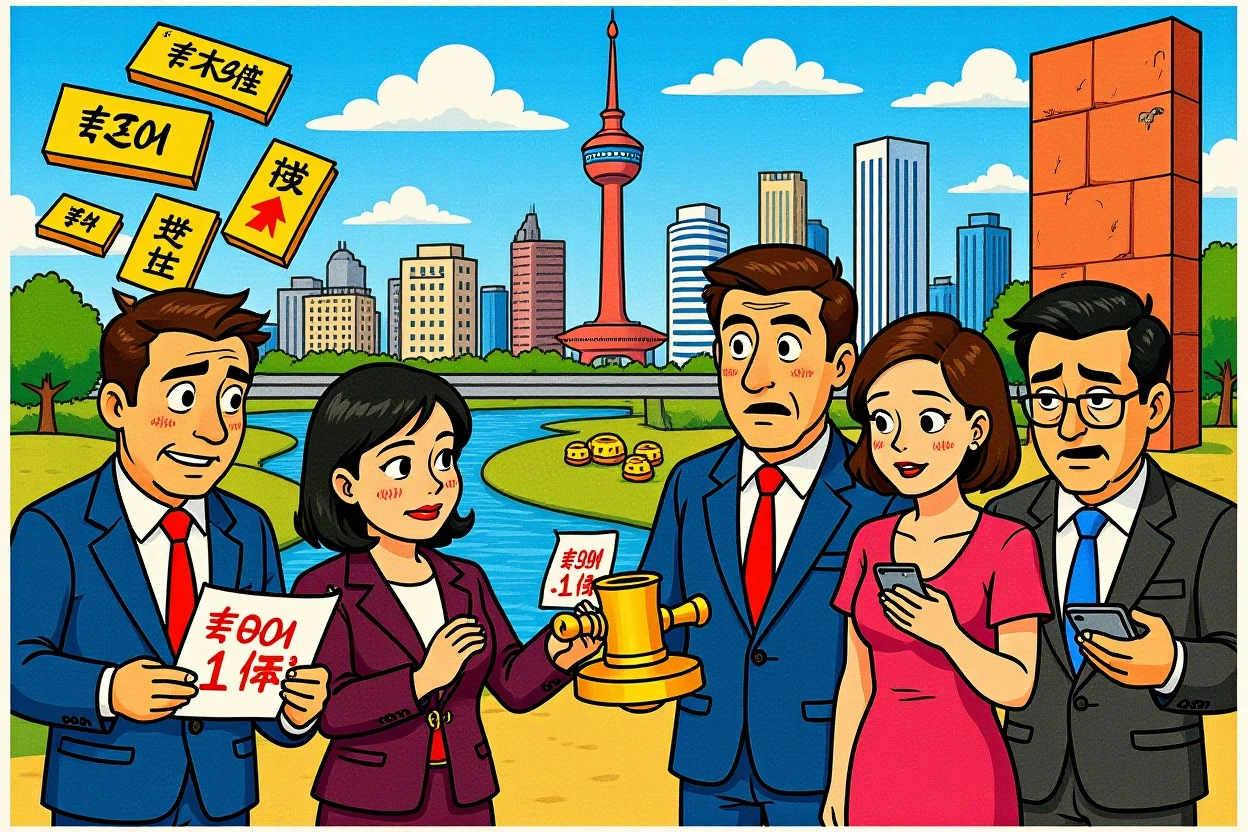
– China’s July Politburo meeting omitted real estate policy discussion for first time in years
– Shanghai’s Xuhui district sets new national land price record at ¥200,300/sqm
– Luxury property transactions surge 214% while mass market faces price corrections
– Foreign investors pour ¥28.7B into commercial real estate amid market polarization
– Analysis shows deepening divergence between financial-asset luxury properties and commodity housing
The Puzzling Policy Silence
When China’s Politburo converged in late July to chart the nation’s economic course, analysts noticed a conspicuous absence: for the first time in recent memory, the high-level meeting made no mention of the real estate sector. This omission comes despite property historically contributing 20-30% of China’s GDP. The silence stands in stark contrast to previous meetings where phrases like ‘housing is for living, not speculation’ dominated policy statements. This strategic quiet speaks volumes about the government’s approach to the evolving real estate polarization.
Reading Between Policy Lines
The meeting instead emphasized ‘maintaining policy continuity and stability while enhancing flexibility and foresight’ – suggesting a deliberate shift toward localized solutions rather than nationwide interventions. Property experts interpret this as tacit approval for cities to implement tailored measures according to their specific market conditions. Shanghai’s approach demonstrates how this plays out: while maintaining purchase restrictions in congested urban cores, the city actively promotes prime land auctions to attract capital.
Shanghai’s Record-Breaking Land Auction
Just days before the Politburo meeting, Shanghai’s property market made headlines when a 4,705 sqm plot in the prestigious Xuhui Hengfu Historical District sold for ¥1.225 billion – equivalent to ¥200,300 per square meter. The winning bidder, Shanghai Qixiang Wangyu Real Estate, prevailed after 28 rounds of fierce competition, securing the site with 22.38% premium. This transaction didn’t occur in isolation: seven of eight plots sold above reserve prices during the July auction series, generating ¥28.96 billion in total revenue.
Anatomy of a Land King
What justifies such astronomical pricing? The Xuhui plot represents extreme scarcity: the first new residential land release in this historic district in a decade. With just 1.3 plot ratio, development will be limited to approximately 6,000 sqm of luxury residences. Situated within Shanghai’s former French Concession – sometimes called the city’s ‘golden central axis’ – the location combines cultural heritage with premier amenities including Huaihai Road luxury shopping and top educational institutions.
– Location Premium: Within 1km of historical landmarks and luxury retail corridors
– Supply Constraint: Shanghai’s 2024 land supply decreased 53% year-on-year
– Demographic Appeal: Proximity to international schools and corporate headquarters
The Great Property Market Divergence
China’s real estate polarization manifests in startling contrasts. While Shanghai’s luxury market soars, nearly 300 residential properties nationwide recently sold via ‘1 yuan starting price’ auctions. This growing bifurcation represents what analysts term the ‘two worlds’ of Chinese property: ordinary housing fulfilling basic needs versus ultra-premium properties functioning as financial assets.
Luxury Market Boom
Shanghai’s high-end segment shows remarkable resilience, with 1,096 properties priced above ¥30 million trading hands in H1 2025 – a 214% increase over the 2017-2023 average. This surge reflects what UBS analyst Zhang Hongwei terms ‘flight to concrete gold’: ‘Luxury properties in gateway cities have become wealth preservation vehicles comparable to fine art or gold bullion.’
Mass Market Challenges
Meanwhile, broader market indicators remain soft. National land sale revenues declined 6.5% year-on-year in H1 2025, with auction failure rates hovering around 15% – predominantly in third and fourth-tier cities. This divergence creates policy headaches: while Shanghai debates cooling measures for luxury properties, smaller cities like Bengbu continue introducing purchase subsidies to clear inventory.
Global Capital Bets on Core Assets
International investors are capitalizing on this real estate polarization. Q2 2025 saw foreign institutions making net purchases of ¥28.7 billion in Chinese commercial property – a 210% year-on-year increase. Major transactions include:
– Blackstone’s ¥5.6B acquisition of 15% stake in Shanghai’s Kerry Center
– Goldman Sachs partnering with Vanke on ¥10B rental housing fund
– Abu Dhabi Investment Authority’s ¥4.2B purchase of Beijing’s China World Tower 3
The New Breed of Developers
Private enterprises are adopting surgical approaches fundamentally different from state-owned developers. Rather than pursuing scale, firms like the Ye Huabiao family office target micro-plots with unique characteristics. Their strategy focuses on ‘cultural compound’ developments merging luxury residences with private museums – exemplified by their winning bid for the Xuhui plot.
Decoding the Policy Signals
The Politburo’s silence shouldn’t be misinterpreted as neglect, but rather recognition of real estate polarization as an established market reality. This represents a philosophical shift from the previous decade’s universal policies toward differentiated management. The government appears to accept that:
– Prime urban land will function as financial assets for high-net-worth individuals
– Ordinary housing requires ongoing support to maintain social stability
– Market segmentation reduces systemic risk by compartmentalizing volatility
Regional Policy Experiments
This approach is already unfolding through localized initiatives. Shenzhen now imposes luxury home transaction taxes exceeding 30%, while Zhengzhou offers 10% purchase subsidies for first-time buyers. Such targeted measures acknowledge that a one-size-fits-all national policy can’t address the deepening real estate polarization.
Future Market Trajectory
Current trends suggest China’s property divergence will intensify through 2030. Three structural drivers will shape this evolution:
Supply Constriction
Shanghai’s 2025 land supply plan shows further 15% reduction in commercial/residential plots, continuing the scarcity premium for core locations. Meanwhile, third-tier cities face inventory overhangs exceeding 24 months of sales.
Wealth Concentration
Credit Suisse reports China’s ultra-high-net-worth population (assets >$50M) grew 16% annually since 2020 – the fastest expansion globally. This cohort’s preference for trophy properties creates pricing dynamics detached from conventional housing metrics.
Financialization of Luxury Assets
Top-tier properties increasingly function as collateral in wealth management products. Private banks now accept premium Shanghai addresses as security for loans at 50-60% loan-to-value ratios, reinforcing their status as financial instruments.
Strategic Implications for Stakeholders
This real estate polarization demands tailored approaches from different market participants:
– Homebuyers: Prioritize location over size, focusing on established urban cores
– Investors: Target cities with constrained supply and expanding high-income employment
– Developers: Adopt precision land acquisition over bulk purchases
Risk Management Considerations
The diverging market requires segmented risk assessment. While luxury properties show low price volatility, they carry concentration risk. Mass market investments offer higher yields but face policy uncertainty. Diversification across city tiers and product segments provides optimal balance.
The contrast between policy silence and record land prices reveals China’s property market transformation. Rather than signaling contradiction, these developments highlight the market’s structural evolution toward distinct segments governed by different dynamics. This real estate polarization demands sophisticated understanding beyond conventional market analysis. For stakeholders, success lies in recognizing that Shanghai’s ¥200,000/sqm land and third-tier cities’ 1 yuan auctions represent two facets of the same market reality – a reality where differentiated strategies replace uniform approaches.