



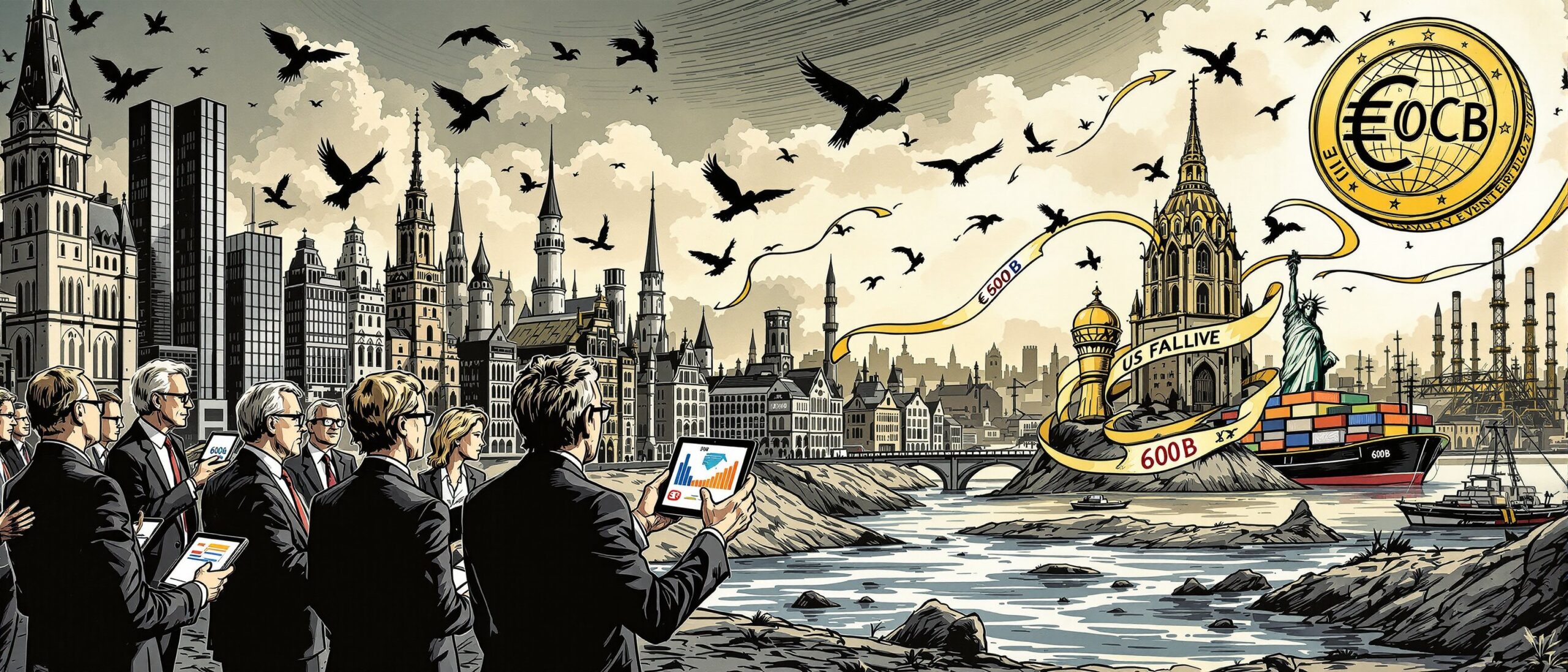
- EU agrees to $750 billion US energy purchases and massive military equipment procurement
- $600 billion EU investment commitment to United States sparks concerns over European growth
- Auto tariffs drop from 25% to 15% for immediate relief but pharmaceutical/semiconductor costs rise
- ECB may halt rate cuts at 2% as trade uncertainty eases
A Lopsided Agreement Emerges from Transatlantic Negotiations
The newly finalized US-EU trade agreement, celebrated by European Commission President Ursula von der Leyen as the ‘best achievable outcome,’ reveals significant asymmetries favoring American interests. Under terms announced by Deutsche Bank analysis, Brussels has made unprecedented concessions involving billions in redirected investments and strategic dependencies. While lowering tariffs on automobiles (25% to 15%) offers immediate relief for European manufacturers, the broader package requires fundamental shifts in energy procurement patterns and military technology relationships. These substantial EU concessions in the US trade deal pose critical questions about economic sovereignty and long-term competitiveness as capital and resources flow across the Atlantic.
The Cost of Avoiding Escalation
Market analysts initially forecasted compromise but few predicted the scale of concessions apparent in the ratified text. According to Deutsche Bank Securities research published July 28, Brussels accepted terms that minimize immediate trade war escalation while creating structural dependencies with lasting implications:
- Energy procurement commitments totaling $750 billion
- Military equipment acquisition programs worth hundreds of billions
- $600 billion capital investment pledge in US markets
ECB President Christine Lagarde noted the ‘controlled uncertainty reduction’ provides monetary breathing room despite these economic trade-offs.
Energy Dependency Shift
The three-year energy framework requires purchasing approximately $250 billion annually in US energy products. This accelerates Europe’s diversification away from Russian supplies while locking in transatlantic energy partnerships long beyond current geopolitical tensions.
Defense Industry Realities
President Trump confirmed multibillion-dollar arms purchases would flow to American defense contractors. With European military production capacity requiring years to scale, NATO’s heightened defense spending targets ensure continuing dependence on US suppliers. Industry analyses indicate half of Europe’s €200 billion defense equipment spending since Russia’s invasion remains contractually bound to American firms.
Investment Drain Warning
The headline concession troubling many analysts remains Brussels’ $600 billion commitment to US investments. As former ECB chief Mario Draghi noted before negotiations, Europe faces €800 billion in annual investment gaps across innovation infrastructure, green transition, and strategic sectors. Diverting capital stateside fundamentally undermines domestic industrial capacity.
Sectoral Impact Assessment
Lower automobile tariffs (25→15%) offer German and French manufacturers relief, but partly offset by:
- 15% duties on exports of pharmaceuticals
- Semiconductors facing equivalent tariffs
- Steel/aluminum sectors excluded from reductions
Agreement exempts aircraft, critical raw materials, and select agricultural products—reflecting French hardline positions during negotiations.
Long-Term Growth Calculus
Deutsche Bank previously modeled 0.4% EU GDP contraction under 10% tariffs. Revised projections accounting for sector-specific tariffs indicate net negative impacts should investments shift from European projects. Paradoxically, while tariff reductions soften manufacturing impacts, investment diversion risks hollowing strategic industrial capacity.
Monetary Policy & Inflation Pathways
The trade agreement significantly alters ECB projections incorporating tariff impacts. With trade uncertainty materially reduced:
- Pressure diminishes for additional interest rate cuts
- Current 2% policy rate may end easing cycle
- Euro appreciation may further suppress inflation
ECB officials signaled contingency-based approaches remain should inflation persistently trail below the 2% target ceiling.
Strategic Autonomy Concerns
Behind the economic metrics lies profound unease among European policymakers regarding asymmetric dependencies. European Commissioner Thierry Breton voiced concerns about maintaining strategic autonomy amid escalating technology competition and US industrial policy initiatives like the CHIPS Act.
Mitigating Growth Risks
Policy responses under discussion include:
- Countervailing investment incentives under EU sovereignty fund
- Deeper pan-European industrial partnerships
- Strategic inventories for critical inputs
German Chancellor Angela Merkel emphasized balancing transatlantic coordination with European capacity-building during her endorsement statement.
The Path Ahead for European Competitiveness
The agreement’s short-term stability has extracted significant structural commitments from Brussels. As European Commission leadership highlighted, pragmatic compromises were necessary to avert mutually damaging escalation. Yet beneath tariff adjustments lies reconfigured transatlantic economic relationships reshaping supply chains, innovation ecosystems, and geopolitical positioning.
Deutsche Bank analysts caution that long-term competitiveness depends on measurable reciprocity in market access. Without concrete offsets, today’s EU concessions in the US trade deal risk permanent capability erosion. Should geopolitical tensions heighten again, bargaining positions weaken alongside diminished self-sufficiency.
Navigating New Economic Realities
The contours of transatlantic economic governance appear irrevocably altered following Europe’s strategic compromises. Automakers gain room to breathe amid tariff relief, but irreversible capacities accumulate offshore. Investors must monitor ECB’s inflation targeting against persistent sub-target readings threatening monetary policy paralysis. Beyond balance sheets, ‘the EU concessions in US trade deal undoubtedly recalibrate Brussels’ geopolitical posture—transforming partners into patrons in defense capabilities and energy systems. For policymakers and corporate leaders alike, strategic foresight demands investing doubly in European resilience while bargaining relentlessly for reciprocal arrangements. Complacency now risks permanent competitive disadvantage in critical industries.
Consider deepening engagement with European Commission Trade Policy Develeopment at [European Commission Trade Policy Develeopment](https://ec.europa.eu/trade/) for timely insights.