



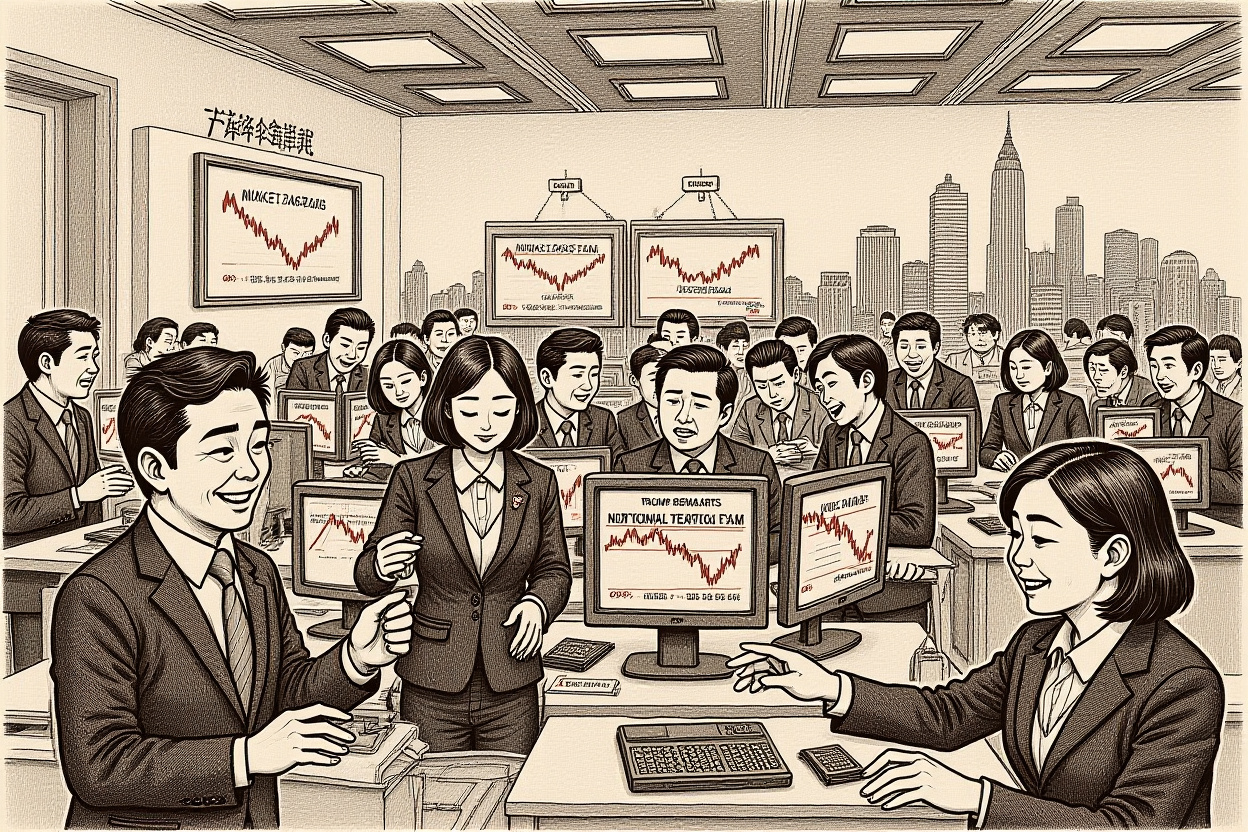
A wave of risk aversion swept across Asian trading floors this week, dragging major indices sharply lower. The sell-off, characterized by heavy volumes and broad-based declines, underscores the fragile sentiment prevailing in global markets. At the heart of the turbulence lies a potent mix of resurgent US inflation concerns, recalibrated Federal Reserve expectations, and renewed geopolitical anxieties, the latter amplified by recent commentary from former US President Donald Trump.
Executive Summary: Key Market Drivers and Implications
- Asia-Pacific equity markets experienced a significant, synchronous decline, led by heavyweight technology and financial sectors.
- The primary catalyst is a global reassessment of the interest rate outlook following stubbornly high US inflation data, prompting fears of a more hawkish Federal Reserve.
- Former President Donald Trump’s remarks on trade and foreign policy injected fresh geopolitical uncertainty, exacerbating risk-off sentiment and capital outflows from emerging markets.
- Chinese markets displayed relative resilience but were not immune, with regulators actively signaling support to stabilize investor confidence.
- Investors are advised to prioritize quality, liquidity, and policy-aligned sectors while maintaining strategic hedges against continued volatility.
The Anatomy of a Regional Sell-Off
The trading session saw a sea of red across major Asian bourses. Japan’s Nikkei 225 (日经225指数) fell sharply, while South Korea’s KOSPI (韩国综合股价指数) and Australia’s S&P/ASX 200 experienced similar pressure. The sell-off was not confined to a single sector; technology stocks, often sensitive to interest rate expectations, were among the hardest hit, alongside financials and cyclical industrials.
Global Macroeconomic Triggers
The immediate spark for the global risk reassessment was the latest US Consumer Price Index (CPI) data, which came in hotter than anticipated. This data point forced market participants to drastically scale back expectations for near-term Federal Reserve rate cuts. Higher-for-longer US interest rates strengthen the US Dollar (USD), exerting pressure on Asian currencies and tightening financial conditions across the region. This dynamic triggers capital flight from riskier emerging market assets back to dollar-denominated safe havens.
Technical Breakdown and Sentiment Erosion
From a technical perspective, several key regional indices breached important psychological and moving-average support levels. This triggered automated selling programs and stop-loss orders, accelerating the downward momentum. The market’s “fear gauge,” the CBOE Volatility Index (VIX), spiked, reflecting a broad-based increase in investor anxiety. The pervasive nature of the decline indicates a shift from sector-specific profit-taking to a systemic de-risking event, a development closely monitored by portfolio managers worldwide.
Trump’s Market-Rattling Rhetoric: A Geopolitical Wildcard
Compounding the purely economic fears was the re-emergence of geopolitical uncertainty as a market force. Former President Donald Trump, leading in key polls for the upcoming US election, made comments perceived as aggressive on trade and international alliances. This Trump’s market-rattling rhetoric specifically referenced potential tariffs and questioned longstanding security commitments, sending shockwaves through export-dependent Asian economies.
Impact on Trade-Sensitive Currencies and Equities
The immediate market reaction was visible in foreign exchange and equity markets. The Korean Won (KRW) and Taiwanese Dollar (TWD) – currencies of economies with massive export sectors – weakened notably against the USD. Stocks of major Asian exporters, particularly in the semiconductor and automotive supply chains, saw intensified selling pressure. Investors are concerned that a return to the trade-war policies of the 2018-2019 period could disrupt global supply chains and corporate earnings forecasts for the region’s economic powerhouses.
Long-term Strategic Uncertainty for Multinationals
Beyond immediate price action, Trump’s market-rattling rhetoric forces corporate strategists and long-term investors to reconsider their Asia-Pacific operational footprints. The potential for renewed trade barriers creates planning headaches for multinational corporations with complex cross-border production networks. This uncertainty acts as a cap on valuation multiples and discourages long-term capital expenditure commitments in the region until greater clarity emerges on the US political trajectory.
China’s Market Response: A Test of Policy Resolve
Within the regional downturn, the performance of Chinese markets offered a nuanced picture. The Shanghai Composite (上证综指) and the CSI 300 (沪深300指数) declined, but the moves were somewhat contained compared to regional peers. This relative stability was not accidental but the result of deliberate and visible action from Chinese financial authorities.
Regulatory Signals and “National Team” Activity
The China Securities Regulatory Commission (CSRC, 中国证监会) issued statements reaffirming its commitment to market stability and healthy, long-term development. Chairman Yi Huiman (易会满) has previously emphasized the importance of protecting investor rights, a message resonating during periods of stress. Market participants reported signs of buying support from state-linked entities, often colloquially referred to as the “national team” (国家队), particularly in large-cap financial and blue-chip stocks. This activity is designed to provide a floor under the market and prevent a self-reinforcing panic.
Sectoral Divergence and Domestic Policy Focus
The sell-off within China was not uniform. While globally-oriented technology and consumer discretionary stocks faced pressure, sectors aligned with China’s domestic policy priorities showed resilience. Stocks linked to high-end manufacturing, green energy, and artificial intelligence – all central to the country’s “new quality productive forces” (新质生产力) drive – experienced milder corrections. This divergence highlights a market increasingly differentiating between companies exposed to external volatility and those buoyed by internal strategic support.
Investment Strategy in a Volatile Landscape
For global investors navigating this turbulence, a reactive approach is insufficient. A proactive, principles-based strategy is essential to manage risk and identify opportunity. The current environment demands a focus on quality, liquidity, and strategic alignment with long-term macroeconomic trends, both in China and globally.
Portfolio Rebalancing and Defensive Posturing
Prudent risk management suggests several immediate actions. Firstly, rebalancing portfolios to ensure adequate exposure to defensive sectors with stable cash flows, such as healthcare and essential consumer staples, can provide a buffer. Secondly, increasing holdings of highly liquid assets is crucial to maintain flexibility. Finally, reviewing and potentially hedging currency exposure, particularly for Asian emerging market holdings, is a key consideration given the strong dollar environment exacerbated by Trump’s market-rattling rhetoric.
Identifying China-Specific Opportunities Amidst the Noise
For investors with a dedicated China mandate, volatility often creates entry points. The key is selective discernment. Focus should be on companies with:
- Robust domestic revenue streams, insulating them from trade friction.
- Strong balance sheets with low debt and high cash reserves.
- Clear alignment with Chinese policy goals like technological self-sufficiency (科技自立自强) and carbon neutrality.
Furthermore, the recent underperformance of high-quality Chinese ADRs (American Depositary Receipts) may present a valuation gap for patient, long-term capital, assuming geopolitical risks are carefully managed.
Synthesizing the Crosscurrents for Forward Guidance
The synchronous Asia-Pacific sell-off is a stark reminder that in an interconnected global financial system, local markets cannot decouple from powerful external shocks. The confluence of restrictive monetary policy from the West and the re-pricing of geopolitical risk creates a challenging backdrop for risk assets. Chinese authorities have demonstrated a willingness to intervene to prevent disorderly market movements, but their tools are more effective at managing the pace of decline than reversing global macro trends.
The path forward will be dictated by the evolution of US inflation data, the Federal Reserve’s communicated path, and the clarity—or lack thereof—surrounding US foreign policy. Investors must remain agile, using periods of heightened fear to strategically accumulate positions in companies with resilient fundamentals and clear competitive moats. As history shows, markets eventually stabilize and differentiate; the current storm of Trump’s market-rattling rhetoric and macroeconomic tightening will separate the strategically sound investments from the merely speculative. The imperative for sophisticated market participants is to look beyond the daily headlines, ground decisions in rigorous fundamental analysis, and maintain a disciplined, long-term perspective amidst the short-term noise.