



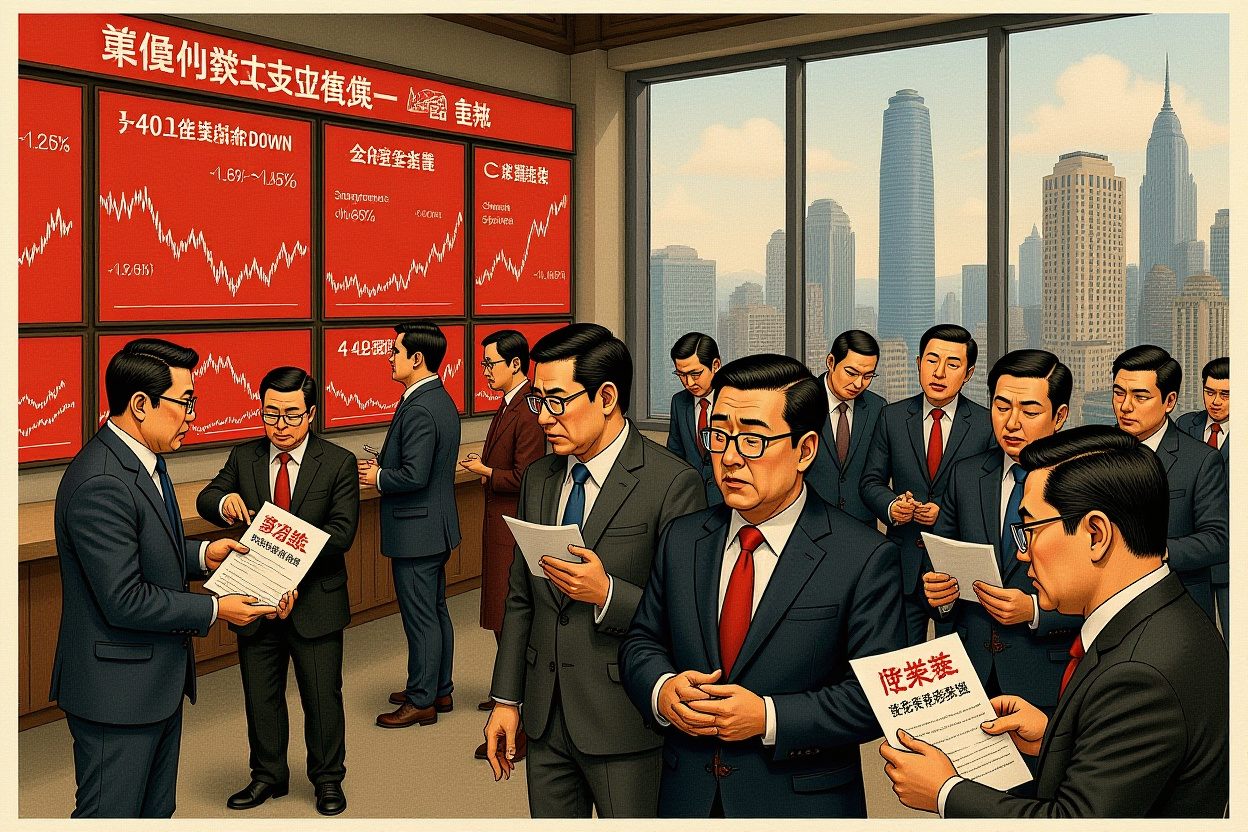
Summary: Key Takeaways from the Midday Market Turmoil
– The 上证指数 (Shanghai Composite Index), 深证成指 (Shenzhen Component Index), and 创业板指 (ChiNext Index) all fell sharply during the midday session, with declines exceeding 1% each, highlighting a broad-based A-Share midday sell-off.
– Approximately 4,400 stocks traded lower, indicating pervasive selling pressure across sectors, particularly in technology and consumer discretionary names.
– Drivers include renewed regulatory scrutiny from bodies like 中国证券监督管理委员会 (China Securities Regulatory Commission), softer-than-expected economic data, and negative spillover from global bond market volatility.
– The sell-off underscores lingering fragility in investor sentiment and emphasizes the importance of tactical positioning amid ongoing market volatility.
– Institutional investors should monitor upcoming policy signals and consider rebalancing portfolios towards defensive sectors or quality companies with strong fundamentals.
As Trading Floors Flash Red: Understanding the Midday Rout
The midday session in China’s equity markets delivered a stark reminder of the inherent volatility in emerging markets. Screens across Shanghai and Shenzhen lit up with a sea of red as the three major A-share indices tumbled in unison, dragging nearly 4,400 individual stocks into negative territory. This A-Share midday sell-off sent ripples of concern through the global investment community, prompting questions about the sustainability of recent gains and the health of China’s corporate sector. For time-pressed professionals, the sudden downturn represents both a risk and a potential opportunity, demanding a nuanced analysis of the underlying catalysts and market mechanics at play.
The Midday Plunge: A Deep Dive into the Numbers
Quantifying the scale of the decline is essential for contextualizing the day’s events. The sell-off was not isolated but rather a synchronized move across China’s key benchmarks.
Index Performance and Key Metrics
The 上证指数 (Shanghai Composite Index), a bellwether for large-cap stocks, closed the morning session down 1.4% at approximately 3,150 points. Similarly, the 深证成指 (Shenzhen Component Index), which tracks Shenzhen-listed companies, fell 1.8%, while the growth-oriented 创业板指 (ChiNext Index) plunged 2.2%. This triple-digit decline across all major indices marked one of the worst midday performances in recent weeks. Market breadth was overwhelmingly negative, with declining issues outnumbering advancers by a ratio of nearly 10-to-1. The sheer number of stocks in the red—close to 4,400—underscores the systemic nature of this A-Share midday sell-off, moving beyond selective profit-taking to a more generalized risk-off sentiment.
Volume and Volatility Spike</h3
Trading volume surged by approximately 25% compared to the previous session's midday figure, indicating heightened activity and potential panic selling. The 沪深300指数 (CSI 300 Index), which tracks the largest A-share listings, saw its volatility index, or "China VIX," jump by 15%. This spike in implied volatility reflects increased investor anxiety and expectations for further turbulence. Data from 上海证券交易所 (Shanghai Stock Exchange) showed that programmatic and algorithmic trading contributed to the volume surge, as automated systems reacted to breaking news and technical breakdowns.
Sectoral Carnage: Identifying the Worst Performers</h2
Not all sectors were equally impacted. A breakdown reveals where the selling was most concentrated and which areas showed relative resilience.
Technology and Consumer Discretionary Lead Declines</h3
The technology sector, often a high-beta play on economic growth, was among the hardest hit. Subsectors like semiconductors and software, represented by indices such as the 中华交易服务半导体芯片行业指数 (CES Semiconductor Chip Index), fell over 3%. Consumer discretionary stocks, including automakers and retailers, also faced intense pressure, declining an average of 2.5%. This weakness suggests investors are pricing in concerns over softening domestic demand and ongoing regulatory pressures on internet platforms, echoing past crackdowns on firms like 阿里巴巴集团 (Alibaba Group).
Defensive Sectors Show Relative Resilience</h3
In contrast, traditionally defensive sectors like utilities and consumer staples experienced milder losses. The 中证主要消费指数 (CSI Consumer Staples Index) dipped only 0.7%, while healthcare stocks, though down, outperformed the broader market. This rotation hints at a flight to safety within the A-share universe. Additionally, select financial names, particularly large state-owned banks, saw limited declines due to their attractive valuations and perceived stability amid economic uncertainty.
Unpacking the Catalysts: Why Did Markets Tumble?</h2
Several intertwined factors converged to trigger the midday downturn. Understanding these drivers is critical for assessing whether the sell-off is a temporary blip or the start of a deeper correction.
Regulatory Headwinds and Policy Uncertainty</h3
Investor sentiment was dampened by fresh regulatory signals. Overnight, comments from 中国证券监督管理委员会 (China Securities Regulatory Commission) officials emphasized stricter oversight of market conduct and corporate governance, reviving memories of the 2021 regulatory clampdown. Specific sectors, including online education and property, faced renewed scrutiny. Furthermore, ambiguous guidance from 中国人民银行 (People's Bank of China) on liquidity provisions left markets guessing about the near-term monetary policy stance, adding to the uncertainty that fueled this A-Share midday sell-off.
Macroeconomic Concerns and Data Disappointments</h3
Weakening economic indicators provided a fundamental backdrop for the decline. The latest 采购经理指数 (Purchasing Managers' Index, PMI) data, released by 国家统计局 (National Bureau of Statistics), showed a contraction in the services sector, missing analyst expectations. Concurrently, export growth forecasts have been trimmed due to global demand concerns. This data disappointment reinforced fears that China's post-pandemic recovery is losing steam, making equities less attractive. The market's reaction was a classic case of "selling the news," as earlier optimism priced into valuations collided with a harsher reality.
Global Context: How International Markets Are Influencing A-Shares</h2
China's markets do not operate in a vacuum. Spillover effects from global financial conditions played a significant role in amplifying the domestic sell-off.
US Treasury Yields and Fed Policy Implications</h3
A sudden rise in US Treasury yields overnight put pressure on risk assets worldwide, including Chinese equities. Higher global yields reduce the relative attractiveness of stocks, particularly growth-oriented names prevalent in the A-share market. Investors are increasingly factoring in a more hawkish stance from the US Federal Reserve, which could lead to capital outflows from emerging markets. This external pressure compounded domestic worries, making the A-Share midday sell-off part of a broader global risk reassessment.
Commodity Price Swings and Their Impact</h3
Volatility in key commodity markets also weighed on sentiment. A sharp pullback in industrial metals like copper and iron ore hurt mining and materials stocks listed in Shanghai and Shenzhen. Since China is a major consumer of commodities, price declines signal concerns about industrial demand. Additionally, fluctuations in the 人民币 (Renminbi) exchange rate added another layer of complexity, as a weaker currency can deter foreign investment in A-shares. Monitoring these global linkages is essential for investors seeking to navigate the A-Share midday sell-off environment.
Technical Perspective: Charting the Path Forward</h2
Beyond fundamentals, technical analysis provides clues about potential support levels and future market direction.
Key Support and Resistance Levels to Watch</h3
Chartists note that the 上证指数 (Shanghai Composite Index) breached its 50-day moving average during the session, a bearish technical signal. Immediate support is now seen around the 3,100-point level, which coincides with the 200-day moving average and a previous consolidation zone. A break below this could trigger further automated selling. Resistance on any rebound is likely at the 3,180-point mark. The high volume during the decline confirms the breakdown, suggesting the A-Share midday sell-off may have legs unless buyers step in aggressively at lower levels.
Moving Averages and Momentum Indicators</h3
The relative strength index (RSI) for the major indices dipped into oversold territory below 30, which could signal a near-term bounce is due. However, the moving average convergence divergence (MACD) indicator turned negative, indicating building downward momentum. For the 创业板指 (ChiNext Index), the technical picture is even weaker, with the index now trading below all key short-term averages. These patterns suggest that while a tactical rebound is possible, the overall trend may have shifted to neutral or negative, requiring investors to adjust their strategies accordingly.
Strategic Implications for Institutional Investors</h2
For fund managers and corporate executives, the midday volatility presents both challenges and opportunities. Actionable insights can be derived from the market's behavior.
Portfolio Rebalancing and Risk Management</h3
In the wake of the A-Share midday sell-off, institutional investors should review portfolio concentration and exposure to high-beta sectors. Consider increasing weightings in defensive plays like utilities, consumer staples, and selected state-owned enterprises, which have shown resilience. Implementing or tightening stop-loss orders on speculative positions can help manage downside risk. Additionally, using derivatives such as 沪深300股指期货 (CSI 300 index futures) for hedging may be prudent if volatility persists. Diversification across asset classes, including bonds and offshore Chinese equities, can also mitigate A-share-specific shocks.
Opportunities Amidst the Turmoil</h3
Market dislocations often create buying opportunities for disciplined investors. Quality companies with strong balance sheets, consistent cash flows, and low debt that have been oversold in the broad-based decline may offer attractive entry points. Sectors aligned with long-term policy priorities, such as renewable energy, advanced manufacturing, and domestic semiconductor production, could see support once the dust settles. Investors should also monitor for potential government intervention; history shows that sharp sell-offs sometimes prompt supportive measures from entities like 中国证券金融股份有限公司 (China Securities Finance Corporation), which provides market liquidity.
Synthesizing the Day’s Events and Looking Ahead</h2
The pronounced A-Share midday sell-off serves as a potent reminder of the dynamic and sometimes unforgiving nature of China's equity markets. While the immediate catalysts—regulatory noise, soft economic data, and global yield pressures—are concerning, they are not necessarily indicative of a prolonged bear market. Instead, they highlight the importance of vigilant risk management and a data-driven investment approach. For international investors, this episode underscores the need to closely track policy communications from 中国证券监督管理委员会 (China Securities Regulatory Commission) and macroeconomic releases from 国家统计局 (National Bureau of Statistics).
Not all sectors were equally impacted. A breakdown reveals where the selling was most concentrated and which areas showed relative resilience.
Technology and Consumer Discretionary Lead Declines</h3
The technology sector, often a high-beta play on economic growth, was among the hardest hit. Subsectors like semiconductors and software, represented by indices such as the 中华交易服务半导体芯片行业指数 (CES Semiconductor Chip Index), fell over 3%. Consumer discretionary stocks, including automakers and retailers, also faced intense pressure, declining an average of 2.5%. This weakness suggests investors are pricing in concerns over softening domestic demand and ongoing regulatory pressures on internet platforms, echoing past crackdowns on firms like 阿里巴巴集团 (Alibaba Group).
Defensive Sectors Show Relative Resilience</h3
In contrast, traditionally defensive sectors like utilities and consumer staples experienced milder losses. The 中证主要消费指数 (CSI Consumer Staples Index) dipped only 0.7%, while healthcare stocks, though down, outperformed the broader market. This rotation hints at a flight to safety within the A-share universe. Additionally, select financial names, particularly large state-owned banks, saw limited declines due to their attractive valuations and perceived stability amid economic uncertainty.
Unpacking the Catalysts: Why Did Markets Tumble?</h2
Several intertwined factors converged to trigger the midday downturn. Understanding these drivers is critical for assessing whether the sell-off is a temporary blip or the start of a deeper correction.
Regulatory Headwinds and Policy Uncertainty</h3
Investor sentiment was dampened by fresh regulatory signals. Overnight, comments from 中国证券监督管理委员会 (China Securities Regulatory Commission) officials emphasized stricter oversight of market conduct and corporate governance, reviving memories of the 2021 regulatory clampdown. Specific sectors, including online education and property, faced renewed scrutiny. Furthermore, ambiguous guidance from 中国人民银行 (People's Bank of China) on liquidity provisions left markets guessing about the near-term monetary policy stance, adding to the uncertainty that fueled this A-Share midday sell-off.
Macroeconomic Concerns and Data Disappointments</h3
Weakening economic indicators provided a fundamental backdrop for the decline. The latest 采购经理指数 (Purchasing Managers' Index, PMI) data, released by 国家统计局 (National Bureau of Statistics), showed a contraction in the services sector, missing analyst expectations. Concurrently, export growth forecasts have been trimmed due to global demand concerns. This data disappointment reinforced fears that China's post-pandemic recovery is losing steam, making equities less attractive. The market's reaction was a classic case of "selling the news," as earlier optimism priced into valuations collided with a harsher reality.
Global Context: How International Markets Are Influencing A-Shares</h2
China's markets do not operate in a vacuum. Spillover effects from global financial conditions played a significant role in amplifying the domestic sell-off.
US Treasury Yields and Fed Policy Implications</h3
A sudden rise in US Treasury yields overnight put pressure on risk assets worldwide, including Chinese equities. Higher global yields reduce the relative attractiveness of stocks, particularly growth-oriented names prevalent in the A-share market. Investors are increasingly factoring in a more hawkish stance from the US Federal Reserve, which could lead to capital outflows from emerging markets. This external pressure compounded domestic worries, making the A-Share midday sell-off part of a broader global risk reassessment.
Commodity Price Swings and Their Impact</h3
Volatility in key commodity markets also weighed on sentiment. A sharp pullback in industrial metals like copper and iron ore hurt mining and materials stocks listed in Shanghai and Shenzhen. Since China is a major consumer of commodities, price declines signal concerns about industrial demand. Additionally, fluctuations in the 人民币 (Renminbi) exchange rate added another layer of complexity, as a weaker currency can deter foreign investment in A-shares. Monitoring these global linkages is essential for investors seeking to navigate the A-Share midday sell-off environment.
Technical Perspective: Charting the Path Forward</h2
Beyond fundamentals, technical analysis provides clues about potential support levels and future market direction.
Key Support and Resistance Levels to Watch</h3
Chartists note that the 上证指数 (Shanghai Composite Index) breached its 50-day moving average during the session, a bearish technical signal. Immediate support is now seen around the 3,100-point level, which coincides with the 200-day moving average and a previous consolidation zone. A break below this could trigger further automated selling. Resistance on any rebound is likely at the 3,180-point mark. The high volume during the decline confirms the breakdown, suggesting the A-Share midday sell-off may have legs unless buyers step in aggressively at lower levels.
Moving Averages and Momentum Indicators</h3
The relative strength index (RSI) for the major indices dipped into oversold territory below 30, which could signal a near-term bounce is due. However, the moving average convergence divergence (MACD) indicator turned negative, indicating building downward momentum. For the 创业板指 (ChiNext Index), the technical picture is even weaker, with the index now trading below all key short-term averages. These patterns suggest that while a tactical rebound is possible, the overall trend may have shifted to neutral or negative, requiring investors to adjust their strategies accordingly.
Strategic Implications for Institutional Investors</h2
For fund managers and corporate executives, the midday volatility presents both challenges and opportunities. Actionable insights can be derived from the market's behavior.
Portfolio Rebalancing and Risk Management</h3
In the wake of the A-Share midday sell-off, institutional investors should review portfolio concentration and exposure to high-beta sectors. Consider increasing weightings in defensive plays like utilities, consumer staples, and selected state-owned enterprises, which have shown resilience. Implementing or tightening stop-loss orders on speculative positions can help manage downside risk. Additionally, using derivatives such as 沪深300股指期货 (CSI 300 index futures) for hedging may be prudent if volatility persists. Diversification across asset classes, including bonds and offshore Chinese equities, can also mitigate A-share-specific shocks.
Opportunities Amidst the Turmoil</h3
Market dislocations often create buying opportunities for disciplined investors. Quality companies with strong balance sheets, consistent cash flows, and low debt that have been oversold in the broad-based decline may offer attractive entry points. Sectors aligned with long-term policy priorities, such as renewable energy, advanced manufacturing, and domestic semiconductor production, could see support once the dust settles. Investors should also monitor for potential government intervention; history shows that sharp sell-offs sometimes prompt supportive measures from entities like 中国证券金融股份有限公司 (China Securities Finance Corporation), which provides market liquidity.
Synthesizing the Day’s Events and Looking Ahead</h2
The pronounced A-Share midday sell-off serves as a potent reminder of the dynamic and sometimes unforgiving nature of China's equity markets. While the immediate catalysts—regulatory noise, soft economic data, and global yield pressures—are concerning, they are not necessarily indicative of a prolonged bear market. Instead, they highlight the importance of vigilant risk management and a data-driven investment approach. For international investors, this episode underscores the need to closely track policy communications from 中国证券监督管理委员会 (China Securities Regulatory Commission) and macroeconomic releases from 国家统计局 (National Bureau of Statistics).
In contrast, traditionally defensive sectors like utilities and consumer staples experienced milder losses. The 中证主要消费指数 (CSI Consumer Staples Index) dipped only 0.7%, while healthcare stocks, though down, outperformed the broader market. This rotation hints at a flight to safety within the A-share universe. Additionally, select financial names, particularly large state-owned banks, saw limited declines due to their attractive valuations and perceived stability amid economic uncertainty.
Unpacking the Catalysts: Why Did Markets Tumble?</h2
Several intertwined factors converged to trigger the midday downturn. Understanding these drivers is critical for assessing whether the sell-off is a temporary blip or the start of a deeper correction.
Regulatory Headwinds and Policy Uncertainty</h3
Investor sentiment was dampened by fresh regulatory signals. Overnight, comments from 中国证券监督管理委员会 (China Securities Regulatory Commission) officials emphasized stricter oversight of market conduct and corporate governance, reviving memories of the 2021 regulatory clampdown. Specific sectors, including online education and property, faced renewed scrutiny. Furthermore, ambiguous guidance from 中国人民银行 (People's Bank of China) on liquidity provisions left markets guessing about the near-term monetary policy stance, adding to the uncertainty that fueled this A-Share midday sell-off.
Macroeconomic Concerns and Data Disappointments</h3
Weakening economic indicators provided a fundamental backdrop for the decline. The latest 采购经理指数 (Purchasing Managers' Index, PMI) data, released by 国家统计局 (National Bureau of Statistics), showed a contraction in the services sector, missing analyst expectations. Concurrently, export growth forecasts have been trimmed due to global demand concerns. This data disappointment reinforced fears that China's post-pandemic recovery is losing steam, making equities less attractive. The market's reaction was a classic case of "selling the news," as earlier optimism priced into valuations collided with a harsher reality.
Global Context: How International Markets Are Influencing A-Shares</h2
China's markets do not operate in a vacuum. Spillover effects from global financial conditions played a significant role in amplifying the domestic sell-off.
US Treasury Yields and Fed Policy Implications</h3
A sudden rise in US Treasury yields overnight put pressure on risk assets worldwide, including Chinese equities. Higher global yields reduce the relative attractiveness of stocks, particularly growth-oriented names prevalent in the A-share market. Investors are increasingly factoring in a more hawkish stance from the US Federal Reserve, which could lead to capital outflows from emerging markets. This external pressure compounded domestic worries, making the A-Share midday sell-off part of a broader global risk reassessment.
Commodity Price Swings and Their Impact</h3
Volatility in key commodity markets also weighed on sentiment. A sharp pullback in industrial metals like copper and iron ore hurt mining and materials stocks listed in Shanghai and Shenzhen. Since China is a major consumer of commodities, price declines signal concerns about industrial demand. Additionally, fluctuations in the 人民币 (Renminbi) exchange rate added another layer of complexity, as a weaker currency can deter foreign investment in A-shares. Monitoring these global linkages is essential for investors seeking to navigate the A-Share midday sell-off environment.
Technical Perspective: Charting the Path Forward</h2
Beyond fundamentals, technical analysis provides clues about potential support levels and future market direction.
Key Support and Resistance Levels to Watch</h3
Chartists note that the 上证指数 (Shanghai Composite Index) breached its 50-day moving average during the session, a bearish technical signal. Immediate support is now seen around the 3,100-point level, which coincides with the 200-day moving average and a previous consolidation zone. A break below this could trigger further automated selling. Resistance on any rebound is likely at the 3,180-point mark. The high volume during the decline confirms the breakdown, suggesting the A-Share midday sell-off may have legs unless buyers step in aggressively at lower levels.
Moving Averages and Momentum Indicators</h3
The relative strength index (RSI) for the major indices dipped into oversold territory below 30, which could signal a near-term bounce is due. However, the moving average convergence divergence (MACD) indicator turned negative, indicating building downward momentum. For the 创业板指 (ChiNext Index), the technical picture is even weaker, with the index now trading below all key short-term averages. These patterns suggest that while a tactical rebound is possible, the overall trend may have shifted to neutral or negative, requiring investors to adjust their strategies accordingly.
Strategic Implications for Institutional Investors</h2
For fund managers and corporate executives, the midday volatility presents both challenges and opportunities. Actionable insights can be derived from the market's behavior.
Portfolio Rebalancing and Risk Management</h3
In the wake of the A-Share midday sell-off, institutional investors should review portfolio concentration and exposure to high-beta sectors. Consider increasing weightings in defensive plays like utilities, consumer staples, and selected state-owned enterprises, which have shown resilience. Implementing or tightening stop-loss orders on speculative positions can help manage downside risk. Additionally, using derivatives such as 沪深300股指期货 (CSI 300 index futures) for hedging may be prudent if volatility persists. Diversification across asset classes, including bonds and offshore Chinese equities, can also mitigate A-share-specific shocks.
Opportunities Amidst the Turmoil</h3
Market dislocations often create buying opportunities for disciplined investors. Quality companies with strong balance sheets, consistent cash flows, and low debt that have been oversold in the broad-based decline may offer attractive entry points. Sectors aligned with long-term policy priorities, such as renewable energy, advanced manufacturing, and domestic semiconductor production, could see support once the dust settles. Investors should also monitor for potential government intervention; history shows that sharp sell-offs sometimes prompt supportive measures from entities like 中国证券金融股份有限公司 (China Securities Finance Corporation), which provides market liquidity.
Synthesizing the Day’s Events and Looking Ahead</h2
The pronounced A-Share midday sell-off serves as a potent reminder of the dynamic and sometimes unforgiving nature of China's equity markets. While the immediate catalysts—regulatory noise, soft economic data, and global yield pressures—are concerning, they are not necessarily indicative of a prolonged bear market. Instead, they highlight the importance of vigilant risk management and a data-driven investment approach. For international investors, this episode underscores the need to closely track policy communications from 中国证券监督管理委员会 (China Securities Regulatory Commission) and macroeconomic releases from 国家统计局 (National Bureau of Statistics).
Investor sentiment was dampened by fresh regulatory signals. Overnight, comments from 中国证券监督管理委员会 (China Securities Regulatory Commission) officials emphasized stricter oversight of market conduct and corporate governance, reviving memories of the 2021 regulatory clampdown. Specific sectors, including online education and property, faced renewed scrutiny. Furthermore, ambiguous guidance from 中国人民银行 (People's Bank of China) on liquidity provisions left markets guessing about the near-term monetary policy stance, adding to the uncertainty that fueled this A-Share midday sell-off.
Macroeconomic Concerns and Data Disappointments</h3
Weakening economic indicators provided a fundamental backdrop for the decline. The latest 采购经理指数 (Purchasing Managers' Index, PMI) data, released by 国家统计局 (National Bureau of Statistics), showed a contraction in the services sector, missing analyst expectations. Concurrently, export growth forecasts have been trimmed due to global demand concerns. This data disappointment reinforced fears that China's post-pandemic recovery is losing steam, making equities less attractive. The market's reaction was a classic case of "selling the news," as earlier optimism priced into valuations collided with a harsher reality.
Global Context: How International Markets Are Influencing A-Shares</h2
China's markets do not operate in a vacuum. Spillover effects from global financial conditions played a significant role in amplifying the domestic sell-off.
US Treasury Yields and Fed Policy Implications</h3
A sudden rise in US Treasury yields overnight put pressure on risk assets worldwide, including Chinese equities. Higher global yields reduce the relative attractiveness of stocks, particularly growth-oriented names prevalent in the A-share market. Investors are increasingly factoring in a more hawkish stance from the US Federal Reserve, which could lead to capital outflows from emerging markets. This external pressure compounded domestic worries, making the A-Share midday sell-off part of a broader global risk reassessment.
Commodity Price Swings and Their Impact</h3
Volatility in key commodity markets also weighed on sentiment. A sharp pullback in industrial metals like copper and iron ore hurt mining and materials stocks listed in Shanghai and Shenzhen. Since China is a major consumer of commodities, price declines signal concerns about industrial demand. Additionally, fluctuations in the 人民币 (Renminbi) exchange rate added another layer of complexity, as a weaker currency can deter foreign investment in A-shares. Monitoring these global linkages is essential for investors seeking to navigate the A-Share midday sell-off environment.
Technical Perspective: Charting the Path Forward</h2
Beyond fundamentals, technical analysis provides clues about potential support levels and future market direction.
Key Support and Resistance Levels to Watch</h3
Chartists note that the 上证指数 (Shanghai Composite Index) breached its 50-day moving average during the session, a bearish technical signal. Immediate support is now seen around the 3,100-point level, which coincides with the 200-day moving average and a previous consolidation zone. A break below this could trigger further automated selling. Resistance on any rebound is likely at the 3,180-point mark. The high volume during the decline confirms the breakdown, suggesting the A-Share midday sell-off may have legs unless buyers step in aggressively at lower levels.
Moving Averages and Momentum Indicators</h3
The relative strength index (RSI) for the major indices dipped into oversold territory below 30, which could signal a near-term bounce is due. However, the moving average convergence divergence (MACD) indicator turned negative, indicating building downward momentum. For the 创业板指 (ChiNext Index), the technical picture is even weaker, with the index now trading below all key short-term averages. These patterns suggest that while a tactical rebound is possible, the overall trend may have shifted to neutral or negative, requiring investors to adjust their strategies accordingly.
Strategic Implications for Institutional Investors</h2
For fund managers and corporate executives, the midday volatility presents both challenges and opportunities. Actionable insights can be derived from the market's behavior.
Portfolio Rebalancing and Risk Management</h3
In the wake of the A-Share midday sell-off, institutional investors should review portfolio concentration and exposure to high-beta sectors. Consider increasing weightings in defensive plays like utilities, consumer staples, and selected state-owned enterprises, which have shown resilience. Implementing or tightening stop-loss orders on speculative positions can help manage downside risk. Additionally, using derivatives such as 沪深300股指期货 (CSI 300 index futures) for hedging may be prudent if volatility persists. Diversification across asset classes, including bonds and offshore Chinese equities, can also mitigate A-share-specific shocks.
Opportunities Amidst the Turmoil</h3
Market dislocations often create buying opportunities for disciplined investors. Quality companies with strong balance sheets, consistent cash flows, and low debt that have been oversold in the broad-based decline may offer attractive entry points. Sectors aligned with long-term policy priorities, such as renewable energy, advanced manufacturing, and domestic semiconductor production, could see support once the dust settles. Investors should also monitor for potential government intervention; history shows that sharp sell-offs sometimes prompt supportive measures from entities like 中国证券金融股份有限公司 (China Securities Finance Corporation), which provides market liquidity.
Synthesizing the Day’s Events and Looking Ahead</h2
The pronounced A-Share midday sell-off serves as a potent reminder of the dynamic and sometimes unforgiving nature of China's equity markets. While the immediate catalysts—regulatory noise, soft economic data, and global yield pressures—are concerning, they are not necessarily indicative of a prolonged bear market. Instead, they highlight the importance of vigilant risk management and a data-driven investment approach. For international investors, this episode underscores the need to closely track policy communications from 中国证券监督管理委员会 (China Securities Regulatory Commission) and macroeconomic releases from 国家统计局 (National Bureau of Statistics).
China's markets do not operate in a vacuum. Spillover effects from global financial conditions played a significant role in amplifying the domestic sell-off.
US Treasury Yields and Fed Policy Implications</h3
A sudden rise in US Treasury yields overnight put pressure on risk assets worldwide, including Chinese equities. Higher global yields reduce the relative attractiveness of stocks, particularly growth-oriented names prevalent in the A-share market. Investors are increasingly factoring in a more hawkish stance from the US Federal Reserve, which could lead to capital outflows from emerging markets. This external pressure compounded domestic worries, making the A-Share midday sell-off part of a broader global risk reassessment.
Commodity Price Swings and Their Impact</h3
Volatility in key commodity markets also weighed on sentiment. A sharp pullback in industrial metals like copper and iron ore hurt mining and materials stocks listed in Shanghai and Shenzhen. Since China is a major consumer of commodities, price declines signal concerns about industrial demand. Additionally, fluctuations in the 人民币 (Renminbi) exchange rate added another layer of complexity, as a weaker currency can deter foreign investment in A-shares. Monitoring these global linkages is essential for investors seeking to navigate the A-Share midday sell-off environment.
Technical Perspective: Charting the Path Forward</h2
Beyond fundamentals, technical analysis provides clues about potential support levels and future market direction.
Key Support and Resistance Levels to Watch</h3
Chartists note that the 上证指数 (Shanghai Composite Index) breached its 50-day moving average during the session, a bearish technical signal. Immediate support is now seen around the 3,100-point level, which coincides with the 200-day moving average and a previous consolidation zone. A break below this could trigger further automated selling. Resistance on any rebound is likely at the 3,180-point mark. The high volume during the decline confirms the breakdown, suggesting the A-Share midday sell-off may have legs unless buyers step in aggressively at lower levels.
Moving Averages and Momentum Indicators</h3
The relative strength index (RSI) for the major indices dipped into oversold territory below 30, which could signal a near-term bounce is due. However, the moving average convergence divergence (MACD) indicator turned negative, indicating building downward momentum. For the 创业板指 (ChiNext Index), the technical picture is even weaker, with the index now trading below all key short-term averages. These patterns suggest that while a tactical rebound is possible, the overall trend may have shifted to neutral or negative, requiring investors to adjust their strategies accordingly.
Strategic Implications for Institutional Investors</h2
For fund managers and corporate executives, the midday volatility presents both challenges and opportunities. Actionable insights can be derived from the market's behavior.
Portfolio Rebalancing and Risk Management</h3
In the wake of the A-Share midday sell-off, institutional investors should review portfolio concentration and exposure to high-beta sectors. Consider increasing weightings in defensive plays like utilities, consumer staples, and selected state-owned enterprises, which have shown resilience. Implementing or tightening stop-loss orders on speculative positions can help manage downside risk. Additionally, using derivatives such as 沪深300股指期货 (CSI 300 index futures) for hedging may be prudent if volatility persists. Diversification across asset classes, including bonds and offshore Chinese equities, can also mitigate A-share-specific shocks.
Opportunities Amidst the Turmoil</h3
Market dislocations often create buying opportunities for disciplined investors. Quality companies with strong balance sheets, consistent cash flows, and low debt that have been oversold in the broad-based decline may offer attractive entry points. Sectors aligned with long-term policy priorities, such as renewable energy, advanced manufacturing, and domestic semiconductor production, could see support once the dust settles. Investors should also monitor for potential government intervention; history shows that sharp sell-offs sometimes prompt supportive measures from entities like 中国证券金融股份有限公司 (China Securities Finance Corporation), which provides market liquidity.
Synthesizing the Day’s Events and Looking Ahead</h2
The pronounced A-Share midday sell-off serves as a potent reminder of the dynamic and sometimes unforgiving nature of China's equity markets. While the immediate catalysts—regulatory noise, soft economic data, and global yield pressures—are concerning, they are not necessarily indicative of a prolonged bear market. Instead, they highlight the importance of vigilant risk management and a data-driven investment approach. For international investors, this episode underscores the need to closely track policy communications from 中国证券监督管理委员会 (China Securities Regulatory Commission) and macroeconomic releases from 国家统计局 (National Bureau of Statistics).
Volatility in key commodity markets also weighed on sentiment. A sharp pullback in industrial metals like copper and iron ore hurt mining and materials stocks listed in Shanghai and Shenzhen. Since China is a major consumer of commodities, price declines signal concerns about industrial demand. Additionally, fluctuations in the 人民币 (Renminbi) exchange rate added another layer of complexity, as a weaker currency can deter foreign investment in A-shares. Monitoring these global linkages is essential for investors seeking to navigate the A-Share midday sell-off environment.
Technical Perspective: Charting the Path Forward</h2
Beyond fundamentals, technical analysis provides clues about potential support levels and future market direction.
Key Support and Resistance Levels to Watch</h3
Chartists note that the 上证指数 (Shanghai Composite Index) breached its 50-day moving average during the session, a bearish technical signal. Immediate support is now seen around the 3,100-point level, which coincides with the 200-day moving average and a previous consolidation zone. A break below this could trigger further automated selling. Resistance on any rebound is likely at the 3,180-point mark. The high volume during the decline confirms the breakdown, suggesting the A-Share midday sell-off may have legs unless buyers step in aggressively at lower levels.
Moving Averages and Momentum Indicators</h3
The relative strength index (RSI) for the major indices dipped into oversold territory below 30, which could signal a near-term bounce is due. However, the moving average convergence divergence (MACD) indicator turned negative, indicating building downward momentum. For the 创业板指 (ChiNext Index), the technical picture is even weaker, with the index now trading below all key short-term averages. These patterns suggest that while a tactical rebound is possible, the overall trend may have shifted to neutral or negative, requiring investors to adjust their strategies accordingly.
Strategic Implications for Institutional Investors</h2
For fund managers and corporate executives, the midday volatility presents both challenges and opportunities. Actionable insights can be derived from the market's behavior.
Portfolio Rebalancing and Risk Management</h3
In the wake of the A-Share midday sell-off, institutional investors should review portfolio concentration and exposure to high-beta sectors. Consider increasing weightings in defensive plays like utilities, consumer staples, and selected state-owned enterprises, which have shown resilience. Implementing or tightening stop-loss orders on speculative positions can help manage downside risk. Additionally, using derivatives such as 沪深300股指期货 (CSI 300 index futures) for hedging may be prudent if volatility persists. Diversification across asset classes, including bonds and offshore Chinese equities, can also mitigate A-share-specific shocks.
Opportunities Amidst the Turmoil</h3
Market dislocations often create buying opportunities for disciplined investors. Quality companies with strong balance sheets, consistent cash flows, and low debt that have been oversold in the broad-based decline may offer attractive entry points. Sectors aligned with long-term policy priorities, such as renewable energy, advanced manufacturing, and domestic semiconductor production, could see support once the dust settles. Investors should also monitor for potential government intervention; history shows that sharp sell-offs sometimes prompt supportive measures from entities like 中国证券金融股份有限公司 (China Securities Finance Corporation), which provides market liquidity.
Synthesizing the Day’s Events and Looking Ahead</h2
The pronounced A-Share midday sell-off serves as a potent reminder of the dynamic and sometimes unforgiving nature of China's equity markets. While the immediate catalysts—regulatory noise, soft economic data, and global yield pressures—are concerning, they are not necessarily indicative of a prolonged bear market. Instead, they highlight the importance of vigilant risk management and a data-driven investment approach. For international investors, this episode underscores the need to closely track policy communications from 中国证券监督管理委员会 (China Securities Regulatory Commission) and macroeconomic releases from 国家统计局 (National Bureau of Statistics).
Chartists note that the 上证指数 (Shanghai Composite Index) breached its 50-day moving average during the session, a bearish technical signal. Immediate support is now seen around the 3,100-point level, which coincides with the 200-day moving average and a previous consolidation zone. A break below this could trigger further automated selling. Resistance on any rebound is likely at the 3,180-point mark. The high volume during the decline confirms the breakdown, suggesting the A-Share midday sell-off may have legs unless buyers step in aggressively at lower levels.
Moving Averages and Momentum Indicators</h3
The relative strength index (RSI) for the major indices dipped into oversold territory below 30, which could signal a near-term bounce is due. However, the moving average convergence divergence (MACD) indicator turned negative, indicating building downward momentum. For the 创业板指 (ChiNext Index), the technical picture is even weaker, with the index now trading below all key short-term averages. These patterns suggest that while a tactical rebound is possible, the overall trend may have shifted to neutral or negative, requiring investors to adjust their strategies accordingly.
Strategic Implications for Institutional Investors</h2
For fund managers and corporate executives, the midday volatility presents both challenges and opportunities. Actionable insights can be derived from the market's behavior.
Portfolio Rebalancing and Risk Management</h3
In the wake of the A-Share midday sell-off, institutional investors should review portfolio concentration and exposure to high-beta sectors. Consider increasing weightings in defensive plays like utilities, consumer staples, and selected state-owned enterprises, which have shown resilience. Implementing or tightening stop-loss orders on speculative positions can help manage downside risk. Additionally, using derivatives such as 沪深300股指期货 (CSI 300 index futures) for hedging may be prudent if volatility persists. Diversification across asset classes, including bonds and offshore Chinese equities, can also mitigate A-share-specific shocks.
Opportunities Amidst the Turmoil</h3
Market dislocations often create buying opportunities for disciplined investors. Quality companies with strong balance sheets, consistent cash flows, and low debt that have been oversold in the broad-based decline may offer attractive entry points. Sectors aligned with long-term policy priorities, such as renewable energy, advanced manufacturing, and domestic semiconductor production, could see support once the dust settles. Investors should also monitor for potential government intervention; history shows that sharp sell-offs sometimes prompt supportive measures from entities like 中国证券金融股份有限公司 (China Securities Finance Corporation), which provides market liquidity.
Synthesizing the Day’s Events and Looking Ahead</h2
The pronounced A-Share midday sell-off serves as a potent reminder of the dynamic and sometimes unforgiving nature of China's equity markets. While the immediate catalysts—regulatory noise, soft economic data, and global yield pressures—are concerning, they are not necessarily indicative of a prolonged bear market. Instead, they highlight the importance of vigilant risk management and a data-driven investment approach. For international investors, this episode underscores the need to closely track policy communications from 中国证券监督管理委员会 (China Securities Regulatory Commission) and macroeconomic releases from 国家统计局 (National Bureau of Statistics).
For fund managers and corporate executives, the midday volatility presents both challenges and opportunities. Actionable insights can be derived from the market's behavior.
Portfolio Rebalancing and Risk Management</h3
In the wake of the A-Share midday sell-off, institutional investors should review portfolio concentration and exposure to high-beta sectors. Consider increasing weightings in defensive plays like utilities, consumer staples, and selected state-owned enterprises, which have shown resilience. Implementing or tightening stop-loss orders on speculative positions can help manage downside risk. Additionally, using derivatives such as 沪深300股指期货 (CSI 300 index futures) for hedging may be prudent if volatility persists. Diversification across asset classes, including bonds and offshore Chinese equities, can also mitigate A-share-specific shocks.
Opportunities Amidst the Turmoil</h3
Market dislocations often create buying opportunities for disciplined investors. Quality companies with strong balance sheets, consistent cash flows, and low debt that have been oversold in the broad-based decline may offer attractive entry points. Sectors aligned with long-term policy priorities, such as renewable energy, advanced manufacturing, and domestic semiconductor production, could see support once the dust settles. Investors should also monitor for potential government intervention; history shows that sharp sell-offs sometimes prompt supportive measures from entities like 中国证券金融股份有限公司 (China Securities Finance Corporation), which provides market liquidity.
Synthesizing the Day’s Events and Looking Ahead</h2
The pronounced A-Share midday sell-off serves as a potent reminder of the dynamic and sometimes unforgiving nature of China's equity markets. While the immediate catalysts—regulatory noise, soft economic data, and global yield pressures—are concerning, they are not necessarily indicative of a prolonged bear market. Instead, they highlight the importance of vigilant risk management and a data-driven investment approach. For international investors, this episode underscores the need to closely track policy communications from 中国证券监督管理委员会 (China Securities Regulatory Commission) and macroeconomic releases from 国家统计局 (National Bureau of Statistics).
Market dislocations often create buying opportunities for disciplined investors. Quality companies with strong balance sheets, consistent cash flows, and low debt that have been oversold in the broad-based decline may offer attractive entry points. Sectors aligned with long-term policy priorities, such as renewable energy, advanced manufacturing, and domestic semiconductor production, could see support once the dust settles. Investors should also monitor for potential government intervention; history shows that sharp sell-offs sometimes prompt supportive measures from entities like 中国证券金融股份有限公司 (China Securities Finance Corporation), which provides market liquidity.
Synthesizing the Day’s Events and Looking Ahead</h2
The pronounced A-Share midday sell-off serves as a potent reminder of the dynamic and sometimes unforgiving nature of China's equity markets. While the immediate catalysts—regulatory noise, soft economic data, and global yield pressures—are concerning, they are not necessarily indicative of a prolonged bear market. Instead, they highlight the importance of vigilant risk management and a data-driven investment approach. For international investors, this episode underscores the need to closely track policy communications from 中国证券监督管理委员会 (China Securities Regulatory Commission) and macroeconomic releases from 国家统计局 (National Bureau of Statistics).
Moving forward, the market's trajectory will likely hinge on the clarity of regulatory direction, the potency of any potential stimulus measures, and the stability of global financial conditions. Investors are advised to avoid knee-jerk reactions but rather use periods of volatility to reassess fundamentals and strategic allocations. The A-Share midday sell-off may well prove to be a healthy correction that resets expectations and creates value. Stay informed by subscribing to real-time market analysis and consulting with seasoned advisors who specialize in navigating the complexities of Chinese capital markets.