



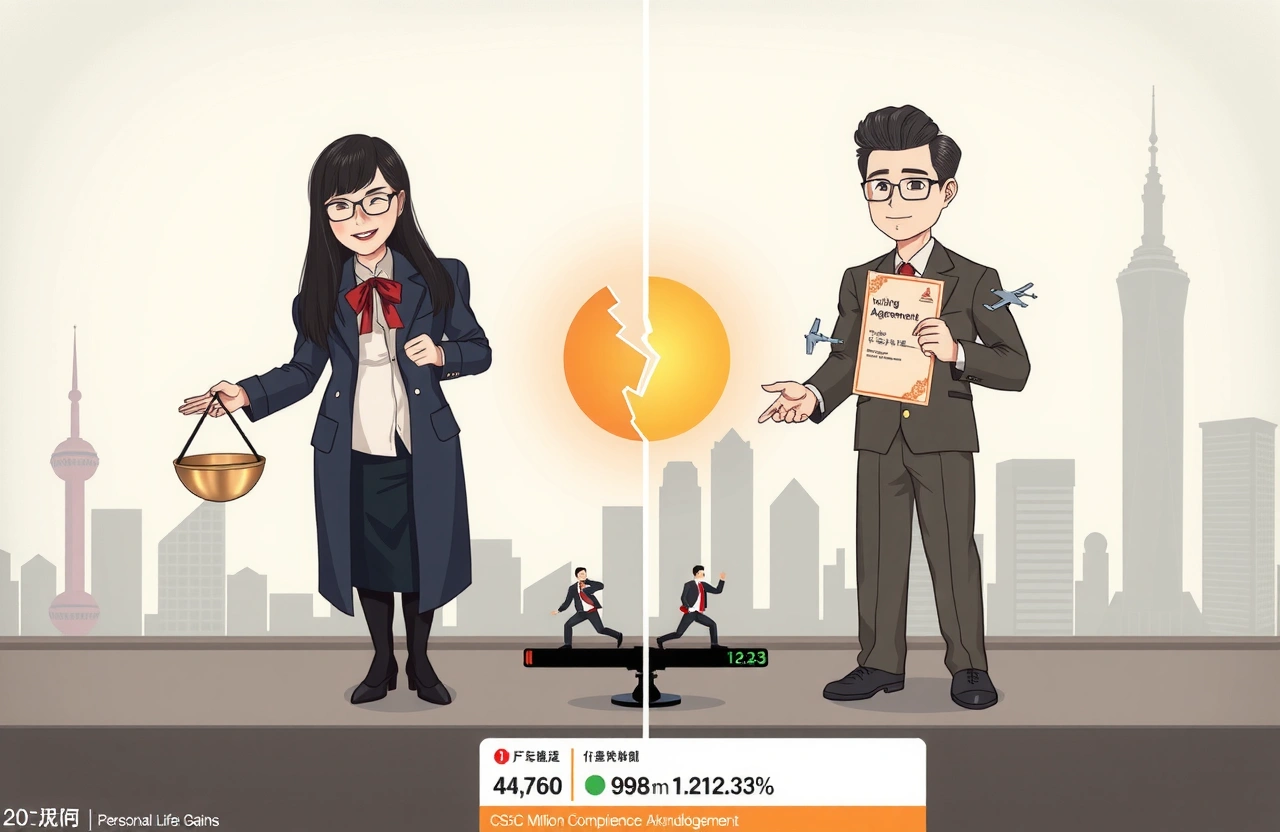
– A Shanghai court finalized China’s largest A-share divorce settlement requiring Zongheng Holdings founder Ren Bin (任斌) to transfer 11.41% of company shares to ex-wife Kuang Mingfang (邝明芳)\n– The transfer significantly reduces Ren’s direct holdings from 23.41% to 12% but maintains overall control through voting agreements\n– Valued at ¥537 million ($75 million) based on recent share price, shares will be transferred within 10 days of ruling\n– Case highlights growing trend of high-value corporate divorces impacting publicly traded companies in China\n\n\n
The Record-Setting Settlement
\n\nWhen Shanghai’s courts finalized the divorce between Zongheng Holdings founder Ren Bin (任斌) and Kuang Mingfang (邝明芳) on July 17th, few anticipated it would set financial history. The Sichuan Chengdu Intermediate People’s Court ordered Ren to transfer 9.996 million shares – representing 11.41% of the industrial drone manufacturer – to his former spouse. This landmark decision created China’s largest publicly disclosed divorce settlement involving A-shares, valued at approximately ¥537 million ($75 million) based on July 17th’s closing price of ¥53.76/share. Such high-value divorce settlements are becoming increasingly common among Chinese executives, revealing how personal events can trigger significant ownership changes in listed companies.\n\n
The Legal Evolution of the Case
\n\nThis landmark ruling marked the culmination of a dramatic 18-month legal battle:\n\n
Initial filings and first trial
\n\nThe divorce proceedings began when Kuang filed her petition with Sichuan Tianfu New District People’s Court on February 27, 2024 requesting dissolution of marriage and division of jointly held assets including Zongheng shares. The first trial concluded in January 2025 with a substantially larger settlement awarding Kuang approximately 14% of company shares (12.3012 million shares).\n\n
Appeals and final judgment
\n\nRen appealed the initial judgment, leading the Sichuan Chengdu Intermediate People’s Court to reduce the share transfer by 2.3412 million shares in its final ruling. The appeals court maintained that Ren must complete all share transfers within 10 days of the judgment becoming effective, requiring significant securities registration adjustments. For context, similar high-profile corporate divorces like Tommy Lai’s $1.2 billion settlement with wife Wendy Chan required extensive Hong Kong Securities and Futures Commission disclosures. \n\n
Corporate Governance Implications
\n\n
Shareholding restructuring
\n\nThe settlement created a seismic shift in Zongheng Holdings ownership structure:\n– Ren Bin’s direct ownership declined from 23.41% to 12.00%\n– Kuang Mingfang instantly became second-largest non-institutional shareholder\n– Combined voting power through existing shareholder agreements allows Ren to retain control\n\nCrucially, Ren maintains 44.76% effective control through:\n\nStrategic voting arrangements\n1. Binding agreements with shareholders Wang Chen and Chen Peng\n2. Control via Hainan Yongxin Dapeng Enterprise Management Center partnership\n\n
Market reaction analysis
\n\nInvestors responded positively to resolution of ownership uncertainty:\n– Share price surged 13.23% immediately following announcement\n– Market capitalization stabilized around ¥4.7 billion\n– Volatility decreased compared to 15% fluctuations during initial lawsuit filing\n\n
Broader Market Context
\n\nThis high-value divorce settlement reflects a growing pattern reshaping Chinese corporate governance:\n\n
Corporate divorce trends
\n\nRecent precedents show similar ownership shifts:\n– 2023: Lens Technology founder Zhou Qunfei (周群飞) transferred $910 million to ex-husband\n– 2022: CommScope Holding CEO transferred $239 million in shares\n– Most corporate divorce settlements average below $20 million\n\n
Regulatory oversight framework
\n\nChinese securities regulations specifically address marital stake transitions:\n\n– CSRC Rules require disclosure of any >5% stakeholder change within 2 days\n– Marriage dissolution qualifies as reportable ownership-change event\n– Settlement mechanisms prevent market manipulation during transfers\n\n
Operational Impact on Zongheng Holdings
\n\nThe industrial drone manufacturer faces specific operational challenges:\n\nFinancial performance update\n– Latest earnings projection shows improved revenues: ¥135 million H1 2025 (+61.7% YoY)\n– Net losses narrowed to ¥-34.68 million as leadership stabilized\n– Industrial UAV market growing annually at 14.3% according to China UAV Industry Association\n\n
Investor Considerations
\n\nMajor ownership changes require careful evaluation:\n\n
Monitoring points
\n\nInvestors should observe:\n– Transfer execution timeline compliance within next fortnight\n– Kuang Mingfang’s intentions regarding long-term holding or eventual disposition\n– Potential updating of voting agreements among controlling consortium\n\n
Broader Implications
\n\nThis precedent-setting divorce case offers vital lessons for corporate stakeholders:\n\nThe finalization of China’s highest-value documented A-share divorce settlement highlights critical vulnerabilities in shareholder agreements and succession planning. Investors must scrutinize leadership’s personal circumstances with equivalent diligence to financial statements. Proactive companies embed marital agreement contingencies in corporate governance documents, while analysts should incorporate divorce statistics in ownership concentration risk models. For up-to-date tracking of major shareholder movements, subscribe to Shanghai Stock Exchange ownership announcements.