



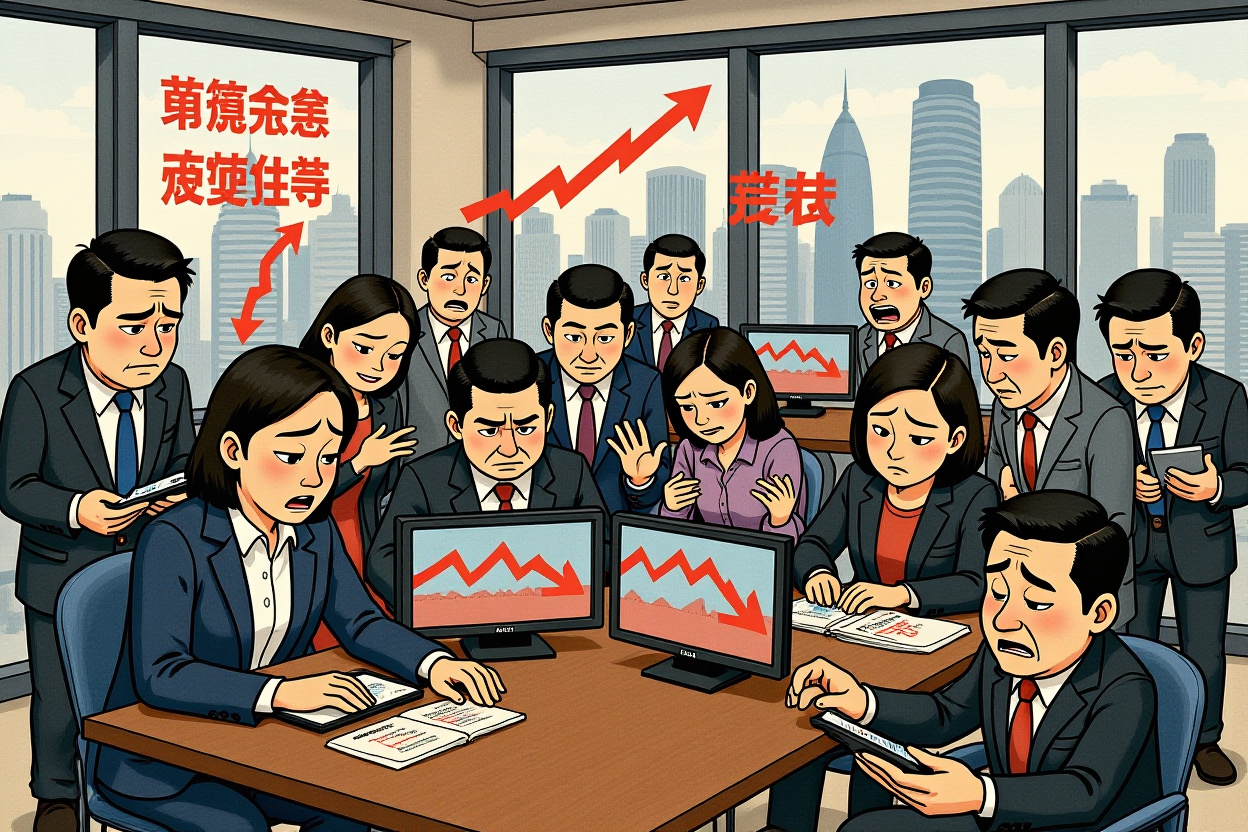
The Broad Sell-Off: A Market Under Pressure
A wave of selling pressure swept through U.S. equity markets on April 7th, with the ripple effects hitting Chinese stocks listed on American exchanges particularly hard. The major indices all closed lower, with the Dow Jones Industrial Average down 0.63%, the S&P 500 falling 0.53%, and the tech-heavy Nasdaq Composite declining 0.58%. This bearish sentiment created a challenging environment for risk assets, setting the stage for a pronounced decline in the U.S.-listed Chinese stocks segment.
Key Indices and Major Tech Drag
The weakness was broad-based among large-cap technology leaders, a sector that often sets the tone for global growth expectations. Apple saw its shares drop over 2%, while other giants like Microsoft, Nvidia, and Qualcomm also traded lower. This tech-led decline underscored investor concerns about valuation and future earnings potential in a higher interest rate environment, which disproportionately affects growth-oriented names—a category that includes many U.S.-listed Chinese stocks.
The Performance of the Nasdaq Golden Dragon China Index
The primary benchmark for this segment, the Nasdaq Golden Dragon China Index (HXC), reflected the day’s gloom, falling 0.46%. This index tracks Chinese companies listed on U.S. exchanges, and its decline signaled a market-wide retreat rather than an issue isolated to a few companies. The day’s performance was a stark reminder of the sensitivity of these stocks to shifts in both U.S. market sentiment and perceptions of China’s economic trajectory.
Breaking Down the Decline: Which Sectors and Stocks Were Hit Hardest?
While the sell-off was broad, a closer look reveals varying degrees of pain across different industries and individual companies within the Chinese cohort. The movement away from risk was evident, but some names faced sharper declines due to company-specific or sector-specific headwinds.
Technology and Consumer Discretionary Lead Losses
The decline encompassed a wide range of China’s tech and internet leaders, key components of the U.S.-listed Chinese stocks universe.
– E-commerce giants Alibaba Group (阿里巴巴集团) and JD.com Inc. (京东集团) both traded lower.
– Tech stalwarts Baidu Inc. (百度集团) and NetEase, Inc. (网易) followed the negative trend.
– Electric vehicle maker NIO Inc. (蔚来) fell over 1%, reflecting ongoing competitive and demand concerns in the crowded EV sector.
– Other notable decliners included data center service provider Century Internet (世纪互联), down over 3%, and lidar maker Hesai Technology (禾赛科技), which dropped more than 2%.
This pattern highlighted that the sell-off was not indiscriminate but concentrated in sectors exposed to consumer spending, technological innovation, and discretionary investment—areas most vulnerable to economic uncertainty.
A Counter-Cyclical Bright Spot: Healthcare
In a clear demonstration of sector rotation, healthcare stocks emerged as a rare pocket of strength. Humana Inc. surged over 7%, and UnitedHealth Group jumped more than 8%. This rally was driven by news that U.S. regulators would not make significant cuts to payments for Medicare Advantage plans, a key revenue source. This divergence underscores a critical point for investors: during periods of broad market stress, capital often flows from growth-oriented sectors like technology into more defensive areas such as healthcare and utilities. The underperformance of U.S.-listed Chinese stocks, heavily weighted toward tech and consumer cyclicals, must be viewed in this context of a broader risk-off rotation.
Unpacking the Drivers: Macroeconomic and Geopolitical Crosscurrents
The April 7th decline was not an isolated event but a symptom of several converging pressures. Understanding these drivers is crucial for investors gauging whether this is a temporary setback or the beginning of a more sustained downtrend for U.S.-listed Chinese stocks.
Resurgent U.S. Treasury Yields and “Higher-for-Longer” Rates
A primary catalyst for the day’s market weakness was a sharp rise in U.S. Treasury yields. Stronger-than-expected U.S. economic data, particularly regarding the labor market and manufacturing, has led investors to recalibrate their expectations for Federal Reserve interest rate cuts. The market is now pricing in a more cautious timeline, with fewer cuts expected in 2024. This “higher-for-longer” interest rate narrative is a direct headwind for growth stocks:
– It increases the discount rate used in valuation models, mechanically lowering the present value of future earnings.
– It raises the cost of capital for companies, potentially slowing expansion and investment.
– It makes fixed-income investments relatively more attractive compared to risky equities.
For U.S.-listed Chinese stocks, many of which are valued on long-term growth prospects, this shift in the U.S. monetary policy outlook is particularly punitive.
Persistent Geopolitical and Regulatory Uncertainty
Beyond macroeconomics, Chinese equities listed abroad continue to navigate a complex geopolitical landscape. Tensions between Washington and Beijing, though showing signs of diplomatic management, remain a latent risk factor. Investors are perpetually attuned to:
– The threat of new regulatory actions from either government that could impact cross-border capital flows, audit compliance (despite the 2022 agreement), or technology access.
– The ongoing scrutiny of data security and national security implications, which affects tech companies disproportionately.
– The potential for export controls or investment restrictions in strategic sectors.
This layer of uncertainty adds a persistent risk premium to U.S.-listed Chinese stocks, making them more volatile when broader market sentiment sours. As noted by analysts at China International Capital Corporation Limited (中金公司), “The valuation discount for offshore-listed Chinese equities compared to their onshore peers partially reflects this enduring geopolitical overhang.”
The A-H Share Connection: Reading the Signals for Domestic Markets
The performance of U.S.-listed Chinese stocks (represented by ADRs) often serves as a leading indicator or sentiment gauge for China’s domestic A-share market and the Hong Kong market (H-shares). The logic of this “mapping” is that the same fundamental companies are being valued in different markets by partially overlapping investor bases.
Sentiment Transmission and Liquidity Linkages
A sustained sell-off in U.S.-listed names can dampen global investor sentiment toward China Inc. as a whole. This can lead to:
– Reduced risk appetite among Qualified Foreign Institutional Investors (QFII) and other foreign channels investing directly in A-shares.
– Selling pressure in the Hong Kong market, where many dual-listed H-shares trade, as global funds reassess their China exposure.
– A negative feedback loop where weak ADR performance leads to cautious headlines, further influencing domestic retail and institutional sentiment.
However, the correlation is not absolute. Domestic A-shares are primarily driven by mainland liquidity conditions, fiscal and monetary policy from the People’s Bank of China (中国人民银行), and China’s internal economic data. For instance, recent efforts by Chinese regulators to stabilize the market and boost confidence can decouple A-share performance from offshore trends in the short term.
Identifying Divergence and Opportunity
Astute investors watch for divergences between ADR prices and their onshore counterparts. A significant underperformance of U.S.-listed Chinese stocks could, in some cases, present an arbitrage opportunity if the fundamentals of the underlying company remain sound. More broadly, weakness offshore may signal a potential buying opportunity in the more insulated A-share market if the domestic policy backdrop is turning supportive. As the old market adage adapted for this context goes: “Observe the trends in U.S. stocks, follow the mapping脉络, and seek opportunities in A-shares.”
Strategic Implications and Forward-Looking Guidance for Investors
For global fund managers and institutional investors, movements in the U.S.-listed Chinese stocks complex are a critical data point in portfolio construction and risk management. The April 7th action offers several key lessons and strategic considerations.
Portfolio Construction in a Fragmented World
The event reinforces the need for nuanced geographical and listing-venue exposure within a China allocation. A blended approach may be prudent:
– **Direct A-Shares:** Offer exposure to China’s domestic policy cycle and sectors favored by state guidance (e.g., green technology, high-end manufacturing).
– **Hong Kong H-Shares and Red Chips:** Provide access to many large Chinese state-owned enterprises and tech giants with somewhat more regulatory predictability for foreign investors.
– **U.S.-Listed ADRs:** Grant liquidity and access to China’s consumer and internet story, but carry higher geopolitical and regulatory volatility risk.
Diversifying across these venues can help mitigate the specific risks that hammered the U.S.-listed Chinese stocks segment on this particular day.
Monitoring the Critical Data and Policy Levers
Going forward, investors should focus on a clear set of indicators to gauge the direction of this asset class:
1. **U.S. Inflation and Labor Data:** These will dictate the Federal Reserve’s path and, by extension, the pressure on global growth stock valuations.
2. **China’s Macroeconomic Releases:** Retail sales, industrial production, and property market data are crucial for confirming or contradicting the weak sentiment seen in offshore markets.
3. **Policy Statements from Chinese Authorities:** Speeches from officials at the China Securities Regulatory Commission (中国证券监督管理委员会) or the People’s Bank of China (中国人民银行) regarding market stability, foreign investment, or specific sector support can quickly alter sentiment.
4. **U.S.-China Diplomatic Engagements:** High-level meetings and working group outcomes on trade and economic issues directly impact the risk premium assigned to these stocks.
Synthesizing the Market Move and Navigating the Path Ahead
The collective decline of U.S.-listed Chinese stocks on April 7th was a multi-faceted event. It was driven by a potent mix of rising U.S. interest rates, a sector rotation into defensive plays, and the ever-present geopolitical discount applied to Chinese assets trading offshore. While the sell-off was broad, it was logically concentrated in the technology and consumer discretionary names that are most sensitive to these factors.
For investors, the key takeaway is the renewed importance of differentiation and active management within the China equity universe. Treating all Chinese exposure as monolithic is a strategy prone to volatility. The divergence between falling tech ADRs and rallying U.S. healthcare stocks is a perfect microcosm of the current global market dynamic: a flight from long-duration growth towards safety and income.
Moving forward, a balanced, data-dependent approach is essential. Monitor the tension between a resilient U.S. economy (pushing rates higher) and China’s own efforts to stimulate its domestic market. Watch for policy signals that could bridge the performance gap between onshore and offshore Chinese shares. Ultimately, periods of stress in the U.S.-listed Chinese stocks segment, while challenging, can also clarify valuations and uncover strategic entry points for investors with a disciplined framework and a clear view on China’s long-term trajectory. The immediate call to action is clear: scrutinize your China exposure, understand the specific risks of each listing venue, and prepare to act not on broad sentiment, but on the fundamental and policy divergences that this sell-off has thrown into sharp relief.