



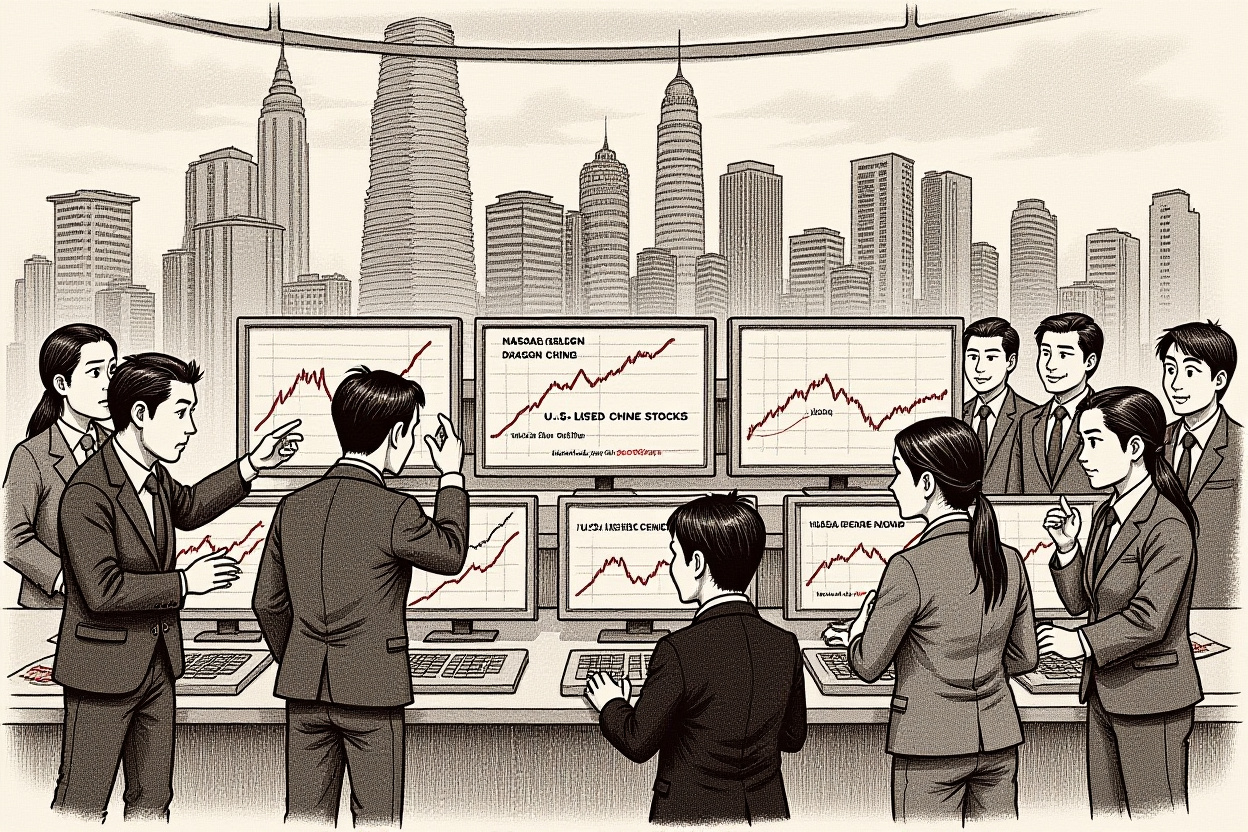
A wave of selling pressure washed over U.S.-listed Chinese equities this week, dragging the Nasdaq Golden Dragon China Index lower alongside major U.S. tech benchmarks. This synchronized decline underscores the intricate and often fragile linkages binding global risk sentiment, sectoral rotations, and the unique political economy of China’s corporate champions abroad. For institutional investors and fund managers with exposure to this critical segment, understanding the anatomy of this move is not merely an academic exercise—it is essential for navigating portfolio risk and identifying the contours of future opportunity in a market characterized by both immense potential and heightened volatility. The performance of U.S.-listed China stocks serves as a vital barometer for Sino-U.S. financial relations and global capital flows into Chinese growth narratives.
Executive Summary: Key Market Implications
• A broad-based sell-off hit U.S.-listed Chinese companies, mirroring weakness in major U.S. technology stocks and signaling a risk-off tilt in global equity sentiment.
• The decline was led by tech and consumer-facing names, reflecting concerns over both external macroeconomic headwinds and persistent internal regulatory scrutiny within China.
• Concurrent strength in U.S. healthcare and insurance stocks highlights a defensive sector rotation, diverting capital away from growth-oriented sectors where many China ADRs reside.
• The event reinforces the critical need for investors to decouple company-specific fundamentals from broader macro and geopolitical narratives when evaluating U.S.-listed China stocks.
• Forward-looking strategy must account for the evolving landscape of dual-listings, potential delistings, and the strategic pivot of Chinese firms towards onshore and Hong Kong listings.
The Day’s Tape: A Detailed Market Snapshot
The trading session on April 7th presented a clear picture of risk aversion. Major U.S. indices opened lower and deteriorated throughout the day, with the tech-heavy Nasdaq Composite leading the decline. This broader market weakness provided a negative backdrop for all growth-sensitive equities.
Nasdaq Golden Dragon Index and Constituent Moves
The Nasdaq Golden Dragon China Index (HXC), a key benchmark tracking U.S.-listed China stocks, fell 0.46%. The selling was not isolated to one sector but reflected widespread caution:
– Technology & Internet: Industry leaders like Alibaba Group Holding Ltd. (阿里巴巴集团), JD.com Inc. (京东集团), and Baidu Inc. (百度集团) all traded lower. Specialized tech firms like Hesai Group (禾赛科技), a leader in LiDAR, fell over 2%.
– Consumer & Electric Vehicles: NIO Inc. (蔚来) declined over 1%, reflecting continued pressure in the competitive EV space.
– Diversified Weakness: Firms from education (New Oriental Education & Technology Group 新东方) to data centers (21Vianet Group 世纪互联) and even frontier tech like autonomous driving (Pony.ai 小马智行) participated in the downdraft.
The U.S. Market Context: Tech Weakness vs. Healthcare Strength
Critically, the decline in China ADRs occurred alongside notable weakness in mega-cap U.S. technology stocks. Apple Inc. fell over 2%, while Microsoft, Nvidia, and Qualcomm also moved lower. This parallel suggests the sell-off was partly driven by a sector-wide reassessment of technology valuations amid rising interest rate expectations and economic uncertainty.
Conversely, U.S. healthcare and managed care stocks rallied sharply, with Humana Inc. (哈门那) and UnitedHealth Group Incorporated (联合健康集团) surging 7% and 8%, respectively. This rotation into defensive, recession-resilient sectors further drained liquidity from the growth-oriented technology and consumer discretionary sectors, exacerbating the pressure on U.S.-listed China stocks, which are overwhelmingly concentrated in these areas.
Deciphering the Drivers: Beyond the Headline Numbers
While a down day for tech explains part of the move, the underperformance of Chinese equities often involves a more complex cocktail of factors. Isolating these drivers is key to determining whether a decline is a transient sentiment shift or the start of a more profound trend.
Macroeconomic Crosscurrents and Global Risk Sentiment
The primary external driver remains the monetary policy trajectory of the U.S. Federal Reserve. Strong economic data has led markets to price in a “higher for longer” interest rate environment. Higher discount rates disproportionately reduce the present value of future earnings for high-growth companies, a category that includes most major technology and internet-focused U.S.-listed China stocks. Furthermore, any strengthening of the U.S. dollar (USD) amid a hawkish Fed can create headwinds for emerging market assets and complicate the repatriation of profits for U.S.-listed firms with primary operations in China.
The Persistent Overhang of Regulatory Uncertainty
Despite recent diplomatic efforts, the regulatory cloud has not fully dissipated. Two key issues remain live wires for investors:
1. Audit Oversight: The Holding Foreign Companies Accountable Act (HFCAA) remains in force. While a preliminary agreement between U.S. and Chinese regulators averted an immediate wave of delistings, the long-term framework for complete audit inspections by the U.S. Public Company Accounting Oversight Board (PCAOB) is still being tested. Any setback in this process could trigger renewed volatility. For official updates, investors monitor the U.S. Securities and Exchange Commission (SEC) and PCAOB announcements.
2. Domestic Chinese Policy: The Chinese government’s focus on “common prosperity,” data security, and anti-monopoly regulation continues to shape the operational landscape for tech giants. While the most aggressive phase of regulatory tightening may be over, the rules of the game have permanently changed. Companies must continually demonstrate alignment with national strategic priorities, which can impact growth algorithms and margins.
Sectoral and Company-Specific Nuances
Not all stocks within the index are created equal. A granular look reveals important differentiators based on business models, exposure to Chinese consumer sentiment, and specific regulatory touchpoints.
Technology and Consumer Internet: The Core Pressure Point
The broad internet sector, encompassing e-commerce, advertising, and cloud services, remains highly sensitive to the pace of China’s domestic economic recovery. Consumer spending data, retail sales, and business confidence indicators are closely watched. Comments from executives like Alibaba CFO Maggie Wu (武卫) on earnings calls regarding demand trends can move entire sub-sectors. Furthermore, these companies are at the forefront of both domestic regulatory efforts and the geopolitical tensions between the U.S. and China, making their stocks a proxy for both economic and political risk.
Electric Vehicles and Autonomous Driving: Growth Amid Competition
Companies like NIO represent a different dynamic. They operate in a sector explicitly encouraged by Chinese industrial policy but face ferocious domestic competition and ongoing price wars. Their performance is tied to delivery numbers, margin profiles, and technological milestones, but also to global supply chain costs and access to advanced semiconductors. The decline in stocks like Hesai (LiDAR) and Pony.ai (autonomous driving) also reflects the challenging path to commercialization for advanced technologies and the capital intensity required.
The Evolving Listing Landscape and Investor Strategy
The ecosystem for Chinese companies seeking international capital is undergoing a fundamental transformation. This structural shift has profound implications for how global investors construct and manage their exposure.
The Rise of Hong Kong and the “Primary Listing” Trend
In response to the delisting risk, major firms like Alibaba, JD.com, and Baidu have pursued secondary listings, and more recently, primary listings, on the Stock Exchange of Hong Kong Limited (香港联合交易所). This provides a crucial conversion path for U.S. ADRs into Hong Kong shares, mitigating the tail risk of a forced delistration from U.S. exchanges. For investors, this means the liquidity and valuation anchor for many large-cap U.S.-listed China stocks is increasingly dual-centered. Monitoring trading volumes and potential inclusion in key Hong Kong indices (like the Hang Seng Index) is now essential.
Strategic Portfolio Considerations for Global Funds
For institutional investors, the current environment demands a more nuanced approach:
– Diversification of Venue Exposure: Considering direct holdings in Hong Kong-listed shares (e.g., 9988.HK vs. BABA) for core, long-term positions to insulate from purely U.S.-centric regulatory shocks.
– Fundamental Over Narrative: Rigorous, bottom-up analysis focusing on cash flow generation, competitive moats, and management execution is paramount. Macro and geopolitical noise should not overshadow company-specific value.
– Regulatory Due Diligence: Maintaining a dedicated focus on regulatory filings from both the SEC and Chinese bodies like the China Securities Regulatory Commission (CSRC 中国证券监督管理委员会) and the Cyberspace Administration of China (CAC 国家互联网信息办公室).
Synthesizing the Market Signal and Looking Ahead
The synchronized decline of U.S. tech and China ADRs is a powerful reminder of their correlated status in global portfolios as growth and risk assets. However, it also highlights the additional idiosyncratic risks—geopolitical and regulatory—that are uniquely baked into the valuation of U.S.-listed China stocks. The defensive rotation into healthcare underscores a market that is cautiously positioning for economic uncertainty, a trend that may continue to pressure high-beta segments.
Moving forward, investors should monitor several catalysts: the next round of U.S. inflation and jobs data influencing Fed policy; quarterly earnings from Chinese tech giants for signs of fundamental resilience or deterioration; and any new material developments in the U.S.-China audit cooperation agreement. The long-term investment case for China’s innovation economy remains intact, but the pathway is likely to be characterized by higher volatility and an increased premium on selective, fundamentally-driven stock picking.
The day’s action is less a definitive verdict on Chinese equities and more a chapter in the ongoing recalibration of their role in global markets. For the sophisticated investor, such periods of stress and dispersion create the conditions for discerning alpha generation. The key is to look beyond the daily index print, understand the multi-layered drivers at play, and construct a resilient strategy that accounts for both the immense opportunities and the unprecedented complexities of this market segment.
To navigate this evolving landscape with precision, ensure you are subscribed to our dedicated channel for real-time analysis on regulatory shifts, earnings deep dives, and strategic frameworks for investing in Chinese equities across all listing venues.