



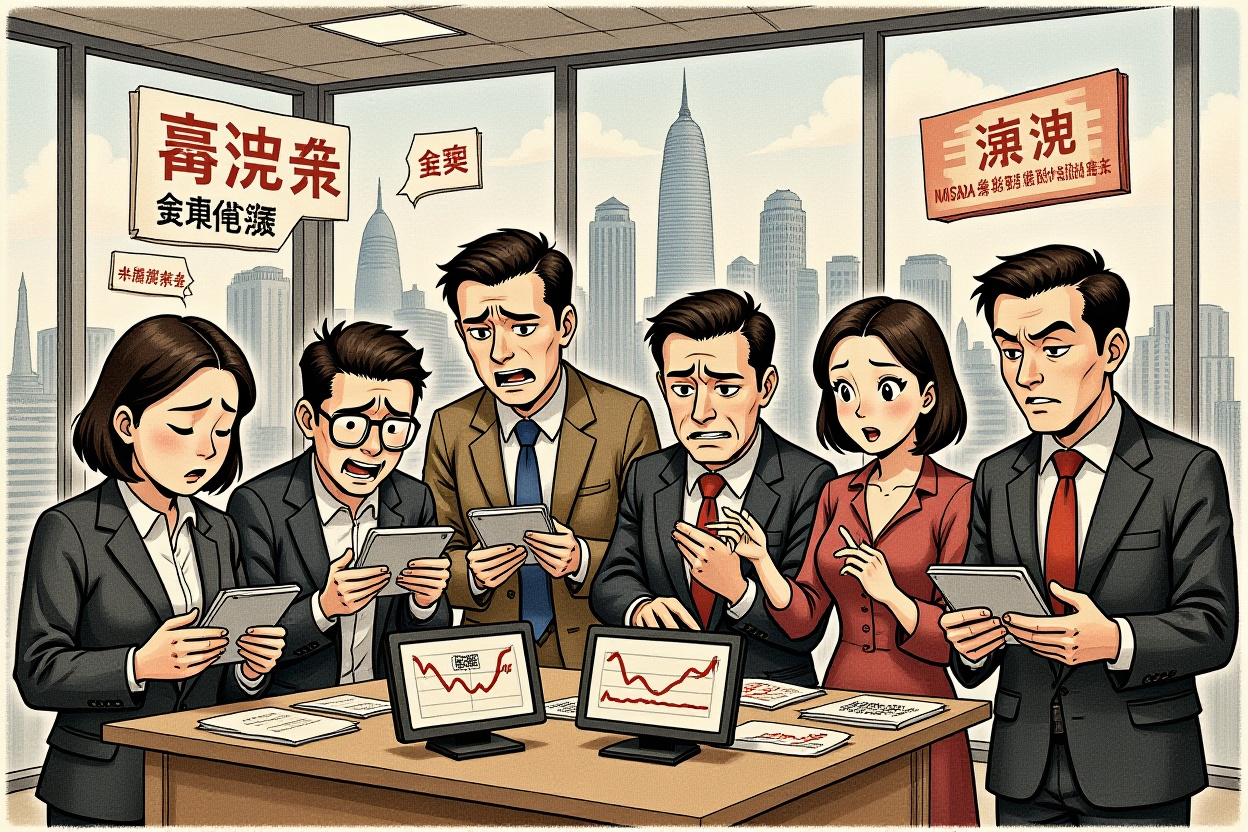
Summary of Key Market Movements and Implications
The trading session on April 7th presented a challenging environment for investors with exposure to Chinese equities. A broad-based sell-off gripped the U.S. markets, significantly impacting the cohort of U.S.-listed Chinese companies. The key developments and their immediate implications are summarized below:
– Broad Market Weakness: All three major U.S. indices opened lower and continued to decline, with the tech-heavy Nasdaq Composite leading the losses. This created a negative backdrop for growth-oriented stocks, including major Chinese tech ADRs.
– Nasdaq Golden Dragon Index Declines: The key benchmark for U.S.-listed Chinese stocks, the Nasdaq Golden Dragon China Index (HXC), fell 0.46%, underperforming the broader Nasdaq and highlighting specific pressures on the Chinese equity sector.
– Wide-Ranging Sell-off: Losses were not isolated. They spanned across sectors, from tech giants like Alibaba Group (阿里巴巴集团) and JD.com Inc. (京东集团) to electric vehicle maker NIO Inc. (蔚来) and education firm New Oriental Education & Technology Group (新东方).
– Divergent Sector Performance: In a stark contrast, U.S. healthcare and managed care stocks, such as Humana Inc. (哈门那) and UnitedHealth Group (联合健康集团), rallied strongly, underscoring a rotational shift away from growth and international exposure towards domestic, defensive sectors.
– Signal for Broader China Markets: This coordinated decline in U.S.-listed Chinese stocks often acts as a leading indicator for sentiment in the onshore A-share and Hong Kong markets, prompting investors to scrutinize underlying fundamentals and regulatory landscapes.
A Day of Broad Declines for U.S.-Listed Chinese Equities
The closing bell on April 7th confirmed a session of pronounced weakness for Chinese companies trading on American exchanges. The U.S.-listed Chinese stocks tumbled in unison, reflecting a potent mix of global macro concerns and China-specific apprehensions. The Nasdaq Golden Dragon China Index, a critical barometer for this asset class, dropped 0.46%, a move that captured the widespread nature of the sell-off.
This was not a story of one or two laggards; it was a sector-agnostic retreat. Technology stalwarts were at the forefront of losses. E-commerce behemoth Alibaba Group (阿里巴巴集团) and search leader Baidu Inc. (百度集团) both traded lower. JD.com Inc. (京东集团) and NetEase, Inc. (网易) followed suit, indicating that the pressure was affecting core internet names. The weakness extended beyond pure tech into adjacent innovative industries. Electric vehicle pioneer NIO Inc. (蔚来) shed over 1%, while Lidar sensor maker Hesai Technology (禾赛科技) experienced a steeper decline of over 2%. Even previously resilient names like New Oriental (新东方) found themselves in negative territory.
Underperformance Relative to U.S. Tech Peers
Interestingly, the decline in Chinese tech ADRs occurred alongside a down day for their U.S. mega-cap counterparts. Apple Inc., Microsoft Corporation, and NVIDIA Corporation all closed in the red. However, the selling pressure on the U.S.-listed Chinese stocks appeared more consistent and broad-based. This relative underperformance is a crucial detail for global allocators. It suggests that while general risk-off sentiment contributed to the downdraft, there were additional, China-specific factors amplifying the losses for this cohort. Investors were not merely reducing exposure to technology; they were applying a specific discount to Chinese assets, questioning the growth trajectory and regulatory stability of the world’s second-largest economy.
The Macroeconomic Backdrop: Rising Yields and Growth Fears
To understand why U.S.-listed Chinese stocks tumbled, one must first look at the global macroeconomic canvas. The trading day was painted with the brush of renewed inflation anxieties and shifting interest rate expectations. A key driver was the continued climb in U.S. Treasury yields, particularly on the longer end of the curve.
Stronger-than-expected economic data, including robust job figures and manufacturing activity, fueled concerns that the Federal Reserve may maintain a “higher for longer” stance on interest rates. Rising yields directly pressure growth stocks—the category that encompasses most major Chinese tech ADRs—by decreasing the present value of their future earnings. For companies like Alibaba or Tencent Music Entertainment Group (腾讯音乐娱乐集团), whose valuations are heavily predicated on long-term growth narratives, even a modest uptick in the discount rate can trigger significant price reassessments.
The Global Growth Conundrum and China’s Role
Simultaneously, mixed signals regarding global economic growth created uncertainty. While the U.S. economy showed resilience, concerns persisted about a slowdown in Europe and the pace of recovery in China. As a major exporter and a key component of global supply chains, China’s economic health is a bellwether for worldwide corporate earnings. Any doubt about the strength of China’s post-pandemic recovery, its property market stabilization, or consumer demand directly weighs on the outlook for its publicly listed companies. International fund managers, faced with this uncertainty, often choose to reduce exposure, leading to the kind of coordinated selling pressure witnessed on April 7th. This macro-driven capital outflow is a primary reason why U.S.-listed Chinese stocks tumbled in sync with broader market anxieties.
Regulatory and Policy Winds: A Persistent Overhang
Beyond global macros, the unique regulatory environment in China remains a pivotal, and often dominant, factor for equity performance. The memory of the sweeping regulatory crackdowns of 2021-2022, targeting antitrust, data security, and private tutoring, is still fresh for investors. While the Chinese government has since shifted to a more supportive tone, emphasizing “high-quality development” and stability, the regulatory framework continues to evolve.
Recent discussions and policy drafts concerning areas like artificial intelligence governance, fintech, and cross-border data flows introduce a layer of uncertainty. For technology companies that are central to the U.S.-listed Chinese stocks universe, navigating this evolving landscape is a constant operational and strategic challenge. Investors, in turn, price in a “regulatory risk premium.” On days of broader market stress, this premium can expand rapidly, exacerbating declines. The performance of sectors previously under intense scrutiny, such as technology and education, remains particularly sensitive to any new regulatory headlines or interpretations of official rhetoric from bodies like the Cyberspace Administration of China (国家互联网信息办公室) or the Ministry of Industry and Information Technology (工业和信息化部).
The Currency Factor and Capital Flows
Another subtle but important channel of pressure is the foreign exchange market. Movements in the Chinese Yuan (人民币) against the U.S. dollar can impact the dollar-denominated returns of ADRs. Expectations of a widening interest rate differential between the U.S. and China can lead to Yuan weakness or volatility. For international investors, a depreciating Yuan erodes the U.S. dollar value of their Chinese equity holdings. This creates an added incentive to sell ADRs during periods of perceived currency vulnerability, contributing to the downward momentum. Monitoring statements from the People’s Bank of China (中国人民银行) and the State Administration of Foreign Exchange (国家外汇管理局) is therefore essential for understanding capital flow dynamics affecting these stocks.
Dissecting the Sell-Off: From Tech Giants to Niche Players
The April 7th session provided a clear case study in how selling pressure permeates through different tiers and sectors of the U.S.-listed Chinese stocks ecosystem. The declines were not uniform in magnitude but were notably widespread, offering clues about market sentiment.
The largest, most liquid ADRs often act as anchors for the sector. When bellwethers like Alibaba (阿里巴巴集团) and JD.com (京东集团) trend lower, it establishes a negative tone that influences trading in smaller-cap names. Their performance is closely tied to perceptions of Chinese consumer spending, corporate cloud adoption, and overall economic vitality. A drop in these giants suggests institutional investors are reassessing core China growth assumptions.
The Ripple Effect on Emerging Growth Stories
More speculative or “story” stocks experienced sharper losses, as seen with Hesai Technology (禾赛科技) down over 2% and autonomous driving company Pony.ai (小马智行) falling over 1%. These companies represent China’s ambition in next-generation technologies. Their stocks are typically held by growth-focused funds and are more sensitive to shifts in risk appetite and liquidity. The fact that they led the declines indicates that the sell-off was partly driven by a contraction in valuation multiples and a retreat from high-risk, high-reward propositions. This pattern is a classic feature of risk-off days: capital fleets the periphery first and fastest. The collective action confirmed that the day’s theme was a broad de-risking from Chinese growth assets, making it unequivocal that U.S.-listed Chinese stocks tumbled across the board.
Implications for A-Shares and the Hong Kong Market
For the sophisticated investor tracking Chinese equities, the performance of U.S. ADRs is rarely an isolated event. It serves as a crucial sentiment indicator and often prefigures movements in the onshore A-share market, traded in Shanghai and Shenzhen, and the Hong Kong market, home to H-shares of many dual-listed companies. The adage “观美股风云,循映射脉络,觅A股机会” (Observe U.S. stock movements, follow the mapping脉络, seek A-share opportunities) holds significant weight.
The negative sentiment that drove the U.S.-listed Chinese stocks tumbled session can quickly transmit to Asian markets when they open. International investors who hedge or adjust their overall China exposure may sell correlated instruments in Hong Kong. Furthermore, domestic A-share investors monitor ADR performance as a gauge of foreign institutional sentiment. A sustained decline in ADRs can dampen confidence locally, potentially leading to cautious trading or profit-taking in related A-share sectors, particularly technology and consumer discretionary names listed on the ChiNext (创业板) or STAR Market (科创板).
Identifying Potential Opportunities Amidst the Weakness
However, this mapping of trends is not merely about risk. It can also illuminate opportunities. A significant dislocation between the price of an ADR and its corresponding H-share or A-share can create arbitrage potential. More strategically, a broad-based sell-off driven by non-fundamental, macro factors may present entry points for long-term investors who maintain conviction in a company’s underlying business. The key is differentiation. Investors must ask: Is this stock falling because of a deteriorating company-specific outlook, or is it being swept up in a sector-wide tide of pessimism? The April 7th moves, characterized by their breadth, suggest the latter was a significant component, hinting that selective, fundamentally-driven buying may emerge once the macro dust settles.
Synthesizing the Market Signal and Path Forward
The coordinated decline on April 7th was a multi-faceted event. It was a function of a hostile global macro environment for growth stocks, compounded by the enduring regulatory uncertainties surrounding China’s tech sector. The fact that U.S.-listed Chinese stocks tumbled in near-unison, while defensive U.S. healthcare names rallied, paints a clear picture of rotational dynamics and rising risk aversion among global fund managers.
For investors, the key takeaways are threefold. First, Chinese ADRs remain highly sensitive to U.S. interest rate expectations and global liquidity conditions; they are not a decoupled asset class. Second, the regulatory overhang, while softened from its peak, remains a permanent feature of the investment landscape, requiring constant monitoring. Third, ADR performance is a vital leading indicator for Asian market openings and sentiment, making it an essential part of any global investor’s China market toolkit.
The path forward requires vigilant analysis of both U.S. economic data and Chinese policy pronouncements. Investors should watch for stabilization in Treasury yields, clearer signals on China’s domestic economic recovery from sources like the National Bureau of Statistics (国家统计局), and any substantive new regulatory frameworks. Volatility in this segment is likely to persist, but within it lies the potential for both risk and reward. The disciplined investor will use days of broad selling to stress-test their investment theses, identify oversold quality assets, and strategically position for the next phase of China’s economic narrative. As always, navigating the U.S.-listed Chinese stocks universe demands a blend of global macro awareness and deep local insight.