



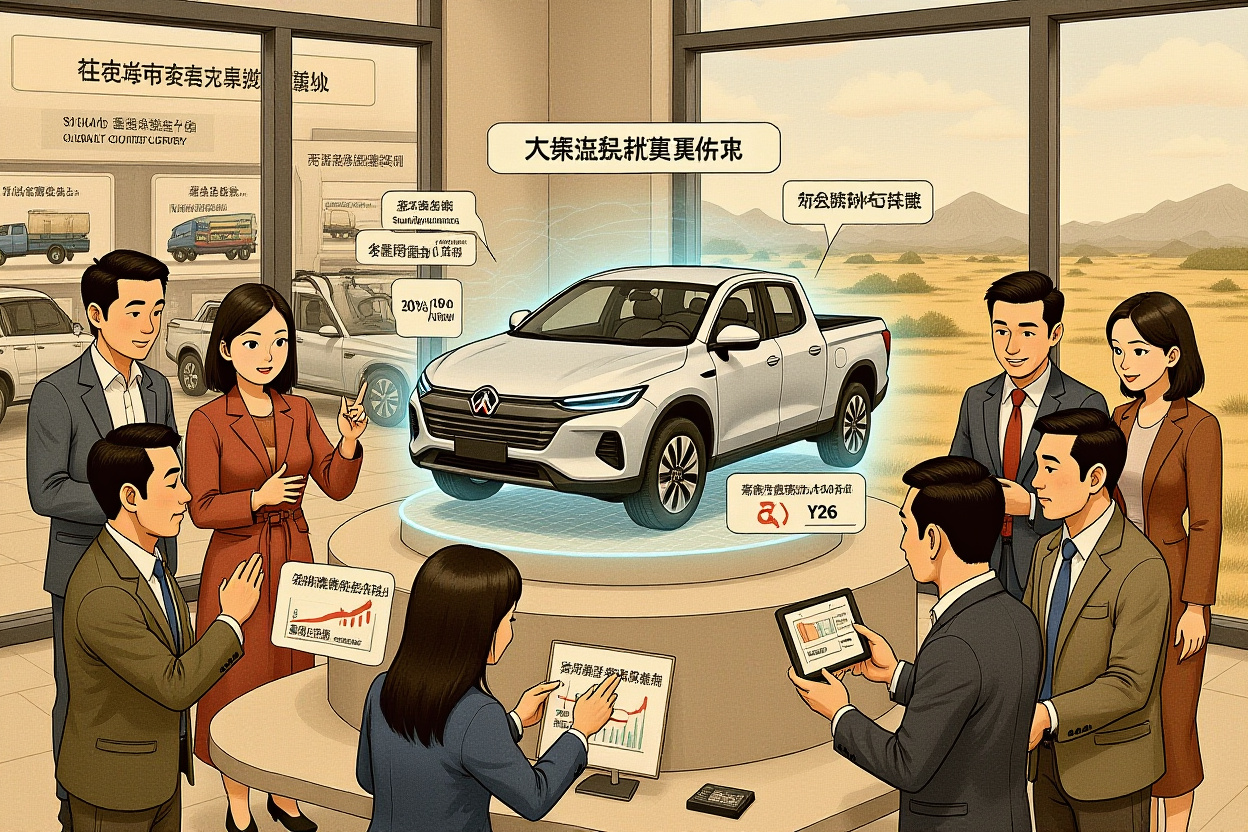
Executive Summary: Key Market Takeaways
The rapid globalization of China’s automotive sector is epitomized by the explosive growth of its pickup truck exports. This article delves into the data, strategies, and technologies propelling this trend. Critical insights for investors and industry professionals include:
– Export Volume Surge: Chinese pickup truck exports reached approximately 50,000 units in January-February 2025, marking a 30% year-over-year increase. For the full year 2025, exports are projected to hit 300,000 units, representing over half of total domestic sales.
– Geographic Diversification: Markets in Australia, South Africa, Latin America (notably Peru and Brazil), and Europe are driving demand, with Chinese brands capturing nearly 17% of the South African market.
– Manufacturing Scalability: Factories are operating at full capacity, with some order books filled through June, leading to dual-shift production to meet international demand.
– Product Localization: Chinese manufacturers are extensively customizing vehicles for local terrain, regulations, and consumer preferences, from suspension upgrades in Brazil to high-altitude performance tweaks in Peru.
– New Energy Leadership: Hybrid, plug-in hybrid, and electric pickup trucks are becoming a significant export segment, with some brands seeing new energy vehicles rise from 0% to over 15% of exports within two years.
The Unstoppable Rise of Chinese Smart Pickup Trucks
The narrative of Chinese automotive exports has evolved from one of pure cost advantage to one of technological sophistication and market adaptation. Nowhere is this shift more evident than in the global pickup truck segment. Chinese smart pickup trucks, leveraging decades of manufacturing expertise and recent breakthroughs in electrification and connectivity, are no longer niche players but formidable competitors on the world stage. The focus phrase, Chinese smart pickup trucks, encapsulates this transition from basic utility vehicles to intelligent, versatile platforms designed for global consumers.
This ascent is backed by hard data. Industry reports indicate that exports now constitute the majority of sales for many Chinese pickup manufacturers. This isn’t a fleeting trend but a structural shift, supported by integrated supply chains, aggressive R&D, and a strategic understanding of diverse international markets. For global investors, the success of these vehicles offers a clear window into the broader competitiveness of China’s advanced manufacturing sector.
Quantifying the Global Footprint
The expansion is quantitatively visible across continents. In Australia, a traditional stronghold for pickup trucks, dealers like Dinesh (迪内什), who represents SAIC Maxus (上汽大通), report a 58.7% year-on-year sales increase for February 2025. The South African automotive market, as tracked by the National Association of Automobile Manufacturers of South Africa (Naamsa), saw a 11.9% growth in pickup and minibus sales in February 2025, with Chinese brands leading the charge.
– Regional Market Penetration: In South Africa, Chinese brands are estimated to have captured close to 17% of the total market by 2025, making it the fastest-growing segment. This is a testament to the vehicles’ perceived reliability and value.
– Logistics as a Growth Indicator: The surge is mirrored in shipping logistics. At the Yangzhou Yuanyang International Container Terminal, port authorities reported handling around 6,000 TEUs (Twenty-Foot Equivalent Units) for pickup trucks in the early months of the year, translating to roughly 18,000 vehicles—a 16% increase from the same period last year.
Scaling Production to Feed Global Demand
Meeting this unprecedented international appetite requires monumental scaling of production and logistics. Chinese pickup truck manufacturers are not just increasing output; they are revolutionizing their production philosophies to be more flexible, efficient, and responsive.
Capacity Expansion and Operational Agility
A visit to a factory in Wuxi, Jiangsu province, reveals rows of pickup trucks rolling off assembly lines, with over 90% destined for overseas markets. Zhao Aimin (赵爱民), Deputy General Manager of SAIC Maxus Automotive Co., Ltd. (上汽大通汽车有限公司), highlighted the geographical spread of new orders: “This year, we have achieved breakthroughs in Africa, South Africa, North Africa, ASEAN, and Southeast Asia. Orders for some products are already scheduled through May or even June, forcing us to operate two production shifts to meet demand.”
This capacity push is multifaceted:
– Flexible Manufacturing Lines: Advanced production facilities now employ flexible lines capable of assembling over a thousand different configurations of pickup trucks. This allows for efficient small-batch production tailored to specific market orders.
– Growth in CKD Exports: Beyond complete built units (CBU), the export of completely knocked-down (CKD) kits has also doubled year-on-year for some manufacturers. This approach supports local assembly in key markets, creating jobs, reducing import duties, and fostering deeper market integration.
Engineering for the World: The Localization Imperative
The global success of Chinese smart pickup trucks is not due to a one-size-fits-all approach. Instead, it stems from a deep commitment to localization—redesigning and re-engineering vehicles to excel in specific regional environments. This customer-centric engineering is a key differentiator.
Case Studies in Customization
In Peru, where vehicles navigate from coastal deserts to the 3,000-meter-high Andes mountains, pickups are indispensable work partners. Chinese brands have responded by enhancing engine performance and cooling systems for better high-altitude climb capability and durability. As noted by CCTV reporter Wang Lulu (王璐璐), the competitive edge in Peru has shifted from price to technology and service, aligning with the region’s ongoing infrastructure and industrial development.
For the Brazilian market, adaptations are equally precise:
– Suspension and Stability: Vehicle suspension stiffness is increased, and electronic stability programs (ESP) are recalibrated to better handle sharp turns, skids, and wet roads common in certain regions.
– Fuel and Emissions Compliance: To align with Brazil’s unique fuel specifications and stringent emissions regulations, manufacturers have added barrier layers to fuel tank designs. This reduces fuel vapor permeation and evaporation, ensuring regulatory compliance and environmental friendliness.
Integrating Local Expertise
This localization process is supercharged by employing local talent. Chinese automakers have established R&D centers worldwide, staffed with engineers from the target markets. These professionals provide invaluable insights into driving habits, regulatory landscapes, and unmet consumer needs, ensuring that Chinese smart pickup trucks are genuinely adapted rather than merely exported.
The Electrification Edge: Redefining the Global Pickup
While durability and customization are crucial, the most transformative factor in the recent export wave is the integration of new energy vehicle (NEV) technology. China’s formidable lead in battery production, electric drivetrains, and hybrid systems is now being deployed in the pickup segment, creating a new value proposition for eco-conscious markets.
The focus phrase, Chinese smart pickup trucks, now inherently includes this technological prowess. From pure electric (EV) to range-extended electric (EREV) and various hybrid configurations, Chinese manufacturers offer a spectrum of solutions.
Market Adoption and Technological Flexibility
In Mexico, NEV technology has been a key market-entry tool. Elias, a Mexico City resident, recently purchased a hybrid Chinese pickup, citing its superior fuel economy and lower emissions compared to traditional diesel models. This consumer shift is reflected in corporate data: one major manufacturer stated that the share of new energy pickups in its export portfolio has grown from zero to over 15% in just two years.
– Platform Strategy: This rapid rollout is enabled by intelligent, modular vehicle platforms. One company’s proprietary platform can support the mixed production of six different powertrain types—diesel, gasoline, pure electric, hybrid, and more—on the same assembly line, allowing for efficient response to heterogeneous global demand.
– Expert Validation: Cui Dongshu (崔东树), Secretary-General of the China Automobile Dealers Association Passenger Car Market Joint Committee (中国汽车流通协会乘联分会), encapsulates the broader industry view: “The improvement in China’s manufacturing level, especially the significant enhancement of overall component quality, supports the substantial rise in complete vehicle manufacturing capability. This has driven export growth in the pickup market and the super-strong growth of new energy pickups. With advantages in product categories and new energy, Chinese pickups have achieved a state of international cross-category competition. Our development is essentially leading the upgrade path for pickups worldwide.”
Strategic Implications and the Road Ahead
The trajectory of Chinese smart pickup trucks points to sustained global influence. This is not merely an export story but a blueprint for how integrated manufacturing, adaptive engineering, and technological innovation can capture international market share. The competitive landscape is being reshaped, with Chinese brands challenging established players in core pickup markets by offering advanced features, competitive pricing, and tailored solutions.
For institutional investors and corporate strategists, several actionable insights emerge:
– Supply Chain Resilience: The ability of Chinese manufacturers to scale and customize rapidly is underpinned by a deeply integrated domestic supply chain for both traditional and new energy components. This ecosystem is a significant moat.
– Regulatory Tailwinds: As more countries enact stricter emissions standards, the ready availability of Chinese hybrid and electric pickups provides a first-mover advantage. Monitoring regulatory changes in target markets like Europe and Southeast Asia is crucial.
– Investment in Soft Power: Success depends on after-sales service, brand building, and financing solutions. Chinese companies are increasingly investing in these areas overseas, which will determine long-term customer loyalty and residual values.
The call to action for global business professionals is clear: closely monitor the product roadmaps and market expansion strategies of leading Chinese automakers like SAIC Maxus, Great Wall Motors (长城汽车), and Jiangling Motors (江铃汽车). Their moves in the pickup segment are a leading indicator of broader trends in automotive globalization, electrification, and smart manufacturing. Engaging with this dynamic sector—whether through partnership, investment, or competitive analysis—is essential for anyone with a stake in the future of global mobility.