



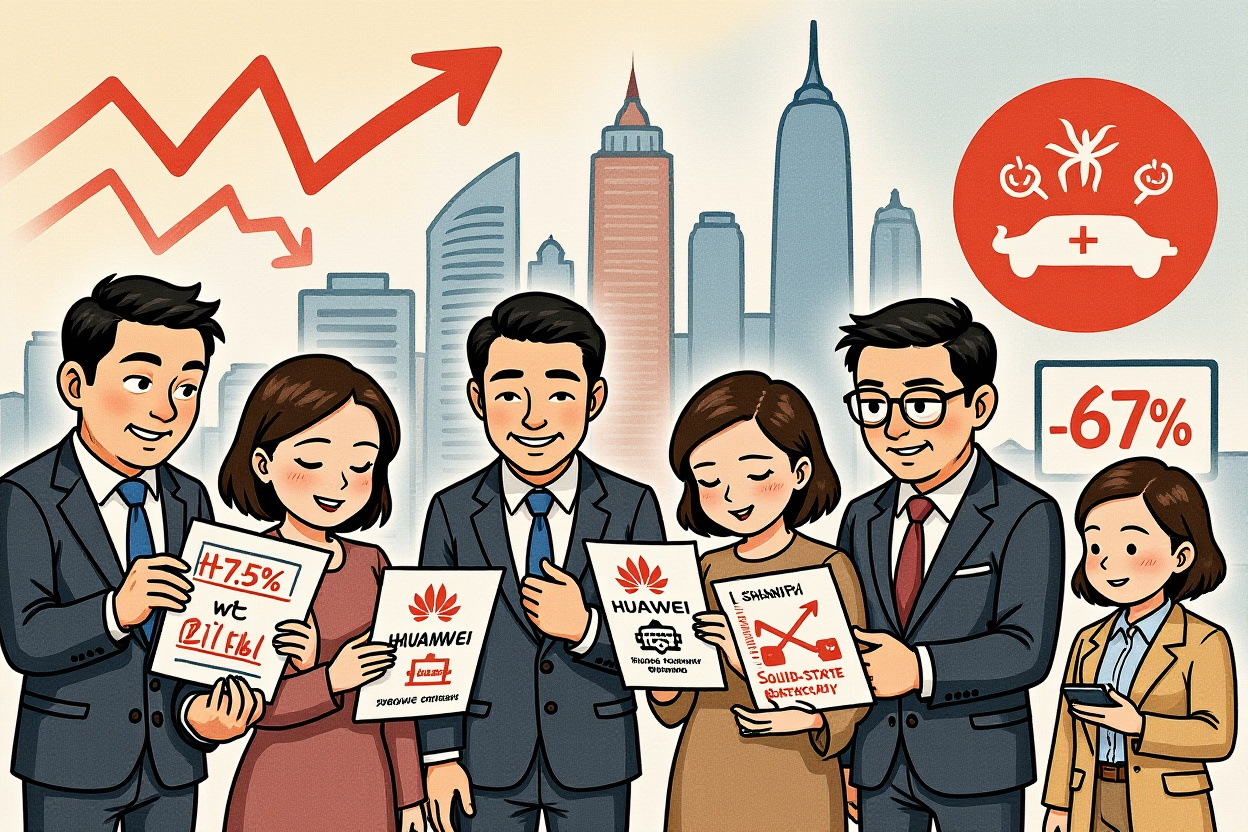
Executive Summary: Key Takeaways from GAC Group’s 2025 Report
– GAC Group posted its first annual net loss of 87.84 billion yuan in 2025, with revenue declining 10.43% to 956.6 billion yuan.
– Vehicle manufacturing毛利率 turned negative at -7.35%, leading to an average loss of 8,300 yuan per vehicle sold.
– All major brands, including joint venture广汽本田 (GAC Honda) and homegrown labels广汽传祺 (GAC Trumpchi) and广汽埃安 (GAC Aion), saw significant sales drops of over 20%.
– Overseas sales grew 47% to nearly 130,000 units, but were insufficient to offset domestic market losses from price wars.
– Strategic initiatives, such as partnering with华为 (Huawei) for high-end EVs and investing in solid-state batteries, are central to GAC Group’s survival strategy in a transforming industry.
The Unprecedented Financial Storm: GAC Group’s 2025 Losses
The Chinese automotive giant广州汽车集团股份有限公司 (GAC Group) has found itself in treacherous waters, reporting its first annual loss since listing. In 2025, the company’s revenue fell to 956.6 billion yuan, a 10.43% year-over-year decline, while归母净利润 (net profit attributable to shareholders) plummeted to -87.84 billion yuan, marking a staggering 1166.51% drop.经营性现金流 (Operating cash flow) turned negative at -150.26 billion yuan, a 237.61% decrease, forcing the company to forgo dividends for the year. This financial turmoil underscores the urgent need for GAC Group’s survival strategy as it navigates industry-wide headwinds.
Negative Margins and Regulatory Scrutiny
A critical factor in GAC’s downturn is its整车制造业务毛利率 (vehicle manufacturing gross margin), which plunged to -7.35% for the year. This resulted in an average loss of approximately 8,300 yuan per vehicle sold, culminating in a 50.75 billion yuan loss for the segment. The第四季度 (fourth quarter) alone accounted for over 50% of the annual loss at 44.72 billion yuan, indicating intensified year-end pressures. The severity of the decline prompted regulatory intervention, with上海证券交易所 (Shanghai Stock Exchange) issuing a监管工作函 (regulatory work letter) demanding explanations on毛利率,存货跌价 (inventory write-downs),无形资产减值 (intangible asset impairments), and投资收益 (investment returns). In its response, GAC cited a三重打击 (triple whammy) of falling revenues, shrinking profits, and rising costs, painting a vivid picture of the challenges embedded in GAC Group’s survival strategy.
Revenue Decline and Cost Pressures
On the revenue front, GAC faced量价齐跌 (volume and price declines).自主品牌乘用车 (Self-owned brand passenger vehicle) sales dropped 22.83% to 609,200 units, driven by aggressive price wars where main models offered discounts of 15,000 to 30,000 yuan.促销投入 (Promotional spending) as a percentage of per-vehicle sales rose by 5 percentage points, but without corresponding volume recovery, these costs could not be diluted, further eroding margins. Cost-wise,产能利用率 (capacity utilization) fell sharply due to lower sales, increasing per-vehicle人工成本 (labor costs),折旧摊销 (depreciation and amortization), and other fixed costs by over 40%. Additionally, upstream原材料 (raw material) prices remained high; for instance,碳酸锂 (lithium carbonate) futures on广州期货交易所 (Guangzhou Futures Exchange) saw an average annual price increase of about 18% in 2025, adding to cost burdens that even bulk purchasing could not fully mitigate.
Brand Performance: Joint Ventures and Domestic Brands in Decline
GAC’s woes are not isolated to one segment but span its entire portfolio, from joint ventures to homegrown brands. This broad-based weakness highlights the complexity of GAC Group’s survival strategy as it seeks to revitalize multiple fronts simultaneously.
GAC Honda’s Struggles
Once a profit engine,广汽本田 (GAC Honda) is now in a prolonged slump. Its 2025 sales fell 25.22% to 351,900 units, nearly halving from peak levels in 2020. To streamline operations, the joint venture计提了 (recorded) approximately 700 million yuan in固定资产减值 (fixed asset impairments) for production lines with diminished economic prospects. This adjustment reflects the broader industry shift away from traditional internal combustion engines, forcing GAC to reassess its joint venture dependencies as part of its survival strategy.GAC Trumpchi and Aion’s Challenges
On the domestic front,广汽传祺 (GAC Trumpchi) saw sales decline 23.02% to 319,100 units. Former best-sellers like the传祺GS4 (Trumpchi GS4), which once moved over 30,000 units monthly, now struggle to surpass 1,000 units per month based on第三方平台数据 (third-party platform data). Similarly,广汽埃安 (GAC Aion), the新能源 (new energy vehicle) subsidiary, experienced a 22.62% sales drop to 290,100 units. Aion’s product lineup reveals deeper issues: no current model sells over 10,000 units monthly, and new launches like theAION RT, priced at 100,000 to 150,000 yuan with advanced宁德时代神行电池 (CATL Shenxing batteries), have underperformed. For example, the AION RT peaks at around 5,000 units monthly, compared to比亚迪秦L (BYD Qin L), which exceeds 27,000 units, underscoring competitive gaps in GAC Group’s survival strategy.
The EV Dilemma: Aion’s Strategic Missteps
GAC Aion’s trajectory from a rising star to a drag on profits exemplifies the pitfalls in electric vehicle execution. Its struggles are a focal point in understanding GAC Group’s survival strategy, particularly in technology and branding.
Overreliance on B2B and Brand Perception
Aion’s early success was fueled byB端 (business-to-business) sales, especially in网约车 (ride-hailing) markets, where it captured significant volume. In 2023, sales surged 77.02% to over 480,000 units. However, this reliance backfired as the网约车 market saturated and B端 orders dwindled, making the transition toC端 (consumer) users arduous. The brand became stigmatized with a low-end网约车 label, hindering its appeal to family buyers. This perception issue is a critical hurdle in GAC Group’s survival strategy, requiring rebranding and product innovation to attract broader audiences.Missed Opportunities in Range-Extender Technology
Aion also missed the增程 (range-extender) boom that propelled brands like理想 (Li Auto),问界 (AITO), and零跑 (Leapmotor). GAC executives, including冯兴亚 (Feng Xingya), admitted misjudging consumer里程焦虑 (range anxiety), viewing增程 and插电 (plug-in hybrid) technologies as transitional. By the time Aion launched its first增程 model, the i60, in late 2025, the market had cooled, and rivals had solidified their positions. This timing misstep left Aion playing catch-up in a segment that could have bolstered sales during the纯电 (pure electric) transition, emphasizing the need for agile technology adoption in GAC Group’s survival strategy.
Glimmers of Hope: Overseas Growth and Technological Investments
Amid the gloom, there are positive indicators that could support GAC Group’s survival strategy. International expansion and R&D bets offer potential pathways to recovery, though they require time and sustained investment.Expanding International Footprint
In 2025, GAC’s自主品牌 (self-owned brands) achieved overseas sales of nearly 130,000 units, a 47% year-over-year increase. The company has set ambitious targets: ensuring 250,000 units in 2026,冲刺 (striving for) 300,000 units, with plans to reach 100,000 to 150,000 units in欧洲市场 (European markets) within 1-3 years. While this growth is promising, it remains a small counterbalance to domestic losses, highlighting that overseas success must scale rapidly to meaningfully contribute to GAC Group’s survival strategy.
Future-Proofing with Huawei and Solid-State Batteries
GAC is making strategic moves to regain competitiveness. Its partnership with华为 (Huawei) aims to launch the高端智能电动车品牌 (high-end smart EV brand)启境 (Qijing) in 2026, with盲订 (blind orders) already underway. Additionally, in全固态电池 (all-solid-state battery) technology—seen as a next-generation breakthrough—GAC completed a中试线 (pilot production line) in November 2025 and plans小批量装车实验 (small-batch vehicle installation tests) for 2026. These initiatives, focused on innovation and premium positioning, are crucial components of GAC Group’s survival strategy, potentially differentiating it in a crowded market.
Navigating the Road Ahead: GAC Group’s Survival Strategy in Focus
As GAC confronts its most challenging period, the company’s survival strategy must address multifaceted issues: restructuring joint ventures, reviving domestic brands, and accelerating EV innovation. The 2025 losses are a wake-up call, but not necessarily a death knell, if execution improves. Industry analysts note that GAC’s deep manufacturing expertise and government ties could provide stability, but it must shed legacy burdens and embrace consumer-centric approaches. For instance, leveraging data from the监管问询函回复 (regulatory inquiry response) to transparently communicate turnaround plans could rebuild investor confidence. Ultimately, GAC Group’s survival strategy hinges on balancing short-term cost controls with long-term bets on smart and green technologies.
Synthesis and Forward Outlook
GAC Group’s 2025 performance reveals a perfect storm of external pressures and internal missteps, from price wars and cost inflation to brand perception and technology timing. The company’s survival strategy is now at a critical juncture, requiring decisive action on portfolio optimization, market diversification, and R&D acceleration. For international investors and industry stakeholders, monitoring GAC’s progress on these fronts—such as the华为 partnership rollout and solid-state battery milestones—will be key to assessing its resilience. As China’s auto sector continues to evolve with智能化和电动化 (intelligent and electrified) trends, GAC must demonstrate agility and innovation to not only survive but potentially thrive in the new era. Consider following regulatory filings and market data for real-time updates on GAC Group’s survival strategy and its implications for global automotive investments.