



Executive Summary
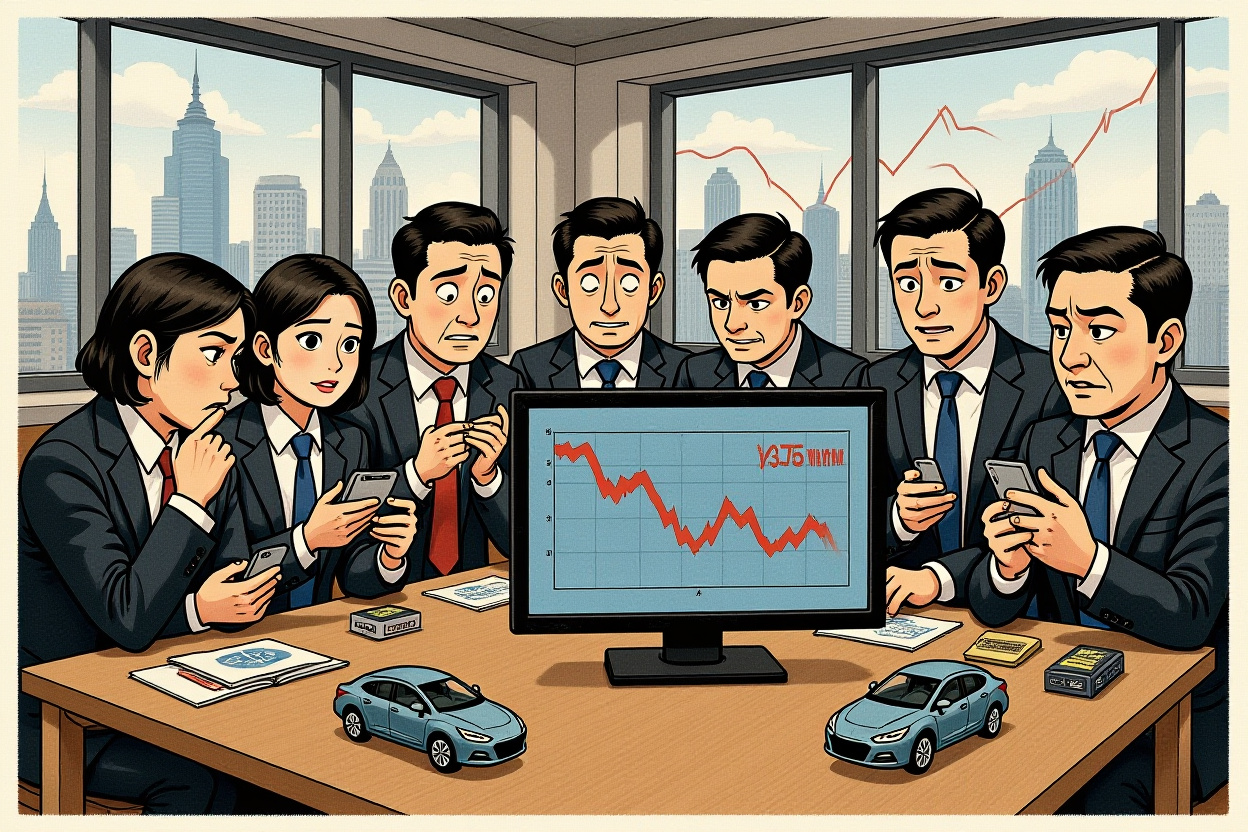
– GAC Group (广州汽车集团股份有限公司) posted its first annual loss since listing, with vehicle manufacturing gross margin turning negative at -7.35%, leading to an average loss of approximately 8,300 RMB per vehicle sold.
– All core brands, including joint venture GAC Honda (广汽本田), own brand GAC Trumpchi (广汽传祺), and new energy vehicle (NEV) subsidiary GAC Aion (广汽埃安), experienced significant sales declines of over 22% in 2025.
– The company received a regulatory inquiry from the Shanghai Stock Exchange (上海证券交易所) regarding its financial performance, emphasizing scrutiny over毛利率 (gross margin) and asset impairments.
– Overseas sales grew 47% to nearly 130,000 units, but this growth is insufficient to counter domestic losses from price wars and fixed cost pressures.
– Strategic responses include a partnership with Huawei to launch the高端智能电动车品牌 (high-end smart EV brand)启境 (Qijing) and investments in全固态电池 (all-solid-state battery) technology for future competitiveness.
The Unprecedented Financial Downturn of an Auto Titan
The year 2025 will be remembered as a watershed moment for GAC Group (广州汽车集团股份有限公司). Once celebrated as the造车界“华南虎” (South China Tiger of the auto industry) for its dominant market position and profitability, the company has now delivered a financial report that sent shockwaves through the investment community. For the first time in its history as a listed entity, GAC Group recorded an annual net loss, with its core vehicle manufacturing business operating at a negative gross margin. This stark reversal underscores the intense pressures facing traditional automakers in China’s rapidly evolving and fiercely competitive market. The focus on negative gross margin is not merely a technical detail; it represents a fundamental breach in the business model that sustained GAC for decades during the joint venture红利 (dividend) era.
Decoding the Numbers: A Deep Dive into the Loss
According to the annual report, GAC Group’s full-year revenue reached 95.66 billion RMB, a decrease of 10.43% year-on-year. More alarmingly, net profit attributable to shareholders plummeted to -8.784 billion RMB, a staggering decline of 1,166.51%. The company’s经营性现金流 (operating cash flow) turned negative to -15.026 billion RMB, a drop of 237.61%. Consequently, GAC proposed no profit distribution for the 2025 fiscal year. The most critical metric, however, is the毛利率 (gross margin) for整车制造业务 (vehicle manufacturing business), which stood at -7.35% for the year. This translates to an average毛利亏损 (gross profit loss) of about 8,300 RMB for every vehicle sold, directly contributing to a 5.075 billion RMB loss in this segment. The deterioration was most pronounced in the fourth quarter, which accounted for over 50% of the annual loss at 4.472 billion RMB, indicating a集中释放 (concentrated release) of operational pressures at year-end.
Regulatory Scrutiny and the Company’s Explanation
The severity of the downturn prompted intervention from the Shanghai Stock Exchange (上海证券交易所), which issued a监管工作函 (supervisory inquiry letter) to GAC Group. The函 (letter) demanded detailed explanations regarding the negative gross margin, inventory write-downs, intangible asset impairments, and investment income. In its response, GAC attributed the毛利率为负 (negative gross margin) to a三重压力 (three-fold pressure) common in today’s auto industry: declining revenue, shrinking profits, and rising costs.
– On the revenue side, the company faced量价齐跌 (volume and price declines). Sales of GAC’s own brand passenger vehicles fell 22.83% to 609,200 units. To maintain market share, GAC was forced to participate in an escalating price war, offering终端优惠 (end-user discounts) of 15,000 to 30,000 RMB on its main models.
–促销费用 (Sales promotion expenses) became a bleeding wound. The average promotional spending per vehicle for own brands increased by 5 percentage points year-on-year. However, as sales failed to rebound, these massive costs could not be diluted by economies of scale, further eroding profits.
– Cost pressures mounted relentlessly. Lower sales volume led to severe产能利用率不足 (insufficient capacity utilization), causing per-vehicle人工成本 (labor costs),折旧摊销 (depreciation and amortization), and other fixed costs to surge by over 40% compared to the previous year. Additionally, high raw material prices added to the burden. Data from the Guangzhou Futures Exchange (广州期货交易所) shows that the average annual price of碳酸锂期货 (lithium carbonate futures) in 2025 rose by approximately 18% year-on-year, a cost that bulk purchasing could not fully absorb.
The Three Pillars Crumble: Joint Venture, Own Brand, and NEV All Stumble
GAC’s困境 (predicament) is systemic, affecting every major segment of its business. The three traditional engines of growth—joint ventures, own brands, and new energy vehicles—have all失速 (decelerated) simultaneously, painting a picture of an organization under comprehensive strain. This broad-based weakness suggests that the challenges are structural, not incidental, and that the era of relying on any single cash cow is decisively over. The negative gross margin is a symptom of this deeper malaise, where no division is immune from the market’s harsh realities.
GAC Honda: The Fading Cash Cow
Once the undisputed profit pillar, GAC Honda (广汽本田) is enduring a prolonged and painful transition. In 2025, its cumulative sales were only 351,900 units, a year-on-year decrease of 25.22%. Compared to its peak in 2020, GAC Honda’s sales volume has nearly halved. The downturn forced the company to recognize approximately 700 million RMB in固定资产减值 (fixed asset impairment) for production lines with diminished expected economic benefits. This move to optimize the asset structure highlights the depth of the joint venture’s struggles in a market where consumer preference is shifting decisively away from traditional internal combustion engine vehicles.
GAC Trumpchi: The Struggling Homegrown Hero
The fundamental platform for GAC’s自主 (independent) ambitions, GAC Trumpchi (广汽传祺), also hit a growth wall. In 2025, GAC Trumpchi’s cumulative sales were 319,100 units, down 23.02% year-on-year. The once-blockbuster model传祺GS4 (Trumpchi GS4), which achieved monthly sales exceeding 30,000 units, has seen its fortunes fade dramatically. Data from third-party platforms indicates that its average monthly sales have not surpassed 1,000 units for four consecutive months. This decline underscores the difficulty legacy own brands face in sustaining relevance amid intense competition and evolving consumer tastes for智能化 (intelligent) and electrified features.
GAC Aion: The NEV Standard-Bearer Loses Its Way
Perhaps the most disappointing setback came from GAC Aion (广汽埃安), the subsidiary once hailed as the新能源尖兵 (NEV vanguard). In 2025, GAC Aion’s cumulative sales were 290,100 units, a decline of 22.62%. Third-party data reveals that currently, none of Aion’s in-market models achieve monthly sales of over 10,000 units. In response to the slump, Aion密集发布 (intensively launched) new models in 2025, including the新款AION V霸王龙 (new AION V Bawanglong), AION RT, and AION UT. These vehicles aimed to attract retail consumers through core technology dissemination and design changes. The AION RT, positioned as a 100,000 to 150,000 RMB纯电家轿 (pure-electric family sedan) with standard CATL (宁德时代)神行电池 (Shenxing Battery) and up to 650 km CLTC range, was particularly highlighted. However, its market reception has been lukewarm, with best monthly sales around 5,000 units—a stark contrast to the BYD Qin L, which surpassed 27,000 units in its best month over the same period. Sales for the AION V and AION UT largely hover between 2,000 and 3,000 units per month.
The Aion Conundrum: How a Pioneer Became a Liability
The case of GAC Aion is a microcosm of the broader转型 (transformation) challenges at GAC Group. Its journey from rapid growth to sharp contraction offers critical lessons on brand positioning and technological timing in China’s NEV sector. The negative gross margin plaguing the group is acutely felt here, as aggressive pricing and high costs converge without the sales volume to create a sustainable business.
The网约车 (Ride-Hailing) Label and a Missed Technological Window
Aion’s early success was heavily built on theB端 (business-to-business)网约车市场 (ride-hailing market). This strategy allowed it to scale quickly, with sales surpassing 480,000 units in 2023, a year-on-year increase of 77.02%. However, this reliance became a double-edged sword. As the ride-hailing market饱和 (saturated) and B端订单 (B-end orders)锐减 (sharply decreased), Aion found it exceptionally difficult to transition to C端家庭用户 (C-end family users). The brand became saddled with a low-end, commercial vehicle标签 (label) that is hard to shake. Furthermore, Aion missed the critical window for增程 (extended-range) technology. While rivals like理想 (Li Auto),问界 (AITO), and零跑 (Leapmotor) achieved massive success with extended-range vehicles, Aion remained committed to a pure-electric路线 (path), viewing plug-in hybrids as a过渡路线 (transitional technology). GAC Group General Manager冯兴亚 (Feng Xingya) reflected on this misstep in July 2025, stating, “当年我们对客户的里程焦虑把握不够精准,认为增程和插电技术是过渡路线,没有抓住这些年增程插混技术高速发展的机遇。” (“In the past, we did not accurately grasp customers’ range anxiety, believing that extended-range and plug-in hybrid technologies were transitional routes, and we missed the opportunity during the high-speed development period of these technologies in recent years.”) Aion only launched its first extended-range model, the i60, at the end of 2025, by which time market momentum had already shifted, leaving the brand struggling to find突破空间 (breakthrough space).
Overseas Expansion: A Flicker of Light in a Long Tunnel
Amid the gloomy financials, one area showed promising growth: international markets. In 2025, GAC Group’s own brand overseas sales reached nearly 130,000 units, a year-on-year increase of 47%. The company has set ambitious targets: ensuring 250,000 units and striving for 300,000 units in overseas sales for 2026, with plans to突破 (break through) 100,000 units in the亚太市场 (Asia-Pacific market) and achieve 100,000 to 150,000 units in the欧洲市场 (European market) within 1 to 3 years by 2027. However, for the current GAC, overseas operations remain in a高投入、长周期的起步阶段 (high-investment, long-cycle start-up phase). The 130,000 units of overseas增量 (incremental sales) are still far from sufficient to cover the毛利黑洞 (gross profit black hole) created by domestic price wars and negative gross margin. While strategic, this international push is a long-term bet rather than an immediate remedy for the financial hemorrhage.
Strategic Pivots and the Path to Recovery
Confronted with these existential challenges, GAC Group is not standing still. The company is initiating several strategic moves aimed at regaining its footing in the high-stakes race for the future of mobility. These initiatives represent a dual focus: addressing immediate brand perception issues and investing in next-generation technologies that could redefine competitiveness. Success in these endeavors is crucial for reversing the trend of negative gross margin and restoring investor confidence.
The Huawei Partnership and the Qijing Brand
In a high-profile move to bolster its智能电动车 (smart EV) credentials, GAC has partnered with Huawei to co-create the高端智能电动车品牌 (high-end smart EV brand)启境 (Qijing). The first model under this brand is slated for launch in 2026 and has already commenced盲订 (blind ordering). This collaboration aims to leverage Huawei’s expertise in智能座舱 (intelligent cockpit) and智能驾驶 (intelligent driving) to create a competitive product in the premium segment, a market where GAC has historically been weak. It is a direct response to the success of similar华为赋能 (Huawei-powered) brands like AITO.
Betting on the Next Frontier: All-Solid-State Batteries
Recognizing that battery technology remains a key battleground, GAC is making a forward-looking investment in全固态电池 (all-solid-state battery) technology, often seen as the next颠覆性技术变革 (disruptive technological change). The company’s中试线 (pilot production line) for all-solid-state batteries was completed and put into operation in November 2025. GAC plans to conduct小批量装车实验 (small-batch vehicle loading experiments) in 2026. While this technology is years away from mass commercialization, securing a position in this arena is critical for long-term relevance and could eventually contribute to cost reduction and performance improvements, indirectly helping to improve gross margins.
Synthesizing the Crisis and Charting the Course Forward
The story of GAC Group in 2025 is a cautionary tale of disruption in the world’s largest auto market. The negative gross margin is not an accounting anomaly but a powerful indicator of a business model under severe stress. The dual pressures of safeguarding joint venture assets while fueling a costly and uncertain transition to electrification and intelligence have created a perfect storm. The regulatory inquiry underscores the seriousness with which the market views these developments. For international investors and industry observers, GAC’s journey offers several key takeaways: the era of easy profits from joint ventures is over; brand repositioning in the NEV space is fraught with peril; and technological foresight is as important as execution. The road ahead for GAC is undeniably challenging. It must successfully launch the Qijing brand, accelerate its overseas footprint to meaningful profitability, and navigate the capital-intensive development of solid-state batteries—all while managing the ongoing decline of its legacy businesses. Investors should closely monitor the company’s cash flow management, the market reception of its new models, and its progress in reducing fixed cost burdens. The ‘South China Tiger’ has been wounded, but its fight for survival and relevance in the new automotive era has only just begun.