



Executive Summary: Key Market Insights
The recent astronomical rise in gold prices has catalyzed a unique consumer and investment trend within China. Below are the critical takeaways for market participants and observers.
– Global gold prices have surged, with spot gold breaching key resistance levels, driving domestic Chinese gold jewelry prices to near 1,400 yuan per gram for major brands like Lao Feng Xiang and Lao Miao.
– A significant behavioral shift is underway, with younger generations, particularly millennials and Gen Z, turning to DIY gold making as a cost-effective and personalized alternative to retail jewelry purchases.
– This trend is revitalizing the traditional goldsmithing craft, creating new entrepreneurial and career opportunities for a wave of young, innovative artisans, often referred to as ’00后’ goldsmiths.
– Despite its appeal, the DIY gold making trend, especially the ‘home gold making’ variant, carries substantial and often overlooked risks, including severe safety hazards and the high probability of significant financial loss due to operational errors.
– Industry experts and regulatory bodies urge caution, emphasizing that successful DIY gold making requires specialized skills, proper equipment, and a clear understanding of the material properties, beyond what social media tutorials can provide.
The Precipitous Rise of Gold: A Global Phenomenon Hits Home
In the early hours of March 27, Eastern Time, global precious metals markets witnessed a sharp rally. Spot gold prices vaulted past the $2,200 per ounce mark, a move that sent immediate ripples across the Pacific to the world’s largest gold consumer—China. By March 28, the domestic translation of this global surge was starkly evident on price boards across the country. The relentless climb in gold prices is more than a fleeting market anomaly; it is a convergence of macroeconomic fears, currency fluctuations, and sustained demand that has repositioned gold as a paramount asset for both institutional and retail investors.
Decoding the Price Surge: Macro Drivers and Market Sentiment
The gold price rally is underpinned by a complex mix of factors. Persistent inflationary pressures in major Western economies, coupled with geopolitical tensions and a weakening U.S. dollar index, have bolstered gold’s traditional role as a safe-haven asset. For Chinese investors, this global narrative interacts with local dynamics, including currency management policies by the People’s Bank of China (中国人民银行) and capital flow regulations. The result is a powerful price signal that consumers and speculators alike cannot ignore. The spot gold price acting as a global benchmark directly feeds into the Shanghai Gold Exchange (上海黄金交易所) pricing, setting the floor for retail jewelry costs.
Domestic Brand Reactions: Prices Nearing 1,400 Yuan per Gram
The immediate impact on the Chinese retail landscape was a series of rapid price adjustments from leading jewelry houses. This is not merely a cost-pass-through but a strategic repositioning in a highly competitive market.
– Lao Feng Xiang (老凤祥): Quoted 1396 yuan per gram, a significant increase of 28 yuan from the previous day’s 1368 yuan.
– Lao Miao Gold (老庙黄金): Priced at 1397 yuan per gram, rising 32 yuan from 1365 yuan.
– Chow Sang Sang (周生生): Listed at 1391 yuan per gram, up 27 yuan from 1364 yuan.
These price points, brushing against the psychologically significant 1,400-yuan threshold, have fundamentally altered the consumer calculus, making the outright purchase of finished jewelry a more substantial investment and inadvertently fueling the search for alternatives like DIY gold making.
DIY Gold Making Emerges as a Mainstream Consumer Trend
Faced with soaring retail prices, a novel form of gold engagement has captured the imagination of cost-conscious and experience-seeking young consumers. DIY gold making—the process of transforming raw gold or old jewelry into new pieces through melting, molding, shaping, and polishing—has exploded in popularity. On Chinese social media platforms, topic views for ‘打金’ have soared into the billions, signaling a massive grassroots interest. This trend represents a fusion of investment savvy, artisan appreciation, and a desire for personalized consumption, effectively creating a ‘new national trend’ that blends aesthetic, emotional, and financial utility.
The Allure of Personalization and Perceived Value Retention
The core appeal of DIY gold making lies in its dual promise: significant cost savings and unique personalization. In a typical gold jewelry store, consumers pay a hefty premium that includes branding, design, and retail overhead. In contrast, the DIY gold making model charges a basic workmanship fee, often ranging from 10 to 40 yuan per gram for simple pieces, and potentially reaching hundreds of yuan for intricate techniques like非遗花丝 (non-legacy filigree) or手工錾刻 (hand engraving). For many, this process also offers emotional value by allowing the repurposing of heirloom or outdated gold pieces, preserving the metal’s intrinsic value while updating its form. As Wang Huiqun (王惠群), Secretary-General of the Shanghai Gold Jewelry Industry Association, notes, consumers should ‘choose larger-scale workshops, observe the craftsman’s skill, clarify any uncertainties in advance, and reach an agreement.’
The DIY Gold Making Process Demystified
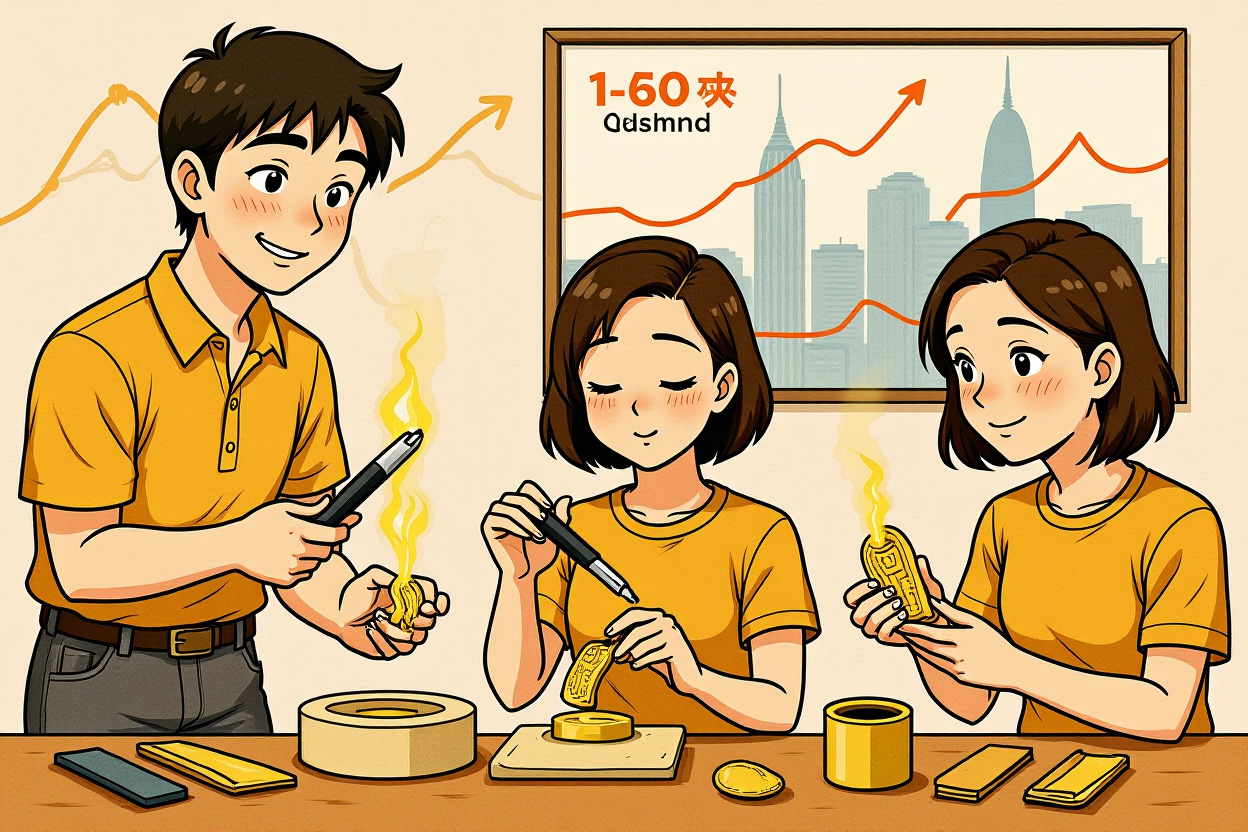
Contrary to its ancient roots, the modern iteration of gold crafting is being documented and shared online. A standard process involves several key steps: melting the gold with a high-temperature torch, pouring it into a mold (often made of油泥王 – oil-based clay or石膏 – plaster), allowing it to cool and solidify, followed by meticulous shaping, filing, and polishing to achieve the final finish. The entire process for a basic item can take one to three hours. This accessibility, demonstrated through countless video tutorials, has lowered the perceived barrier to entry, making DIY gold making seem like a feasible weekend project.
A New Generation of Artisans: The ’00后’ Goldsmiths
The DIY gold making boom is not just creating consumers; it is forging a new generation of craftsmen and women. Young people, many born after the year 2000 (hence ’00后’), are entering this traditional field, bringing with them contemporary aesthetics, digital marketing skills, and a fresh entrepreneurial spirit. They are instrumental in driving the trend’s popularity, as they can intuitively understand and cater to the design preferences of their peers.
Career Pathways and Economic Incentives
The goldsmithing trade is experiencing a talent infusion. Shop owners report that young teams excel in innovation and client communication. The barrier to entry in terms of formal education is relatively low, attracting both recent graduates and career changers. The economic incentive is clear. As noted by Zhou Baolin (周宝林), a store manager in Shanghai’s Yuyuan area, a junior goldsmith can earn around 10,000 yuan per month, with skilled specialists like engravers commanding 15,000 yuan or more. This competitive salary, combined with the creative and tangible nature of the work, makes it an attractive new professional track in a crowded job market.
The Sobering Reality and Risks of Home Gold Making
While the professionalization of the craft is a positive development, a parallel and riskier trend has emerged: amateur home gold making. Driven by the desire to save even the modest workmanship fees, individuals are purchasing basic toolkits online and attempting the craft in their own homes. A search for ‘打金套装’ (gold making kit) on e-commerce platforms yields numerous options, with prices as low as 100-200 yuan. These kits typically include long-nose pliers, torches, files, borax, crucibles, and molds. However, the transition from watching a tutorial to successful execution is fraught with peril, a gap that many enthusiasts discover too late.
Substantial Safety Hazards: Beyond Simple Burns
The most immediate dangers of DIY gold making are physical. Gold melts at over 1064 degrees Celsius, requiring a powerful and potentially dangerous torch. The risk of severe burns or starting a fire is high in a non-industrial setting. Furthermore, as Wang Chao (王超), Director of the Ningbo Quality Inspection Institute Gold and Jewelry Testing Center, warns, a critical and often ignored risk involves toxic fumes. ‘If [the gold] is mixed with other, more volatile metals… for example, if there is mercury, it turns into mercury vapor. In a poorly ventilated environment, this can easily lead to poisoning.’ He advises that if one must attempt it, operate in a well-ventilated area with protective gear like thick gloves and long tongs.
The Financial ‘Pitfall’: Unexpected and Irrecoverable Gold Loss
Beyond safety, the most common ‘pitfall’ for home gold makers is financial loss. The promise of ‘saving money’ often backfires spectacularly. Operational errors are frequent and costly. Improper preparation of plaster molds can cause the cast piece to shatter. Incorrect temperatures during melting or welding can lead to metal fracture or excessive oxidation. Each mistake results in gold being lost—trapped in mold crevices, scattered as dust, or rendered unrecoverable. This loss, known as ‘损耗’ (shu hao), can far exceed the cost of professional workmanship. Many find themselves taking their botched projects to professional shops for repair, incurring additional costs and ending up spending more than if they had gone to a professional in the first place. Wang Chao (王超)坦言 (frankly states) that ‘DIY gold making is not something that can be achieved simply by following tutorial steps,’ urging a rational view of its possibilities and limitations.
Navigating the Trend: Expert Guidance and Market Implications
For investors and consumers captivated by the allure of gold and the DIY gold making trend, a measured approach is essential. The phenomenon is more than a consumer fad; it reflects deeper shifts in how value is perceived and interacted with in the Chinese market. It blurs the lines between consumption, investment, and hobbyist craft.
Strategic Considerations for Investors and Consumers
For those considering engaging with DIY gold making, due diligence is paramount. Firstly, understand the source and purity of your gold. Dealing with reputable refiners or using certified old jewelry is crucial to avoid the toxic metal mixtures experts warn about. Secondly, recognize the skill threshold. As with any craft, proficiency in DIY gold making requires practice and patience; the first attempt is unlikely to yield a professional result. Thirdly, factor in the full cost, including potential loss of material and the cost of tools, not just the saved workmanship fee. For purely investment-minded individuals, purchasing gold bullion or regulated financial products like gold ETFs may offer a more efficient and secure exposure without the operational risks of DIY gold making.
The Broader Market and Regulatory Outlook
This trend presents both opportunities and challenges for the established gold jewelry industry. Brands may need to explore more customizable services or educational workshops to engage this new customer segment. From a regulatory perspective, while the craft itself is legal, the sale of unregulated gold-making kits and the potential for unlicensed operations pose consumer protection questions. Industry associations may develop basic safety standards or certification programs for aspiring goldsmiths. Monitoring by bodies like the China Gold Association (中国黄金协会) will be key to ensuring market order and consumer safety as the DIY gold making sector evolves.
Synthesis and Forward-Looking Guidance
The surge in gold prices has undeniably acted as a catalyst, but the rise of DIY gold making is a distinct socio-economic trend with its own momentum. It embodies a search for value, authenticity, and creative agency among younger consumers. However, the romanticized view of crafting one’s own jewelry must be balanced with a sober assessment of the realities. The risks associated with home gold making—both to personal safety and financial well-being—are significant and non-trivial.
The key takeaway is to engage with this trend intelligently. For those interested in the craft, seek proper training or apprenticeships before attempting complex work. Consider using professional DIY studios that provide equipment and guidance rather than working in a completely unsupervised home environment. For investors, view gold primarily through its macroeconomic drivers and consider DIY gold making as a consumption activity with investment characteristics, rather than a pure investment strategy.
As the market for gold continues to evolve, staying informed through reliable financial news and heeding expert warnings will be crucial. The DIY gold making craze is a fascinating chapter in China’s consumer story, but navigating it successfully requires caution, preparation, and respect for the craft’s inherent challenges. Always prioritize safety and consult with certified professionals before making significant decisions regarding physical gold assets.