



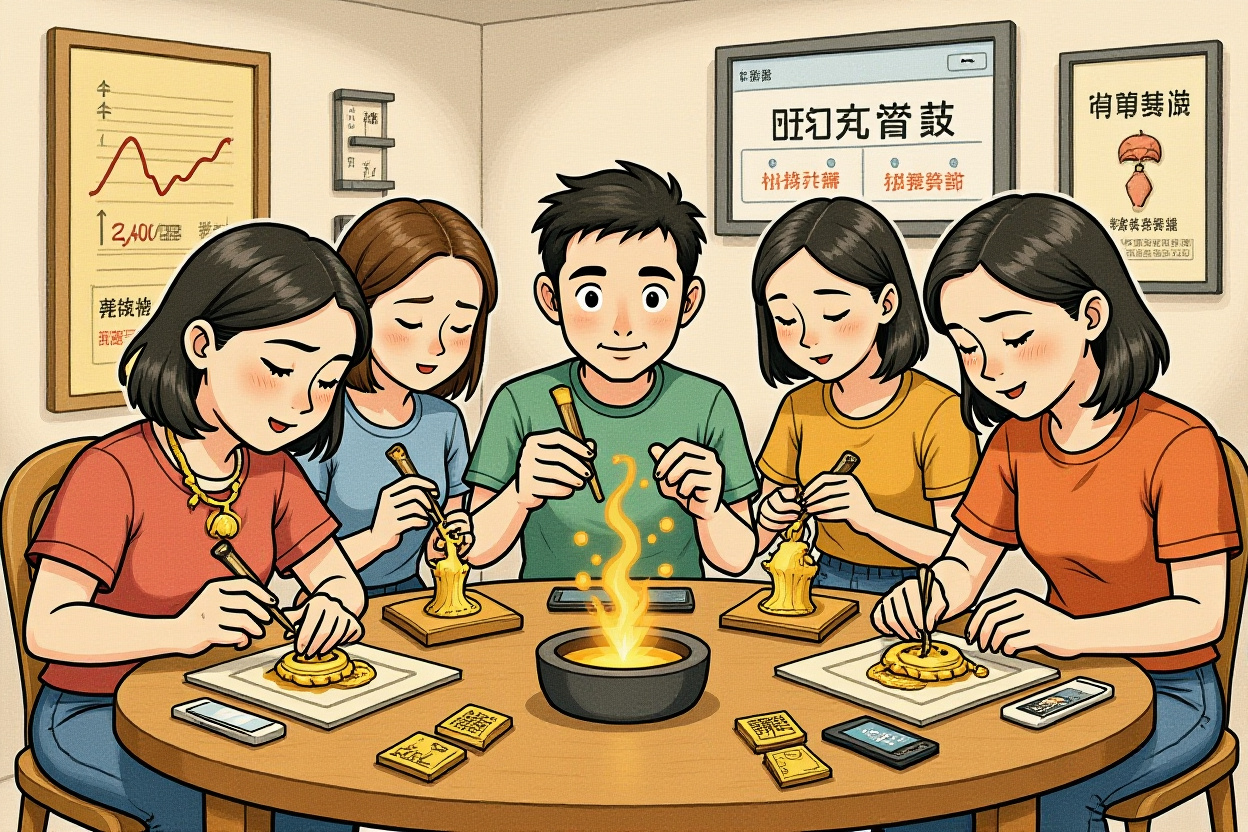
– Gold prices have surged globally, with domestic Chinese jewelry brands like Lao Feng Xiang (老凤祥) nearing 1,400 yuan per gram, driven by market volatility and economic uncertainty.
– A DIY gold crafting trend, fueled by social media with billions of views, is gaining popularity among young consumers seeking personalized, cost-effective alternatives to retail jewelry.
– Young artisans, including the ’00后’ (post-2000s) generation, are revitalizing the traditional gold crafting trade, offering innovative designs and new career opportunities.
– Experts warn of significant safety hazards, such as metal toxicity and fire risks, and financial losses from operational errors in home gold crafting, urging caution and professional consultation.
– This trend reflects broader shifts in consumer behavior towards asset preservation and emotional investment, but requires informed decision-making to navigate risks effectively.
The Meteoric Rise of Gold Prices: A Market Analysis
The recent surge in gold prices has sent shockwaves through global financial markets, with现货黄金 (spot gold) briefly surpassing $4,555 per ounce on March 27, Eastern Time. This rally is not isolated to international benchmarks; domestically in China,品牌金饰 (brand gold jewelry) prices have escalated rapidly, approaching 1,400 yuan per gram by March 28. This price movement underscores gold’s enduring role as a safe-haven asset amid geopolitical tensions and inflationary pressures, while also catalyzing unexpected consumer trends like the DIY gold crafting phenomenon.
Domestic Price Benchmarks and Comparative Data
Data from leading Chinese jewelry retailers highlights the sharp increase. For instance, Lao Feng Xiang (老凤祥) reported a price of 1,396 yuan per gram, up 28 yuan from the previous day, while Lao Miao Gold (老庙黄金) reached 1,397 yuan per gram, a 32-yuan increase. Similarly, Chow Sang Sang (周生生) priced its足金首饰 (pure gold jewelry) at 1,391 yuan per gram, reflecting a 27-yuan rise. These figures, sourced from official brand announcements, indicate a broader trend of rising costs that is reshaping consumer behavior and investment strategies in precious metals.
Underlying Drivers: Geopolitical Tensions and Economic Indicators
The gold price surge is fueled by multiple factors, including anticipations of interest rate cuts by the Federal Reserve, ongoing conflicts in regions like Ukraine and the Middle East, and a weakening U.S. dollar. In China, economic indicators such as the Consumer Price Index (CPI) and monetary policies from the中国人民银行 (People’s Bank of China) also influence domestic gold demand. For international investors, this environment presents both opportunities and risks, as gold’s volatility can impact portfolio diversification and hedging strategies. The DIY gold crafting trend emerges as a microcosm of this larger market dynamics, where individuals seek to leverage gold’s value through hands-on engagement.
DIY Gold Crafting: From Niche Hobby to Mainstream Craze
DIY gold crafting, or ‘打金’ (da jin), involves transforming raw gold into personalized jewelry through processes like熔金 (melting),倒模 (casting),塑型 (shaping), and抛光 (polishing). Historically a specialized trade, it has exploded in popularity among young consumers, driven by social media platforms where the hashtag #打金 has garnered over 1.3 billion views. This trend represents a shift towards experiential consumption, where individuals value customization, cost savings, and emotional connection over traditional retail purchases. The allure of DIY gold crafting lies in its ability to merge financial prudence with creative expression, but it also introduces complexities that require careful navigation.
Defining the Craft: Processes and Techniques
A typical DIY gold crafting session lasts one to three hours, with basic pieces costing 10 to 40 yuan per gram in labor fees, compared to higher brand premiums at established jewelers. For intricate designs like非遗花丝 (intangible cultural heritage filigree) or手工錾刻 (hand engraving), fees can range from几十元 (tens of yuan) to上百元 (over a hundred yuan). This affordability, coupled with the personalized outcome, appeals to millennials and Gen Z consumers who prioritize uniqueness and value retention. As noted by Wang Huiqun (王惠群), Secretary-General of the Shanghai Gold and Jewelry Trade Association (上海黄金饰品行业协会), ‘Consumers should choose reputable workshops and clarify all terms before proceeding,’ highlighting the need for due diligence in this growing market.
The Social Media Catalyst: Billions of Views and Viral Tutorials
Platforms like Douyin and Weibo are awash with tutorials showcasing DIY gold crafting successes, often omitting the inherent challenges. These videos, which demonstrate steps from tool assembly to final polishing, have normalized the practice, making it seem accessible to amateurs. However, this visibility can mask the risks, as many enthusiasts overlook the technical expertise required. The trend’s viral nature underscores how digital communities are driving financial behaviors, with DIY gold crafting serving as both a hobby and a potential investment avenue. For global investors, this social dimension offers insights into consumer sentiment and market trends in China’s equity and commodity sectors.
Youthful Innovation: The New Generation of Gold Artisans
The DIY gold crafting boom is not just about consumers; it’s also creating opportunities for a new wave of artisans. Young craftsmen, often from the ’00后’ (post-2000s) generation, are entering the field, blending traditional skills with modern aesthetics. This infusion of youth is revitalizing an old trade, offering career paths outside conventional sectors and contributing to economic diversification. In cities like Shanghai, workshops report that their teams are predominantly under 30, with the oldest member being 28, reflecting a demographic shift that prioritizes creativity and customer engagement.
Demographic Shift: Post-2000s Artisans and Their Impact
These young artisans bring fresh perspectives, leveraging digital tools for design and marketing. As one shop owner noted, ‘Young teams excel in innovation and understanding client needs,’ which enhances competitiveness in a crowded market. The barrier to entry is relatively low, with no strict age or学历 (educational background) requirements, making it accessible to应届毕业生 (fresh graduates) and career changers alike. This flexibility is crucial in China’s evolving labor market, where traditional industries face disruption and new niches like DIY gold crafting offer sustainable incomes.
Economic Viability: Wages and Career Prospects
According to Zhou Baolin (周宝林), a store manager in Shanghai’s豫园街道 (Yuyuan Street), gold craftsmen typically earn around 10,000 yuan monthly, with skilled錾刻师 (engravers) reaching 15,000 yuan. These wages, while modest compared to high-finance roles, provide stability and growth potential in a sector fueled by consumer demand. For institutional investors, this trend signals opportunities in related equities, such as gold mining companies or retail chains adapting to the DIY wave. The DIY gold crafting movement thus represents a micro-economy within the broader gold market, with implications for employment and investment portfolios.
The Dark Side of DIY: Risks and Realities of Home Gold Crafting
While the DIY gold crafting trend offers excitement and potential savings, it is fraught with dangers that experts urgently highlight. Home enthusiasts often underestimate the complexities involved, leading to safety hazards and financial losses. Wang Chao (王超), Director of the Ningbo Quality Inspection Institute Gold and Jewelry Testing Center (宁波市质检院黄金珠宝检测中心), emphasizes that ‘gold melts at over 1,000 degrees Celsius, posing significant risks in non-professional settings.’ These warnings are critical for anyone considering DIY gold crafting, as the consequences can extend beyond minor mishaps to serious health and economic impacts.
Safety First: Perils of High-Temperature Operations
Home gold crafting requires tools like火枪 (torches) and坩埚 (crucibles), which, if mishandled, can cause fires, burns, or toxic exposure. Wang Chao (王超) notes that impurities in gold, such as mercury, can vaporize during heating, leading to poisoning in poorly ventilated areas. Proper precautions, like using thick gloves and long tongs, are essential but often overlooked in tutorial videos. For a detailed guide on safety standards, refer to the中国国家标准化管理委员会 (Standardization Administration of China) website, which outlines protocols for hazardous material handling. This aspect of DIY gold crafting demands respect for the craft’s technical demands, rather than casual experimentation.
Financial Pitfalls: When Savings Turn into Losses
Common errors in DIY gold crafting include improper模具制备 (mold preparation) causing castings to shatter, or焊接 (soldering) mistakes leading to metal loss. These issues can result in gold wastage that exceeds expected损耗 (loss rates), sometimes requiring professional repair at added cost. For example, a failed home attempt might lose 5-10% of the gold’s weight, negating any initial savings. This financial risk is a stark reminder that DIY gold crafting is not a guaranteed money-saver; instead, it requires skill and precision to avoid setbacks. Investors should view this trend cautiously, as it reflects consumer optimism but also potential market inefficiencies in gold recovery and recycling.
Expert Perspectives: Balancing Enthusiasm with Caution
Wang Chao (王超) advises that ‘DIY gold crafting is feasible for those with strong动手能力 (hands-on ability), but failures are common due to operational uncertainties and模具质量 (mold quality).’ He recommends starting with small projects and seeking professional guidance, such as from certified workshops affiliated with the上海黄金交易所 (Shanghai Gold Exchange). These insights underscore the importance of education and risk management in the DIY gold crafting space. For financial professionals, this trend offers lessons in consumer risk tolerance and the intersection of retail investment with hands-on activities, highlighting areas for regulatory oversight and market education.
Synthesizing the Gold Rush: Key Takeaways and Forward Guidance
The convergence of soaring gold prices and the DIY gold crafting craze presents a multifaceted narrative for global markets. On one hand, it demonstrates gold’s resilient appeal as an asset class, driving both institutional investment and retail engagement. On the other, it reveals vulnerabilities in consumer practices, where enthusiasm can outpace expertise. The DIY gold crafting trend, while innovative, serves as a cautionary tale about the risks of blending finance with amateur craftsmanship. For investors, this underscores the need to diversify beyond traditional holdings and monitor emerging consumer behaviors for market signals.
Looking ahead, stakeholders should prioritize education and safety in the DIY gold crafting ecosystem. Consumers are encouraged to consult professionals, use reputable suppliers, and consider insured services for valuable projects. Institutional players can explore opportunities in gold-backed financial instruments or tech solutions that mitigate crafting risks. Ultimately, the gold market’s evolution will depend on balancing innovation with prudence, ensuring that trends like DIY gold crafting contribute positively to economic resilience. As next steps, readers should assess their exposure to gold assets and stay informed through sources like the世界黄金协会 (World Gold Council) for global insights and the中国黄金协会 (China Gold Association) for domestic trends.