



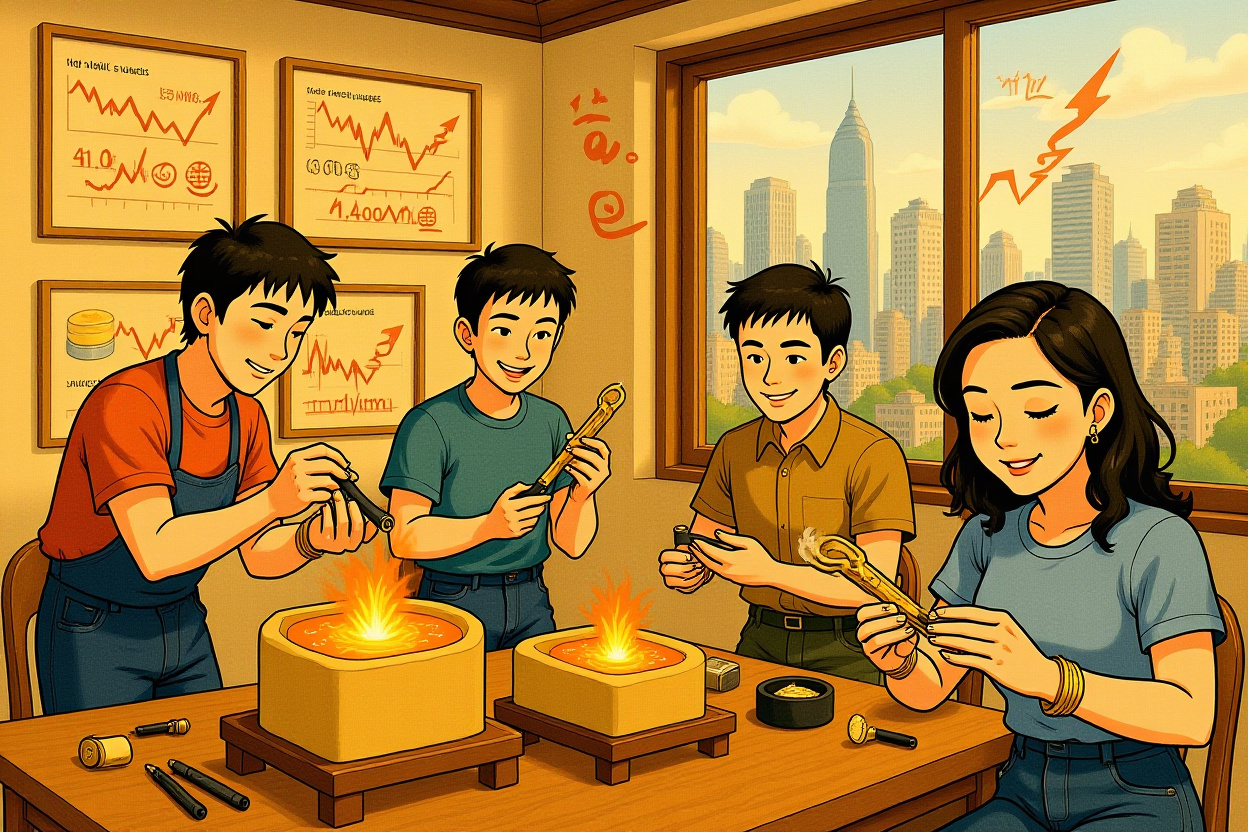
Gold Market Rally Fuels Consumer Frenzy
The global gold market witnessed a dramatic surge on March 27 (U.S. Eastern Time), with spot gold prices briefly breaking through $4,555 per ounce. This rally has reverberated across China’s domestic market, where branded gold jewelry prices are nearing historic highs, sparking a consumer trend toward alternative gold consumption methods, including the burgeoning home gold crafting trend.
Record-Breaking Prices in Global and Domestic Markets
The overnight spike in precious metals was driven by a combination of geopolitical tensions, inflationary concerns, and shifts in central bank policies. For Chinese consumers, this translated into immediate price increases at retail counters on March 28. Major domestic jewelers reported significant jumps, with per-gram prices approaching the 1,400 yuan psychological barrier.
- Lao Feng Xiang (老凤祥) quoted 1,396 yuan/gram, up 28 yuan from the previous day.
- Lao Miao Gold (老庙黄金) quoted 1,397 yuan/gram, a rise of 32 yuan.
- Zhou Sheng Sheng (周生生) quoted 1,391 yuan/gram, increasing by 27 yuan.
This price environment is making traditional gold jewelry purchases less accessible, prompting cost-conscious buyers, particularly younger demographics, to explore more hands-on and personalized avenues like the home gold crafting trend.
Impact on Branded Gold Jewelry Retailers
The steep climb in gold prices pressures retailers’ margins and consumer demand. Brand premiums and processing fees at established stores, which can add substantially to the base gold cost, are pushing savvy shoppers toward craft-based alternatives. This shift is part of a broader movement where gold is not just a store of value but a medium for personal expression, feeding directly into the DIY gold crafting phenomenon.
The Renaissance of Gold Crafting Among Youth
Gold crafting, or “da jin” (打金), an ancient technique involving melting, molding, shaping, and polishing gold into jewelry, is experiencing a modern revival. On social media platforms, topics related to this craft have garnered over 1.3 billion views, indicating massive interest among China’s youth.
Understanding the “Da Jin” Process and Its Appeal
A typical gold crafting session for a basic item like a ring or bracelet takes one to three hours. The process includes melting gold, pouring it into molds, shaping, filing, and polishing. Labor costs range from 10 to 40 yuan per gram for simple designs, while intricate techniques like非遗花丝 (non-legacy filigree) or手工錾刻 (hand engraving) can cost from tens to hundreds of yuan per gram.
Compared to the high brand markups in retail stores, this method offers significant cost savings and a unique, personalized touch. Consumers report that refurbishing old gold jewelry not only preserves the metal’s intrinsic value and sentimental memory but also aligns with contemporary aesthetics, creating a “new national trend” that blends emotion, finance, and style.
Social Media Drives Billion-View Trend
Platforms like Douyin and Xiaohongshu are flooded with tutorials and success stories, making gold crafting appear accessible and trendy. This visibility is a key driver behind the home gold crafting trend, as amateurs are inspired to try their hand at creating jewelry from the comfort of their homes. However, this democratization of the craft comes with risks that are often glossed over in viral content.
New Faces in an Old Trade: Young Goldsmiths on the Rise
The popularity of gold crafting is not just reshaping consumer behavior but also revitalizing the workforce. A new generation of craftsmen, often from the post-2000 cohort, is entering the field, bringing fresh creativity and technical skills.
Demographic Shift in the Goldsmithing Industry
Gold crafting workshops are increasingly staffed by young artisans. One shop owner reported that after noticing the trend three years ago, she now operates two stores with 20 employees, including 10 goldsmiths mostly in their twenties, the oldest being 28. These young teams excel in innovation and understanding client demands, which is crucial in a market driven by customization.
The industry has low barriers to entry regarding age or formal education, attracting recent graduates and career changers alike. This influx is helping to modernize a traditional trade and meet the growing demand fueled by the home gold crafting trend.
Economic Opportunities for Aspiring Craftsmen
According to Zhou Baolin (周宝林), store manager at a gold crafting shop in Shanghai’s Yuyuan area, average monthly wages for goldsmiths start around 10,000 yuan, with skilled engravers or craftsmen earning up to 15,000 yuan. This competitive income, coupled with the craft’s creative appeal, makes it an attractive career path, further sustaining the gold crafting ecosystem.
The Dark Side of DIY: Risks of Home Gold Crafting
While the home gold crafting trend offers apparent benefits like cost savings and personal fulfillment, it harbors significant dangers that are frequently underestimated by enthusiasts. Experts from质检机构 (quality inspection institutions) and industry veterans are sounding the alarm on both safety and financial fronts.
Safety Hazards from High-Temperature Operations
Gold melting requires temperatures exceeding 1,000 degrees Celsius, posing serious fire and burn risks in non-professional settings. Wang Chao (王超), Director of the Gold and Jewelry Testing Center at the宁波市质检院 (Ningbo Product Quality Inspection Institute), emphasizes that home operations lack controlled environments. “It is crucial to work in a ventilated area with protective gear like thick gloves and long tongs,” he advises. “Improper handling can lead to accidents or even toxic fume exposure if the gold contains volatile impurities like mercury.”
Basic toolkits for home gold crafting, readily available on e-commerce platforms for 100 to 200 yuan, include items like crucible tongs, torches, borax, and molding clay. However, these kits often come with inadequate safety instructions, increasing the risk for novices diving into the home gold crafting trend.
Financial Pitfalls and Unexpected Gold Loss
Beyond physical dangers, property loss is a common pitfall. Operational errors during casting, welding, or molding can lead to gold wastage that far exceeds expectations. Common mistakes include improper preparation of石膏模具 (plaster molds) causing breakage, or incorrect welding leading to metal fracture and irrecoverable gold residue.
Wang Chao notes, “Many assume that following online tutorials guarantees success, but the reality is different. Factors like模具质量 (mold quality) and individual skill variability mean failure rates are high. Those who attempt home gold crafting often end up bringing damaged pieces to professionals for repair, incurring additional costs that negate the intended savings.” This financial downside is a critical aspect of the home gold crafting trend that consumers must weigh carefully.
Expert Insights and Regulatory Perspectives
As the home gold crafting trend gains momentum, industry bodies and experts are advocating for greater awareness and precautionary measures to protect consumers and uphold standards in the gold market.
Warnings from Industry Professionals
Wang Huiqun (王惠群), Secretary-General of the上海黄金饰品行业协会 (Shanghai Gold Jewelry Industry Association), recommends that consumers seeking gold crafting services choose established workshops with experienced craftsmen. “Visit the shop, observe the goldsmith’s technique, and clarify all terms beforehand to avoid disputes,” she suggests. For those tempted by DIY, the message is clear: the home gold crafting trend is not as simple as it appears online.
Wang Chao adds, “Home gold crafting is theoretically possible for those with strong动手能力 (hands-on ability), but most people underestimate the complexities. It requires precise control over temperature, timing, and material purity. Without proper knowledge, the risks outweigh the rewards.”
Best Practices for Safe Gold Crafting
For enthusiasts determined to explore this trend, experts outline key precautions:
- Start with small, low-value projects to minimize potential loss.
- Invest in quality tools and materials from reputable suppliers.
- Always work in a well-ventilated, fire-safe area away from flammable materials.
- Wear appropriate protective equipment, including heat-resistant gloves and eyewear.
- Consider taking a basic course from a professional before attempting complex designs.
Additionally, consumers should be wary of the gold’s source; using old jewelry with unknown alloys can introduce hazards during melting. Regulatory frameworks for amateur gold crafting are still evolving, making self-education and caution paramount in navigating the home gold crafting trend.
Navigating the Golden Frenzy with Prudence
The confluence of soaring gold prices and a cultural shift toward personalized consumption has undeniably ignited the home gold crafting trend in China. While it offers an innovative way to engage with precious metals, this movement is fraught with challenges that demand careful consideration.
Key takeaways include the volatility of gold markets, which continues to drive alternative consumption models; the economic and creative opportunities emerging for young goldsmiths; and the substantial risks associated with DIY approaches. The home gold crafting trend exemplifies how financial behavior intersects with lifestyle choices in today’s digital age, but it also highlights the importance of expertise in handling valuable assets.
For investors and consumers, the path forward involves balancing enthusiasm with education. Before diving into home gold crafting, assess your skill level, understand the full cost implications, and prioritize safety. Consult professionals or reputable workshops for guidance, and stay informed about market dynamics through trusted sources like the中国人民银行 (People’s Bank of China) or上海黄金交易所 (Shanghai Gold Exchange). By approaching this trend with prudence, you can potentially enjoy the benefits of personalized gold jewelry without falling prey to its hidden pitfalls.