



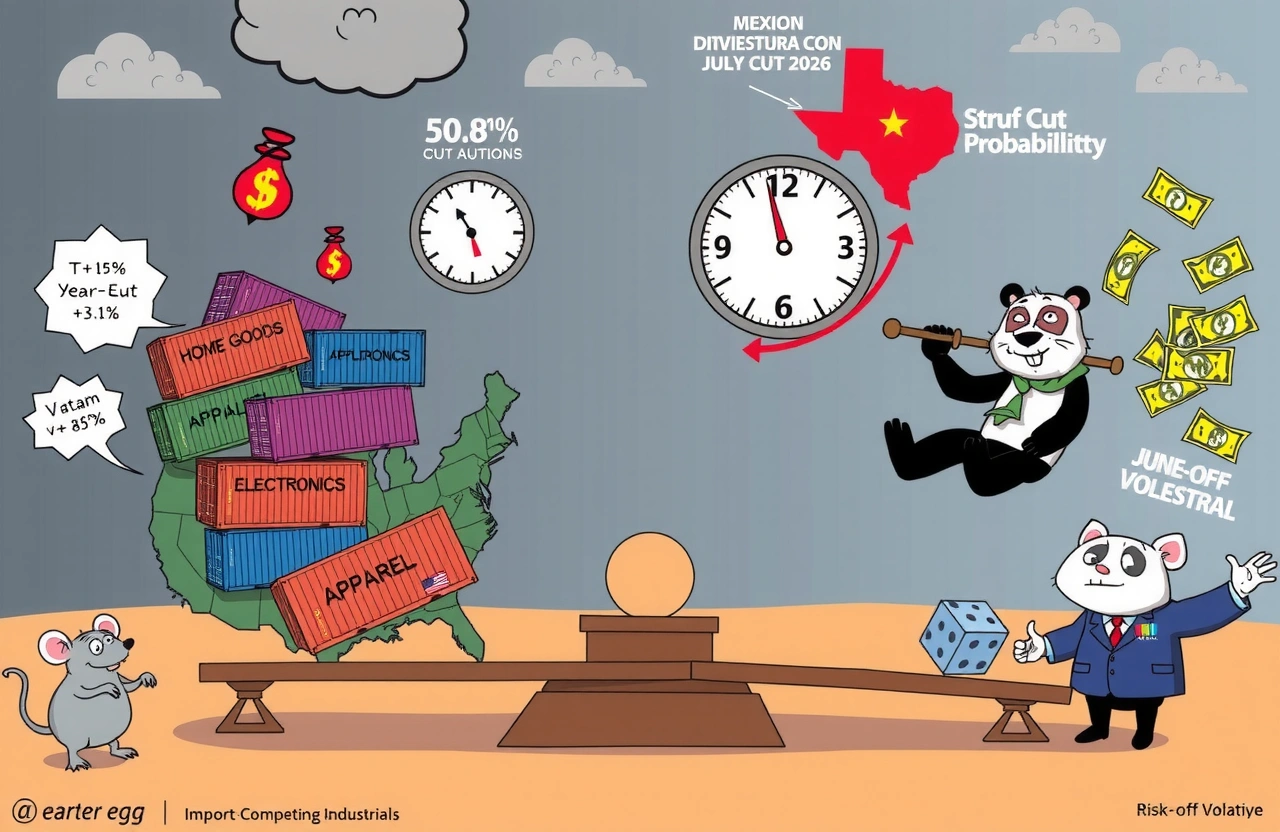
The upcoming US June CPI report carries heightened significance as economists anticipate the first tangible evidence of tariff impacts filtering into consumer prices. With new import duties now active for several months, analysts are scrutinizing whether inflation will accelerate enough to influence the Federal Reserve’s rate-cut trajectory. Market tensions mount as traders balance concerns about persistent inflation against hopes for monetary policy easing.
Key data points to watch:
- Consensus forecasts project 0.3% monthly core inflation acceleration
- Goldman Sachs identifies targeted pressure points: home goods (+0.08%) and electronics
- Fed officials express divergent views on whether tariff effects warrant delayed rate cuts
- Probability models show under 5% chance of July rate reduction
- Market pricing suggests fully anticipated 50bps cuts by year-end
The Tariff-Inflation Nexus
Economists across Wall Street agree that June’s data will likely reveal initial inflationary impacts from the tariff measures. The central debate concerns whether this represents sustained inflation pressure or temporary price turbulence. Core CPI projections cluster around 0.3% monthly growth – triple May’s 0.1% rate – with annualized forecasts ranging from 2.8% to 3.1%. Goldman Sachs emphasises targeted effects in select goods categories:
- Household furnishings: Direct tariff impact on Chinese imports
- Recreation equipment: Higher component costs translating to retail pricing
- Apparel: Gradual pass-through from textile tariffs
The delayed manifestation of tariff effects stems from existing inventory buffers and contracted pricing agreements. Firms typically absorb initial cost increases before passing them to consumers, creating a critical time lag policymakers now monitor.
Cumulative Impact Projections
High-frequency shipping data and customs records indicate logistical bottlenecks emerging at major West Coast ports. Deutsche Bank’s Global Trade Monitor reveals 12% container slowdown since April – often preceding inflationary spikes. The developing trajectory shows powerful interplay between tariffs and inflation fundamentals:
- Transportation costs: +18% YoY for cross-Pacific freight
- Warehousing delays: +8% inventory holding costs
- Supply chain diversification: Preliminary evidence of production shifts to Vietnam and Mexico
Bank Forecasts: Divergent Perspectives
Goldman Sachs: Accelerated Second-Half Impact
Goldman Sachs economists project 0.23% core CPI growth for June, slightly below consensus. Joseph Briggs, the firm’s chief economist, emphasised cyclical dynamics: “We detect tariff effects amplifying substantially post-summer, projecting 0.3-0.4% monthly core inflation through Q3.” Their model incorporates:
- Used vehicle prices: -0.5% (auction data correlation)
- Motor insurance: +0.3% (telematics-adjusted projection)
- Airfare: +1.0% (fuel surcharge transmission)
- Shelter costs: Persistent 0.4% monthly growth
Notably, Goldman sees tariff adjustments adding approximately 0.8ppt to inflation projections by December 2025 – equivalent to 3.1% versus 2.3% baseline.
Wells Fargo: ‘Bump Versus Surge’ Hypothesis
Contrasting Goldman’s stance, Wells Fargo analysts argue tariff impacts resemble price volatility rather than durable inflation pressure. Senior economist Sarah House frames this as “isolated acceleration in select goods baskets amid cooling service inflation.” Their position relies on:
- Stable services inflation: Education/medical costs decelerating
- Manufacturing slack: Industrial capacity utilization below pre-pandemic levels
- Consumer resilience: Absence of wage-price feedback loops
House notes: “While tariffs lift specific components, fundamental disinflationary forces persist – particularly in tech-driven productivity sectors.”
Deutsche Bank: Market-Priced Expectations
Deutsche Bank’s modeling reveals sophisticated adjustment patterns within commodity markets. Their tariff-to-CPI conversion methodology suggests traders have priced approximately 10% tariff rate increases across affected categories. Global economics head David Folkerts-Landau’s team observed:
- Energy sector: Projected 0.55% monthly increase
- Food inflation: Anticipated 0.37% growth
- Container freight derivatives: Implied transportation cost premium
Current inflation swaps indicate heightened concern about second-order tariff impacts – specifically, commodity hoarding behaviors and secondary supplier price cascades.
JPMorgan’s Risk Horizon Framework
JPMorgan’s Market Intel division cautions against premature reaction to June data. Their analysis highlights qualitative difference between initial tariff manifestations versus deeper structural impacts. Economist Stephen Parker explains: “June likely captures inventory depletion phase rather than full restructuring impacts.” Critical markers approaching:
- August 1st: Next tariff policy deadline
- August 12th: Subsequent CPI release
- Q4 supply chain contracts: Key commodity agreements renewal cycle
Probability-based market scenarios suggest asymmetric reactions:
- Core CPI >0.37%: 70% S&P 500 downside volatility
- Core CPI <0.23%: Opportunity for tactical equity positioning
Interest Rate Implications
The Fed navigates complex crosscurrents: moderating growth indicators versus tariff-driven inflation risks. Recent FOMC communications reveal policy committee divisions concerning appropriate responses.
The Case for Delayed Action
Fed Governors Christopher Waller and Michelle Bowman publicly frame tariff consequences as transitory shocks rather than cyclical shifts warranting monetary policy adjustment. Their reasoning leans on:
- Import substitution effects emerging: Early Vietnam/Mexico sourcing shifts
- Core services moderation: Shelter cost growth plateau
- Disinflationary services: Technology-enabled price declines
Cleveland Fed President Loretta Mester explicitly noted during June policy discussions: “Trade policy responses should remain distinct from monetary accommodation decisions when facing exogenous shocks.”
The Accommodation Argument
Chicago Fed President Austan Goolsbee explicitly cited tariff uncertainty in recent remarks warning about premature tightening. His staff analysis connects:
- Retaliatory tariffs: Recent Brazilian/Canadian agricultural duties
- Small business vulnerability: Average 8% margin compression expected
- Consumption sensitivity: Lower-income household disproportionate exposure
Goolsbee’s cautionary stance aligns with Richmond Fed research showing tariff passthrough disproportionately impacts disadvantaged communities through household essentials inflation.
Market Positioning Strategies
Traders confront asymmetric outcomes surrounding CPI release. Fixed-income desks overwhelmingly positioned for:
- Short-term volatility: Yield curve steepeners ahead of announcement
- Intermediate hedging: Treasury options expiry concentration
- Sector differentials: Consumer staples futures underperformance
Equity correlation frameworks show unusual dispersion between tariff-exposed sectors and broader indices. Morgan Stanley quant strategy head Boris Steimetz advises: “Portfolios should overweight domestic-services sectors while underweighting import-competing industrials until passthrough coefficients clarify.”
Strategic Trade Constructs
Sensitivity analysis reveals optimal positions across scenarios:
- Accelerated inflation: Commodity producer equities + Treasury inflation-protected securities
- Moderate readings: Quality compounders with pricing power
- Negative surprise: Rate-sensitive technology with expanding margins
Currency markets exhibit typical flight-to-quality patterns when CPI surprises trigger volatility spikes, with USD futures leverage positions approaching twelve-month highs. Monitoring commercial hedging patterns helps anticipate these USD movements.
The Path Forward
June’s CPI data represents merely the first installment in assessing tariff impacts. Economists unanimously expect progressive cost transmission throughout second-half performance indicators. Three essential signposts warrant attention:
- Container freight rate stabilization: Baltic Dry Index normalization target
- Inventory-to-sales ratios: Retail sector restocking equilibrium
- Producer input costs: Intermediate goods PPI deceleration signal
The Federal Reserve’s August review calendar creates critical policy nexus:
- August 1st non-farm payrolls: Labor market cooldown velocity
- August 13th CPI: Cumulative tariff impact measurement
- September SEP: Dot plot adjustment window
The combined impact from tariffs and inflation pressures poses complex challenges for policymakers navigating economic soft landing ambitions. Market participants should monitor Treasury auction patterns for institutional positioning clues while examining inverted commodity basis curves for inflation expectations. Quality data analysis now proves essential: Request CPI component decomposition reports and tariff-exposure analytics from brokers to identify relative-value opportunities amid impending volatility. The true inflationary test arrives not in June’s initial reaction, but through autumn’s accumulated sectoral impacts.