



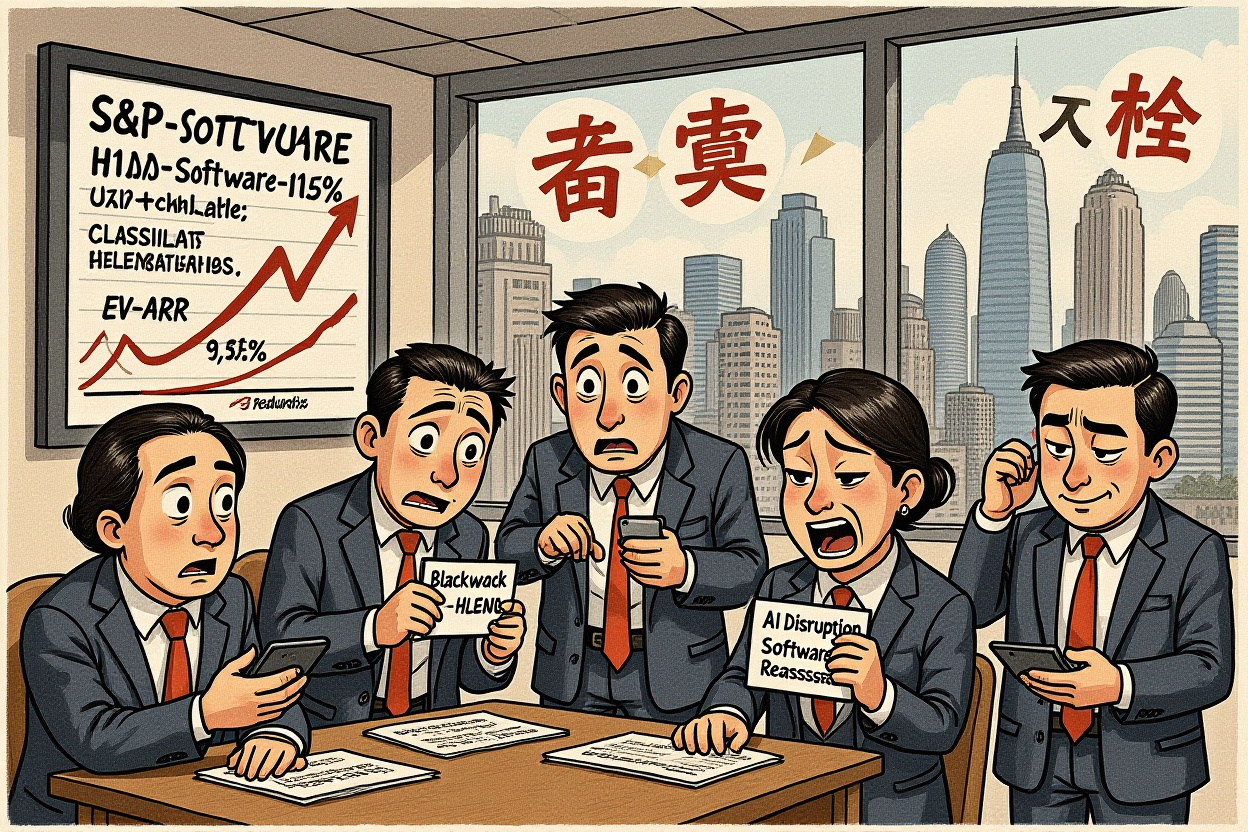
• BlackRock’s $26 billion HPS Corporate Lending Fund (HLEND) faces redemption requests exceeding 9.3%, triggering deferral mechanisms and highlighting acute liquidity stresses in the private credit market.
• The core driver is a fundamental value reassessment of software and SaaS assets—long favored by private equity lenders—due to AI disruption eroding traditional business models and pricing power.
• Other major players like Blue Owl Capital (蓝猫资本), Blackstone (黑石), and Cliffwater have encountered similar redemption pressures, with some implementing permanent withdrawal limits or emergency capital infusions.
• This private credit liquidity crisis has erased over $100 billion in market value from publicly traded PE firms, questioning the sustainability of their lucrative ‘fee-based growth’ narratives and prompting strategic portfolio reassessments.
A mounting private credit liquidity crisis is shaking the foundations of the global private equity industry, with giants like BlackRock (贝莱德) scrambling to manage unprecedented investor redemption demands. This turmoil stems from a rapid reassessment of underlying asset values, particularly in the software sector, where artificial intelligence (AI) is disrupting long-held investment theses. For institutional investors and fund managers worldwide, understanding this private credit liquidity crisis is crucial for navigating market volatility and safeguarding portfolios against similar liquidity shocks.
The Immediate Liquidity Squeeze: Redemption Waves Crash Upon PE Giants
The private credit liquidity crisis has moved from theoretical risk to harsh reality, with several top firms facing redemption requests that threaten their operational stability. This section details the specific incidents triggering market alarms.
BlackRock’s HLEND Fund: Hitting the 5% Redemption Ceiling
BlackRock’s (贝莱德) HPS Corporate Lending Fund (HLEND), a $26 billion vehicle, became a focal point in early 2026 when it received redemption requests totaling approximately $1.2 billion, or 9.3% of its net asset value. This figure drastically exceeded the fund’s contractual quarterly redemption limit of 5%, forcing BlackRock to invoke a deferral mechanism. The firm permitted redemptions for only 5% of the fund’s value (around $620 million), postponing the remaining 4.3% (about $580 million) to the next quarter. The announcement precipitated a sharp sell-off in BlackRock’s stock, which fell over 7% on the day and cumulatively dropped more than 10% within five trading sessions, reflecting investor panic over liquidity management.
Industry-Wide Strain: Blue Owl, Blackstone, and Cliffwater Face Pressure
Root Cause Analysis: AI Disruption Forces Software Asset Value ReassessmentBeneath the surface-level redemption panic lies a more profound shift: the rapid devaluation of software and SaaS companies, which form the core collateral for many private credit funds. The advent of generative AI and other technologies is fundamentally challenging the economics of these businesses.
Case Studies: ServiceNow and Cornerstone OnDemand Signal Eroding Value
Market signals are clear. ServiceNow (NYSE: NOW), a bellwether software company, saw its stock price plummet from $184 in November 2025 to $105 by March 2026—a 43% drop far exceeding broader market declines. Its price-to-earnings (P/E) multiple contracted from 99x to 65x, indicating severe market skepticism about future growth and pricing power in an AI-saturated landscape. Similarly, Cornerstone OnDemand, a company held in the debt portfolios of multiple PE firms, witnessed the trading price of its term loan fall to around 83 cents on the dollar by early 2026, a 10-point drop, while the average carrying value on the books of six Business Development Companies (BDCs) was 97 cents—a clear mark-to-market discount revealing perceived credit risk.
Broad Market Confirmation: Index Plummets and Valuation Multiples Collapse
The negative reassessment is sector-wide. In January 2026, the S&P North America Software Index fell 15%, its worst monthly performance since 2008. Valuation metrics have compressed dramatically: the enterprise value to annual recurring revenue (EV/ARR) multiple for software companies has fallen from a peak of 15-25x in 2021 to a range of 6-10x, with premium leaders at 8-12x. Forward P/E ratios have dropped from around 35x at the end of 2025 to approximately 20x, touching lows not seen since 2014. This repricing reflects a market no longer willing to fund cash-burning growth at any cost, demanding clearer paths to profitability—a shift that directly threatens the value of loans extended to such companies.
The Golden Decade: How Private Credit and Software Became Inextricably Linked
To understand the current private credit liquidity crisis, one must appreciate the symbiotic rise of private credit and the software sector over the past decade, which created both immense profits and concentrated risk.
Explosive AUM Growth and the Fee-Based Profit Engine
In the United States, private credit assets under management (AUM) ballooned from roughly $200 billion in 2015 to over $800 billion by 2021, boasting an 18% compound annual growth rate. Software emerged as the dominant sector for private equity and credit investments. Software companies, often asset-light, found traditional bank lending challenging, creating a perfect niche for private credit providers. This demand, coupled with high valuation expectations and a robust merger-and-acquisition environment, fueled a boom. For PE giants, management fees based on these growing asset bases became a profit cornerstone. For instance, the fee income from Blackstone’s (黑石) $82 billion BCRED fund alone contributed about 13% of the firm’s total fee revenue, generating $1.2 billion in 2025.
Vista Equity Partners and Thoma Bravo: Beneficiaries of the Software Era
Cracks in the Foundation: The Fee-Based Growth Model Under ThreatThe ongoing private credit liquidity crisis has exposed the fragility of the ‘fee-based growth’ narrative that propelled PE stock valuations. As underlying software assets are marked down, the very engine of profit growth is sputtering.
Strategic Retreats: Apollo and JPMorgan Sound the Alarm
Market Punishment: PE Stocks Tumble as the Narrative UnravelsNavigating the Future: Implications and Strategic ImperativesThe path forward requires careful navigation by both private equity firms and their investors. The resolution of this private credit liquidity crisis will shape the industry for years to come.