



Executive Summary
China’s food inflation narrative has taken a sharp turn, with staple proteins experiencing significant deflation. However, for the country’s vast catering sector, lower input costs are not translating to easier profits. This article delves into the complex dynamics at play.
- Pork prices have plunged to levels just 0.3 RMB per kilogram above the 2018 historic low, driven by severe oversupply and accelerated herd liquidation post-Lunar New Year.
- While pork, eggs, and some vegetables see price relief, catering operators remain trapped by a trifecta of rising fixed costs: skyrocketing commercial rents, escalating labor expenses for enhanced customer experience, and intensely price-sensitive consumers.
- The industry is undergoing a fundamental shift from a high-growth, high-margin era to a micro-profit age, where survival hinges on fine-grained operational efficiency and supply chain mastery.
- Case studies from turnaround story Nancheng Xiang and global value leader Saizeriya reveal that success now depends on ruthless cost accounting, menu engineering, and technological investment in kitchen automation.
- The overarching theme is clear: the catering industry cost crisis is structural, not cyclical. Navigating it requires moving beyond commodity price watchlists to a holistic, data-driven management approach.
From Feast to Famine: The Stark Deflation in China’s Pork Market
In an era where global food prices often seem relentlessly upward, China is witnessing a dramatic correction in one of its most politically and economically significant commodities: pork. The nation’s favorite meat is now cheaper than it has been in years, presenting a curious paradox for businesses downstream. The focus phrase for our analysis—the catering industry cost crisis—remains acutely relevant, as lower pork prices alone are insufficient to alleviate broader financial pressures.
Data Pointing to a Historic Low
The numbers are striking. According to weekly data from the 农业农村部 (Ministry of Agriculture and Rural Affairs), national pork prices have declined for four consecutive weeks as of early March. The average price fell to 23.04 RMB per kilogram, a drop of 2.1% from the previous week. More critically, the live hog price, a leading indicator for future pork supply, fell for five straight weeks to 11.89 RMB per kilogram, a 4.5% weekly decline. Independent monitoring from 中国养猪网 (China Pig Network) shows an even starker picture: by March 20, the national average price for foreign三元 pigs had collapsed to 10.24 RMB per kilogram. This price is a mere 0.3 RMB per kilogram away from the historic bottom reached in 2018, a period remembered for its devastating impact on pig farmers.
Understanding the Supply Glut
Industry participants uniformly point to产能过剩 (overcapacity) as the root cause. Two key factors are at play. First, the post-Spring Festival period typically sees ample market supply as herds held back for the holiday rush are released. Second, and more significantly, farmers have rapidly reduced their压栏 (holding back of animals for better prices) due to pessimistic price expectations and high feed costs, accelerating the pace of slaughter. This has led to a simultaneous year-on-year and month-on-month increase in hog slaughter volumes for March. Analysts predict that the industry will remain in a rapid destocking phase through March and April, with pork prices potentially probing further lows. While short-term demand bumps from the Qingming and May Day holidays may spur minor price rebounds, the fundamental oversupply is expected to persist for two to three quarters, keeping a lid on any sustained recovery.
Beyond Pork: A Mixed Bag for Ingredient Costs
The deflationary trend extends beyond the pigpen. National egg prices have also followed a downward trajectory, with the Ministry of Agriculture and Rural Affairs reporting a 2% week-on-week drop to 8.81 RMB per kilogram in early March. Vegetable prices, while more stable, have also shown modest declines. From February 20 to March 15, the average wholesale price for 28 key monitored vegetables was 5.20 RMB per公斤, which was 1.9% lower than the average for the same period over the previous three years (2023-2025). By mid-March, prices had edged down further to around 4.86 RMB per kilogram.
The Persistent “Vegetables More Expensive Than Meat” Phenomenon
Despite recent dips, a crucial caveat remains: the structural shift where vegetables often command higher per-kilogram prices than pork—a situation colloquially termed “菜比肉贵”—persists. This trend, ongoing since October of last year, has fundamentally altered kitchen economics. A classic example is the humble 大白菜 (napa cabbage). Once purchasable for four or five RMB for an entire head, it now often costs over ten RMB. In restaurant kitchens, this translates to visible menu adjustments: a plate of番茄炒蛋 (stir-fried tomato and egg) may now feature more egg and less tomato, while a simple vegetable dish can approach the cost of a meat-based offering. Therefore, while some cost pressures have eased, the overall ingredient cost basket for caterers remains elevated and volatile.
The Core Dilemma: Why the Catering Industry Cost Crisis Endures
This is the central paradox. Logic would suggest that falling prices for major proteins like pork and eggs should provide welcome relief to the catering sector’s battered profit margins. Yet, operators across China report that making money is harder than ever. This deepening catering industry cost crisis is fueled by a perfect storm of stagnant or falling revenue and rigidly high operational expenses.
The Squeeze from Above and Below: Rent and Labor
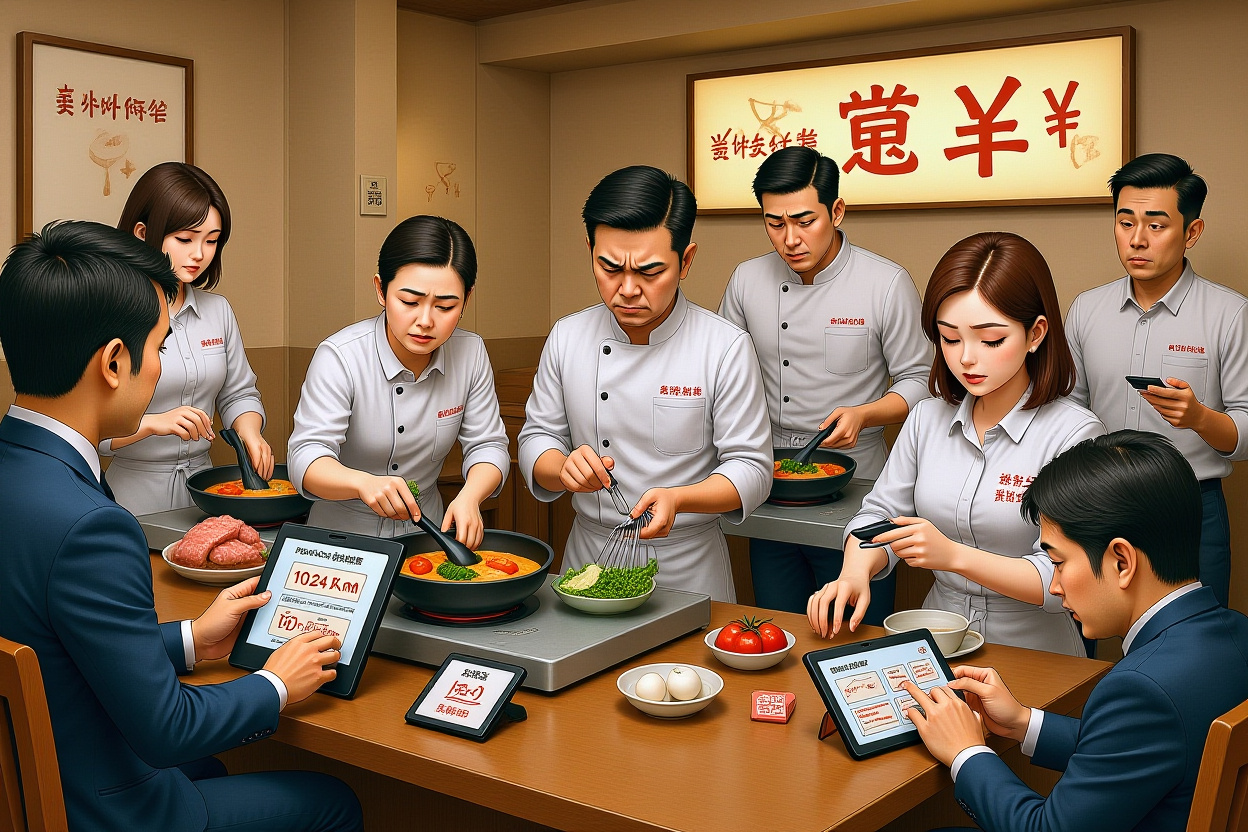
First, consider the fixed costs that are immune to pork price fluctuations. Commercial rent, especially in prime urban locations, continues its upward climb. A report cited by 联商网 (Linkshop) highlighted a restaurant in a Shanghai shopping mall facing an annual rent of 2.2 million RMB—over 6,100 RMB per day. With average industry gross margins around 50%, such a store must generate daily revenue of at least 12,200 RMB just to break even on rent alone. Second, labor costs are rising not just nominally but qualitatively. Today’s consumers demand more than low prices; they expect enhanced service and experience. The流行 (popularity) of板前 (counter-style) dining, where customers watch chefs prepare meals, exemplifies this trend, now seen not only in Japanese cuisine but even in casual formats like claypot rice. Delivering this experience requires more staff, better training, and higher wage bills, further compressing margins.
The Consumer Conundrum: Falling Ticket Sizes and Rising Sensitivity
Simultaneously, average customer spending, or客单价 (average ticket size), is declining across the board—not just in low-cost segments like bubble tea and fast food, but also in mid-to-high-end full-service restaurants. This creates a vicious cycle: costs remain high, but selling prices cannot be increased without risking customer alienation. Consumers have become hyper-price-sensitive; any attempt to raise menu prices often leads to immediate and significant客流 (customer flow) loss. Some brands, trapped in this bind, resort to stealth cost-cutting, such as downgrading ingredient quality without changing menu prices—a strategy that erodes brand equity and customer trust over time. This multifaceted pressure confirms that the catering industry cost crisis is systemic.
Blueprint for Survival: Lessons from the “Accountants” of Dining
Amidst this challenging landscape, certain brands not only survive but thrive. Their success underscores a repeated mantra from industry leaders: the future of餐饮 (catering) belongs to those who know how to算账 (keep detailed accounts). This heralds the end of China’s餐饮暴利时代 (era of catering super-profits) and the dawn of a微利时代 (micro-profit era), where victory goes to the most operationally精细 (fine-grained).
Case Study: Nancheng Xiang’s Data-Driven Turnaround
A prime example is南城香 (Nancheng Xiang), a Beijing-based fast-food chain. At its annual meeting, founder Wang Guoyu (汪国玉) revealed that in 2025, the company achieved a 101% year-on-year increase in net profit despite a 0.95% drop in actual sales—a stark reversal from 2024’s declines. Nancheng Xiang executed a three-pronged reform focused squarely on efficiency and profitability. First, it overhauled personnel, with a 30% turnover rate at headquarters, 80% in operations, and 20% among store managers, redirecting talent back to frontline stores. Second, it rigorously optimized its menu, eliminating low-margin items like dinner hotpot and introducing higher-value现炒 (freshly stir-fried) dishes like三杯鸡 (three-cup chicken) and辣椒炒肉 (stir-fried pork with peppers), while unbundling套餐 (set meals) to promote high-quality single items. Third, it doubled down on供应链 (supply chain) advancements, deploying智能炒菜机 (intelligent cooking machines), new electric kebab grills, and upgrading its中央厨房 (central kitchen) to boost standardization. Every change was evaluated through the lens of profit contribution.
Case Study: Saizeriya’s Gospel of Standardization
The philosophy behind Nancheng Xiang’s turnaround echoes the global playbook of萨利亚 (Saizeriya), the famed Japanese Italian restaurant chain renowned for极致性价比 (extreme cost-performance). Saizeriya’s model demonstrates that low prices do not preclude profitability. Its core logic rests on a ruthlessly efficient system: a高度标准化 (highly standardized) supply chain from central kitchens, a精简 (streamlined) menu that maximizes ingredient crossover and reduces waste, and an极致人效管理 (extreme labor efficiency management) system where staff are trained as多能工 (multi-skilled workers). This integrated approach allows Saizeriya to carve out a stable profit margin from seemingly razor-thin price points, proving that meticulous operational control can defeat commodity cost volatility.
Navigating the New Reality: Strategic Imperatives for Operators
The message from the market is unambiguous. Relying on external factors like falling pork prices to solve profitability issues is a dangerous gamble. The true path forward requires an internal transformation. Beating the catering industry cost crisis demands a relentless focus on every link of the value chain.
Embracing Fine-Grained Management
Operators must transition from粗放 (extensive) management to a culture of precision. This involves detailed tracking and optimization of采购 (procurement),库存 (inventory),加工 (processing),出品 (plating),服务 (service), and能耗 (energy consumption). Technology plays a pivotal role here, from inventory management software that minimizes waste to energy-efficient equipment that cuts utility bills. The goal is to identify and eliminate inefficiencies in every process, turning saved cents into accumulated profits.
Building a Resilient and Agile Supply Chain
Investing in supply chain resilience is no longer optional. This can mean diversifying suppliers to mitigate price spikes, forming purchasing cooperatives with other restaurants to gain bulk-buying power, or even investing in proprietary production or processing capabilities for key ingredients. The升级 (upgrading) of kitchen technology, as seen with Nancheng Xiang’s智能炒菜机, is also a form of supply chain investment, reducing reliance on skilled, high-cost labor and ensuring consistent quality.
The Bottom Line: Control What You Can Control
The dramatic plunge in pork prices is a significant market event, but for China’s catering industry, it is merely one variable in a far more complex equation. The enduring catering industry cost crisis, driven by structural shifts in rent, labor, and consumer behavior, demands a fundamental rethink of business models. Success in the coming years will not be defined by who benefits most from a temporary dip in ingredient costs, but by who best masters the art of operational excellence. The examples of Nancheng Xiang and Saizeriya provide a clear roadmap: prioritize profitability over pure top-line growth, empower data in decision-making, and obsess over every operational detail. For restaurant owners and investors, the call to action is immediate. Conduct a thorough audit of your cost structure beyond food costs. Explore partnerships for cost-sharing in areas like logistics or procurement. Invest in technology that enhances efficiency. In a micro-profit era, the margin for error is vanishingly small, but the rewards for those who can expertly navigate the numbers are substantial and sustainable.