



Executive Summary
This analysis delves into the complex dynamics shaping China’s food service industry amidst volatile input costs. Key takeaways include:
– National pork and live hog prices have plunged to levels within cents of the 2018 historic low, driven by a severe supply glut and accelerated destocking by producers.
– While pork, egg, and some vegetable prices have softened, the overall cost structure for restaurants remains crippling due to skyrocketing commercial rents and labor expenses required for enhanced customer experiences.
– The industry-wide decline in average customer spend, or客单价 (average ticket size), is compressing margins, forcing brands into a perilous balance between maintaining quality and covertly cutting costs.
– Successful case studies like Nanchengxiang (南城香) and the global model of Saizeriya demonstrate that survival hinges on radical operational efficiency,供应链 (supply chain) mastery, and granular cost control.
– The core challenge is that making money is increasingly difficult, transforming Chinese餐饮 (food service) from a high-margin business into a arena of micro-profits where only the most financially astute operators will thrive.
A Market in Freefall: Pork Prices Approach Decade Lows
The narrative of relentless inflation across consumer goods has found a stark exception in China’s pork market. Since March, prices for both pork and live hogs have entered a steep and sustained decline, bringing them alarmingly close to the bottom seen during the previous cycle. For international investors monitoring Chinese consumer price indices and agricultural commodity flows, this trend signals both opportunity and underlying economic stress.
Data Points Paint a Clear Picture of Decline
According to weekly data from the Ministry of Agriculture and Rural Affairs (农业农村部), the national average pork price fell for four consecutive weeks, reaching 23.04 yuan per kilogram in the first week of March, a drop of 2.1% from the prior week. More significantly, the live hog price fell for five straight weeks, declining 4.5% to 11.89 yuan per kilogram. Independent monitoring from China Pig Web (中国养猪网) shows an even starker reality: by March 20, the national average price for外三元生猪 (ternary hybrid pigs) had crashed to 10.24 yuan per kilogram. This price is a mere 0.30 yuan away from the historic low recorded in 2018, indicating that the market is testing a critical support level.
The Primary Driver: A Structural Supply Glut
Industry participants uniformly point to产能过剩 (overcapacity) as the root cause. The post-Lunar New Year period typically sees ample supply, but this year, the situation is exacerbated by reduced压栏 (holding back hogs for higher prices) at farms. Producers are accelerating出栏 (slaughtering and sales) to manage costs, leading to a simultaneous increase in supply both year-on-year and month-on-month. The consensus among analysts is that the sector will remain in a rapid destocking phase through March and April, with prices potentially probing further lows. While seasonal demand from the Qingming and May Day holidays may spur a minor rebound, the fundamental oversupply is expected to persist for two to three quarters, keeping pork prices depressed. This prolonged downturn underscores that making money is increasingly difficult for pig farmers, who are now operating on razor-thin margins or at a loss.
Beyond Pork: Mixed Signals in the Broader Food Basket
The deflationary trend is not confined to pork. Prices for other key食材 (ingredients) are also showing weakness, but the picture is nuanced and fails to provide comprehensive relief for food costs.
Eggs and Vegetables Follow a Downward, Yet Uneven, Path
Ministry of Agriculture and Rural Affairs data indicates the national egg price fell 2% in early March to 8.81 yuan per kilogram. For vegetables, the 28 key varieties monitored showed an average wholesale price of 5.20 yuan per公斤 (kilogram) from February 20 to March 15. While this was 6.9% higher than the same period last year, it was 1.9% below the average for the past three years (2023-2025). The trend continued, with the average price dipping to 4.88 yuan/kg by March 17. However, the long-observed phenomenon of“菜比肉贵” (vegetables being more expensive than meat) has not disappeared. Since October 2025, vegetable prices have remained stubbornly elevated during a period when they traditionally fall due to seasonal abundance. A classic example is the humble大白菜 (napa cabbage), once purchasable for four to five yuan per head, now often costing over ten yuan. In restaurants, the cost of a plate of素菜 (vegetable dish) now rivals that of荤菜 (meat dishes), forcing chefs to adjust portions—a visible sign that making money is increasingly difficult when core ingredient costs defy seasonal norms.
The Restaurant Cost Crisis: Why Lower Input Prices Aren’t Enough
Superficially, falling pork and egg prices should be a boon for China’s vast餐饮 industry (restaurant and food service sector). In reality, they offer only marginal respite against a tidal wave of other rising expenses. The central paradox is that making money is increasingly difficult despite some cost relief, due to powerful countervailing forces.
The Squeeze from Falling Average Customer Spend
One of the most alarming trends is the sustained decline in客单价 (average customer spend). This降价 (price reduction) is occurring not just in low-ticket segments like tea drinks and fast food but has also infiltrated higher-end正餐 (full-service dining). As brands engage in fierce price competition to attract cost-conscious consumers, profit margins are being eviscerated. This environment has led some operators to resort to隐蔽的方式 (hidden methods) like ingredient substitution to maintain price points—for instance, a popular fast-food chain downgrading the chicken quality in its signature three-cup chicken dish without changing the menu price. Such tactics risk brand integrity but highlight the desperate measures taken when making money is increasingly difficult.
The Shift in Consumer Demand Amplifies Cost Pressure
Today’s diners are not仅仅 seeking低价 (low prices); they demand enhanced service and experience. This has fueled the popularity of板前模式 (counter-style dining), where customers watch chefs prepare meals, now extending from traditional Japanese cuisine to even煲仔饭 (clay pot rice). Delivering this upgraded experience requires significant investment in frontline staff, training, and ambiance, directly increasing人力成本 (labor costs). Furthermore, while食材成本 (ingredient costs) may fluctuate, they are often dwarfed by the relentless pressure from房租 (rent). A report from联商网 (Linkshop) highlighted a restaurant in a Shanghai mall facing an annual rent of 2.2 million yuan, equating to 6,100 yuan per day. With an industry-average gross margin of 50%, the store needs a daily turnover of at least 12,200 yuan just to break even. Such figures illustrate why, for many, making money is increasingly difficult when fixed costs consume such a large portion of revenue.
The Triple Burden: Rent, Labor, and the Illusion of Cost Relief
To understand why the餐饮 sector remains under duress, one must examine the three major cost components simultaneously. Even a decline in one area is insufficient to offset rises in the others, creating a persistent squeeze on profitability.
Commercial Rent: The Immovable Object
Rental contracts, especially in prime shopping malls and commercial districts, often feature annual escalator clauses. As mall footfall declines in some areas, landlords have been slow to adjust rates, leaving tenants to bear the burden. The high cost of prime real estate acts as a fixed “高压线” (high-voltage line) that limits operational flexibility. For a restaurant, saving a few yuan per kilogram on pork is negligible when daily rent obligations run into thousands of yuan.
Labor: The Price of Premium Service
The competition for skilled front-of-house and kitchen staff is intensifying. As consumers value experience more, restaurants must invest in better-trained employees who can provide personalized service, manage complex板前 interactions, and maintain higher standards. This translates to higher wages, benefits, and continuous training costs. The人力 (human resources) cost center is becoming a larger and more critical part of the P&L statement, further proving that making money is increasingly difficult in a service-oriented market.
Blueprint for Survival: Lessons from Brands Navigating the Micro-Profit Era
Amidst this challenging landscape, certain brands are not only surviving but thriving. Their strategies provide a roadmap for how to operate when making money is increasingly difficult, emphasizing that the future belongs to “会算账的餐饮人” (restaurateurs who know how to account for every penny).
Case Study: Nanchengxiang’s Radical Operational Overhaul
At its annual meeting, Nanchengxiang founder Wang Guoyu (汪国玉) revealed that in 2025, the chain achieved a 101% year-on-year increase in net profit despite a 0.95% decline in actual sales. This followed a difficult 2024 where per-store revenue and profit fell by 14% and 35%, respectively. Nanchengxiang executed a three-pronged turnaround:
1. Boosting Efficiency: The company underwent significant personnel changes, with 30% of headquarters staff, 80% of the operations team, and 20% of store managers being replaced, with many reassigned to frontline stores to reduce overhead and improve ground-level decision-making.
2. Menu and门店 (store) Optimization for Profit: It eliminated low-margin items like dinner hotpot and introduced higher-margin现炒 (freshly wok-fried) “hard dishes” like three-cup chicken and辣椒炒肉 (stir-fried pork with peppers). It also moved away from bundled套餐 (set meals) to focus on high-quality single items.
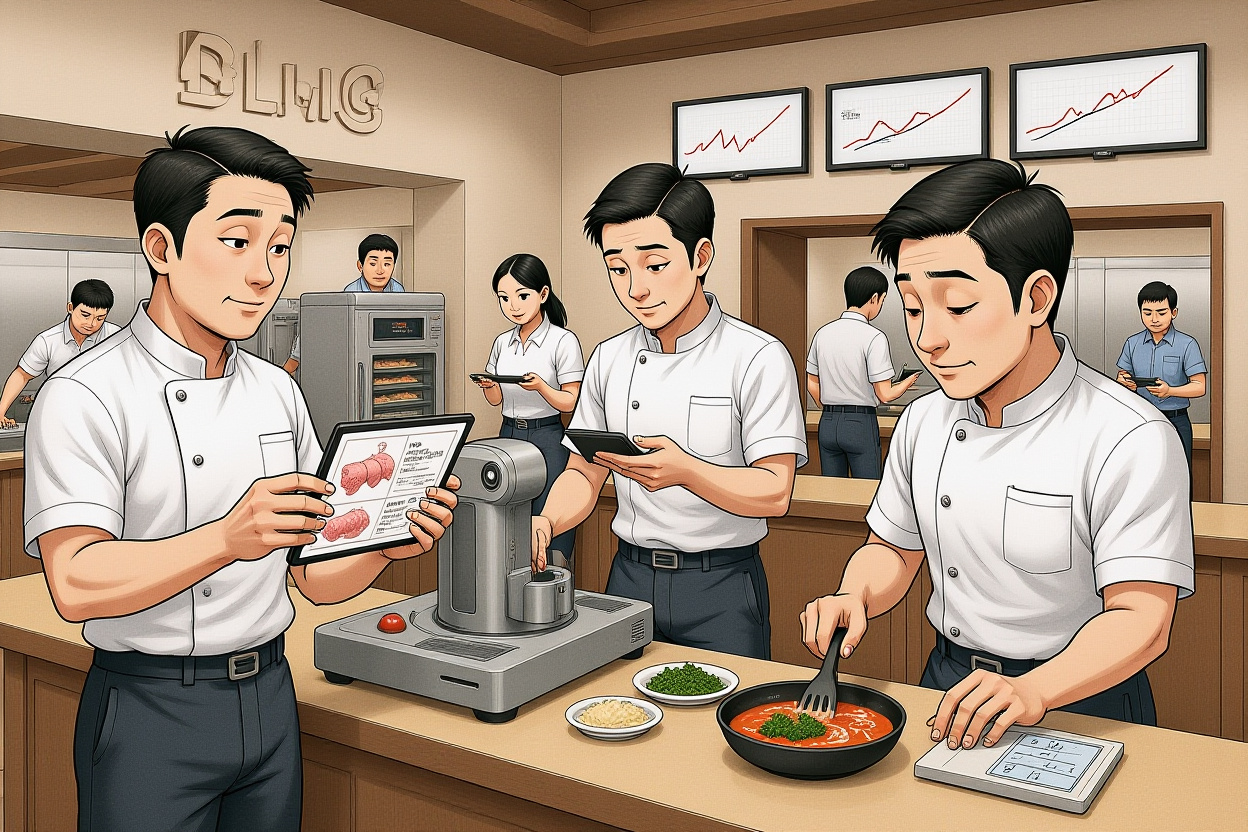
3.供应链 (Supply Chain) Deepening: Investments were made in automation, including升级智能炒菜机 (upgrading intelligent cooking robots), rolling out new electric kebab grills, and planning further upgrades to steaming equipment and the中央厨房 (central kitchen) to enhance standardization and reduce labor dependency.
The Global Benchmark: Saizeriya’s Model of Extreme Efficiency
The success of Saizeriya, famed for its极致性价比 (ultimate cost-performance ratio), mirrors Nanchengxiang’s approach. Its core logic is squeezing profit from low price points through a高度标准化的供应链 (highly standardized supply chain), a精简高效的菜单结构 (streamlined and efficient menu structure), and极致的人效管理 (extreme labor efficiency management). Its central kitchen system, optimized store workflows, and cross-trained multi-skilled staff are foundational to achieving “低价不低利” (low prices without low profits). For observers of Chinese equities, these operational models highlight investable traits: brands that master cost control and scalability are better positioned for sustainable growth.
Mastering the Art of Accounting in a New Era
The fluctuation in pork prices is merely a single variable in a complex equation. The fundamental shift is that Chinese餐饮 is transitioning from a暴利时代 (era of high profits) to a微利时代 (era of micro-profits). Survival now depends on精细化的比拼 (competition through精细化, or fine-grained management).
Every link in the value chain—from采购 (procurement) and库存 (inventory) to加工 (processing),出品 (plating),服务 (service), and能耗管理 (energy management)—holds potential for cost savings and efficiency gains. The brands that will endure are those that embed financial discipline into their daily operations, constantly analyzing data to optimize portion sizes, reduce waste, negotiate better supply contracts, and manage staffing levels with precision. Making money is increasingly difficult, but not impossible, for those who treat their restaurant as a complex financial instrument to be tuned daily.
For international investors, this environment creates a clear divide. Companies with robust operational frameworks, strong supply chain integration, and a proven ability to adapt to cost pressures represent lower-risk opportunities in the consumer discretionary space. The call to action is clear: look beyond top-line revenue growth and scrutinize gross margins, operating costs, and management’s capability in精细化管理 (fine-grained management). The future of Chinese consumer markets will be won not by who sells the most, but by who manages their costs the best. In this new reality, making money is increasingly difficult, but the rewards will flow to the most disciplined and agile players.