



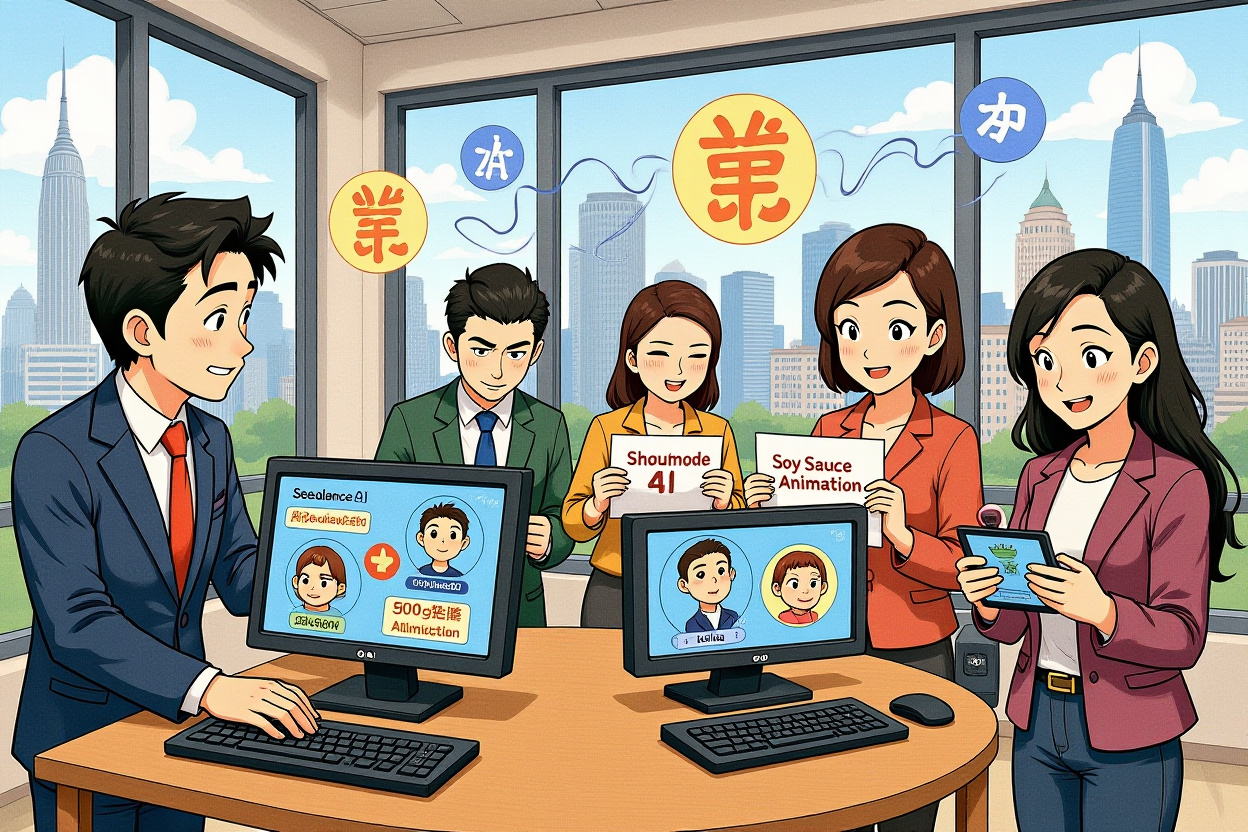
– The AI-generated comic dramas market has exploded, with monthly revenues exceeding 500 million yuan for top players like Soy Sauce Animation, driven by low-cost production and high demand.
– Technological advances in multimodal AI models, such as Seedance2.0, have slashed production costs from thousands to hundreds of yuan per minute, enabling rapid scaling and disrupting traditional media roles.
– Vocational school graduates, earning around 3,000 yuan monthly, are now leading production teams, replacing Beijing Film Academy-trained directors in a shift toward labor-intensive yet tech-driven content creation.
– Major platforms like ByteDance’s Hongguo Comic Drama are aggressively acquiring content, with DAU surpassing 10 million, fueling competition among tech giants and reshaping investment flows in Chinese media equities.
– The industry faces rapid evolution, with AI-generated comic dramas moving from low-quality sand animation to premium AI仿真人剧 (AI simulation human dramas), highlighting both opportunities and risks for investors in China’s fast-changing tech sector.
The Disruption of Traditional Media by AI-Generated Content
The clock is ticking for traditional film directors as a new wave of creators emerges from vocational schools, harnessing AI to produce viral comic dramas. This shift isn’t just a cultural phenomenon; it’s a financial revolution reshaping China’s media investment landscape. With AI-generated comic dramas generating billions in revenue, platforms and investors are racing to capitalize on this低成本 (low-cost), high-yield model. The story begins with entrepreneurs like Huang Haonan (黄浩南), founder of 酱油动漫 (Soy Sauce Animation), who leveraged AI to transform from obscurity to industry leadership, demonstrating how technology can democratize content creation and drive market growth.
In less than a year, AI-generated comic dramas have evolved from niche experiments to a mainstream force, challenging established players in short-form video and animation. For international investors monitoring Chinese equity markets, this trend offers insights into tech-driven disruptions that could influence sectors from entertainment to artificial intelligence. As AI tools like Seedance2.0 reduce barriers to entry, vocational graduates are not just participating—they’re leading, forcing a reevaluation of talent pipelines and business models. This article delves into the economic implications, technological foundations, and investment opportunities spawned by the rise of AI-generated comic dramas, providing actionable insights for professionals navigating China’s dynamic media ecosystem.
The Meteoric Rise of AI-Generated Comic Dramas
The explosion of AI-generated comic dramas mirrors earlier booms in web literature and short videos, but with a technological twist that accelerates growth and profitability. Initially, these dramas filled a gap in the market for泛二次元 (pan-secondary element) content on platforms like Douyin, where demand outstripped supply for traditional dynamic comics. By late 2025, companies like 酱油动漫 (Soy Sauce Animation) were reporting monthly revenues over 50 million yuan, signaling a成熟 (mature) yet rapidly expanding sector.
From Short-Video Roots to AI Dominance
AI-generated comic dramas owe their origins to the short-video industry, where真人短剧 (real-person short dramas) faced saturation and declining profits. As Liu Wei (刘伟), founder of Minglu Animation, notes, many short-video companies pivoted to AI to survive, leveraging existing投流 (traffic acquisition) expertise. This transition was swift: by 2025, AI漫剧 (AI comic dramas) accounted for over 10,000 monthly releases, rivaling真人短剧 (real-person short dramas) in volume. The商业模式 (business model) remains similar, with 80% of revenue dedicated to advertising, but production costs plummeted from 8,000-10,000 yuan per minute to mere hundreds, enabling暴富 (sudden wealth) stories like that of Baize, who earned hundreds of thousands with minimal investment.
Key Players and Market Expansion
The landscape is dominated by转型 (transformed) short-video firms and new entrants like 鹤芽漫剧 (Heya Comic Drama), which capitalized on local talent pools in长沙 (Changsha). Platforms such as ByteDance’s红果漫剧 (Hongguo Comic Drama) have been instrumental, with DAU突破 (breaking through) 10 million in months, driving acquisition sprees. According to industry data, the AI-generated comic dramas market规模 (scale) exceeded 20 billion yuan by 2025, attracting giants like Tencent and百度 (Baidu), which engaged in挖人 (poaching) wars to secure talent. This frenzied growth underscores the sector’s potential for scalable returns, but also highlights volatility as技术迭代 (technological iterations) rapidly obsolete existing practices.
Technological Foundations Driving the Revolution
At the heart of the AI-generated comic dramas boom are advancements in multimodal AI models, which have transformed content production from an artisanal craft to a streamlined, automated process. Models like Seedance2.0, launched in early 2026, enable users to generate coherent video clips with simple prompts, reducing reliance on skilled directors and后期 (post-production) teams. This technological leap has not only cut costs but also accelerated production cycles, allowing companies to scale output from dozens to hundreds of dramas monthly.
Advances in AI Video Generation
Multimodal models have evolved rapidly, with 2025 seeing the rollout of tools like Google DeepMind’s Veo3 and国内 (domestic) versions such as可灵 (Keling). Jiang Yigi (姜奕祺), former AI expert at Alibaba Damo Academy and CEO of Sansheng Qingying, explains that these models now support音画同步 (audio-visual synchronization) and longer video durations, addressing早期 (early-stage) consistency issues. The cost of算力 (computing power) has also dropped, from 1 yuan per second to 0.5 yuan, making AI-generated comic dramas more accessible. For instance, Seedance2.0 charges around 10 yuan for a 10-second video, a fraction of traditional costs, which has spurred adoption among both startups and established media houses.
Efficiency Gains and Production Workflows
The production pipeline for AI-generated comic dramas is straightforward:剧本 (scriptwriting),文生图 (text-to-image) for storyboarding,图生视频 (image-to-video) for animation, and剪辑 (editing) with配音 (dubbing). AI tools automate each step, allowing vocational graduates with minimal training to produce content that garners millions of views. As Yang Hao (杨浩) of Heya Comic Drama notes, teams can now operate with just three members instead of ten, thanks to models like Seedance2.0 that eliminate the need for分镜导演 (storyboard directors). This efficiency has turned AI-generated comic dramas into a labor-intensive yet high-tech industry, where human input focuses on quality control and创意 (creativity) rather than technical execution.
The Human Element: Vocational Graduates vs. Traditional Directors
The rise of AI-generated comic dramas has flipped talent hierarchies, placing vocational school graduates at the forefront while marginalizing traditionally trained directors from institutions like the Beijing Film Academy. These graduates, often earning monthly salaries of 3,000-4,000 yuan, are now responsible for generating content that competes with high-budget productions, highlighting a shift toward技能 (skills) over credentials in China’s media sector.
Labor-Intensive Production with Low Barriers to Entry
Companies like 酱油动漫 (Soy Sauce Animation) have adopted aggressive hiring strategies, recruiting hundreds with minimal qualifications and training them in days. Huang Haonan (黄浩南) boasts that his highest-educated employee holds only a本科 (bachelor’s degree), yet他们 (they) produce over 100 dramas monthly. This approach contrasts sharply with traditional media, where directors undergo years of training. The result is a魔幻 (surreal) scenario: former factory workers and vocational students operate AI models in办公楼 (office buildings), creating viral content that challenges elitist norms. However, this model also raises questions about sustainability, as platforms increasingly demand精品化 (premium quality), pushing companies to balance cost-cutting with innovation.
Job Market Shifts and the Decline of Traditional Roles
The advent of Seedance2.0 has led to layoffs among分镜导演 (storyboard directors), including those from prestigious backgrounds. Yang Hao (杨浩) recounts裁掉 (dismissing) Beijing Film Academy graduates who disparaged AI-generated comic dramas, as technology rendered their expertise redundant. Similarly,抽卡师 (card drawers)—specialists in generating AI video—face obsolescence as models improve. This displacement reflects broader trends in China’s labor market, where AI is reshaping demand for creative professionals. For investors, this signals potential in edtech and reskilling sectors, as well as risks for traditional media stocks reliant on outdated talent models.
Market Dynamics and Platform Strategies
The AI-generated comic dramas sector is characterized by fierce competition among tech platforms, which are driving consolidation and setting industry standards. ByteDance, through its番茄系 (Tomato ecosystem) including Hongguo Comic Drama, has been particularly proactive, using data and流量扶持 (traffic support) to catalyze growth. This has created a fast-paced environment where speed is critical to capturing红利 (dividends), influencing investment decisions in Chinese tech equities.
ByteDance’s Aggressive Moves and Platform Influence
ByteDance quickly integrated AI-generated comic dramas into its短剧版权中心 (Short Drama Copyright Center), overseen by Zhang Chao (张超), who leveraged experience from红果短剧 (Hongguo Short Drama) to scale the new format. The platform’s efficient合同 (contract) processes, often finalized in days compared to weeks for competitors, have accelerated market maturity. According to industry insiders, ByteDance’s收购 (acquisition) strategies have turned niche opportunities into mainstream trends, forcing其他平台 (other platforms) like Tencent and快手 (Kuaishou) to follow suit. This consolidation benefits top producers but squeezes smaller players, mirroring patterns in China’s broader internet economy where scale dictates survival.
Competition Among Tech Giants and Investment Flows
Major players are investing heavily in AI-generated comic dramas, with字节 (ByteDance),腾讯 (Tencent), and百度 (Baidu) all securing content through年框协议 (annual framework agreements). For example, Heya Comic Drama recently signed a 10-million-yuan deal with火山引擎 (Volcano Engine), ByteDance’s cloud arm, to access premium API interfaces. This influx of capital has预订 (booked) production capacity for months ahead, stabilizing revenue streams for companies but also increasing dependency on平台政策 (platform policies). Investors should monitor regulatory shifts, such as potential内容审核 (content moderation) tightenings, which could impact growth. The sector’s reliance on投流 (traffic acquisition) also ties profitability to advertising markets, linking AI-generated comic dramas to broader economic indicators in China.
Financial Implications and Investment Trends
The rise of AI-generated comic dramas presents both lucrative opportunities and significant risks for investors focused on Chinese equity markets. With market size projected to reach千亿 (hundreds of billions) of yuan as it encroaches on traditional film and TV, this sector offers exposure to high-growth tech and media subsegments. However, the rapid pace of change requires careful analysis of business models and technological moats.
Revenue Models and Profitability Metrics
AI-generated comic dramas primarily monetize through平台分成 (platform revenue sharing) and广告投放 (advertising), with top companies achieving ROIs over 300% on successful titles. For instance, Heya Comic Drama’s《盘丝洞素锦传》 (Pansi Cave Sujin Biography) yielded high returns without initial marketing spend. Yet, as Huang Haonan (黄浩南) notes,自然流 (organic traffic) has dried up, increasing reliance on paid promotion and squeezing margins. Investors should evaluate companies based on产能 (production capacity) and成本控制 (cost control), as these factors determine competitiveness in a crowded market. Data from sources like DataEye-ADX indicates that月上线量 (monthly release volumes) have stabilized around 10,000, suggesting a maturation phase where quality outweighs quantity.
Risks and Opportunities in a Volatile Sector
Volatility stems from technological disruptions, as seen with Seedance2.0’s impact on production workflows, and platform policy changes, such as Hongguo’s reduced保底 (guaranteed minimum) payments. Entrepreneurs like Xiao Chuan (小川), a former short-video executive, advise a cautious approach, focusing on内容本身 (content itself) to build enduring value. For institutional investors, this means diversifying across tool developers, content producers, and platforms to mitigate risk. The growth of AI仿真人剧 (AI simulation human dramas) offers a premium segment with higher barriers to entry, potentially yielding better returns. Additionally, the sector’s ties to China’s泛娱乐 (pan-entertainment) and AI industries make it a bellwether for broader tech investments, especially as global interest in Chinese media equities rebounds.
The Future of Content Creation and Industry Evolution
As AI-generated comic dramas evolve, they are pushing the boundaries of what’s possible in digital storytelling, from沙雕漫 (silly comics) to cinematic-quality simulations. This progression mirrors historical shifts, such as television’s impact on Hollywood, where technological upheaval ultimately spurred creative renewal. For stakeholders, the key is to anticipate trends while fostering innovation that transcends temporary advantages.
Technological Evolution and the Quest for Quality
The industry is rapidly moving toward精品化 (premiumization), with AI仿真人剧 (AI simulation human dramas) representing the current pinnacle. These dramas address early issues like恐怖谷效应 (uncanny valley effect) and are being采购 (procured) by platforms for longer formats, up to 120 minutes. As Jiang Yigi (姜奕祺) points out, consistency and emotional depth are improving, potentially enabling AI-generated comic dramas to compete with traditional film. However, this race relies on continuous model upgrades, making companies dependent on tech providers like字节 (ByteDance) and百度 (Baidu). Investors should track R&D investments in AI video generation, as breakthroughs could quickly reshape the competitive landscape.
Long-Term Outlook and Strategic Recommendations
The future of AI-generated comic dramas hinges on balancing technological efficiency with artistic integrity. Lessons from film history suggest that content quality will ultimately determine longevity, as audiences seek meaningful narratives over mere novelty. For businesses, this means investing in编剧 (scriptwriting) and创意团队 (creative teams), even as automation advances. Industry veterans like Feng Ji (冯骥), producer of《黑神话:悟空》 (Black Myth: Wukong), warn that the童年时代 (childhood era) of AIGC is ending, urging a focus on sustainable models. As global investors look to China’s tech sector, AI-generated comic dramas offer a microcosm of innovation-driven growth, but due diligence is essential to navigate risks like overcapacity and regulatory scrutiny.
The disruption caused by AI-generated comic dramas is more than a media trend—it’s a financial paradigm shift redefining talent, technology, and investment in China. From vocational graduates outpacing traditional directors to platforms driving unprecedented scale, this sector exemplifies how AI can democratize creation and unlock new markets. For professionals in Chinese equity markets, the takeaways are clear: monitor companies with robust产能 (production capacity) and adaptive strategies, diversify across the value chain, and stay attuned to regulatory developments that could impact growth. As the industry evolves toward higher-quality content, opportunities will emerge for those who prioritize innovation over imitation. We encourage investors to engage with this dynamic sector through targeted research and strategic partnerships, leveraging insights from this analysis to make informed decisions in the fast-paced world of AI-driven media.