



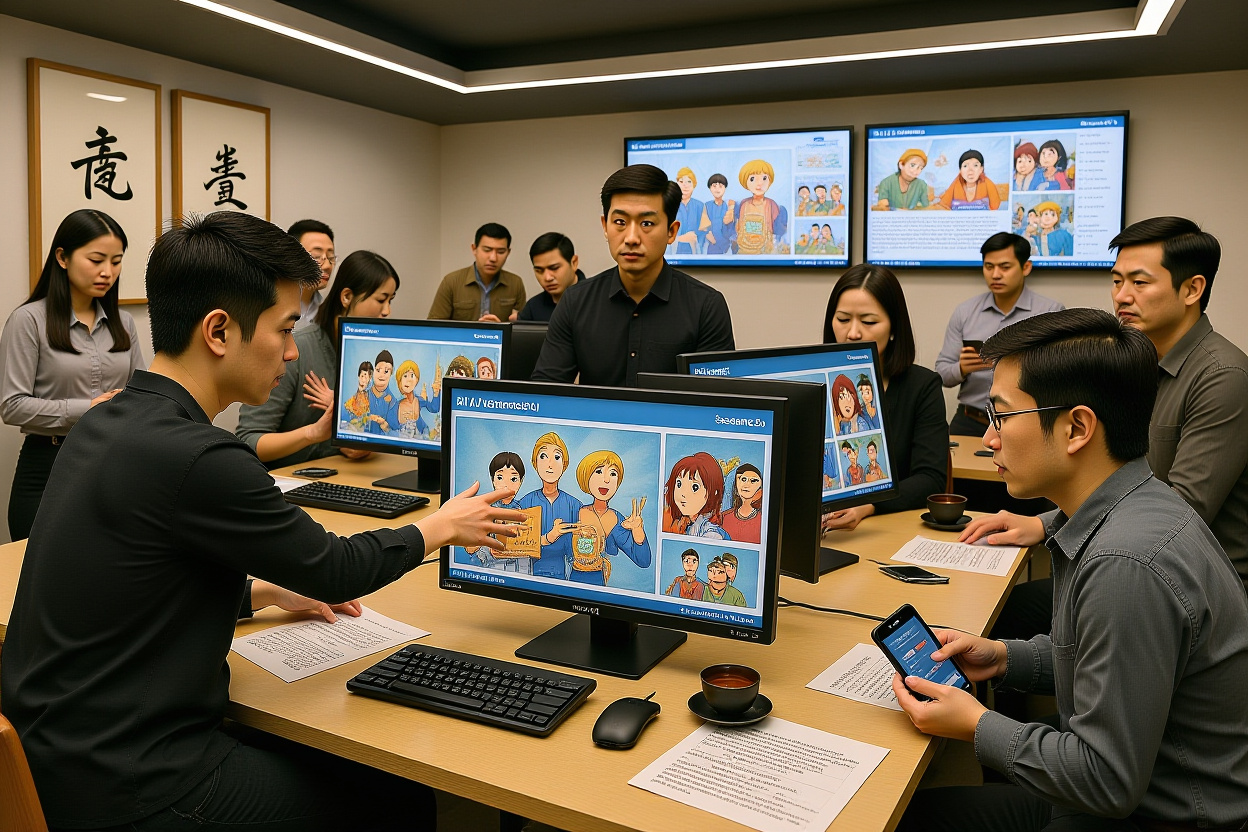
– The AI-generated comic drama (AI漫剧) sector in China has exploded into a multi-billion-yuan market, driven by technological advancements like Seedance2.0 and low-cost labor.
– Traditional short drama companies are pivoting to AI漫剧 to survive, leveraging existing monetization models but facing intense competition and rapid content cycles.
– Vocational school graduates and former factory workers are becoming key producers in this industry, earning modest wages while displacing roles like分镜导演 (storyboard directors) from prestigious institutions.
– Major platforms like ByteDance’s Hongguo Manju (红果漫剧) are aggressively acquiring content, with DAUs surpassing 10 million, signaling strong market demand and investment potential.
– The industry’s future hinges on content quality and technological adaptability, with AI仿真人剧 (AI realistic-person dramas) emerging as the next frontier, posing both opportunities and risks for investors.
The landscape of China’s digital content creation is undergoing a seismic shift, one where the most advanced artificial intelligence tools are wielded not by Silicon Valley veterans, but by vocational school graduates earning mere thousands of yuan monthly. At the heart of this transformation is the explosive growth of AI-generated comic dramas, a sector that has rapidly evolved from niche experiments to a mainstream force challenging traditional filmmaking hierarchies. For international investors monitoring Chinese equity markets, particularly in technology and media, understanding this disruption is crucial, as it highlights broader trends in labor, innovation, and consumption that could redefine investment portfolios. This phenomenon isn’t just about content; it’s a case study in how AI can democratize production, create new market inefficiencies, and potentially unlock value in unexpected corners of the economy.
The Genesis of a Content Revolution: From Short Dramas to AI漫剧
The story of AI-generated comic dramas begins with the prior boom in真人短剧 (real-person short dramas), a format that captivated Chinese audiences with its fast-paced, sensational narratives. However, by early 2025, that market had matured, leaving many companies struggling with thin margins. As profitability waned, savvy entrepreneurs sought alternatives, leading to the serendipitous discovery of AI漫剧. This content form—a hybrid of漫画 (comics) and动漫 (animation)—initially gained traction on platforms like Douyin, where it resonated with泛二次元受众 (pan-anime audiences). The key insight was that AI could replicate the appeal of traditional动态漫 (dynamic comics) at a fraction of the cost, setting the stage for a new industry.
Market Evolution and Early Adopters
Companies on the brink of exit from the short drama race were among the first to embrace AI-generated comic dramas. For instance, Soy Sauce Animation (酱油动漫), founded by Huang Haonan (黄浩南), transitioned from obscure operations to a market leader with monthly revenues exceeding 50 million yuan by late 2025. Huang, a vocational graduate with no family backing, epitomizes the self-made ethos driving this sector. His strategy involved aggressive scaling, hiring hundreds of low-wage workers to operate AI tools, and focusing on volume over refinement. Similarly, other firms like Minglu Animation (鸣鹿动画), led by Liu Wei (刘伟), capitalized on the downturn in traditional short dramas to recruit talent and pivot to AI content. This shift wasn’t merely opportunistic; it was a survival mechanism in a hyper-competitive landscape, demonstrating how technological adoption can revive struggling business models.
Technological Enablers: The AI Tools Powering the Boom
The rise of AI-generated comic dramas is inextricably linked to advancements in多模态大模型 (multimodal large models), which have made video generation more accessible and affordable. Over the past year, models like Google DeepMind’s Veo3 and domestic solutions such as Seedance have lowered barriers to entry. Seedance2.0, launched in February 2026, was a game-changer, enabling users to produce 10-second videos with coherent dialogue and scenes from simple text prompts for as little as 10 yuan. This technological leap reduced the need for specialized roles like分镜导演 (storyboard directors), allowing producers to streamline workflows and cut costs dramatically. For investors, this represents a dual narrative: AI tools are driving efficiency gains but also accelerating market saturation, necessitating careful analysis of which companies can leverage technology sustainably.
Cost Dynamics and Efficiency Gains
The economic impact of these tools is profound. Prior to AI integration, producing dynamic comics cost 8,000-10,000 yuan per minute, but AI-generated comic dramas have slashed that to hundreds of yuan per minute. For example, an independent creator known as Baize produced nearly 30 AI漫剧 at几十元/分钟 (tens of yuan per minute), netting significant profits with minimal investment. Moreover, platforms like Kling (可灵) have reduced computing costs from 1 yuan per second to 0.5 yuan per second, further amplifying scalability. This cost revolution isn’t just about production; it extends to labor, where companies hire vocational graduates at average monthly salaries of 3,000-4,000 yuan, contrasting sharply with the high wages once commanded by短剧投手 (short drama promoters). Such shifts underscore the deflationary pressure AI imposes on creative industries, a trend that could influence broader media sector valuations.
Labor Market Transformation: The New Workforce in AI漫剧
The Rise and Fall of Specialized RolesMarket Dynamics and Platform StrategiesCompetition and Consolidation PressuresInvestment Implications and Future OutlookRisks and Strategic ConsiderationsThe pace of change is dizzying; what works today may be obsolete tomorrow. For example,粗糙的 (rough) content forms like沙雕漫 (silly comics) had a lifespan of under three months before being supplanted by more sophisticated AI仿真人剧. Investors should look for companies that balance technological adoption with creative innovation, such as those investing in剧本收购 (script acquisitions) at高价 (high prices) to secure quality narratives. Additionally, regulatory scrutiny from bodies like the National Radio and Television Administration (国家广播电视总局) could impact content guidelines, affecting market dynamics. A prudent investment approach might involve diversifying across platforms and producers, while keeping an eye on mergers and acquisitions as the industry consolidates. The call to action for fund managers is clear: conduct deep due diligence on AI tool dependencies, labor models, and platform relationships to identify resilient players in the AI-generated comic drama ecosystem.
The disruption wrought by AI-generated comic dramas in China’s media landscape is a microcosm of larger global trends, where technology democratizes creation and reshapes economic hierarchies. From vocational graduates outearning film school elites to platforms dictating production at unprecedented scale, this sector underscores the transformative power of AI. Yet, as history shows—from Hollywood’s battle with television to the rise of new cinematic waves—content ultimately prevails. For investors, the opportunity lies in backing entities that harness AI not just for efficiency, but for storytelling excellence, ensuring sustainability beyond the hype. As the market evolves, staying informed through continuous analysis of technological advancements and consumer preferences will be key to capitalizing on this dynamic segment of China’s technology and media sectors.