



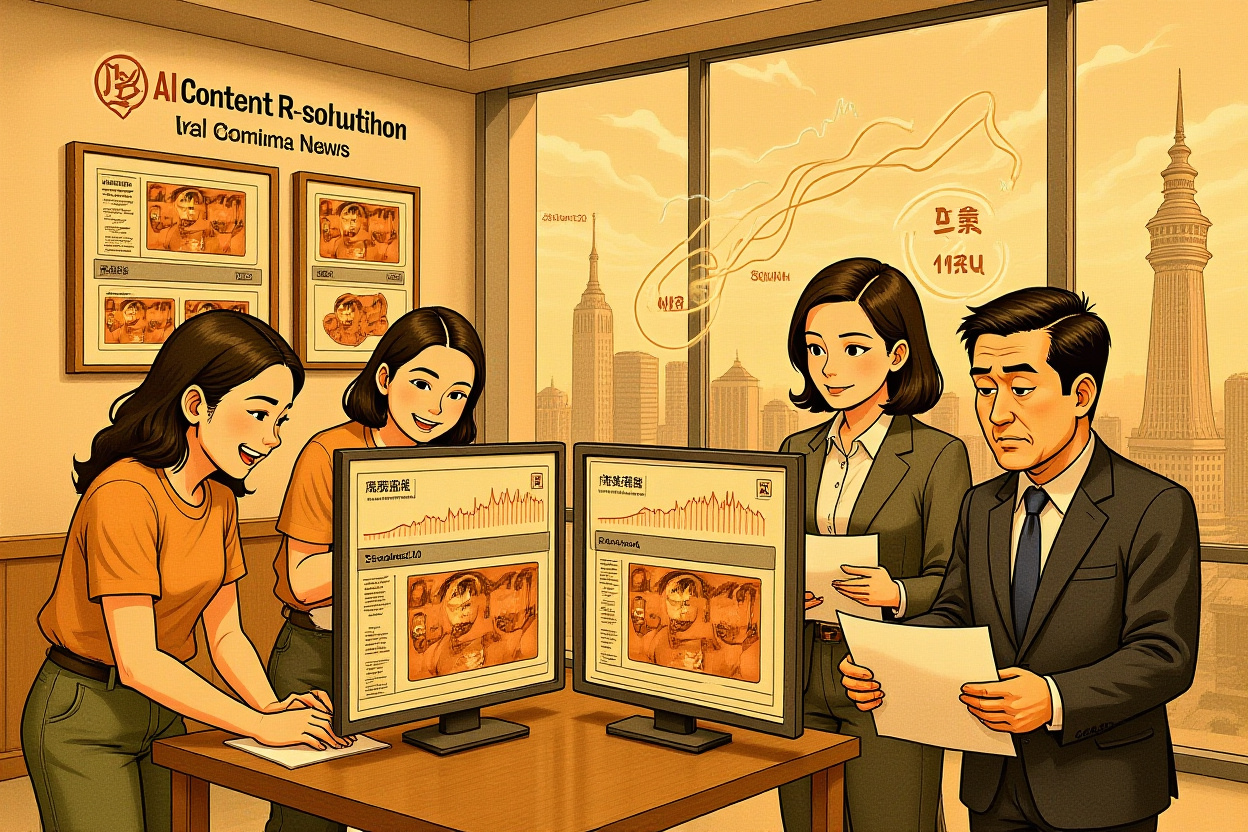
The AI Content Revolution: From Obscurity to Dominance
In China’s hyper-competitive digital content arena, a seismic shift is underway. Vocational school graduates earning mere thousands of yuan monthly are leveraging cutting-edge artificial intelligence to produce viral comic dramas, fundamentally challenging the economics and expertise of traditional film production. This phenomenon of AI-generated comic dramas represents not just a fleeting trend but a profound restructuring of content creation, driven by platforms like ByteDance’s Hongguo and tools such as Seedance2.0. As capital floods in and technology evolves at breakneck speed, the line between amateur and professional blurs, creating both unprecedented opportunity and existential threat. For global investors and market watchers, understanding this sector is key to grasping the future of Chinese digital media and its implications for equity valuations in tech and entertainment stocks.
The Meteoric Rise of AI-Generated Comic Dramas
From Fringe Experiment to Mainstream Juggernaut
The story of AI-generated comic dramas is one of explosive, platform-fueled growth. Initially emerging on Douyin as a low-cost alternative to traditional animation, these short-form videos—often adapting popular web novels—quickly captured audience attention. By late 2025, the sector’s scale had ballooned, with monthly releases surpassing 10,000 titles. Key to this was the involvement of former short-drama companies, which pivoted to AI production after facing losses in the overcrowded live-action short drama market. Firms like Soy Sauce Anime (酱油动漫), founded by Huang Haonan (黄浩南), went from obscurity to earning over ¥50 million monthly by November 2025, demonstrating the lucrative potential of AI-generated comic dramas.
Platform Catalysis and the ByteDance Factor
ByteDance’s strategic embrace of this format has been a primary accelerant. Its Hongguo platform dedicated to comic dramas achieved over 10 million daily active users within months of launch. The company’s integrated ecosystem—from Tomato Novel for IP to Jianying for editing—allowed for rapid content scaling. A source close to ByteDance noted that AI-generated comic dramas, especially the more sophisticated ‘simulated human’ variants, are seen as a tool to capture market share from longer-form video platforms. This institutional push has created a voracious demand for content, with platforms pre-ordering capacity from producers months in advance.
The Technology Stack Powering the Disruption
Breakthrough Models: Seedance2.0 and the End of ‘Childhood’ for AIGC
The technical backbone of this boom is the rapid iteration of multimodal AI models. The February 2026 release of Seedance2.0 was a watershed moment. Capable of generating coherent, 10-second video clips from simple text prompts for as little as ¥10, it dramatically lowered production barriers. As Feng Ji (冯骥), producer of ‘Black Myth: Wukong,’ stated, ‘The childhood era of AIGC has ended.’ This model eliminated the need for specialized roles like storyboard directors, directly enabling the workforce transformation at the heart of this story. Competing models from Kuaishou, Tencent, and Baidu have similarly driven down the cost of computational power, from over ¥1 per second in early 2025 to roughly ¥0.5 per second today.
Democratizing Production: From ‘Card Drawing’ to Streamlined Workflows
Prior to these advances, generating consistent AI video was a laborious process nicknamed ‘card drawing,’ where operators would repeatedly prompt models hoping for a usable output. Seedance2.0 and similar tools have streamlined this into a predictable pipeline: script writing, AI-generated images for storyboards, image-to-video animation, and final editing with voiceovers. This standardization allows companies to train new hires—often with minimal formal education—in days, not months. The focus on AI-generated comic dramas has thus shifted competition from pure technological access to operational efficiency and cost management.
The New Workforce: Vocational Labor Meets AI
Building an Army of Content Operators
The most striking aspect of the AI-generated comic drama boom is its labor model. Companies like Soy Sauce Anime embarked on aggressive hiring sprees, expanding from dozens to over 1,200 employees in half a year. The typical recruit is a vocational school graduate or former factory worker, with an average monthly salary of ¥3,000 to ¥4,000. Housed in modern office buildings, their task is to feed tropes from fantasy and romance web novels into AI models, churning out content that collectively garners billions of views. This creates a surreal contrast: the world’s most advanced generative AI tools being operated by one of the industry’s lowest-paid workforces.
Displacing the ‘Old Guard’: The Crisis for Traditional Talent
Market Dynamics: Speed, Scale, and the Pursuit of ProfitThe Relentless Pace of Change and Platform Dominance
The lifecycle of an AI content trend is now measured in months, not years. The crude ‘sand sculpture’ style of early AI漫剧 was eclipsed by more polished ‘dynamic comics,’ which were then superseded by today’s ‘simulated human drama.’ Companies that hesitate risk missing the entire profit window. ByteDance’s platform operations exemplify this relentless pace, with contract negotiations often concluded within 48 hours via electronic signature. This contrasts sharply with slower-moving rivals still using paper contracts. In this environment, speed is the ultimate competitive advantage, and platforms with integrated data and distribution, like ByteDance’s Hongguo, set the rules for the entire AI-generated comic dramas ecosystem.
Financial Flows and Investment Frenzy
The Future: Evolution, Consolidation, and the Primacy of ContentBeyond the Hype: Seeking Sustainable Advantage
Lessons from History and a Call for Strategic AdaptationThe disruption caused by AI-generated comic dramas echoes past technological shocks in media, such as television’s challenge to Hollywood in the mid-20th century. The film industry survived not by rejecting TV but by innovating in content, giving rise to movements like the French New Wave. Today’s lesson for investors and creators is clear: technology democratizes production, but enduring value resides in intellectual property, audience connection, and strategic agility. For international investors, this means looking beyond the pure-play AI toolmakers to content aggregators and platforms with scalable monetization. For professionals, it necessitates upskilling in AI literacy and narrative design.
The rise of AI-generated comic dramas is more than a niche market story; it’s a case study in how technology, capital, and labor interact in China’s digital economy. It highlights the vulnerabilities of traditional creative industries and the opportunities created by platform capitalism. As the dust settles, the winners will be those who master the blend of AI efficiency and human ingenuity. The call to action is unambiguous: monitor this space closely, for the forces reshaping Chinese content today will inevitably influence global media trends tomorrow.