



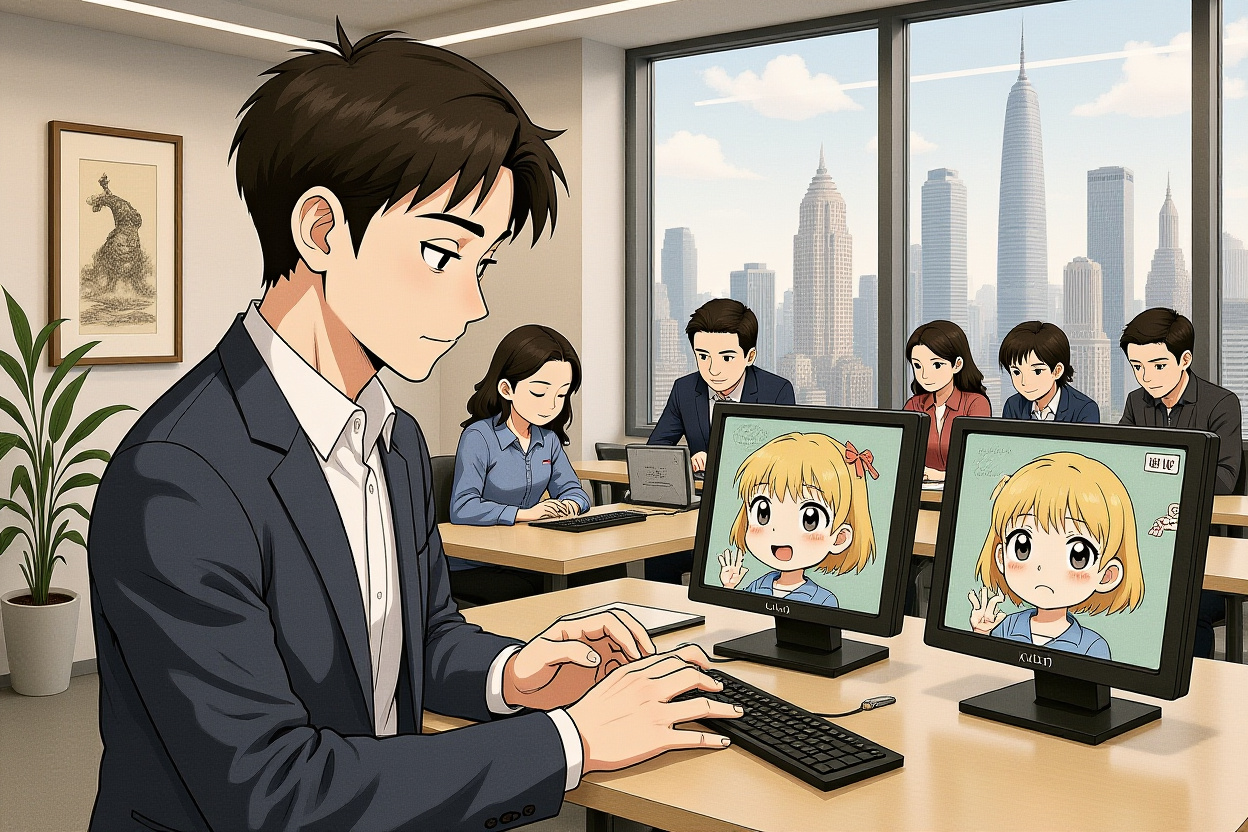
The race to dominate China’s next major content gold rush is not being waged in the soundstages of Hollywood or the production houses of Beijing’s film district. Instead, it is happening in the fluorescent-lit offices of tech startups, fueled by generative artificial intelligence and staffed by an army of young workers earning as little as 3,000 yuan ($420) per month. This is the explosive world of AI anime dramas (AI漫剧), a sector that has rocketed from obscurity to a multi-billion yuan market in under two years, fundamentally challenging the economics and hierarchy of traditional entertainment. For international investors and market watchers, this phenomenon represents a seismic shift in China’s digital content landscape, where technological democratization is creating new fortunes while rendering old skills obsolete at a breathtaking pace.
Executive Summary: Key Market Implications
- The AI anime drama (AI漫剧) market has explosively grown to an estimated scale exceeding 20 billion yuan, driven by generative video models like Sora, Seedance2.0, and Kling, which have slashed production costs from thousands to mere hundreds of yuan per minute.
- A new, low-cost labor model has emerged: companies like Soy Sauce Anime (酱油动漫) recruit vocational school graduates with minimal training to operate AI tools, creating a scalable, labor-intensive production line for digital content.
- Rapid platform adoption, led by ByteDance’s Red Fruit Manga Drama platform (红果漫剧), is accelerating market consolidation. The platform’s DAU surpassed 10 million in just three months, creating immense demand for content.
- Technical iteration is compressing industry cycles, forcing constant reinvention. Content formats like “sand sculpture manga” are becoming obsolete within months, giving way to higher-quality “AI simulation dramas (仿真人剧),” which threaten longer-form video markets.
- The disruption is spreading upstream, displacing traditional roles like storyboard directors and creating FOMO (Fear of Missing Out) among established short-drama and film companies, signaling a broader transformation of China’s entire visual content industry.
The Billion-Yuan Gold Rush: AI Anime Dramas Erupt
In late 2025, a quiet revolution in China’s content sector became a deafening roar. AI anime dramas (AI漫剧), serialized animated stories generated primarily by AI models, transitioned from a niche experiment to a mainstream, high-volume business. The catalyst was the confluence of accessible, multi-modal large language models and a voracious appetite from short-video platforms for engaging, low-cost content. For founders like Huang Haonan (黄浩南) of Soy Sauce Anime, it was the long-awaited “风口” or “wind vent” – the kind of trend that propels savvy entrepreneurs to rapid wealth. By November 2025, his company’s monthly revenue had surpassed 50 million yuan, cementing its status as a sector leader with the audacious goal of becoming “the nation’s largest AI video group.”
The growth metrics are staggering. According to DataEye-ADX industry data, the monthly release volume of AI anime dramas (AI漫剧) surged past 13,000 titles in September and October 2025, nearly matching the total annual output of the entire真人短剧 (live-action short drama) industry from the previous year. This explosion was not confined to production studios. ByteDance’s dedicated Red Fruit Manga Drama App (红果漫剧), achieved a milestone of 10 million daily active users in just over three months, demonstrating the formidable platform pull and audience demand fueling this boom. The business model, inherited from真人短剧, remains heavily reliant on advertising流量 (投流), with up to 80% of revenue often reinvested in user acquisition.
The Perfect Storm: Technology Meets Market Demand
The rise of AI anime dramas (AI漫剧) was not accidental. It filled a critical gap identified by platforms. When a precursor format, dynamic manga (动态漫), began gaining traction on抖音 (Douyin), it revealed a vast, underserved audience of泛二次元 (pan-anime) fans. However, traditional production was prohibitively expensive, costing 8,000-10,000 yuan per minute with a limited number of capable teams nationwide. AI generation collapsed this cost structure to a few hundred yuan per minute, enabling mass production. As Xiao Chuan, a former head of short drama operations at a leading internet company, noted, struggling真人短剧 companies were the first to pivot, seeing AI漫剧 as a lifeline. The industry’s pioneers were not traditional creatives but entrepreneurs from the adjacent, hyper-competitive short-drama world, adept at the brutal economics of content流量.
New Money, New Players: The Capital and Labor Transformation
The promise of the AI anime drama (AI漫剧) gold rush triggered a dramatic influx of capital and a unique labor transformation. Stories of immense, rapid profits circulated widely. In February 2025, an AIGC work titled “兴安岭诡事” garnered over 50 million plays on抖音 (Douyin), with industry rumors swirling of revenues reaching eight figures. By July, with抖音’s流量 support, the sector’s daily advertising spend突破 (broke through) the ten-million-yuan level. This attracted diverse participants, from solo developers like Bai Ze, who allegedly turned 1,000 yuan into several hundred thousand by producing low-cost content, to传闻 (rumored) wealthy heirs in Changsha who包下 (rented entire buildings) to house hundreds of workers churning out content.
This influx led to fierce competition for talent, sometimes spilling into corporate drama. Huang Haonan publicly accused employees from百度 (Baidu) and its subsidiary Qimao (七猫) of poaching his staff with offers of tenfold salaries during a supposed参观 (visit). While swiftly resolved and attributed to individual actions, the incident highlighted the intense pressure to secure capable personnel in a market moving at light speed.
From Glut to Shakeout: The Precarious Pre-AI Short Drama Market
Understanding the frenzy requires looking at the market conditions that preceded it. By early 2025, the真人短剧 market was experiencing a severe shakeout. Despite the continued success of top players like听花岛 (Ting Hua Dao), industry insiders reported that over 90% of companies were facing losses. Many firms that had rushed in during the peak were now收缩 (contracting) or exiting. Liu Wei, founder of Minglu Animation, observed that by the first half of 2025, “除了最头部的那一批,有名有姓的短剧公司都裁过员” (aside from the very top tier, every notable short-drama company had conducted layoffs). This created a pool of experienced, available talent, particularly in the critical area of advertising投放 (投手), which AI漫剧 companies eagerly absorbed, often at lower salaries. The stage was thus set for a mass migration to the next perceived opportunity.
The Production Paradox: Cutting-Edge Tech, Manual Assembly Lines
In a striking paradox, companies have built what is essentially a labor-intensive assembly line around the world’s most advanced generative AI technology. Soy Sauce Anime embarked on what Huang Haonan termed a “radical expansion,” ballooning from dozens to over 1,200 employees in under six months. The hiring strategy focused on ultra-low门槛 (thresholds). Huang candidly stated that anyone over 18 without intellectual disabilities could apply, boasting that the highest学历 (educational qualification) in the company was an undergraduate degree. The corresponding average salary was a mere 3,000-4,000 yuan per month.
The production pipeline for an AI anime drama (AI漫剧) is modular and simplified: scriptwriting, text-to-image for storyboards, image-to-video for animation, followed by editing, dubbing, and synthesis. New hires, often vocational school graduates or former factory workers, are trained for just “two or three days” on proprietary tools to operate these AI modules. They sit in modern offices, inputting tropes from爽文 (wish-fulfillment fiction) into大模型 (large language models), collectively producing content viewed billions of times. This model allows for staggering output scalability. Soy Sauce Anime increased its monthly production from over 10 titles to 60, and by January, it had突破 (surpassed) 100, with an annual target of 1,000 – equal to one-third of the entire live-action short drama industry’s current monthly output.
Location and Leverage: Tapping into Legacy Talent Pools
Other companies leveraged geographic advantages. Hey Ya Manga Drama (鹤芽漫剧), based in Changsha, tapped into the city’s rich talent pool from the golden era of湖南卫视 (Hunan TV) and芒果TV (Mango TV). Founder Yang Hao (杨浩) and a single HR manager recruited over 50 people in a month by reaching out to professionals from the now-declining long-form video承制 (production) sector. These workers adapted to a nocturnal schedule—starting at midnight and finishing around 1 PM—to capitalize on cheaper cloud computing rates and shorter queues for AI processing during off-peak hours. This schedule was later pushed to a 3 AM start after the launch of Seedance2.0, as queues remained in the tens of thousands even at 1 AM. The core competitive advantage in this initial phase, as noted by Jiang Yiqi (姜奕祺), former AI expert at Alibaba DAMO and current CEO of Sansheng Qingying, is not proprietary models, but “产能和成本” (production capacity and cost).
Evolving at Warp Speed: From “Sand Sculpture” to Simulation
The lifecycle of trends within the AI anime drama (AI漫剧) sector is measured in months, not years. The红利 (dividend period) for each content format is brutally short. Early, crude formats like “沙雕漫” (sand sculpture manga), characterized by simplistic, often humorous animation, saw their profitability window slam shut within roughly 90 days. Huang Haonan lamented that the自然流 (organic traffic) that once yielded tens of thousands of yuan from 20 million views had dwindled to under 1,000 yuan by late 2025. This rapid obsolescence left latecomers, like a煤老板 (coal tycoon) who invested millions, facing total losses.
The industry’s focus has since pivoted decisively towards higher-fidelity “AI simulation dramas (AI仿真人剧),” which represent the current technological ceiling for AI-generated content. These productions feature near-photorealistic human characters and aim for a cinematic quality. Initially considered a technical “坑” (pitfall) due to issues with lip-sync, character consistency, and the “uncanny valley” effect, they are now the battleground for the next phase of growth. Yang Hao saw the potential early, reasoning that while AI漫剧 was a 20-30 billion yuan market,仿真人剧 could tap into the trillion-yuan markets for movies, TV series, and traditional short dramas.
The Platform Catalyst: ByteDance’s Hyper-Accelerated Playbook
The sector’s frantic pace has been dramatically accelerated by platform strategy, particularly from ByteDance. The company moved with remarkable speed to institutionalize and shape the AI anime drama (AI漫剧) ecosystem. After the format emerged on抖音, oversight was quickly transferred to the Short Drama Copyright Center established in May 2025, reporting to Zhang Chao, the head of the番茄小说 (Tomato Novel) and红果短剧 (Red Fruit Short Drama) ecosystem. This placed AI content under the leadership of a team with a proven track record of scaling short-form content.
When AI simulation dramas began gaining traction, the Tomato系 (Tomato division) swiftly adjusted revenue分成系数 (split ratios) to favor精品 (high-quality) content. This move, described by partners as高效且强势 (highly efficient and strong-willed), standardized电子合同 (electronic contracts) with a take-it-or-leave-it attitude, often closing deals in 2-3 days. This decisiveness forced the entire industry to rapidly upgrade its quality standards, as slower platforms lost out on premium content. In an industry where trends shift quarterly, speed itself became the ultimate barrier to entry and a key competitive advantage for the fastest players.
When Wonder Becomes Cheap: The Disruption of Creative Labor
The launch of Seedance2.0 in February 2026 marked a watershed moment, described by Feng Ji, producer of the acclaimed game “Black Myth: Wukong,” as the end of “AIGC’s childhood.” The model’s ability to generate consistent, 10-second video clips with coherent dialogue, scenes, and action from simple text prompts, at a cost of around ten yuan, sent immediate shockwaves through production teams. The implications for human labor were profound and immediate. On the very day of the launch, Yang Hao made the decision to lay off his team of storyboard directors, retaining only one lead director. These directors, some graduates of the prestigious北京电影学院 (Beijing Film Academy), were deemed obsolete as the AI now handled complex shot composition autonomously.
Similarly, at Minglu Animation, an employee in the AI platform department worked through the night in disbelief, realizing that work that had taken weeks of refinement could now be replicated by a novice in moments. The team ultimately decided to scrap a week’s worth of work, as the cost of further editing exceeded simply regenerating it with Seedance2.0. The specialized role of the “抽卡师” (“gacha master”)—operators who spent hours crafting and regenerating prompts to get usable video clips from less capable models—was also rendered far less critical. As one抽卡师 noted, the job was no longer “废人” (exhausting), but consequently, it no longer required as many people. Production teams that once required 8-10 people per title were being reconfigured for 3-person crews.
The Bigger Picture: Historical Echoes and Future Uncertainty
This technological upheaval has historical echoes. In the mid-20th century, the rise of television threatened Hollywood, which responded with technological gimmicks like 3D and smell-o-vision before ultimately being forced to reinvent itself through narrative innovation, leading to movements like the French New Wave. The current trajectory of AI anime dramas (AI漫剧) suggests a similar, compressed cycle of technological disruption followed by a potential reckoning with content quality. For now, the industry remains in a feverish state of expansion. Major platforms including Tencent, Baidu, and Kuaishou are all buying content aggressively, often pre-booking entire annual production capacities from leading studios.
Yet, beneath the表面热度 (surface heat), uncertainty brews. Traditional真人短剧 companies are facing残酷淘汰 (brutal elimination) as platforms tighten guarantees. Even leading players like听花岛 are now investing in AI漫剧, driven by FOMO. Investors, wary of the breakneck speed of technological change, are becoming more cautious. As serial entrepreneur You You found when trying to raise funds post-Lunar New Year, securing investment now requires a compelling reason beyond mere technical capability in an era of increasing技术平权 (technological parity). Industry veterans like Xiao Chuan are biding their time, planning to enter the market “一边做内容生产,一边等整个行业回归到一个相对冷静的状态” (while producing content, waiting for the entire industry to return to a relatively冷静 state), where focus might finally shift back to the core of storytelling itself.
Strategic Outlook for Investors and the Market
The rise of China’s AI anime drama (AI漫剧) industry is more than a niche content trend; it is a powerful case study in how generative AI is reshaping entire economic sectors. It demonstrates a model where low-cost labor is leveraged not for manual repetition, but for the mass operation and curation of advanced AI systems, creating a highly scalable digital content factory. For investors, the immediate opportunity lies in the infrastructure and tooling layer—cloud computing, model APIs, and specialized SaaS platforms—as evidenced by deals like Yang Hao’s 10-million-yuan annual commitment to火山引擎 (Volcano Engine). The content producers themselves, while currently profitable, operate in an environment of extreme volatility where today’s leading format is tomorrow’s commodity.
The long-term winners will likely be the platforms that successfully aggregate and monetize audience attention, and the few production studios that can consistently decode the evolving algorithm for hits while mastering the relentless logistics of cost-effective, AI-driven production. As the technology continues to advance, the line between AI-generated content and traditional production will blur further, applying pressure on the entire value chain of China’s film and television industry. The ultimate question, as the industry matures past its initial gold rush phase, is whether it can evolve from a pure流量 (traffic) play into a sustainable ecosystem for creative storytelling, or if it will remain a perpetual, high-speed churn of disposable digital product.
For global market participants, the lessons are clear: monitor the adoption curves of generative video tools in China closely, as they often foreshadow broader global trends in content creation. Assess traditional media and entertainment holdings for their vulnerability to this low-cost, high-speed competitive threat. Finally, look beyond the headlines of layoffs and labor disputes to identify the companies building defensible moats—whether in data, distribution, or unique creative IP—in this brave new world of AI-powered entertainment. The vocational graduate with the AI prompt may have disrupted the film school director, but the next chapter of this story is still being written, one algorithmically generated frame at a time.