



Executive Summary
This article delves into the explosive growth of AI-generated comic dramas in China, highlighting key market shifts and implications for investors and professionals.
- AI-generated comic dramas have spawned a market exceeding 20 billion yuan, driven by video generation models like Seedance2.0, enabling mass production at minimal cost.
- Vocational school graduates and low-wage workers are being deployed in labor-intensive setups to create content, with companies like Jiangyou Animation (酱油动漫) scaling production to hundreds of monthly.
- Platforms such as ByteDance’s Hongguo Manju (红果漫剧) are accelerating industry evolution, shifting from rough AI drafts to premium simulation human dramas that mimic traditional film quality.
- Technological advancements are automating roles like storyboard directors, displacing Beijing Film Academy graduates and forcing a rethink of creative workflows in media.
- The future hinges on content innovation amid rapid tech changes, with AI-generated comic dramas poised to capture segments of the broader film and short-video markets.
The AI Comic Drama Gold Rush: New Money Meets Old Guard
The Chinese media landscape is witnessing a seismic shift as AI-generated comic dramas emerge from obscurity to dominate online platforms. In late 2025, Huang Haonan (黄浩南), founder of Jiangyou Animation (酱油动漫), celebrated monthly revenues surpassing 50 million yuan, cementing his company’s position as a sector leader. This surge mirrors broader trends where AI tools empower non-traditional creators, including vocational school graduates earning mere 3,000 yuan monthly, to produce content that rivals output from established film studios. The focus phrase, AI-generated comic dramas, encapsulates this disruption, blending low-cost labor with cutting-edge technology to challenge entrenched industry norms.
Initially, AI-generated comic dramas gained traction as a lifeline for struggling short-drama companies. After a boom in 2024, many traditional short-drama firms faced losses, prompting pivots to AI-driven content. Liu Wei (刘伟), founder of Minglu Animation (鸣鹿动画), noted that during 2025 hiring sprees, resumes from displaced short-drama professionals flooded in, allowing his firm to acquire talent at reduced costs. This transition underscores how AI-generated comic dramas are not just a niche but a strategic response to market saturation, with platforms like Douyin (抖音) quickly capitalizing on unmet demand for泛二次元 (pan-secondary) content.
From Obscurity to Overnight Success
Early successes, such as the AIGC work 兴安岭诡事 (Xing’an Ling Guishi), which garnered over 50 million views on Douyin in February 2025, fueled rumors of million-yuan revenues. By July 2025, daily ad spending on AI-generated comic dramas突破千万级 (broke through the ten-million-yuan level), driven by ByteDance’s流量扶持 (traffic support). This rapid monetization attracted diverse players, from wealthy individuals in Changsha funding large-scale production to solo entrepreneurs like Baize (白泽), who turned minimal investments into substantial profits. The frenzy highlights how AI-generated comic dramas have democratized content creation, enabling rapid wealth generation even for those without formal film education.
Labor-Intensive AI: Cutting Costs with Cheap Manpower
Paradoxically, the AI-generated comic drama industry has become a labor-intensive endeavor, reliant on廉价人力 (cheap labor) to maximize output. Huang Haonan of Jiangyou Animation embarked on an aggressive expansion, growing his workforce from dozens to over 1,200 employees in under six months. He openly stated that hiring criteria were minimal—requiring only adulthood and basic cognitive ability—with average wages around 3,000-4,000 yuan. This approach contrasts sharply with traditional film production, where skilled directors command high salaries, yet it enables the mass production of AI-generated comic dramas that captivate millions of viewers.
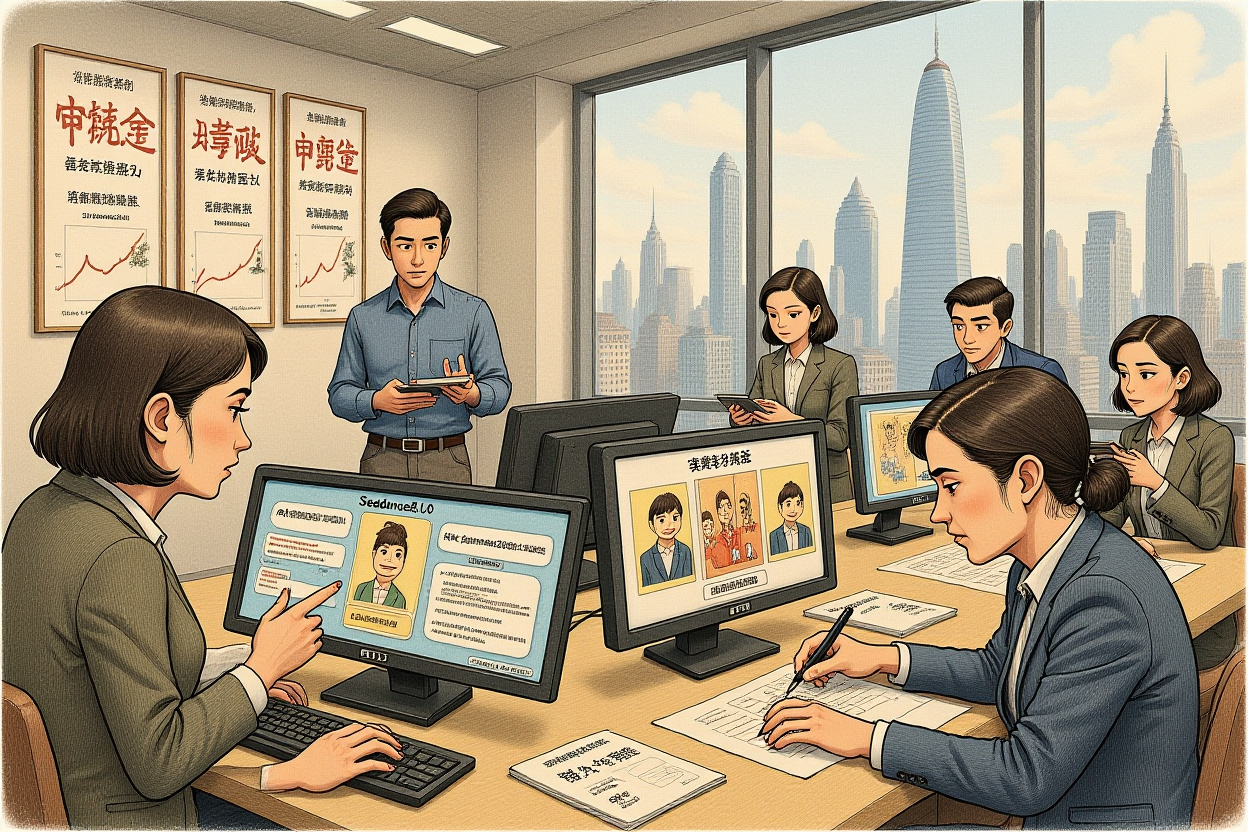
The production pipeline for AI-generated comic dramas is streamlined: scripts are fed into multimodal大模型 (large models) for image generation, followed by video synthesis, editing, and dubbing. Workers, often fresh from vocational schools or factories, operate in office settings, inputting爽文 (wish-fulfillment literature) prompts into AI systems. This setup魔幻 (magically) merges rudimentary tasks with advanced technology, driving down costs to as low as 600 yuan per minute for basic content. As Jiang Yiqi (姜奕祺), CEO of Sansheng Qingying (三生清影) and former Alibaba DAMO Academy expert, observed, when底层模型 (underlying models) are inaccessible,核心竞争力 (core competitiveness) hinges on产能和成本 (production capacity and cost).
Scaling Production Amid Technological Advances
Technological evolution further amplifies efficiency. In 2025, video generation models like Google DeepMind’s Veo3 and Kling 2.0 (可灵) became widely available, reducing算力 (computing power) costs from 1 yuan per second to 0.5 yuan. This allowed companies like Heya Manju (鹤芽漫剧), founded by Yang Hao (杨浩), to ramp up output by hiring over 50 employees in a month, leveraging talent pools from湖南卫视 (Hunan TV) and芒果TV (Mango TV) impacted by the decline of long-form video. Workers adapted to odd hours, such as 3 AM shifts, to capitalize on cheaper off-peak computing resources, illustrating how AI-generated comic dramas optimize every aspect of production for cost-effectiveness.
Rapid Evolution: From Rough Drafts to Simulation Human Dramas
The lifecycle of AI-generated comic dramas is accelerating, with content formats evolving at a breakneck pace. What began as粗糙的 (rough)沙雕漫 (silly comics) lasting only months has given way to AI仿真人剧 (simulation human dramas), which represent the current technical pinnacle. These premium AI-generated comic dramas feature more realistic characters and narratives, aligning with platform demands for higher quality. ByteDance’s Hongguo Manju, for instance, has started procuring 120-minute不分集 (non-episodic) simulation human dramas, aiming to capture长视频市场 (long-video market) shares and appeal to下沉市场 (lower-tier cities).
Early simulation human dramas faced challenges like口型对不上 (misaligned lip-sync) and恐怖谷效应 (uncanny valley effects), but pioneers like Yang Hao saw potential. After visiting the team behind 兴安岭诡事, he confirmed profitability, with the show yielding approximately 600,000 yuan in profit. His firm’s debut simulation human drama, 盘丝洞素锦传 (Pansi Dong Sujin Zhuan), achieved a 3x ROI without ad spending, attracting investment and orders. This rapid adoption underscores how AI-generated comic dramas are maturing, with platforms like番茄系 (Tomato ecosystem, including Hongguo) adjusting分成系数 (revenue-sharing ratios) to incentivize quality content.
Platform-Driven Market Acceleration
ByteDance has been particularly proactive in shaping the AI-generated comic drama sector. Upon observing early trends, it reorganized its structure, placing AI-generated comic dramas under the短剧版权中心 (Short Drama Copyright Center) reporting to Zhang Chao (张超), head of番茄小说 (Tomato Novels) and Hongguo. This move leveraged existing expertise from短剧 (short dramas) to streamline operations. Contract signings became电子签署 (electronically signed) within days, contrasting with slower platforms still using纸质合同 (paper contracts). As Xiaochuan (小川), a former head of short-drama business at a top internet firm, noted,速度本身,就是门槛 (speed itself is the barrier), with delays meaning missed红利 (dividends) in this fast-paced industry.
The Speed of Change: How Technology Reshapes Creative Roles
Technological breakthroughs, notably the launch of Seedance2.0 in early 2026, are fundamentally altering production dynamics for AI-generated comic dramas. This model allows users to generate 10-second videos with coherent dialogue, scenes, and character consistency from brief prompts, costing just 10 yuan. Feng Ji (冯骥), producer of Black Myth: Wukong (《黑神话:悟空》), remarked that it marks the end of AIGC’s童年时代 (childhood era). For AI-generated comic drama companies, this translates to immediate operational overhauls, such as裁员 (layoffs) of specialized roles like分镜导演 (storyboard directors), many of whom were Beijing Film Academy graduates.
At Heya Manju, Yang Hao dismissed storyboard directors shortly after Seedance2.0’s release, retaining only one总镜头导演 (chief lens director). Similarly, Minglu Animation discarded a week’s work to restart with the new model, as后期成本 (post-production costs) outweighed regeneration expenses. The role of抽卡师 (card drawers), who previously spent hours tweaking prompts to avoid absurd outputs, became obsolete overnight. This displacement highlights a broader trend: as AI-generated comic dramas advance, they render traditional skills redundant, forcing a reevaluation of value in creative industries.
Efficiency Gains and Human Cost
While efficiency surges, human impacts are palpable. Teams that once required 8-10 people per AI-generated comic drama can now operate with 3, slashing labor needs. Huang Haonan and Yang Hao both plan to reallocate 80% of their产能 (production capacity) to simulation human dramas, envisioning competition with renowned directors like Zhang Yimou (张艺谋). However, this optimism is tempered by uncertainty among professionals. A continuous entrepreneur, Youyou (悠悠), found investors increasingly cautious due to rapid technological changes, seeking non-tech reasons to fund ventures. This dichotomy between innovation and instability defines the current state of AI-generated comic dramas, where progress comes at the expense of job security for traditional creatives.
Looking Ahead: Content vs. Technology in the AI Era
The trajectory of AI-generated comic dramas offers lessons from media history. In the mid-20th century, television’s rise threatened Hollywood, leading to sensory-driven innovations like立体电影 (3D movies) that ultimately failed to stem decline. However, movements like the法国新浪潮 (French New Wave) revived cinema by focusing on narrative depth over technical gimmicks. Similarly, the future of AI-generated comic dramas may depend on balancing technological prowess with compelling storytelling, as the market consolidates around quality.
Currently, major platforms including ByteDance, Tencent (腾讯), Baidu (百度), and Kuaishou (快手) are批量收购 (bulk purchasing) AI-generated comic dramas to secure market share. On March 19, 2026, ByteDance’s剪映 (Jianying) launched小云雀Agent (Xiao Yunque Agent), lowering barriers for individual creators but potentially creating new bottlenecks. Meanwhile, traditional short-drama firms like听花岛 (Tinghua Island) are venturing into AI-generated comic dramas, driven by FOMO (fear of missing out). As Xiaochuan plans his own startup, he anticipates a return to content-centricity once the industry cools, suggesting that sustainable success in AI-generated comic dramas will require more than just technical efficiency.
Strategic Implications for Investors and Professionals
For global investors and media executives, the rise of AI-generated comic dramas signals a shift in Chinese equity markets towards tech-driven content sectors. Key metrics to watch include DAU figures for platforms like Hongguo Manju, which surpassed 10 million within months, and regulatory developments from bodies like the国家广播电视总局 (National Radio and Television Administration). The proliferation of AI-generated comic dramas also highlights opportunities in related fields, such as AI tool development and intellectual property management. As the market evolves, stakeholders should monitor how platforms leverage data from 36Kr reports and other sources to refine their strategies, ensuring alignment with both technological trends and audience preferences.
Synthesizing the AI-Driven Media Revolution
The emergence of AI-generated comic dramas represents a profound transformation in China’s media industry, where vocational graduates and AI tools are collectively challenging the hegemony of film school elites. From cost-effective production models to rapid technological迭代 (iteration), this sector exemplifies how innovation can democratize creativity while disrupting established norms. However, as Seedance2.0 and similar advances automate roles, the industry must navigate ethical considerations around employment and content quality.
Moving forward, success will likely hinge on integrating AI efficiency with human ingenuity, fostering narratives that resonate beyond mere technical spectacle. For professionals worldwide, staying informed on developments in AI-generated comic dramas is crucial, as they offer insights into broader trends in digital media, investment flows, and regulatory shifts in China’s dynamic market. Engage with ongoing analysis and explore partnerships to leverage this burgeoning field, ensuring preparedness for the next wave of media innovation.