



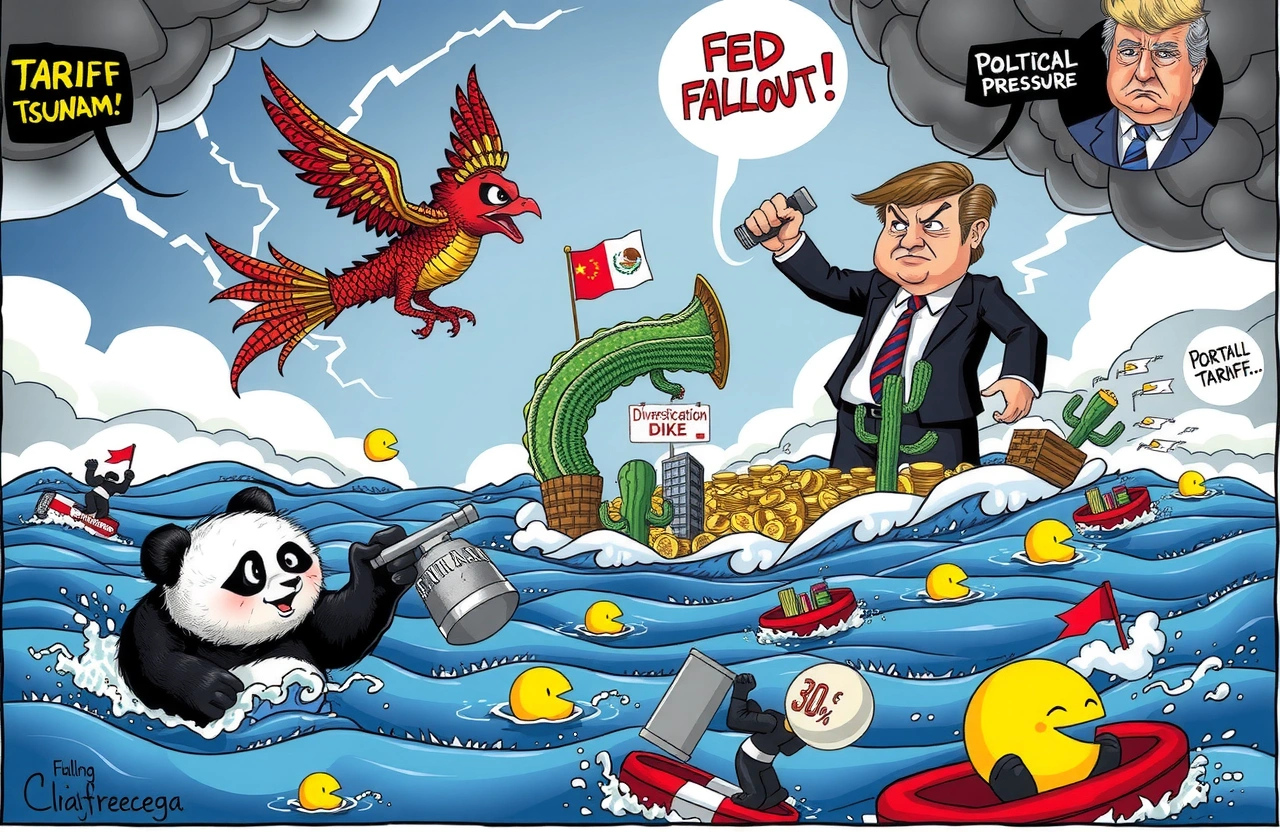
Financial markets faced whiplash as twin disruptions emerged over the weekend. Former President Donald Trump simultaneously escalated trade conflicts while reopening political warfare against Federal Reserve leadership, creating perfect storm conditions as Monday trading commenced. The timing of his double-barreled announcements – imposing 30% tariffs against EU and Mexican imports while publicly calling for Jerome Powell’s removal – triggered immediate capital flight toward haven assets.
The Tariff Offensive: Trump’s New Trade War Fronts
Sunday’s unprecedented tariff letters targeted America’s closest allies with rates dwarfing previous trade skirmishes. The 30% blanket tariffs on European Union and Mexican goods reflect Trump’s abandonment of prior negotiation patterns documented throughout his first term.
The ‘TACO Trade’ Collapse
Market analysts dubbed Trump’s previous tariff pattern ‘TACO’ (Trump Always Chickens Out), noting his tendency to deploy extreme threats then retreat amid market turmoil. This time differs:
- No delayed implementation: August 1 deadline shows hardened stance
- Coordinated bilateral assaults replace isolated disputes
- Explicit refusal of compromise language except complete capitulation
European Response Calculus
EU Commission President Ursula von der Leyen’s extension of countermeasure deadlines until August demonstrated careful crisis management. Contrasting approaches emerged:
| Position | Key Proponent | Strategy |
|---|---|---|
| Retaliatory | French President Macron | Immediate matching tariffs |
| Diplomatic | German Chancellor Scholz | Negotiation pathway preservation |
Mexico responded proportionally via agricultural tariffs targeting Republican-leaning states, while Canada maintained its USMCA compliance posture.
The Fed Front: Undermining Central Bank Independence
Parallel to trade salvos, Trump renewed attacks on Federal Reserve Chair Jerome Powell. The coordination suggests institutional strategy:
‘Renovation Gate’ Controversy
White House officials constructed dismissal justification around Powell’s congressional testimony regarding Fed headquarters’ $2.5 billion renovations. Budget Director Russell Vought declared: “The severe management failures… warrant your immediate resignation.”
Historical echoes resonate:
- 1972 Nixon pressure campaign against Fed Chair Arthur Burns
- Repeated Trump administration attacks on Fed rate decisions
- Legal barriers against politically-motivated removals
Procedural Power Plays
Trump installed three White House advisors on the Federal Facilities Committee overseeing the renovation project. Critics view this as procedural groundwork for Powell’s potential ouster. As Powell’s term extends until 2028, constitutional scholars warn removing governors requires “cause” beyond policy disagreements.
Market Implications: Unpriced Risks Solidify
Trading floors confront velocity gaps between headline absorption and valuation adjustments:
Capital Flight Patterns
Monday’s dawn brought predictable haven flows:
- Gold futures surged past $2,400/ounce resistance
- 10-year Treasury yields fell beneath 4.2%
- Dollar index witnessed sharpest intraday drop since May
Deutsche Bank strategists note: “Simultaneous trade and institutional instability creates reflexive impacts that compound initial shocks.”
Currency Vulnerabilities
ING forecasts disequilibrium across currency markets:
- Yield curve steepening likely against USD
- Euro and yen positioned as primary alternatives
- Emerging market carry trades facing margin pressure
As gold’s breakout suggests, traders increasingly hedge tail risks ignored during plateaued volatility indexes.
Strategic Navigation Through Dual Crises
Prudent positioning requires layered defenses:
Corporate Mitigation Framework
Exporters face immediate adaptation imperatives:
- Sourcing Diversification: Reduce tariff-exposed materials
- Hedging Acceleration: Lock in currency rates immediately
- Logistics Restructuring: Mexican nearshoring re-evaluation
Investor Portfolio Chokepoints
Critical vulnerability assessments:
| Avoid | Monitor | Increase |
|---|---|---|
| USD cash positions | Yield spreads | Gold miners |
| European automakers | Congress hearings | Defensive bonds |
Financial historian Adam Tooze contextualizes: “When trade and monetary shocks collide, they disproportionately punish carry positions.
Breathing Space Amid Geopolitical Whiplash
The synchronized assaults represent escalation requiring profound realignment. As Macron’s call for EU countermeasures gains traction, negotiators scramble behind technical delays:
- EU countermeasure deadlines extend through August
- Senate Banking Committee monitors Fed pressures
- Currency swaps stabilize settlement bottlenecks
Disciplined investors avoid complacency traps in undervalued volatility instruments, recalling similar dual-crisis inflection points:
“When two tidal waves converge, the impact defies linear forecasts. Only fundamentals provide navigational buoys.”
Marginal tax-sensitive sectors face existential choices – relocate supply chains or absorb non-competitive tariffs. As 30% rates reset global cost structures, strategic pivots commence outside Washington’s corridors.
Leadership voids emerge as institutional fraying accelerates. Without explicit guardrails shielding Fed independence, dollar assets risk permanent risk premium expansion. Yet domiciled within chaos lie recalibrated alliances: Mexico strengthens Pacific partnerships while Brussels advances Asian trade pacts.
Market participants ignoring contained equilibrium risks pay premium prices during chaotic phase transitions. Constructive action begins with mapping exposures to Trump’s simultaneous fronts – then constructing resilient pathways no single policy shock can fracture.