



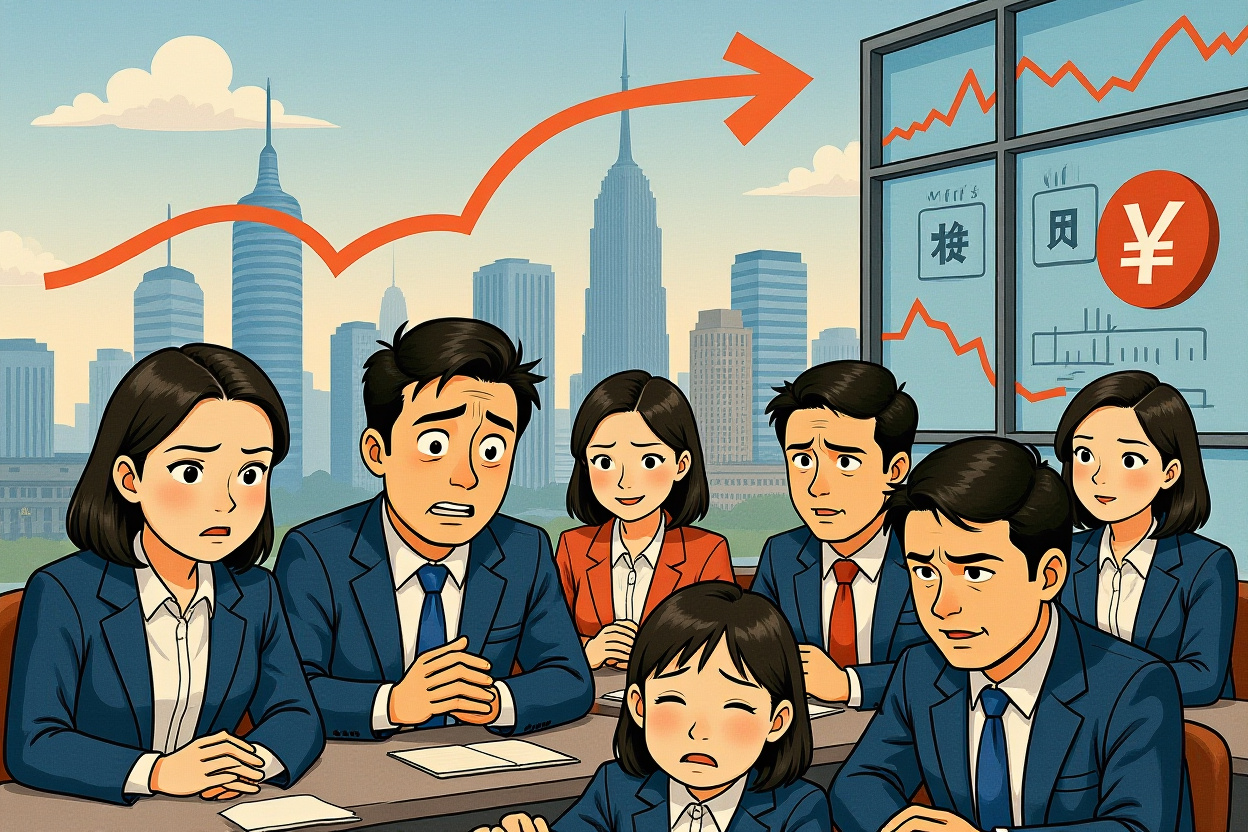
The Persian Gulf’s Shockwaves Crash onto Tokyo’s Shores
A storm brewed in the Middle East, but the financial lightning struck Japan. Following the late-February U.S.-Israel coalition strikes on Iranian targets, the Japanese yen entered a precipitous decline. It tumbled from the 155-yen-per-dollar range straight through the critical 159-yen barrier, settling at its weakest point in nearly 18 months. Against the Chinese renminbi, the yen fell to a record low of 4.32 yuan per 100 yen. This is more than a market fluctuation; it is a stark revelation of deep, structural vulnerabilities within the world’s third-largest economy. The core question for global investors is stark: what does the historic plunge of the yen signal about Japan’s economic future and its ramifications for Asian markets? This analysis delves into the immediate triggers and the decades-long policy failures that have culminated in this moment, exploring the dangerous path Japan may now be forced to take.
The Immediate Trigger: Energy Insecurity and Investor Flight
The direct cause of the yen’s recent collapse is textbook economics disrupted by geopolitics. The conflict in the Persian Gulf damaged critical oil facilities and led to the closure of the Strait of Hormuz, immediately constricting global oil supply and sending prices higher.
Japan’s Achilles’ Heel: Import Dependency
For Japan, a resource-poor island nation, this is a catastrophic scenario. The country relies on the Middle East for 90% to 95% of its oil imports. Furthermore, as an archipelago, nearly all its raw material imports and finished goods exports move by sea. Rising fuel costs directly translate to soaring transportation costs across its entire economy. Investors swiftly connected the dots: prolonged energy insecurity and higher input costs could cripple Japan’s manufacturing base and trigger debilitating domestic inflation. The rational response was a swift and severe sell-off.
– Currency: The yen was dumped en masse.
– Equities: The stock market saw significant outflows.
– Bonds: Government debt also faced selling pressure.
This triple sell-off highlights how quickly investor sentiment can turn against an economy perceived as fundamentally exposed. However, while the Middle East conflict was the spark, the tinder had been piling up for over a decade. This event merely illuminated the long-term, structural decline of the yen’s value and Japan’s economic model.
The Long Descent: From “Safe Haven” to Chronic Weakness
The recent plunge is a dramatic episode in a much longer tragedy. Since the advent of Abenomics in 2012, the yen has been on a persistent downtrend against the U.S. dollar, sliding from around 70 to 120 by 2020, and now sinking further into uncharted territory. The Bank for International Settlements delivered a sobering assessment in early 2026: Japan’s real effective exchange rate index fell to 67.73, its lowest level since the country adopted a floating exchange rate in 1973. The purchasing power of the yen has shrunk to one-third of its peak value 31 years ago.
This represents a profound identity crisis for the currency. For decades, the yen was a premier safe-haven currency. During global crises—the 2008 financial meltdown, the 2011 European debt crisis, the 2020 pandemic panic—investors flocked to the yen, causing it to appreciate sharply. Today, that status is shattered. In times of crisis, the yen now appears to be among the first casualties, not a refuge.
The Domestic Toll: Eroding Purchasing Power and Social Strain
The human and social cost of this devaluation is immense and palpable.
– Inflation Outpaces Wages: Japan’s core consumer price index rose 3.1% in 2025, marking the fourth consecutive year it exceeded the Bank of Japan’s 2% target. Meanwhile, nominal wage growth was a meager 2.3%, meaning real wages and household purchasing power continue to shrink.
– Soaring Cost of Living: Staple goods have become luxury items for many. Egg prices have surged over 50% in three years, beef imports have tripled in price compared to a dozen years ago, and supermarkets have resorted to selling cabbage by the leaf and chicken legs in halves—a practice framed as reducing waste but understood by consumers as a necessity for strained budgets.
– Record Financial Pressure: In 2025, the Engel’s coefficient (the proportion of income spent on food) for households with two or more people hit 28.6%, the highest level in 44 years, driven by skyrocketing food prices.
This economic pressure manifests in deteriorating social indicators, from rising crime rates—which increased from 610,000 incidents in 2020 to 774,000 in 2025, predominantly theft—to public health concerns, shattering the long-held image of Japan as a uniquely safe and orderly society. The yen’s record-breaking decline is not just a number on a screen; it is a force degrading the quality of life for millions.
The Root Cause: A Manufacturing Exodus and the “Lost Decades”
To understand the yen’s weakness, one must examine Japan’s trade. The story is complex, yet its essence is simple: the hollowing out of Japan’s export engine.
Post-World War II, the U.S. established a fixed exchange rate of 360 yen to the dollar to accelerate Japan’s reconstruction. This artificially low rate provided a massive competitive subsidy to Japanese manufacturers, fueling an export boom. For over two decades, Japan’s export trade grew at an average annual rate of 16.8%, double the global average.
The Unraveling: Plaza Accord and Industrial Flight
This success bred friction. The 1985 Plaza Accord, pressured by the U.S., forced the yen to appreciate significantly. Overnight, Japan’s domestic costs, when converted to foreign currency, became exorbitant. Japanese corporations made a rational choice: they moved. Toyota, Nissan, Sony, and other giants shifted production to North America, Europe, and other parts of Asia to be closer to markets or to chase cheaper labor.
This was not just a migration of final assembly lines but of entire upstream supply chains. Once these ecosystems were established overseas, the cost of repatriating them became prohibitive, even if the yen later fell. While Japanese multinationals remained profitable, the domestic industrial base that supported them began to atrophy. Japan’s share of global manufacturing plummeted from over 20% in the late 1980s to around 10% by 2012.
The 21st century compounded the problem. In low-tech goods, China and Southeast Asian nations captured market share with overwhelming scale and cost advantages. In high-value sectors like automobiles, consumer electronics, and home appliances, Chinese firms achieved technological breakthroughs and built competitive clusters, relentlessly eating into the market share of Japanese keiretsu. By 2021, Japan’s share of global manufacturing had dwindled to a mere 6%. This period of industrial decline, stagnant wages, and demographic retreat is what the Japanese famously term the “Lost Decades.”
The Failed Gambit: Abenomics and the Vicious Cycle
It was against this bleak backdrop that former Prime Minister Shinzo Abe (安倍晋三) launched his radical economic program, Abenomics, in 2012. Its logic regarding the yen was straightforward: force it down to revitalize exports.
The Bank of Japan embarked on unprecedented quantitative easing, flooding the market with yen. Simultaneously, it pushed interest rates into negative territory. This dual policy aimed to engineer a sharp currency depreciation. A weaker yen, the theory went, would make Japanese exports cheaper, boost tourism, and end deflation.
The Double-Edged Sword of Devaluation
However, this strategy ignored Japan’s fundamental vulnerabilities. As any economics student knows, currency devaluation makes imports more expensive. For a nation that imports over 90% of its energy and a vast array of food and components due to its hollowed-out industry, this was a critical flaw. The architects of Abenomics hoped that Japan’s technological edge would allow its exports to command high enough premiums to offset rising import costs.
The results have been disastrous. The yen’s record-breaking decline did not spark an export renaissance. Instead, Japan’s trade balance turned structurally negative. In fiscal year 2024, the trade deficit ballooned to 5.22 trillion yen.
– Stagnant Exports: Japanese products continued to lose ground in key markets.
– The “Digital Deficit”: Japan’s failure in the digital revolution created a massive new import bill for IT services and software. In 2024, the digital trade deficit hit a record 6.46 trillion yen, single-handedly negating surpluses from other sectors.
This created a vicious, self-reinforcing cycle: trade deficits pressure the yen to stay weak; a weak yen raises import costs, worsening the trade balance by making essential imports more expensive, without a corresponding boost in export volume. The policy meant to cure Japan’s ills has exacerbated them.
The final blow came from Japan’s closest ally. The U.S. Federal Reserve’s aggressive interest rate hikes from 2022 onward, aimed at controlling domestic inflation, widened the yield gap with Japan’s near-zero rates to a historic chasm. This turbocharged the “carry trade,” where investors borrow cheap yen to buy higher-yielding dollar assets, accelerating the yen’s fall from a policy-driven devaluation into a speculative rout. The Bank of Japan finds itself in a policy trap: it cannot ask the Fed to stop, and raising its own rates significantly would catastrophically increase the servicing cost on the national debt, which stands at a staggering 1,342 trillion yen.
The High-Stakes Pivot: Betting the Nation on Arms Exports
The fundamental equation is clear: to save its currency, Japan must revive its export economy. With its traditional industries under siege, it is seeking a new, desperate solution—transforming into a major arms exporter.
This is not a far-fetched notion. Japan’s military-industrial base, preserved within conglomerates like Mitsubishi Heavy Industries (三菱重工業), Kawasaki Heavy Industries (川崎重工業), and IHI Corporation (石川島播磨重工), never fully atrophied. For decades, Japan’s Self-Defense Forces have paid exorbitant premiums for domestically produced weapons to keep this capacity alive.
Becoming America’s Arsenal in Asia
The inefficiency of Western defense contractors, starkly exposed by the war in Ukraine and Middle East tensions, has created an opportunity. Japan’s industrial discipline and precision manufacturing are now seen as assets.
– Supply Chain Integration: Japanese firms are already key suppliers for advanced U.S. systems like the F-35 fighter jet, providing critical engine components and radar modules.
– Missile Production: With U.S. stockpiles depleted, Mitsubishi is now producing Patriot missile interceptors for export to America, with plans to build air-to-air and cruise missiles.
– Formalized Partnership: In April 2024, the U.S. and Japan established a “Defense Industrial Cooperation, Acquisition and Sustainment (DICAS) Forum,” formally integrating Japanese industry into the U.S. defense maintenance and production network.
The payoff is significant. In 2024, sales at Japan’s top five defense contractors surged 40% year-on-year to $133 billion (approx. 20 trillion yen). The Japanese government now optimistically forecasts that by 2030, defense equipment could become the nation’s third-largest export sector after automobiles and electronics.
The Political Price and China’s Countermove
This strategic pivot comes with immense political costs. To become a trusted arms merchant for the West, Japan must bind itself ever closer to U.S. strategic interests, acting as a frontline state in Asia. Domestically, it must continue to dismantle its pacifist legal framework, notably the “Three Principles on Arms Exports,” which currently restrict sales to conflicts and limit end-use.
China, recognizing this gambit, has moved decisively to counter it. In a significant escalation, Beijing placed 20 Japanese entities—including Mitsubishi, Kawasaki, and IHI—on its export control list in February, banning the export of dual-use materials and components critical for advanced manufacturing. This is a direct challenge to the viability of Japan’s defense production ramp-up, testing how deeply reliant these “Japanese” systems are on Chinese industrial inputs. The message is clear: if Japan chooses to become an arsenal for a containment strategy, China will leverage its dominance in the foundational layers of the global supply chain.
This confrontation marks a dangerous new phase. Japan’s attempt to escape its economic malaise through militarized exports directly collides with China’s core strategic interests, ensuring that future volatility in the yen’s exchange rate will be inextricably linked to geopolitical tensions in the Indo-Pacific.
A Currency Adrift in a Sea of Challenges
The yen’s plunge to historic lows is a symptom, not the disease. The disease is a 30-year erosion of industrial competitiveness, compounded by a monetary policy that addressed the symptoms of deflation while neglecting the patient’s fundamental frailty: a crippling dependency on imports for survival. The Middle East conflict was merely the catalyst that exposed these vulnerabilities to a ruthless market.
Japan now stands at a perilous crossroads. Its planned economic salvation through arms exports is a high-risk, high-reward strategy that could provide a temporary export boost but at the cost of deeper regional instability and a triggering of supply chain countermeasures from China. For global investors, the implications are profound. The yen can no longer be considered a reliable safe haven. Its trajectory will be a key barometer of Japan’s success in navigating its structural crises and of the escalating tech-industrial competition between China and the U.S.-aligned bloc in Asia.
Monitoring Japan’s trade data, particularly the balance between traditional goods and nascent defense exports, along with the political maneuvering around its constitutional constraints, will be essential. The era of a predictably weak yen managed by the Bank of Japan is over. We have entered an era where the currency will be buffeted by the twin storms of geopolitics and a desperate national economic strategy. Investors in Asian equities must now price in this new source of systemic risk emanating from one of the region’s largest economies.