



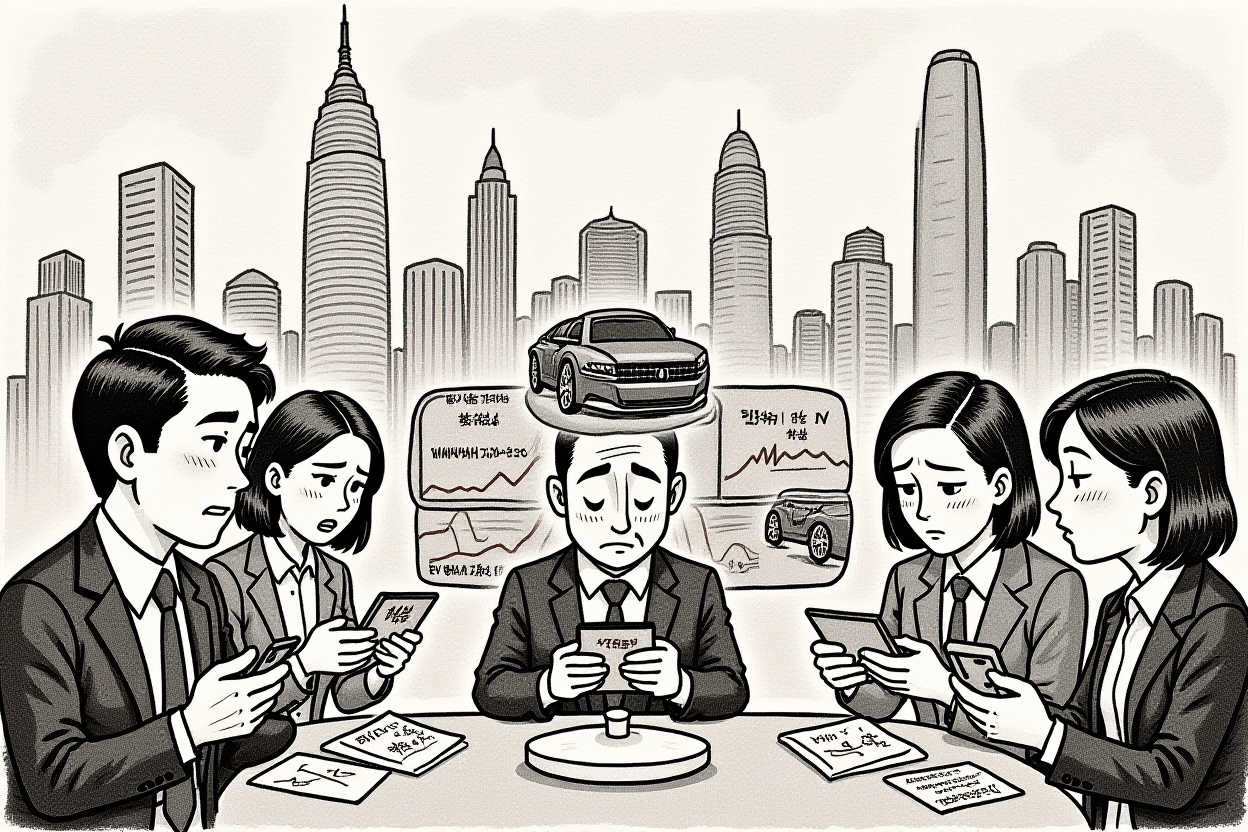
Li Auto’s Q4 2025 net profit crashed 93.2%, exposing fierce competition, technological shortcomings, and management turmoil in China’s new energy vehicle sector. This analysis delves into the root causes and broader implications for investors.
Executive Summary: The Core Takeaways
Key Insights from Li Auto’s Financial Collapse
– Li Auto, once the profitability leader among China’s EV startups, reported a 93.2% year-over-year net profit plunge in Q4 2025, with revenue down 35%.
– Annual vehicle deliveries fell 18.81% to 406,000 units, significantly missing its 640,000 target, highlighting severe sales stagnation.
– The crisis stems from intense market competition, reliance on outdated extended-range technology, and failed internal management reforms.
– This event serves as a microcosm for the entire new energy vehicle (NEV) industry, signaling the end of easy growth and the start of a brutal consolidation phase.
– Investors must reassess the sustainability of business models in China’s EV sector, focusing on technological innovation and adaptive management.
The Unraveling of a Former Star Performer
For years, Li Auto (理想汽车) stood apart in the crowded field of Chinese electric vehicle startups. As rivals burned cash in pursuit of scale, Li Auto carved a profitable niche by meticulously targeting family users with its spacious SUVs and leveraging extended-range electric vehicle (EREV) technology to alleviate range anxiety. It was hailed as a template for sustainable growth in the capital-intensive automotive sector. However, the final quarter of 2025 delivered a brutal reality check, marking a stark reversal of fortune for the company. The focus phrase, Li Auto’s profit plummet, is not just a quarterly anomaly but a symptom of deeper strategic failures that have left the company struggling to maintain control in a rapidly evolving market.
Q4 2025: The Numbers Behind the Crash
The financial figures for the quarter ending December 31, 2025, are alarming. Revenue collapsed to 28.775 billion yuan, a 35% decrease from the same period in 2024. More devastating was the net profit, which cratered 93.2% to a mere 274 million yuan, teetering on the edge of unprofitability. This Li Auto’s profit plummet was compounded by a full-year delivery tally of 406,000 vehicles, an 18.81% annual decline. Notably, Li Auto was the only major NEV startup to report negative sales growth among peers like Nio (蔚来) and XPeng (小鹏汽车). The company achieved only 63.48% of its ambitious 640,000-unit annual target, leaving a gap of over 230,000 vehicles—a clear signal that demand had fundamentally softened.
From Model Recall to Market Reality
While the costly recall of its flagship MEGA multi-purpose vehicle served as an immediate trigger—draining profits through warranty costs, brand damage, and production disruption—it merely accelerated an inevitable downturn. Even without this event, analysts note that warning signs of slowing sales and eroding margins were evident throughout 2025. The core issue remains simple: the cars stopped selling at the expected pace. This Li Auto’s profit plummet underscores that the company’s historical playbook is no longer effective in a transformed competitive landscape.
A Red Ocean of Competition: The External Squeeze
The Chinese new energy vehicle market in 2025 is a world apart from the nascent industry Li Auto successfully navigated earlier. The sector has matured into a hyper-competitive red ocean where differentiation is increasingly difficult. Li Auto’s once-unique selling propositions of “spacious family comfort” and “no range anxiety” have been systematically replicated and improved upon by a swarm of rivals.
The Proliferation of Direct Challengers
– Traditional OEM Offensives: Legacy automakers like BYD (比亚迪), Geely’s Zeekr (极氪), and SAIC’s IM Motors (智己汽车) have launched compelling, feature-rich SUVs directly targeting the premium family segment Li Auto once dominated.
– New Energy Rivals Ramping Up: Nio (蔚来) solidified its product matrix and enhanced its battery-swap network, locking in high-end users. XPeng (小鹏汽车) doubled down on advanced driver-assistance systems (ADAS), building a formidable reputation for smart technology.
– The Price and Configuration War: An intense battle on pricing, interior tech, and luxury amenities has erupted, giving consumers an overwhelming array of choices. According to data from the China Association of Automobile Manufacturers (中国汽车工业协会), the average discount on NEVs priced above 300,000 yuan increased by 15% year-over-year in 2025.
Dilution of Core Competencies
Li Auto’s failure to innovate beyond its initial formula left it vulnerable. As competing products offered similar space and comfort while also boasting superior pure-electric range, faster charging, or more advanced infotainment, the brand’s halo dimmed. Consumer loyalty, once strong, fragmented as buyers no longer saw sufficient reason to choose a Li Auto vehicle over a growing list of alternatives. This market saturation directly fed the sales decline that precipitated the Li Auto’s profit plummet.
The Technological Trap: Extended-Range’s Growing Obsolescence
Perhaps the most critical internal flaw exposed in 2025 is Li Auto’s heavy reliance on extended-range (增程) technology. While this powertrain—which uses a gasoline engine as a generator to charge the battery—provided a clever workaround for China’s underdeveloped charging infrastructure in the early 2020s, it is increasingly viewed as a transitional solution with significant long-term drawbacks.
Mounting Disadvantages in a Pure-EV World
The limitations of EREV technology have become glaring in key areas that affect consumer purchase decisions:
– Charging Speed Lag: While pure-electric competitors achieve 10-15 minute fast-charging for hundreds of kilometers of range, Li Auto’s EREV models have not kept pace. Their peak charging power remains subpar, making long-distance travel less convenient compared to latest-generation BEVs.
– Higher Total Cost of Ownership: EREV owners face the maintenance burdens of both an internal combustion engine and an electric powertrain. Over a 5-year period, estimated maintenance costs for a Li Auto model can be 30-40% higher than for a comparable pure-electric vehicle, eroding its value proposition.
– Abysmal Resale Value: The二手车市场 (used car market) has turned cold on EREVs. Dealers report offering 20,000-30,000 yuan less for used Li Auto vehicles compared to similar-age BEVs, with inventory turnover taking three months or longer. This steep depreciation is a major deterrent for cost-conscious buyers.
The Strategic Imperative for a Pure-Electric Pivot
Li Auto’s slow rollout of dedicated pure-electric platforms, such as its upcoming high-voltage architecture, has left it playing catch-up. The company’s earlier bet that EREV would remain relevant for a decade now appears misguided. The market’s rapid shift toward pure electrification, supported by expanding ultra-fast charging networks backed by state grid companies like State Grid (国家电网), has made EREV’s compromises less acceptable. This technological stagnation is a core reason behind the Li Auto’s profit plummet, as consumers vote with their wallets for more future-proof options.
Internal Disarray: Management Experimentation and Its Aftermath
Compounding external pressures, Li Auto has been grappling with significant internal turbulence. As the company scaled, founder and CEO Li Xiang (李想) initiated a transition to a professional manager-led structure around 2022, aiming to instill corporate discipline and processes suited for a large automaker.
The Failed Professional Manager Model
This three-year experiment in corporate governance ultimately fractured. Insiders reported conflicts between the entrepreneurial founding team and hired executives over product roadmap priorities and cost controls. The lack of cohesive strategy during this period is cited by analysts as a factor in the delayed response to competitive threats. In a stunning admission during the November 2025 earnings call, Li Xiang (李想) declared the model a failure and announced a full return to “startup-style” management rhythms, emphasizing speed and agility over bureaucracy.
Leadership in Crisis Mode
The announcement has not instantly stabilized the organization. As of early 2026, the company remains in a state of flux, with ongoing restructuring and refocusing efforts. The management upheaval has undoubtedly consumed executive attention and resources at a time when relentless execution is required to navigate the market downturn. This internal uncertainty has further eroded investor confidence, amplifying the negative sentiment following the Li Auto’s profit plummet.
Broader Implications: A Wake-Up Call for China’s NEV Sector
Li Auto’s dramatic stumble is far from an isolated incident. It represents a pivotal moment for China’s entire new energy vehicle industry, which is transitioning from a subsidy-driven growth phase to a maturity defined by consolidation, technological sophistication, and profitability pressures.
The End of the ‘Easy Growth’ Era
The era where a startup could ride a single compelling insight or technology differentiation to rapid growth and market share is over. The China EV market is now characterized by:
– Intense Margin Compression: Widespread price wars, as seen in initiatives led by BYD (比亚迪) and Tesla (特斯拉), are squeezing profitability across the board.
– Regulatory Scrutiny: Bodies like the Ministry of Industry and Information Technology (工业和信息化部) are enforcing stricter data security and production standards, increasing compliance costs.
– Capital Market Caution: After years of exuberant funding, investors are becoming more selective, demanding clear paths to profitability and sustainable moats. The performance of Li Auto’s stock on the Hong Kong Exchange reflects this heightened scrutiny.
Lessons for Investors and Executives
For global institutional investors and fund managers, the Li Auto’s profit plummet serves as a critical case study. It underscores the necessity of evaluating Chinese EV players not just on delivery volumes, but on:
1. Technological Roadmap Resilience: How adaptable is the company’s core technology to industry shifts?
2. Brand Equity and Pricing Power: Can the brand command a premium in a commoditizing market?
3. Operational and Cost Efficiency: Is the manufacturing and supply chain structure lean enough to withstand price competition?
4. Management Cohesion and Vision: Does leadership have a clear, unified strategy for the next phase of competition?
Navigating the Road Ahead: Can Li Auto Regain Control?
Confronted with this multifaceted crisis, Li Auto has been forced to initiate a painful self-reinvention. Its survival and potential recovery hinge on the execution of several critical maneuvers.
Accelerating the Pure-Electric Transition
The company must rapidly advance and market its next-generation pure-electric vehicles. Any delay risks permanent relegation in consumer perception. Success requires not just launching new models, but ensuring they offer competitive specifications in battery energy density, charging speed, and software-defined features. Partnerships with battery giants like Contemporary Amperex Technology Co. Limited (CATL, 宁德时代) will be crucial.
Strategic Refocusing and Cost Rationalization
Li Auto has announced a return to its entrepreneurial roots, implying a leaner organization with faster decision-making. This must be coupled with a ruthless reassessment of product lineup and marketing spend to reconnect with core family users. Furthermore, optimizing its direct sales and service network, a significant cost center, is essential to protect remaining margins. The company’s ability to manage this delicate balance between investment and austerity will directly impact whether the Li Auto’s profit plummet is a one-time event or a trend.
The Imperative for Continuous Evolution
The stark message from Li Auto’s disastrous quarter is that past success guarantees nothing in China’s ferociously competitive automotive landscape. The company’s future depends on its capacity to learn from this profit plummet, shed complacency, and innovate with the urgency of a challenger once more. This means embracing software excellence, exploring new mobility services, and potentially forging alliances to share the burdens of R&D and scale.
Synthesis and Forward-Looking Guidance
The 93% profit collapse at Li Auto is a watershed moment, signaling a profound shift in China’s new energy vehicle industry dynamics. It demonstrates that even well-regarded, previously profitable players are not immune to the forces of technological disruption, market saturation, and internal misalignment. The Li Auto’s profit plummet should be interpreted as a clear indicator that the industry’s shakeout phase has intensively begun. For market participants, the key takeaway is that investment theses must now be built on robust technological moats, operational excellence, and agile management—not merely on narrative or historical growth trajectories. Monitor Li Auto’s execution on its pure-electric pivot and cost-restructuring efforts in the coming quarters as a bellwether for the sector’s health. For all stakeholders in Chinese equities, maintaining a disciplined focus on fundamentals and sustainable competitive advantages has never been more critical.