



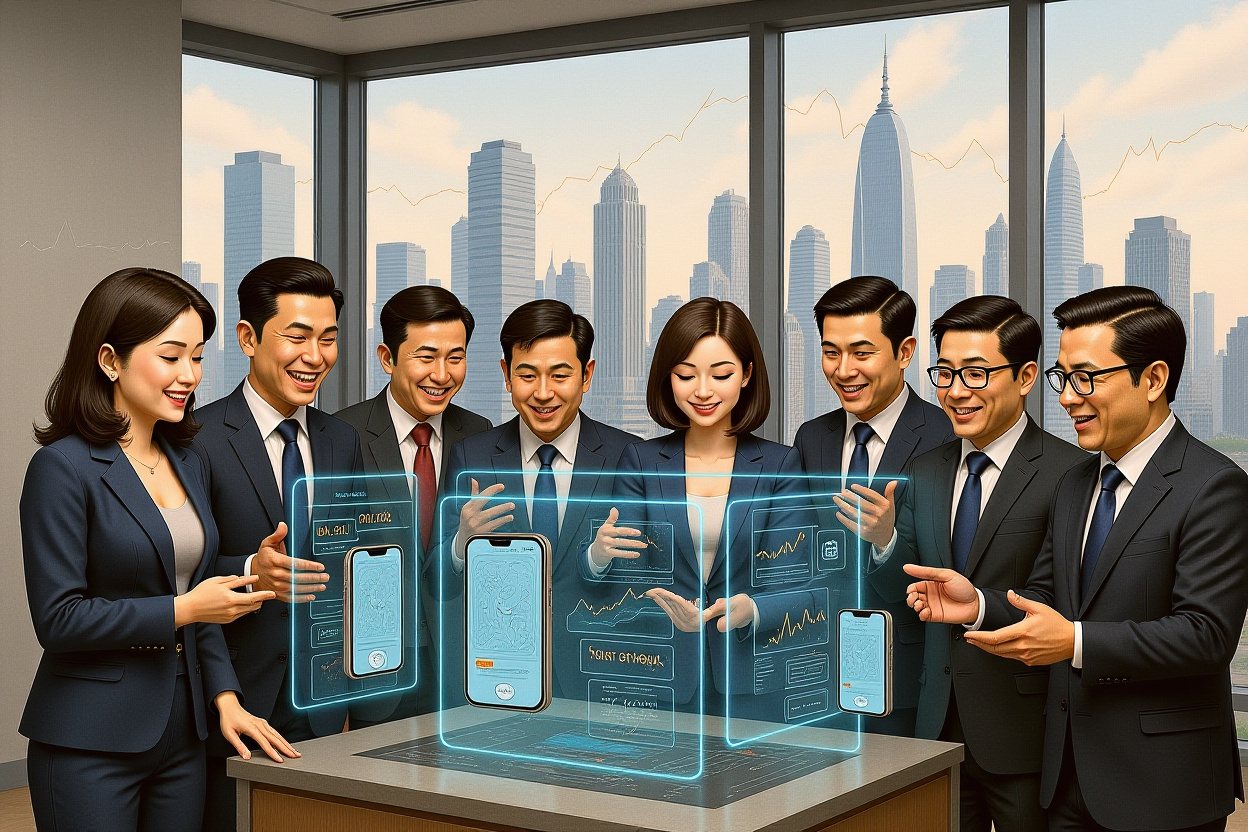
– The smartphone industry is experiencing its most significant price increases in five years, driven by soaring storage chip costs and broader supply chain pressures.
– Mid to low-end segments are most affected, forcing brands like OPPO and vivo to adjust strategies, while smaller players face existential threats.
– AI integration emerges as a critical new battleground, with innovations like GUI Agents and ecosystem partnerships defining future competitiveness.
– Market consolidation accelerates, with top brands leveraging scale to navigate costs, and the 2026 smartphone market transformation hinges on balancing price sensitivity with technological advancement.
A Sudden Surge Rocks the Smartphone Landscape
The year 2026 has ushered in a seismic shift for the global smartphone industry, marked by the most widespread and aggressive price hikes witnessed in nearly half a decade. In a move that caught many industry watchers off guard, leading Chinese manufacturers OPPO and vivo simultaneously announced substantial increases to their suggested retail prices in mid-March. This coordinated action signals a profound change in market dynamics, directly impacting consumers and investors alike. The 2026 smartphone market transformation is now unmistakably underway, driven by relentless cost pressures and a frantic search for new growth engines beyond traditional hardware specs.
On March 16, OPPO’s official website updated prices for several models, with increases ranging from 200 to 500 Chinese Yuan. Devices like the OnePlus 15 and Ace 6 saw notable jumps. Not to be outflanked, vivo and its sub-brand iQOO issued a formal notice the same day, confirming price adjustments effective March 18. This isn’t an isolated incident but a symptom of a deeper, industry-wide recalibration. As component costs spiral, the entire value chain is under strain, forcing manufacturers to make difficult decisions that will reshape competitive landscapes and consumer choice for years to come.
Anatomy of the Cost Crisis: Why Prices Are Skyrocketing
The primary catalyst for this pricing upheaval is a severe and sustained increase in the cost of core components, most critically memory chips. Storage is a non-negotiable element in every smartphone, from budget devices to flagship models. However, the explosive growth in artificial intelligence (AI) and high-performance computing has created a massive demand shock. Chipmakers are prioritizing production for data centers and AI training clusters, drastically squeezing the supply available for consumer electronics like smartphones.
The Storage Chip Squeeze and Its Ripple Effects
Industry executives have been vocal about the unprecedented speed of this cost inflation. Lu Weibing (卢伟冰), Partner and President of Xiaomi Group, highlighted in a recent interview that storage chip quotes for Q1 2026 are nearly four times higher than they were in the same period last year. This isn’t a minor fluctuation but a structural shift. According to analysis from Counterpoint Research, the cost contribution of memory in entry-level smartphones priced around $150 could soar to 43%. For mid-range and flagship devices, the proportions are similarly elevated, fundamentally altering product economics.
The pain extends beyond memory. Other essential components are also on the rise:
– High-end OLED display panels, crucial for premium devices.
– High-density batteries required for longer battery life.
– Advanced thermal materials needed to manage heat from powerful processors.
This constitutes a full-industry cost uplink cycle. Supply chain intelligence suggests that major memory suppliers like Samsung Electronics and SK H力士 (SK Hynix) have notified clients of further planned price increases for DRAM, particularly DDR5颗粒 (DDR5颗粒), in Q2 2026, with hikes estimated around 40%. Most analysts project this inflationary trend will persist through 2027, indicating that the 2026 smartphone market transformation is based on long-term, not temporary, factors.
Segmented Impact: From Budget to Flagship
The impact of these cost pressures is not uniform across market segments. Brands are making strategic choices on where to absorb costs and where to pass them on. OPPO’s initial adjustments focused on its A and K series, which occupy the 1000-2500 Yuan price bracket. This tactical move recognizes that while users in this segment are price-sensitive, they also have lower brand loyalty, making small increases more palatable for cost recovery.
Even the high-end market is not immune. While Honor maintained the starting price for its flagship foldable, the Magic V6, it raised the price of higher-storage configurations by 1000 Yuan. As Yuan Shuai (袁帅), Co-initiator of the New Zhi派 New Quality Productivity Salon, notes, flagship models represent brand image; stabilizing their prices is crucial for maintaining a foothold in the premium segment, even if it means compressing margins or adjusting auxiliary models.
Market Reshuffling: Consolidation and the Survival Challenge
The ongoing price surge is acting as a powerful accelerant for market consolidation. China’s smartphone market has been a red ocean of存量竞争 (stock competition) for years, with shipment volumes stagnating or declining slightly. IDC data shows 2025 shipments in China were approximately 285 million units, a 0.6% year-over-year decrease. Broad-based price increases threaten to further dampen replacement cycles, especially among cost-conscious consumers. This creates a daunting environment for mid-tier and smaller manufacturers who lack the scale, supply chain clout, and brand equity of the top players.
The Exit of Weaker Players
The top six brands—Huawei, OPPO, vivo, Xiaomi, Honor, and Apple—command over 80% of the domestic market share. This leaves scant room for others. In February 2026, Meizu announced it was suspending in-house research and development for new phone models in China, a stark signal of the intense pressure. This move is perhaps the most emblematic exit in the current wave of industry rationalization.
For other niche brands like Nubia or Red Magic (under ZTE), survival hinges on differentiated strategies and the financial backing of their parent companies. Their ability to negotiate favorable component pricing or pivot quickly to new technologies will be severely tested during this prolonged cost hike. The 2026 smartphone market transformation is, in part, a Darwinian process where only the most resilient and adaptable will endure.
Strategic Responses from the Leaders
Faced with this dual challenge of rising costs and softening demand, leading brands are not standing still. Xiaomi’s founder Lei Jun (雷军), speaking after the recent ‘Two Sessions’ political meetings, acknowledged the pressure and stated the company would ‘explore all methods to minimize the difficulty for consumers to accept (price increases).’ This could involve innovative financing options, trade-in programs, or a renewed focus on software and services to offset hardware margin compression. The strategies deployed now will define market positions for the next cycle.
AI as the New Frontier: Beyond Hardware Specifications
With margins under pressure from component costs and consumer fatigue over incremental camera or battery improvements, the industry’s quest for a new growth vector has converged on artificial intelligence. The goal is no longer to build a better tool but to create an ‘AI智能体 (AI agent)’—a proactive, context-aware assistant that lives on the device. This shift is central to the 2026 smartphone market transformation, offering a path to differentiated value and renewed consumer interest.
Collaborative Models vs. Closed Ecosystems
The race to integrate AI has spawned different approaches. For smaller players with limited market share, partnering with established AI model providers offers a fast track to relevance. A prime example is the ‘Doubao Phone’—a device developed by ByteDance in collaboration with ZTE’s Nubia brand, featuring deep integration of ByteDance’s Doubao large language model. Priced at 3499 Yuan, its limited release sold out rapidly, and even sparked a rise in ZTE’s stock price.
Ni Fei (倪飞), CEO of Nubia, has publicly stated that the trend toward AI phones is irreversible and views ‘开放合作 (open cooperation)’ as a key path forward. For brands like Transsion or Lenovo, which have smaller domestic footprints, similar licensing models—where they pay a technology fee to embed an AI service—present a cost-effective way to join the AI era without massive R&D investment.
In contrast, giants with vast ecosystems like Huawei, Xiaomi, and OPPO are pursuing a different route. They are focused on developing and controlling their own on-device AI capabilities and system-level assistants, such as Huawei’s Xiaoyi, Xiaomi’s integrated AI in HyperOS, and OPPO’s Andes model. This strategy prioritizes ownership of the user experience and data, but requires immense resources and deep vertical integration.
Technical Pathways and the Privacy Conundrum
The Doubao Phone gained significant attention for its use of a GUI Agent—a system that allows the AI to ‘see’ the screen and simulate taps, swipes, and inputs to perform multi-step tasks across different apps autonomously. This enables complex actions like comparative shopping or booking tickets through voice commands alone (with only the final payment step requiring manual confirmation).
However, this approach requires deep system permissions and has ignited serious privacy and security debates. Major platforms including Alibaba’s Taobao and Tencent’s WeChat have reportedly blocked or flagged access from devices using such模拟操作 (simulated operation) techniques, fearing they mimic the behavior of malicious scripts or bots. Security experts are divided; some see it as a solvable technical challenge, while others warn of inherent risks like fraud or data leakage.
The alternative technical route, exemplified by Huawei and OPPO’s A2A (App-to-Agent) approach, relies on standardized application programming interfaces (APIs). This method is more stable and secure but depends entirely on app developers opening their functionalities to the phone’s AI—a significant ecosystem challenge. The battle to build the most compelling and trustworthy AI experience is now a core part of the 2026 smartphone market transformation.
The Road Ahead: Innovation, Ecosystems, and Endurance
Looking forward, the competitive dynamics of the smartphone industry will be dictated by a trifecta of factors: managing cost pressures, delivering groundbreaking AI experiences, and fostering expansive ecosystems. The 2026 smartphone market transformation is pushing companies to innovate on multiple fronts simultaneously. Some are even rethinking hardware form factors; Honor’s recent ROBOT Phone prototype, with a gimbal-stabilized camera that works in concert with its AI agent, points to a future where hardware actively enables smarter software.
Key Factors for Success
The winners in this new era will likely be those who excel in several areas:
– Supply Chain Mastery: The ability to secure components at viable costs through scale, long-term contracts, or strategic investments.
– AI Differentiation: Developing or accessing unique on-device AI capabilities that offer tangible, daily utility to users while navigating privacy concerns.
– Ecosystem Depth: Creating or participating in a broad network of services and applications that enhance the core device experience, breaking down ‘应用孤岛 (app silos)’.
– Brand Resilience: Maintaining consumer trust and loyalty even as prices rise, potentially through enhanced software support, sustainability initiatives, or exclusive services.
Synthesizing the Market Shift
The simultaneous price hikes by OPPO and vivo are not merely a pricing adjustment but a bellwether for profound industry change. The era of competing solely on specs per dollar is fading. The path forward is fraught with challenges—from prolonged component inflation to the complexities of AI integration—but it also brims with opportunity for those who can innovate. The 2026 smartphone market transformation will separate trend-followers from true visionaries.
For investors and industry professionals, close monitoring of quarterly supply chain reports, AI partnership announcements, and market share shifts is crucial. The companies that successfully balance cost control with aggressive investment in next-generation intelligent experiences will likely emerge as the leaders of the next decade. The call to action is clear: look beyond the sticker shock and analyze the underlying strategies in R&D, ecosystem building, and supply chain management to identify the resilient players poised to thrive in this transformed landscape.