



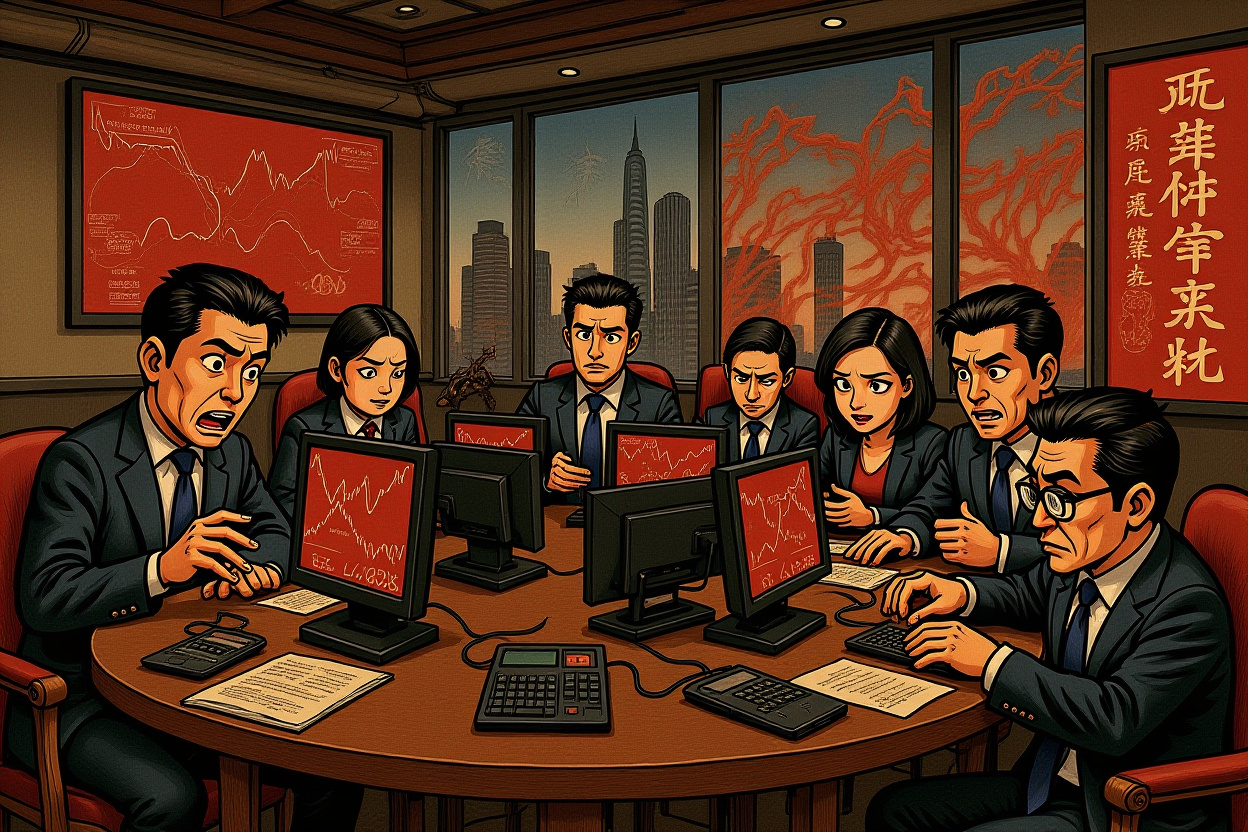
– Markets experienced extreme volatility with Brent crude oil surging over 30% and major Asian indices like Korea’s KOSPI plummeting by record margins.
– Traditional safe-haven assets, including gold and U.S. Treasuries, failed to provide protection as inflation fears driven by energy prices took precedence.
– Veteran traders emphasize that in such environments, a single misstep can lead to losses of $1 million in seconds, requiring constant screen vigilance and adapted risk management.
– Asian currencies, including the Indian Rupee and Indonesian Rupiah, hit historic lows, highlighting the region’s acute vulnerability to energy-driven shocks.
– The event underscores a new market paradigm where geopolitical flashpoints can trigger whipsaw price actions globally, with significant implications for Chinese equity market correlations and international portfolio strategy.
The Midnight Wake-Up Call: Panic Grips Global Trading Desks
At 1 AM London time, the market’s frenzy jolted Michael Brown (迈克尔·布朗) from sleep. His phone, placed on the nightstand, buzzed incessantly with alerts: Brent crude breaching $100 per barrel; then $110; Nasdaq futures down 2%; the Nikkei index collapsing 5%. The senior strategist at brokerage Pepperstone rolled out of bed, powered on his computer, and was immediately engulfed by a flood of calls from anxious clients across Asia. A palpable sense of panic had already taken hold.
This scene played out simultaneously in trading rooms worldwide. According to Bloomberg (彭博社), investor fear briefly propelled oil prices more than 30% higher. In Singapore, Gerald Gan (杰拉尔德·甘), Chief Investment Officer at Reed Capital Partners, was also roused by the turmoil. With clients facing substantial equity losses, his team needed urgent guidance, calling him repeatedly before dawn with pleas to protect portfolios. The opening salvo of the Middle East conflict had triggered a global financial tremor, demonstrating how swiftly crisis can travel from geopolitical hotspots to brokerage screens.
Oil’s Overnight Explosion and Immediate Ripple Effects
The initial shockwave was most visceral in the commodities complex. In the U.S. oil patch, veteran trader Dennis Kisler (丹尼斯·基斯勒) faced a different kind of frenzy. Many of his clients at BOK Financial Securities were executives from shale oil producers, increasingly eager to lock in soaring prices as crude rocketed in overnight trade. From the moment he walked into his Oklahoma City office at 6 AM Monday, orders piled up, forcing him to juggle multiple phone lines simultaneously. By noon, his voice was hoarse.
The data painted a stark picture of the volatility. Beyond oil, European natural gas futures soared 68% in just two days. This kind of move creates a punishing environment where, as Kisler noted, losing focus or being on the wrong side of a trade can mean two seconds to lose $1 million. The speed of the price action was unprecedented, catching even seasoned professionals off guard and setting the tone for a week where market fundamentals were overtaken by headline risk.
The Anatomy of a Modern Market Meltdown: Velocity and the Whipsaw Effect
What stunned participants was not just the scale of the moves, but their violent reversals—a phenomenon traders call the “whipsaw effect.” Markets convulsed on news, even when it was erroneous. For instance, U.S. WTI crude futures nearly erased a 31% gain in one day after a political comment hinted at conflict de-escalation, marking the largest intraday reversal in at least four decades. Similarly, the S&P 500 rallied sharply in the final hour of one session, logging its biggest gain in a month on shifting sentiment.
This environment means that fortunes can be made and lost with breathtaking speed. Major financial firms, including PIMCO (品浩), Citadel (城堡), and ExodusPoint Capital Management, were reported to have been caught in the crossfire. The core lesson for institutional investors is that liquidity can vanish and correlations can break down in an instant, making traditional models inadequate. The phrase two seconds to lose $1 million evolved from trader hyperbole into a stark operational reality.
Case Study: When Headlines Override Fundamentals
A telling example occurred when a social media post from a U.S. official about naval activity in the Strait of Hormuz briefly reignited market anxiety. This highlights a critical vulnerability: in the digital age, unverified information can trigger automated selling or buying algorithms, exacerbating swings before human traders can react. For portfolio managers, this necessitates a real-time news monitoring apparatus that goes beyond traditional financial wires, incorporating geopolitical intelligence feeds and social media sentiment analysis.
Asian Markets in the Crosshairs: Currencies and Equities Under Siege
While the shock was global, Asian financial markets proved particularly vulnerable due to the region’s heavy dependence on Middle Eastern energy imports. The Indian Rupee and Egyptian Pound plummeted to record lows. More dramatically, South Korea’s KOSPI index nosedived over 7% on March 3, followed by a historic 12% plunge the next day, before paring some losses in wildly volatile sessions. Indonesia’s Rupiah and the Philippine Peso also faced intense pressure.
For Gerald Gan (杰拉尔德·甘) in Singapore, it was akin to riding a rollercoaster. He adopted a marathon trading schedule, online by 6 AM and often watching screens until 2 AM the next morning. The direct transmission channel is clear: soaring oil import bills worsen trade deficits, pressure currencies, and force central banks into difficult choices between supporting growth and defending their exchange rates. This, in turn, impacts corporate earnings and equity valuations, creating a feedback loop of negativity for Asian stocks.
The Korean Stock Market Meltdown: A Symptom of Systemic Stress
The record collapse in the KOSPI was not an isolated event but a symptom of broader stress. Korean markets, with significant foreign investor participation and export-oriented economies, are highly sensitive to global risk appetite and input cost shocks. The precipitous drop triggered circuit breakers and forced a reassessment of risk models that may have underestimated tail-risk scenarios linked to Middle Eastern geopolitics. For international funds with exposure to Asia, the episode served as a brutal reminder of concentration risk and the need for robust regional hedging strategies beyond simple currency forwards.
The Great Safe-Haven Failure: Redefining Crisis Hedging
One of the most confounding features of the sell-off was the simultaneous failure of traditional refuge assets. Gold, the Japanese Yen, the Swiss Franc, and U.S. Treasury bonds—all typically sought in times of crisis—stumbled. The reason was a powerful reinvestment of inflation fears. Skyrocketing energy prices threatened to re-ignite price pressures globally, pushing interest rate expectations higher and thus undermining fixed-income securities.
Raymond Li (雷蒙德·李), Chief Investment Officer at Sydney’s Torica Capital, experienced this firsthand. He had positioned in U.S. Treasury futures as a hedge, only to see them fall further as oil spiked. Concluding that the bond market had effectively become an extension of the oil market, with yields moving in lockstep with crude prices, he ordered his traders to exit the positions. This paradigm shift suggests that in a world prioritizing inflation containment, the old playbook for crisis hedging is obsolete. Investors now must consider assets that hedge against both geopolitical risk and its inflationary consequences, a far more complex calculus.
The Bond Market-Oil Correlation: A New Macro Driver
The tight correlation observed between oil prices and Treasury yields presents a significant challenge for balanced portfolios. When energy shocks are perceived as persistent, they compel central banks to maintain or even tighten monetary policy, directly opposing the typical crisis-response of cutting rates. This dynamic flips the script for asset allocation, potentially making certain commodity-linked equities or inflation-protected securities more effective hedges than sovereign bonds in the current cycle.
Trader Survival Guide: Enduring the 24/7 Storm
Veterans like Dennis Kisler (丹尼斯·基斯勒), who cut his teeth in the Chicago Mercantile Exchange pits during the 1990 Gulf War, draw on decades of experience. His directive to his team was simple: maintain full staffing and constant vigilance. One practical tip he offers: moderate coffee and water intake to minimize bathroom breaks. “You never let your eyes leave the screen,” he stresses. This level of dedication underscores that modern market crises are fought in real-time, across all time zones, with no room for error.
The psychological toll is immense. The emotional whipsaw, as Pepperstone’s Michael Brown (迈克尔·布朗) described, is exhausting: one minute thinking progress is being made, the next minute seeing news reverse and all positions turn red. Effective firms are now investing not just in technology but in trader wellness programs and structured shift patterns to prevent burnout during extended periods of high volatility where the risk of a mistake leading to two seconds to lose $1 million is ever-present.
Risk Management Recalibration for Funds and Institutions
For institutional investors and fund managers, this episode mandates a recalibration of risk frameworks. Key adjustments include:
– Stress testing portfolios against simultaneous energy spikes and equity corrections, particularly for Asia-heavy allocations.
– Reviewing leverage and margin requirements to ensure survival during periods of extreme volatility and potential liquidity gaps.
– Establishing clearer protocols for after-hours trading and headline response to prevent knee-jerk reactions.
– Diversifying hedge instruments beyond traditional safe havens to include strategic commodities or options strategies that pay off during volatility spikes.
Implications for Chinese Equities and the Global Investor Playbook
For the sophisticated international audience focused on Chinese equity markets, the Middle East turmoil presents both direct and indirect implications. Directly, while Chinese benchmarks like the 上证指数 (Shanghai Composite Index) may exhibit relative resilience due to capital controls and domestic policy buffers, they are not immune. Spiking oil prices increase input costs for China’s vast manufacturing sector, squeezing margins. Indirectly, the global risk-off sentiment can trigger foreign capital outflows from emerging markets, including Chinese A-shares, as investors seek to reduce risk exposure.
The regulatory environment in China will be crucial to watch. Authorities like the 中国证监会 (China Securities Regulatory Commission) may employ measures to stabilize markets if volatility spikes, such as guiding state-owned funds or adjusting margin rules. Furthermore, the event reinforces the importance of the strategic “Dual Circulation” policy aimed at boosting domestic demand and insulating the economy from external shocks. For global portfolio managers, this suggests a nuanced approach: maintaining exposure to China’s internal consumption stories while hedging external vulnerability through careful sector selection and currency management.
Forward-Looking Guidance for Portfolio Allocation
Looking ahead, the situation remains fluid. As Gerald Gan (杰拉尔德·甘) warned, “This isn’t over.” Investors should prepare for sustained volatility. Key actions include:
– Increasing allocation to sectors less sensitive to energy costs, such as technology or consumer staples within Asian markets.
– Closely monitoring the 中国人民银行 (People’s Bank of China) for any policy shifts in response to imported inflation.
– Utilizing instruments like VIX-related ETFs or options to hedge portfolio volatility directly.
– Engaging in rigorous scenario planning that incorporates prolonged Middle East tension as a base case, not a tail risk.
Synthesizing the Storm: Key Takeaways for the Astute Investor
The recent market convulsions triggered by Middle East conflict have delivered a masterclass in modern financial interconnectedness and volatility. The core takeaway is that geopolitical risk has returned as a primary market driver with the power to override economic fundamentals in the short term. The era where two seconds to lose $1 million is a tangible risk demands a new level of respect for market mechanics and personal discipline from every market participant.
For institutional investors and corporate executives worldwide, particularly those with stakes in Asian and Chinese markets, the path forward involves fortified vigilance, adapted hedging strategies, and a deep understanding of new crisis correlations. Proactive monitoring of geopolitical developments, coupled with robust, real-time risk management systems, is no longer optional but essential for capital preservation and seizing opportunistic dislocations. Begin by stress-testing your current portfolio against similar shock scenarios today, and consider consulting with advisors who specialize in geopolitical risk integration to navigate the uncertain quarters ahead.