



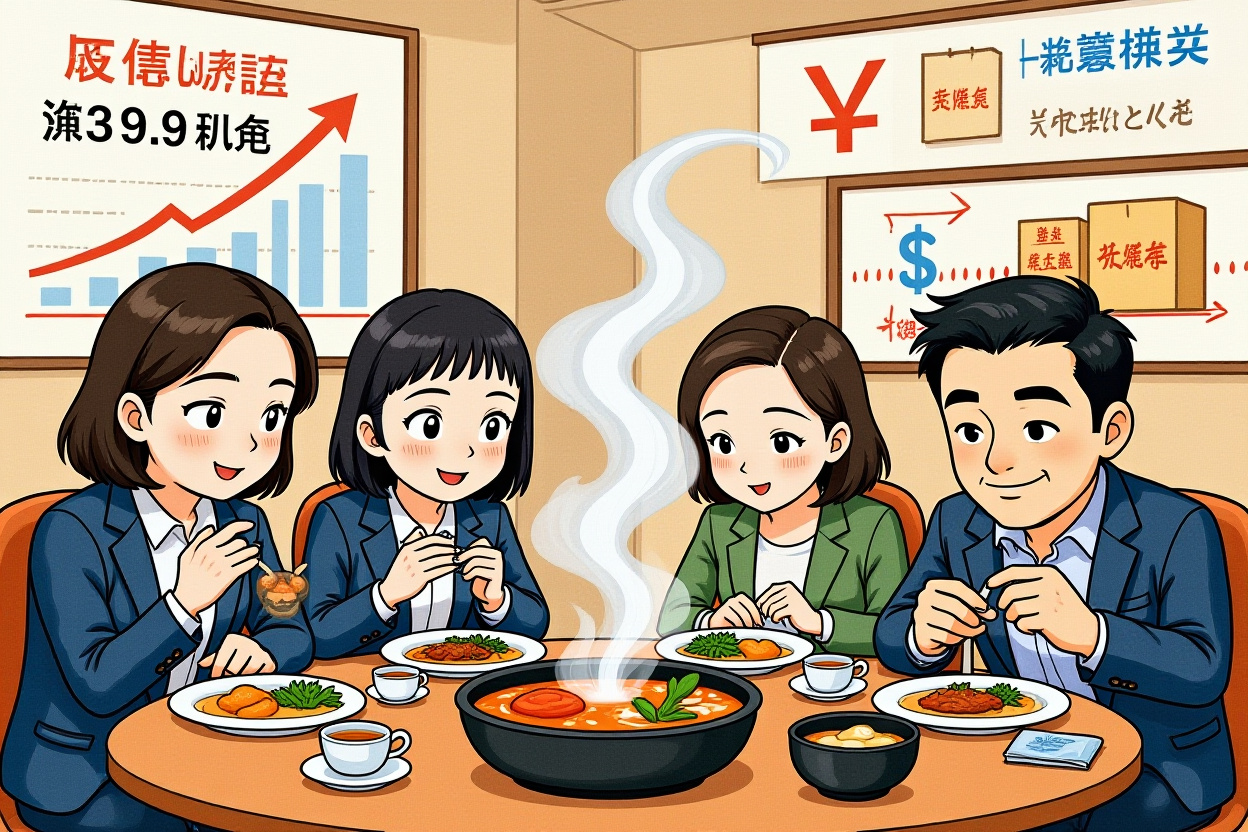
The Chinese hot pot giant 呷哺呷哺 (Xiabu Xiabu) is making a high-stakes wager on the all-you-can-eat model to reverse a trajectory of deep financial losses. With a projected annual deficit nearing 3 billion yuan, this strategic shift towards buffet-style dining is not just a menu change—it’s a critical test of the company’s ability to adapt in a hyper-competitive, value-driven market. This move places the buffet model at the center of Xiabu Xiabu’s potential turnaround story, a narrative that will be closely watched by institutional investors assessing the resilience of China’s consumer discretionary sector.
- 呷哺呷哺 (Xiabu Xiabu) is rolling out buffet or semi-buffet concepts across its main brand and subsidiaries like 湊湊 (Coucou) and new ventures 呷牛排 (Xiabu Steak) and 呷哺牧场 (Xiabu Ranch), signaling a group-wide strategic pivot.
- The company’s financial distress is acute: its 2025 preliminary report forecasts a net loss of 2.9 to 3.1 billion yuan, despite a modest year-on-year improvement, underscoring the urgency for a viable second growth curve.
- Adopting the buffet model carries significant operational risks, including compressed margins, intense competition in the self-service hot pot segment, and the potential for brand dilution if execution falters.
- Xiabu Xiabu’s primary competitive advantage lies in its nearly 30-year-old integrated supply chain, which could be the key to delivering the “high-quality at平价 (affordable prices)” promise essential for buffet success.
- Market timing is a critical concern; the company may be entering a crowded field late, needing exceptional differentiation to capture market share from established regional players.
The All-You-Can-Eat Gambit: Xiabu Xiabu’s Multi-Pronged Buffet Offensive
Facing relentless market pressure, 呷哺呷哺 (Xiabu Xiabu) is not placing a single bet but a series of calculated wagers across its brand portfolio. The buffet model is being tested in various formats and price points, from ultra-budget to mid-premium, in an attempt to recapture lost customers and improve store-level economics.
Main Brand Reinvention: The 39.9 Yuan Semi-Buffet Experiment
The core 呷哺呷哺 (Xiabu Xiabu) brand, once synonymous with affordable individual hot pot, has begun a quiet transformation. In Shenyang, two locations—杉杉奥莱店 (Sanshan Outlets Store) and 三台子万象汇店 (Santaizi Mixc Store)—were converted to a semi-buffet format. For 39.9 yuan, customers get unlimited access to nearly a hundred菜品 (dishes),锅底 (soup bases), and drinks. This radical shift slashes the average per-person spend to 40-50 yuan, a deliberate move to rebuild traffic through perceived value. Early customer feedback is mixed: some praise the return to decade-old price points, while others critique the limited selection of畅吃 (all-you-can-eat) items, noting that premium proteins like牛羊肉 (beef and lamb) still require additional payment.
湊湊 (Coucou) Ups the Ante with Tiered Premium Buffets
Recognizing the different competitive dynamics in the mid-to-high-end segment, the group’s profit engine, 湊湊 (Coucou), launched a “甄选单点+欢乐畅吃 (A la carte selection + happy all-you-can-eat)” dual model in 2025. It offers单人畅吃 (single-person buffet) tiers at 158, 198, and 258 yuan. In some cities, a 128-yuan package focused on beef and lamb has been introduced. This structured approach aims to protect the brand’s premium positioning and average check size while using the buffet model as a tool to boost footfall and table turnover率 (turnover rate). The launch was notably low-key, avoiding the fanfare of a typical major brand initiative, perhaps indicating a cautious, test-and-learn phase.
Financial Desperation: The Driving Force Behind the Buffet Pivot
The embrace of the buffet model is not born of opportunistic expansion but of severe financial necessity. 呷哺呷哺 (Xiabu Xiabu)’s业绩 (performance) has been under water for years, mirroring broader challenges in the casual dining sector but with greater severity.
A Balance Sheet in Crisis: Dissecting the 3 Billion Yuan Loss
The company’s 2025 financial preview reveals the stark reality:预计营收 (estimated revenue) of 3.8 billion yuan, a decline of approximately 20% year-over-year, and a projected净利亏损 (net loss) between 2.9 and 3.1 billion yuan. While this represents a 22.2% to 27.2% reduction from 2024’s 3.98 billion yuan loss, it remains a staggering figure. Over a five-year period, cumulative losses exceed 15 billion yuan. This context makes the search for a第二增长曲线 (second growth curve) not just strategic but existential. The buffet model is being positioned as a key component of this search. Even industry leader海底捞 (Haidilao) reported declining revenue and profit in the first half of 2025, confirming the sector-wide headwinds.
Precedents and Pitfalls: When the Buffet Model Fails
History offers a cautionary tale for 呷哺呷哺 (Xiabu Xiabu). The once-popular chain哥老官 (Gelaoguan) attempted a similar buffet-driven turnaround to combat sliding sales. The transition led to widely reported declines in core ingredient quality, loss of portion control, and a collapse in口碑 (word-of-mouth), ultimately accelerating the brand’s decline. This highlights the fundamental truth: a buffet model is far from a guaranteed savior. It introduces immense operational complexity, squeezing margins through high食材成本 (food cost) and demanding flawless品控管理 (quality control management). For Xiabu Xiabu, successfully implementing this model across multiple brands is a monumental operational challenge.
Market Timing and Competition: Has Xiabu Xiabu Missed the Buffet Window?
The critical question for investors is whether 呷哺呷哺 (Xiabu Xiabu)’s buffet strategy is a timely adaptation or another case of strategic tardiness. The company’s previous foray into high-end dining with the now-defunct brand趁烧 (Chenshao) demonstrated a costly misreading of consumer trends. The current bet on buffets, while aligned with the pervasive demand for性价比 (cost-performance ratio), faces a battlefield that is already dense with competitors.
Navigating the Red Ocean of Self-Service Hot Pot
The specific sub-segment Xiabu Xiabu is entering with its”呷哺牧场·自选小火锅 (Xiabu Ranch · Self-Service Small Hot Pot)” is intensely crowded. Data from企查查 (Qichacha) shows there are over 20,000 registered”小火锅 (small hot pot)” businesses in China, implying a national store count approaching 50,000. Regional champions have already emerged, such as围辣小火锅 (Weila Small Hot Pot) with over 2,000 stores and龍哥自助小火锅 (Longge Self-Service Small Hot Pot), which opened more than 300 outlets in a single year. At a price point around 50 yuan, 呷哺牧场 (Xiabu Ranch) offers little immediate differentiation in a sea of similar concepts, making customer acquisition and brand building a steep uphill climb.
The Innovation Lag: Struggling to Differentiate New Ventures
Beyond the core hot pot space, Xiabu Xiabu’s new concepts also face the challenge of distinctiveness. The”呷牛排 (Xiabu Steak)” brand, which combines steak a la carte with a buffet side, enters a牛排自助 (steak buffet) category that lacks a national leader. However, initial探店 (store visit) experiences suggest the offering is conventional, lacking a memorable hook or exceptional experience that would drive repeat visits. The risk is that it becomes perceived as a”高配快餐 (high-end fast food)” option rather than a destination dining experience. This underscores a broader issue: simply deploying the buffet model is insufficient; it must be coupled with compelling innovation to stand out.
The Foundation for a Turnaround: Supply Chain and Operational Discipline
Amidst the challenges, 呷哺呷哺 (Xiabu Xiabu) is not without assets. The company’s potential path to success with the buffet model—and its broader recovery—hinges on leveraging deep-seated strengths and exercising rigorous operational discipline.
The Supply Chain as a Strategic Moat
Chairman贺光启 (He Guangqi) has consistently emphasized”高品质和平价化 (high quality and affordable pricing).” The vehicle to achieve this in a cost-sensitive buffet format is the company’s extensive供应链 (supply chain). As a publicly listed entity with nearly three decades of history, Xiabu Xiabu has built an integrated system encompassing global procurement, central kitchen processing, and nationwide logistics. This infrastructure could provide a crucial edge in managing the razor-thin margins of buffet operations by ensuring consistent quality and controlling costs at scale. If the buffet model is the药引子 (catalyst), a reactivated and optimized supply chain is the essential medicine.
The Prudent Path: Model Refinement Over Reckless Expansion
The current phase appears focused on careful validation rather than explosive growth. New buffet concepts are being rolled out slowly, with explicit plans like opening 100 呷牛排 (Xiabu Steak) stores over three years. This suggests a strategy of perfecting the单店盈利模型 (single-store profit model) and ensuring operational viability before scaling. This cautious approach aligns with the broader industry shift from”跑马圈地 (land-grabbing)” to精细化运营 (refined operations). However, it also means that these new buffet ventures are unlikely to contribute meaningfully to the group’s top or bottom line in the immediate future, prolonging the financial recovery timeline.
The journey ahead for 呷哺呷哺 (Xiabu Xiabu) is fraught with complexity. The buffet model presents a plausible, albeit risky, avenue to reconnect with consumers and stabilize operations. Its ultimate success will depend on a trifecta of factors: flawless execution that avoids the quality pitfalls of past failures, genuine innovation that differentiates its offerings in a saturated market, and the effective monetization of its supply chain advantage. For now, the company’s moves reflect a necessary, if belated, adaptation to China’s new消费现实 (consumption reality). Investors and market watchers should monitor key metrics in upcoming quarters, particularly same-store sales growth, customer traffic at newly converted buffet locations, and any improvements in gross margin that signal supply chain efficiency. The buffet bet is on the table; the next few rounds will determine if 呷哺呷哺 (Xiabu Xiabu) can finally play a winning hand.