



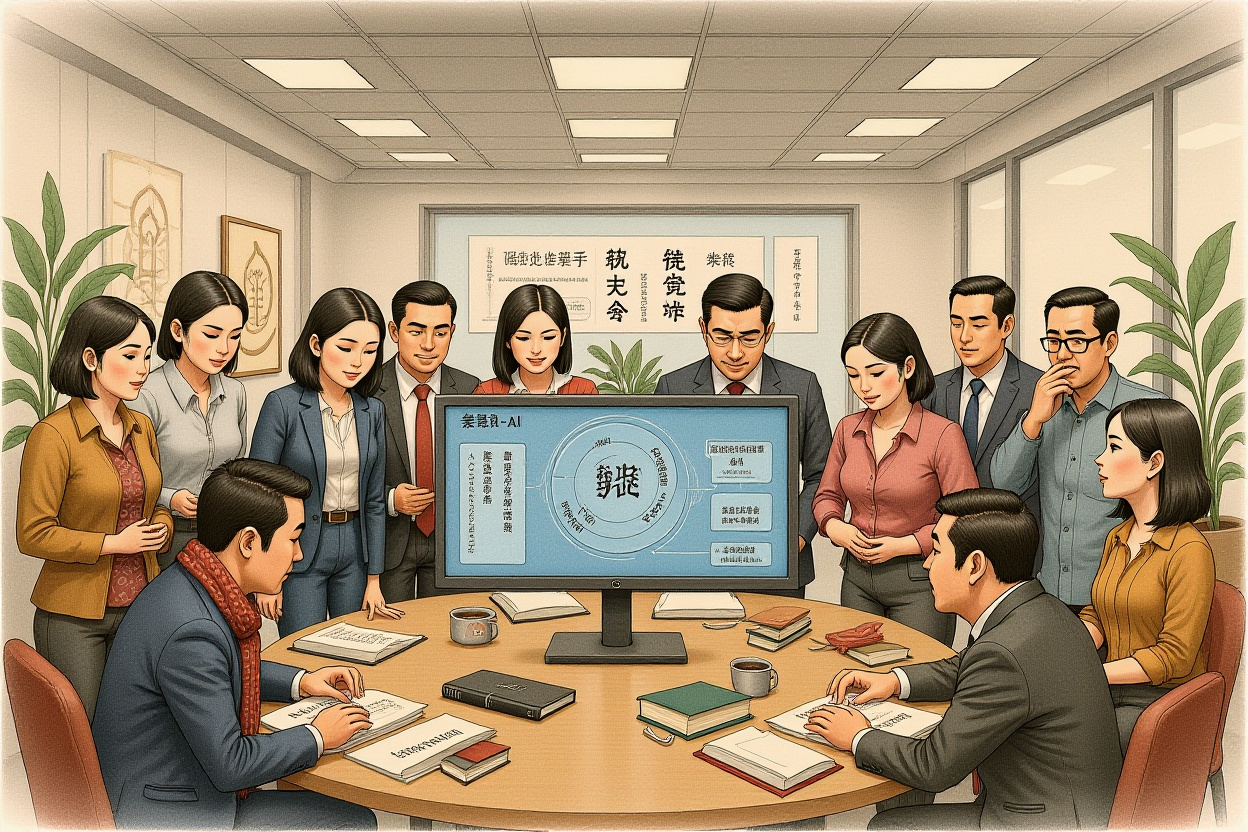
A profound shift is underway in China’s technology employment landscape, one that defies the prevailing narrative of a ‘liberal arts retreat.’ Just as public discourse laments the declining employability of humanities and social science graduates, a counter-trend is emerging from the epicenter of innovation itself: artificial intelligence. Leading Chinese tech firms and their global counterparts are aggressively recruiting—and handsomely compensating—talent with backgrounds in philosophy, linguistics, literature, and sociology. This pivot suggests that the core value in the AI age may not be pure coding prowess, but the uniquely human skills of critical thinking, ethical reasoning, and narrative craft. For investors monitoring China’s tech sector, this evolution signals a deeper maturation of the AI industry, moving beyond pure model development to the crucial phases of alignment, application, and societal integration.
Key Takeaways and Market Implications
- The rise of generative AI is creating a new class of high-value roles centered on model alignment, safety, and narrative design, where liberal arts skills are paramount.
- Leading AI companies, both in China and Silicon Valley, are actively seeking ‘AI-humanists’—professionals who can bridge the gap between technical capability and human context, ethical norms, and compelling storytelling.
- This trend challenges the simplistic ‘humanities vs. STEM’ debate, highlighting the growing premium on interdisciplinary thinkers who combine technical literacy with deep humanistic insight.
- For the Chinese equity market, companies that successfully integrate this humanistic layer into their AI offerings may gain a significant competitive and regulatory advantage.
- The trend presents both a lucrative opportunity and a potential long-term risk for white-collar professionals, as their expertise is used to train the very systems that may eventually displace broader swaths of knowledge work.
The Great Contradiction: AI’s Dual Impact on the Liberal Arts
The current employment scene presents a stark contradiction. On one hand, automation and algorithms are steadily absorbing routine administrative, clerical, and customer service roles—traditional landing spots for many liberal arts graduates. Within academia, a ‘liberal arts retreat’ is visible as institutions globally reevaluate the practicality of certain humanities programs.
Yet, simultaneously, the command centers of the AI revolution are populated with an unexpected cohort. The CEOs and founders of pivotal AI firms often boast backgrounds far removed from computer science. Alex Karp, CEO of Palantir Technologies (PLTR), studied law and neoclassical social theory. Mustafa Suleyman, co-founder of DeepMind, focused on philosophy and theology. This pattern extends into the operational heart of AI development. At Anthropic, a leader in AI safety, teams are led by individuals like Daniela Amodei, who holds a degree in English literature, and are staffed by philosophers like Amanda Askell, who crafts extensive ‘AI Constitutions’ to guide model behavior.
Why AI Needs the Humanities
The rationale is becoming increasingly clear. As Zhou Hongyi (周鸿祎), founder of 360 Security Technology, argued in a recent interview, the rapid advancement of AI does not solely create a need for more engineers. It creates a world filled with intelligent agents that require management and a cascade of novel social, ethical, and legal dilemmas that demand solutions. The core training of the humanities—critical thinking, navigating ambiguity, ethical reasoning, and advanced communication—is precisely what is needed to steer this powerful technology.
In essence, the industry requires not only Turing-like architects to build AI but also Socratic-like rhetoricians to refine, interrogate, and contextualize it. Large language models (LLMs) are, at their foundation, vast exercises in linguistics, psychology, and cultural understanding. Optimizing them for safety, nuance, and practical utility is as much a humanistic endeavor as a technical one. This is where liberal arts graduates are finding their unexpected niche.
The New “AI-Humanist” Professions: From Prompt Engineering to Chief Storyteller
The proof of this demand is materializing in concrete job titles and salary bands, visible on Chinese recruitment platforms and in Silicon Valley boardrooms. The era of the pure ‘coder’ is being supplemented by the era of the ‘AI-humanist.’
Scrolling through major Chinese job sites reveals a crop of novel positions directly tied to AI development. Roles such as “Large Model Evaluation Expert (Writing Direction),” “AI Narrative Designer,” and “AI Trainer” are proliferating. While supporting algorithm engineers, the core requirement for these jobs is expertise in Chinese language, screenwriting, sociology, or journalism. Their mission is to imbue AI with a more ‘human’ touch within cultural and social contexts.
The Rise of the Chief Storyteller
Perhaps the most emblematic of these new roles is the “Chief Storyteller,” a position emerging in Silicon Valley with annual compensation packages reaching $300,000 (approximately over 2 million RMB). This role is an evolution of the PR or communications director, often filled by veteran journalists or media professionals. Their task is to translate complex, intimidating technological advances into compelling, accessible narratives that help the public understand and adopt a company’s products.
This function is crucial in an AI market crowded with similar claims of capability. The company that can best articulate its vision, its ethical stance, and the tangible human benefit of its AI may win the trust of consumers, regulators, and investors alike. This trend is rapidly gaining traction among China’s tech giants, who are increasingly aware that superior technology alone does not guarantee market success or social license.
The career path of individuals like Lin Junyang (林俊旸), who left Alibaba’s (阿里巴巴集团) AI team, illustrates the premium on interdisciplinary backgrounds. With an undergraduate degree in English and a master’s in linguistics requiring cross-disciplinary study, his profile represents the ideal blend of understanding both the structure of language and the potential of the technology that processes it.
Case Study: Anthropic and the “AI Constitution”
A closer look at leading AI firms provides a blueprint for how liberal arts talent is being deployed at the highest level. Anthropic’s approach, centered on Constitutional AI, is particularly instructive. The company employs researchers like Amanda Askell, a philosophy PhD from New York University, whose work involves crafting extensive rule sets—an “AI Constitution”—to shape the values, ethics, and conversational tone of their Claude models.
This is not mere public relations. It is a fundamental engineering challenge known as “alignment”—ensuring AI systems act in accordance with human intent and values. Solving this requires deep engagement with moral philosophy, legal frameworks, and linguistic nuance. As Daniela Amodei has stated, she does not regret her humanities education; she sees it as increasingly vital. The skills honed in analyzing a complex novel or debating ethical frameworks directly apply to the problem of creating safe, reliable, and useful AI.
For investors, a company’s investment in and sophistication around AI safety and alignment is becoming a critical due diligence factor. It mitigates regulatory risk, enhances long-term product viability, and builds brand trust. Companies like Baidu (百度), Alibaba Cloud (阿里云), and Tencent (腾讯) that develop similar, robust ‘humanistic’ layers to their AI development may be better positioned for sustainable growth.
The Perilous Bargain: Training the Systems That May Replace You
This emerging opportunity for liberal arts graduates is shadowed by a profound and unsettling risk. The very process of employing human experts to train AI models can be a double-edged sword. There is a growing realization that professionals may be meticulously teaching AI systems to eventually automate their own professions.
This pattern is already unfolding. Initially, it affected mechanical data annotation roles. For instance, Elon Musk’s xAI and data-labeling firm Scale AI have reportedly reduced their reliance on large, basic annotation teams as models became more advanced, seeking instead more specialized ‘AI tutors.’
The next wave is impacting specialized knowledge workers. Stories have emerged of editors, writers, and analysts unknowingly training AI replacements. In one reported case, an academic editor spent months mentoring a seemingly incompetent ‘new hire,’ only to discover it was an AI system being groomed for her job. More systemically, platforms like Mercor have leveraged databases of unemployed, high-skilled professionals—from film critics to writers—to train large models for tech giants, paying piecemeal wages while acquiring rights to their intellectual output.
The “Human in the Loop” for Liability
A stark academic perspective on this dynamic comes from an Oxford University paper titled “The Role of Humans in an AI World.” It posits that one enduring reason for keeping humans in certain decision-making loops, particularly in law and business, may be to have a legally accountable entity—a “human liability anchor”—to bear responsibility when an AI system causes harm. This is a cynical but pragmatic view of a potential future role: not as a director, but as a designated scapegoat.
This creates a precarious bargain for the modern knowledge worker. Their deep expertise is currently invaluable for refining AI, making them highly employable in the short term. However, they may be actively contributing to the development of systems that will commoditize or obsolete that same expertise for the broader market.
The Irreplaceable Core: Humanity as the Final Moat
Despite these disruptive forces, history suggests that human creativity and insight find new expressions. The invention of photography was predicted to kill painting; instead, it liberated the art form to explore impressionism, abstraction, and expressionism. The AI shock may trigger a similar renaissance for human-centric skills.
As AI models become exponentially more competent at generating text, analyzing data, and even mimicking creativity, the unique value of human work may shift to a higher plane. The frontier will no longer be technical execution but rather: perception of a rapidly changing world, real-time reflection on societal and ethical transitions, and genuine empathy for the human condition within technological modernity.
These capacities for deep contextual understanding, moral sense, and authentic emotional connection represent the ‘final moat’ for humanity. They are the skills that liberal arts education has cultivated for centuries. As Daniela Amodei emphasizes, “In a world where AI is very smart and can do a lot of things, the things that make us human are going to become more important.” This human element becomes the ultimate differentiator in a sea of efficient, synthetic output.
Strategic Outlook for Professionals and Investors
The narrative that AI exclusively threatens liberal arts careers is incomplete. The reality is more nuanced and dynamic. AI is simultaneously displacing routine cognitive tasks and creating high-value, strategic roles that demand the very skills the humanities provide. The future belongs not to the pure technologist or the pure humanist, but to the bilingual individual who can operate in both domains.
For professionals, especially in China’s competitive job market, the imperative is clear: cultivate interdisciplinary fluency. Technical literacy—understanding the capabilities and limitations of AI—is now essential for humanities graduates. Conversely, engineers must develop stronger communication, ethics, and systems-thinking skills. The most coveted talent will be hybrids like the ‘AI narrative designer’ or the ‘model alignment strategist.’
For investors analyzing the Chinese technology sector, this trend is a key metric for evaluating AI companies. Look beyond pure technical benchmarks like model parameters or training compute. Scrutinize the company’s human capital strategy. Does it have a dedicated, senior team focused on AI ethics, safety, and storytelling? Is it investing in the ‘human-in-the-loop’ layer that will ensure product-market fit and regulatory compliance? Companies that recognize the indispensable role of the liberal arts in the AI stack may prove to be more resilient, innovative, and ultimately, more valuable in the long-term evolution of this transformative market.
The AI revolution is not making the humanities obsolete; it is revealing their indispensable worth in a new and urgent context. The challenge and the opportunity lie in forging a new synthesis between human insight and machine intelligence.