



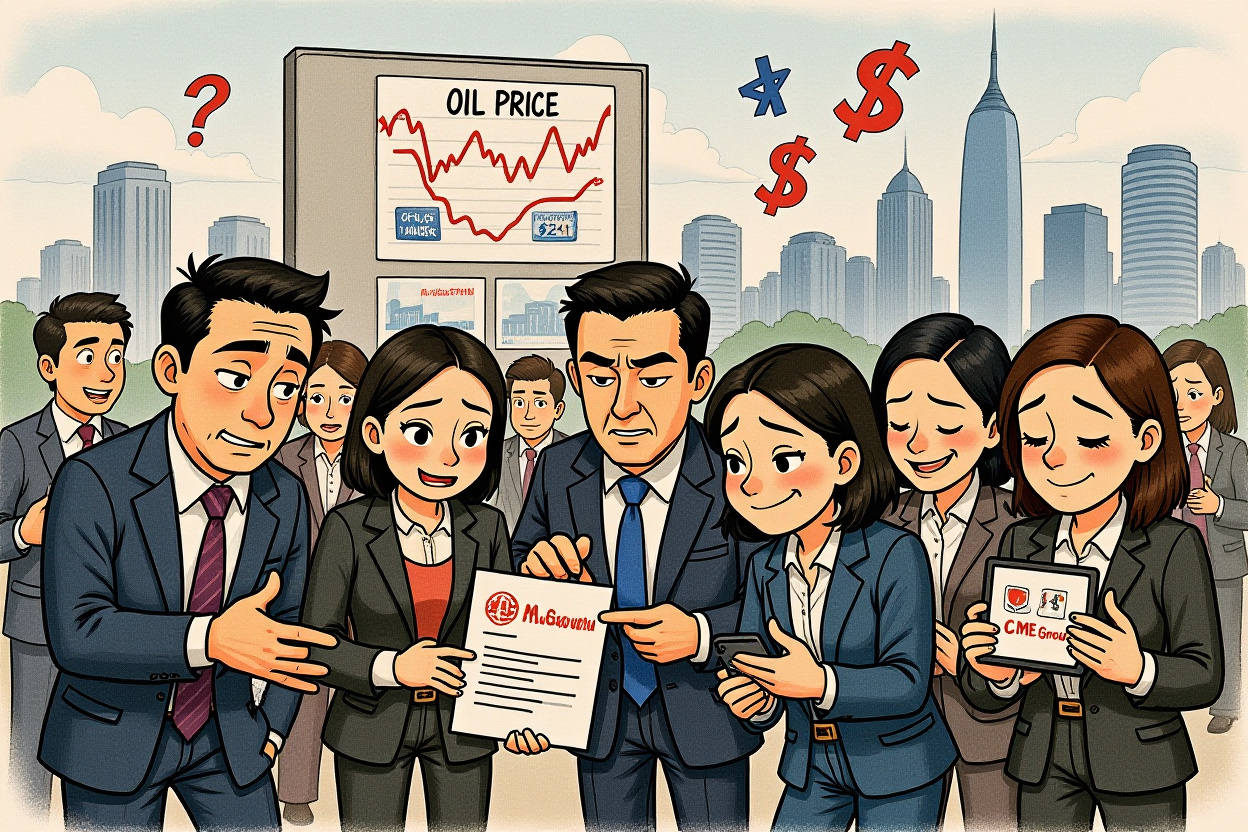
Executive Summary:
– The CME Group has issued a stark public warning that U.S. government intervention in oil derivatives markets could trigger an “epic catastrophe,” eroding fundamental market confidence.
– Intense market volatility and unexplained large trades have fueled speculation that the U.S. Treasury itself may be a “mystery seller” actively shorting crude futures to curb prices.
– Erratic communications from U.S. officials, including a swiftly retracted social media post, have compounded market instability and raised questions about competence or malfeasance.
– Beyond direct market intervention, the administration is weighing alternative measures like a federal gas tax holiday or an oil export ban, each with significant global ramifications.
– For China-focused investors, this saga underscores profound systemic risks, with direct implications for energy imports, inflation, and the stability of related equities in the A-share and Hong Kong markets.
The ‘Epic Catastrophe’ Warning That Shook Global Markets
A seismic warning from the heart of the global financial system has sent ripples through commodities desks worldwide. Terry Duffy (特里·达菲), CEO of CME Group Inc., the world’s largest derivatives exchange operator, delivered a blunt message to the U.S. administration: tampering with oil futures markets could spell disaster. For sophisticated investors navigating Chinese equities, where energy costs directly impact corporate margins and consumer inflation, this is not a distant theoretical risk but a looming specter affecting portfolio valuations.
The core of the warning revolves around market integrity. “The market doesn’t like the government intervening in pricing,” Duffy stated at a conference in Boca Raton, Florida. His concern is foundational. If participants believe that price discovery—the very mechanism that determines the value of crucial commodities like crude oil—can be overridden by political diktat, the trust underpinning trillions of dollars in contracts evaporates. This potential epic catastrophe is not merely about price swings; it’s about the credibility of the global financial architecture.
CME’s Stakes in a Transparent Marketplace
The CME Group’s forceful stance is born of self-interest, but one that aligns with market health. As the operator of the New York Mercantile Exchange (NYMEX), the primary venue for WTI crude oil futures, its business model depends on being perceived as a neutral, reliable, and transparent marketplace. Government intervention would be anathema to this principle, potentially driving liquidity to other jurisdictions and undermining the U.S.’s central role in global commodities trading.
This warning comes amid concrete reports that the U.S. Treasury is actively considering measures to lower oil prices, including interventions in the futures market. The administration has already deployed one tool, announcing a release from the Strategic Petroleum Reserve (SPR). However, the epic catastrophe scenario painted by Duffy pertains to active trading—selling futures contracts to depress prices—a move that would cross a Rubicon of market governance.
The Ghost in the Machine: Is the U.S. Treasury the Mystery Seller?
The oil market has been a theater of extreme volatility. On a single Monday, Brent crude futures rocketed toward $120 per barrel only to plunge precipitously below $100. For traders, such violent, seemingly inexplicable moves trigger immediate suspicion of a large, motivated seller operating outside normal commercial logic.
Industry whispers have coalesced around a stunning hypothesis: the seller is the U.S. Treasury itself. Tim Skirrow, Head of Derivatives at Energy Aspects, confirmed that clients are relentlessly asking, “Who is the big seller?” The circumstantial evidence is compelling. With a clear political incentive to lower gasoline prices and the financial resources to move markets, the Treasury is a prime suspect. While direct intervention would be “unprecedented,” analysts at Rapidan Energy Group conceded that in the current panic, it cannot be ruled out.
Official Denials and Unanswered Questions
The official response has been a mix of denial and silence. The U.S. Treasury has declined to comment. A person familiar with the thinking of Treasury Secretary Janet Yellen (珍妮特·耶伦) denied the agency was intervening. A Department of Energy spokesperson also stated it does not participate in oil derivatives trading.
However, in high-stakes finance, the absence of a categorical, on-the-record denial from the highest level often fuels speculation rather than quells it. For global investors, particularly those with exposure to Chinese energy giants like PetroChina (中国石油) or Sinopec (中国石化), the ambiguity is a risk factor. Their profitability is directly tied to global crude benchmarks, making the integrity of those benchmarks paramount. The possibility of a politically motivated epic catastrophe in pricing adds a layer of unquantifiable political risk to their investment thesis.
Policy Panic and the ‘Malfeasance’ Specter
Beyond the rumors of direct market manipulation, the administration’s actions have displayed a level of disorder that further destabilizes markets. In a bizarre episode, U.S. Secretary of Energy Jennifer Granholm (詹妮弗·格兰霍姆) posted on social media platform X that the U.S. Navy was escorting commercial ships through the Strait of Hormuz—a critical chokepoint for oil. The post caused an immediate sell-off. It was deleted minutes later, and the White House denied the claim. Granholm later clarified that such escorts were unlikely to begin before the end of the month.
This incident, viewed from the professional lens of a fund manager, is alarming. John Evans, an analyst at London-based PVM Oil Associates, captured the sentiment perfectly, questioning whether it was “another case of complete ineptitude” or something more serious: “an act of malfeasance.” For investors allocating capital to China’s energy sector, stability and predictability from the world’s largest economy are assumed. Erratic behavior challenges that assumption, increasing the perceived risk premium for all energy-related assets.
The Broader Toolkit of Intervention
The discussion around curbing prices extends far beyond the futures pit. The administration is reportedly weighing a suite of other measures, each with complex implications:
– Suspending the federal gasoline tax: This would provide direct consumer relief but would strain highway trust fund revenues and might not increase supply.
– Relaxing environmental fuel regulations: A move that could boost refinery output but would face fierce political opposition and long-term climate policy consequences.
– Temporarily banning U.S. crude oil exports: This is perhaps the most dramatic option. While it could increase domestic supply in the short term, it would severely disrupt global trade flows, alienate allies, and likely provoke retaliation. For China, a major global buyer, such a ban would scramble supply chains and could push it to accelerate long-term diversification efforts away from U.S. energy, potentially toward Russian or Middle Eastern suppliers.
Implications for Chinese Markets and Global Investors
For the sophisticated, China-focused audience, this unfolding drama is not a sidebar but a core strategic concern. The stability of China’s economic recovery, its management of producer price inflation (PPI), and the profitability of its vast industrial base are intimately linked to global energy prices. A politicized and volatile oil market directly threatens these pillars.
– Inflationary Pressures: China imports over 70% of its crude oil. A supply shock or sustained price volatility fueled by Western market interventions complicates the People’s Bank of China (中国人民银行) monetary policy and can feed into consumer prices, affecting sectors from transportation to manufacturing.
– Equity Market Impact: Shares of Chinese energy and chemical companies are sensitive to crude inputs. Unpredictable pricing driven by non-market forces makes earnings forecasts and valuations exceptionally difficult. Investors in A-shares or H-shares of firms like CNOOC (中国海洋石油) must now factor in the risk of an epic catastrophe in Western derivatives markets.
– Strategic Energy Security: This episode validates China’s long-standing drive for energy security. It may accelerate investments in:
– Domestic production and reserves
– Alternative energy sources (solar, wind, nuclear)
– Currency diversification in oil trade, promoting the internationalization of the Renminbi (人民币)
– Long-term supply contracts with “friendly” nations, reducing reliance on spot markets vulnerable to such dislocations.
The Call for Vigilance and Diversification
The CME warning is a canonical red flag for institutional investors. It signals that a foundational asset class may be transitioning from a market-driven to a politically-driven paradigm. The forward-looking guidance for China market participants is clear:
1. Scrutinize energy sector holdings with heightened sensitivity to global political risk, not just supply-demand fundamentals.
2. Re-evaluate commodity exposure within portfolios, considering hedges or a shift towards companies with pricing power or domestic supply advantages.
3. Monitor Chinese policy responses closely, as moves to bolster energy security could create investment opportunities in related infrastructure and technology sectors.
A Precarious New Paradigm for Global Commodities
The warning from CME CEO Terry Duffy (特里·达菲) is a watershed moment. It publicly acknowledges a fear that has long simmered among professional traders: that the sanctity of the market is under threat. Whether the “mystery seller” is the U.S. Treasury or not, the mere plausibility of such action, combined with chaotic official communications, has injected a dangerous element of political uncertainty into global oil pricing.
For investors whose mandate is Chinese equities, the implications are profound and multi-layered. The direct channel is through the cost base of China Inc. and the inflation outlook for the world’s second-largest economy. The indirect channel is through the erosion of trust in the Western financial system’s core pricing mechanisms—a development that could accelerate the bifurcation of global systems and bolster China’s push for financial self-reliance.
The key takeaway is that energy market analysis can no longer be confined to rig counts, OPEC+ decisions, and inventory data. It must now incorporate a rigorous assessment of political intervention risk in Western capitals. The potential for an epic catastrophe of market confidence, as framed by the CME, is a new variable in the investment equation. Prudent investors will now adjust their models, stress-test their portfolios against such scenarios, and pay even closer attention to Beijing’s next moves in securing its energy future amidst this burgeoning global instability.
Your Next Step: In an environment where core market principles are being tested, robust intelligence is paramount. We encourage you to deepen your analysis by reviewing the latest policy statements from China’s National Development and Reform Commission (国家发展和改革委员会) on energy security and examining the quarterly reports of major Chinese energy firms for commentary on input cost volatility. Staying ahead requires understanding not just the numbers, but the shifting foundations upon which they are built.