



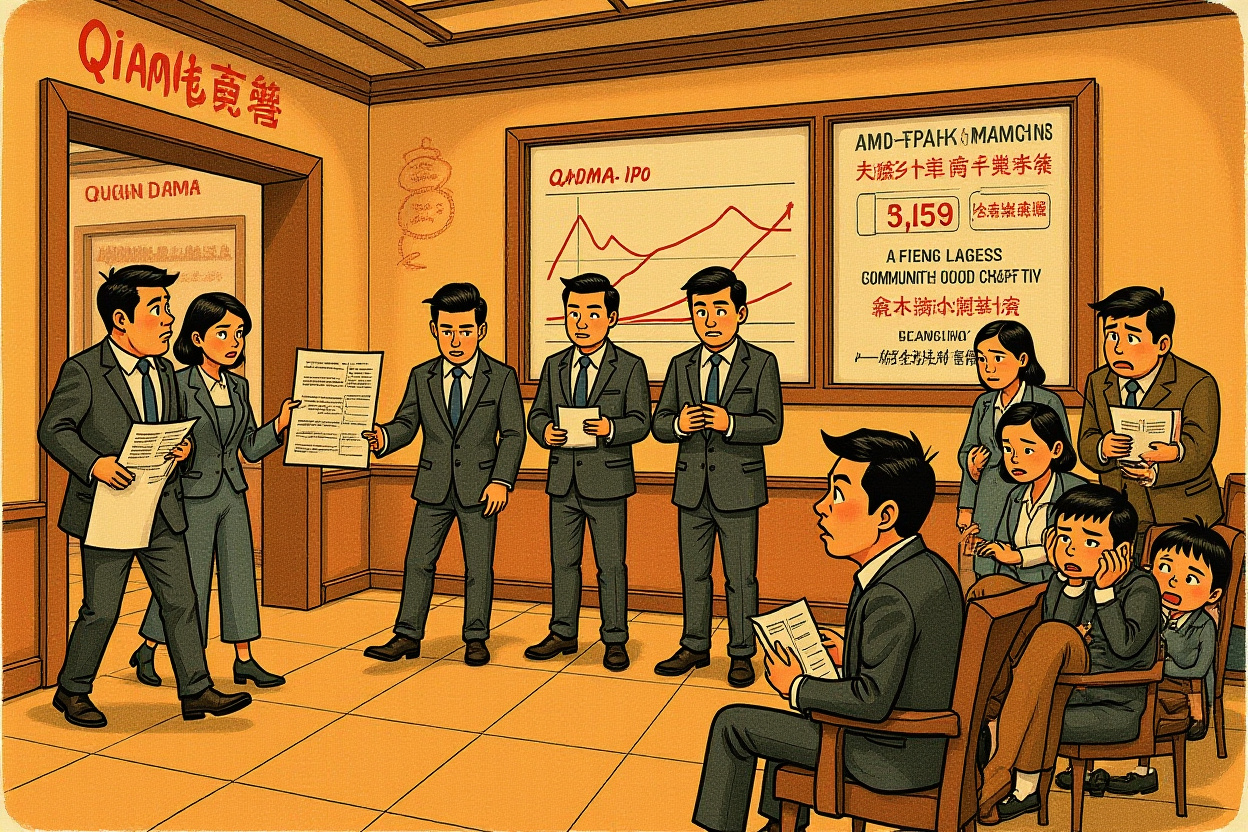
– Qian Dama, China’s largest community fresh food chain by GMV, has submitted its third IPO application to the Hong Kong Stock Exchange (港交所), seeking to become the “community fresh food first stock” despite internal turmoil.
– Founder Feng Jisheng (冯冀生) has exited entirely after transferring equity and obtaining low-interest loans, while eight non-executive directors resigned pre-filing, raising governance red flags.
– Revenue growth has stagnated around 117 billion yuan, with a 4.2% year-on-year decline in Q1-Q3 2025, and debt ratios have soared to 196.7%, highlighting financial strain.
– The core “no overnight meat” daily clearance model drives brand loyalty but erodes franchisee profits, leading to 1,159 store closures since 2023 and reliance on a shrinking加盟店 (franchise) network.
– Regional concentration in Southern China (68.6% of stores) and fierce competition from new retail models like即时零售 (instant retail) make this third IPO attempt a critical test for survival and scalability.
In a startling prelude to its latest listing push, Qian Dama (钱大妈), the Chinese fresh food retailer renowned for its “不卖隔夜肉” (no overnight meat) promise, finds itself at a crossroads. The company’s third IPO attempt comes not as a triumph but amidst a storm of controversy: the enigmatic departure of its founder and a wholesale board exodus. This third IPO attempt is more than a fundraising exercise; it is a desperate bid to stabilize a business model showing alarming cracks. For global investors eyeing China’s resilient consumer sector, Qian Dama’s saga offers a cautionary tale on the perils of rapid, franchise-led expansion and the high-stakes gamble of daily inventory clearance. Can this community giant, once a darling of venture capital, convince the market it has a sustainable future beyond its Southern China stronghold?
The Meteoric Rise of a Community Fresh Food Pioneer
Qian Dama’s origin story is a classic tale of entrepreneurial ingenuity meeting a pervasive market pain point. In 2012, siblings Feng Weihua (冯卫华) and Feng Jisheng (冯冀生) operated a humble猪肉档口 (pork stall) in Dongguan’s农贸市场 (wet market). Grappling with the industry’s chronic issue of spoilage loss on unsold meat, Feng Jisheng drew inspiration from Dutch auction systems and implemented a radical, time-based discount strategy. This gave birth to the iconic “no overnight meat” model: starting at 7 p.m., prices drop every 30 minutes until unsold items are given away free by 11:30 p.m.
Building a Brand on Freshness and Efficiency
The model was a masterstroke in consumer psychology. It instantly communicated unmatched freshness, turning a liability—perishability—into a powerful brand virtue. By guaranteeing daily inventory clearance, Qian Dama minimized waste and achieved operational efficiencies that fueled early growth. Relocating to社区 (community) settings in 2013, the brand expanded into a full-spectrum fresh food retailer, resonating with households seeking both quality and value. Media reports of neighbors queueing for discounted deals became free marketing, solidifying its reputation.
Capital Fuel and Breakneck Expansion
Venture capital swiftly took notice. From 2015 onwards, Qian Dama secured multiple funding rounds from prominent firms like启承资本 (Qicheng Capital),高榕资本 (Gaorong Capital), and泰康保险 (Taikang Insurance). A nearly 10-billion-yuan Series D round in late 2019 catapulted its valuation to the”独角兽” (unicorn) status of 10 billion yuan. Flush with capital, Qian Dama shifted to a加盟 (franchise)-heavy model in 2015, enabling blistering growth. Store count skyrocketed from the first to over 3,700 at its 2021 peak, making it the undisputed leader in community fresh food chains by生鲜产品 (fresh product) GMV, according to consultancy灼识咨询 (Frost & Sullivan).
The Cracks Beneath the Surface: An Unsustainable Business Model?
The very engine of Qian Dama’s growth—the daily clearance franchise model—has become its greatest liability. The third IPO attempt documentation reveals a business grappling with the mathematical limits of its core premise.
The Franchisee Profitability Crisis
The “阶梯折扣” (step discount) system, while great for consumers, brutally compresses margins for franchisees. They bear the full brunt of the discounted sales and free giveaways, yet have little control over procurement volumes or pricing, which are dictated by headquarters. As consumers became savvy to the discount timetable, they delayed purchases, cannibalizing full-price sales and depressing average order values. Prospectus data shows overall毛利率 (gross margin) languishing at 9.8%-11.3%, far below the 15%-25% typical for supermarkets. Single-store daily sales fell from 12,000 yuan in 2023 to 9,000 yuan in 2025, illustrating the model’s scaling failure.
Network Contraction and Stagnant Revenue
The financial strain on加盟商 (franchisees) has triggered a network reversal. From 2023 to Q3 2025, 1,159 franchise stores terminated contracts. With 98.6% of its network being franchised, this instability directly impacts top-line growth. Revenue, after hitting 117.44 billion yuan in 2023, barely inched up to 117.88 billion yuan in 2024, and declined 4.2% year-on-year for the first nine months of 2025 to 83.59 billion yuan. This stagnation starkly contrasts with its “industry first” narrative and poses a critical question for this third IPO attempt: where is the growth?
Governance Earthquake: Founder Flight and Board Exodus
The run-up to this third IPO attempt has been marred by extraordinary corporate turmoil, undermining investor confidence at a crucial juncture.
The Enigmatic Exit of Feng Jisheng (冯冀生)
Founder Feng Jisheng, the operational mind behind the “no overnight meat” concept, has completely dissociated from the company. Reports indicate he transferred his equity and repeatedly obtained substantial low-interest loans from Qian Dama before vanishing from the shareholder register. While the company attributes this to “家族内部” (family internal) arrangements, the timing and nature of the exit—akin to a financial extraction before a potential liquidity event—fuel speculation about the business’s true health and the founder’s confidence in its future.Pre-IPO Board Resignations: A Red Flag
Perhaps more alarming was the collective resignation of eight non-executive directors just before the prospectus filing, including Feng Weihua’s brother, Feng Weiguo (冯卫国). Such a sweeping board change is highly unusual before a listing and suggests deep-seated disagreements or a lack of alignment on strategy. For potential investors evaluating this third IPO attempt, these governance issues raise serious concerns about oversight, risk management, and the stability of the leadership team tasked with steering the post-IPO company.Strategic Quagmire: Regional Limits and Fierce Competition
Qian Dama’s growth story remains geographically lopsided, and its market is now besieged by well-funded competitors employing more advanced retail technologies.The Southern China Trap
Despite national ambitions, Qian Dama is overwhelmingly a regional player. As of September 2025, 68.6% of its 2,938 stores were in华南地区 (Southern China), contributing 65.9% of revenue. Attempts to replicate the model in the north, like a failed foray into Beijing in 2020, highlighted the model’s fragility. The “no overnight meat” promise requires an intensely localized, efficient供应链 (supply chain). Outside its Guangdong base, where it built dense distribution networks, Qian Dama loses its cost and freshness advantage, making expansion prohibitively expensive and complex.New Retail Models Erode the Value Proposition
The competitive landscape has evolved dramatically. Qian Dama’s core advantage—proximity within 500 meters of communities—is being nullified by即时零售 (instant retail) platforms like美团闪购 (Meituan Instashopping) and京东到家 (JD Daojia), which deliver in 30 minutes.前置仓 (Front-end warehouse) models like朴朴超市 (Pupu Supermarket) and叮咚买菜 (Dingdong Maicai) offer vastly larger SKU selections (数千个 vs. Qian Dama’s 400-500). Innovators like盒马 (Hema) with its “店仓融合” (store-warehouse integration) and超合算NB店 (Hema Chaohesuan NB stores) achieve lower spoilage rates through direct sourcing. These players are fragmenting the consumer base and raising the bar for convenience and assortment, pressures starkly visible in Qian Dama’s slowing growth as it embarks on its third IPO attempt.The IPO as a Lifeline: Financial Pressures and the Path Forward
Qian Dama’s third IPO attempt is not merely an ambition; it is a financial imperative driven by mounting liabilities and binding commitments to early backers.The Weight of Debt and Betting Agreements
The company’s balance sheet has deteriorated sharply. By the end of September 2025, its资产负债率 (asset-liability ratio) had surged to 196.7%, with净流动负债 (net current liabilities) of 17.16 billion yuan, indicating severe short-term repayment pressure. More compelling is the reported对赌协议 (betting agreement) with investors: if Qian Dama does not complete an IPO by January 2027, they can demand share redemption at a 15% annualized interest rate. This clause turns the third IPO attempt into a race against time to avoid a potentially crippling cash outflow.Can Listing Funds Solve the Core Problems?
In its prospectus, Qian Dama states IPO proceeds will be used for supply chain enhancement, store network optimization, and technology investment. However, capital alone cannot fix the fundamental tension between its discount-driven brand promise and franchisee profitability. The company has tried to reassure markets, with Feng Weihua (冯卫华) publicly reaffirming commitment to the “no overnight meat” ethos. Yet, the strategic roadmap remains unclear. Success post-listing would require a delicate recalibration: perhaps moderating discount aggressiveness, improving revenue-sharing with franchisees, or developing hybrid store models for new regions. This third IPO attempt buys time, but the underlying business model challenges demand more than a financial Band-Aid.Qian Dama’s narrative is a potent mix of visionary branding, operational innovation, and the harsh realities of scale. This third IPO attempt arrives as a pivotal moment of truth. While the company boasts leading market share and a powerful community brand, its financials reveal stagnation, its franchise network is fraying, and its leadership is in flux. For institutional investors, the prospectus offers a case study in the risks of over-reliance on a single, margin-pressuring operational gimmick and the difficulties of transplanting a locally optimized model. The upcoming listing, if successful, will provide essential capital, but the true test will be whether management can execute a difficult转型 (transformation)—moving from a discount-driven traffic model to a sustainably profitable, geographically diversified fresh food retailer. Market participants should closely monitor post-IPO communications for concrete plans on franchisee relations, regional strategy, and margin improvement. Qian Dama’s journey underscores that in China’s cutthroat fresh retail arena, even industry giants must continually evolve or risk being left behind.