



Executive Summary
In early March 2026, a poorly executed product promotion by McDonald’s CEO spiraled into a global public relations disaster, highlighting significant vulnerabilities for the fast-food giant.
– A viral video showing CEO Chris Kempczinski (克里斯·坎普钦斯基) taking only a tiny, hesitant bite of a new burger ignited widespread online ridicule and accusations of inauthenticity.
– The incident exposes a broader McDonald’s trust crisis, compounded by recent global sales declines, inflationary cost pressures, and past food safety incidents.
– In China, McDonald’s ambitious expansion faces fierce competition from localized fast-food rivals like Wallace (华莱士) and Tasting (塔斯汀), challenging its value proposition.
– Kempczinski’s elite background and personal image contributed to a perception gap, fueling public backlash and competitor exploitation.
– The episode underscores the critical need for authentic leadership and strategic recalibration as McDonald’s navigates growth and brand perception globally.
The PR Spark That Ignited a Firestorm
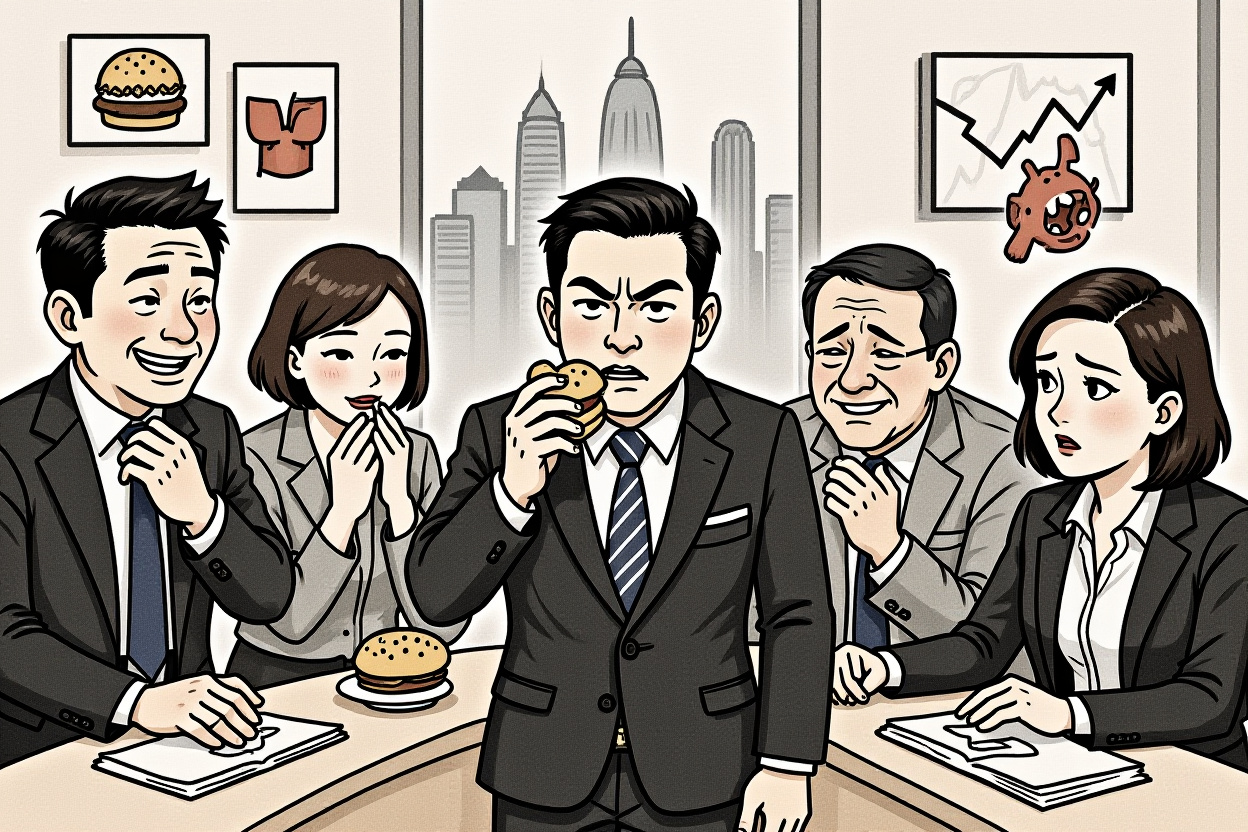
What was intended as a routine global新品 (new product) launch for McDonald’s quickly devolved into a textbook case of corporate communication gone awry. A short promotional video featuring CEO Chris Kempczinski (克里斯·坎普钦斯基) tasting the new “Grand Arch” burger became the epicenter of a social media maelstrom. Instead of projecting confidence and relish, Kempczinski appeared uncertain, joked about not knowing how to take a bite, and ultimately delivered what netizens derisively called a “one-bite wound”—a minuscule, symbolic nibble from the burger’s edge. This seemingly minor act was magnified through the lens of digital scrutiny, transforming a marketing asset into a liability.
The video’s fallout was immediate and severe. Critics flooded social platforms, noting the CEO’s performative discomfort and contrasting it with the hearty appetite expected from a fast-food chain’s leader. This McDonald’s trust crisis was not born in a vacuum; it tapped into a growing public skepticism about corporate authenticity. The CEO’s consistent reference to the burger as a “product” rather than “food” was perceived as coldly commercial, stripping away any semblance of genuine enthusiasm. This linguistic choice framed the interaction as a corporate pitch, alienating consumers who seek emotional connection with brands they patronize.
Competitors Seize the Moment
The speed of the digital age ensures that missteps are rarely contained. Rival Burger King’s North American president, Tom Curtis, swiftly capitalized on McDonald’s embarrassment. He released a counter-video featuring himself enthusiastically devouring a Whopper, sauce and all. This stark, authentic contrast was a masterclass in借势营销 (opportunistic marketing), amplifying McDonald’s awkwardness and positioning Burger King as the more relatable and genuine alternative. The episode highlighted how vulnerabilities in brand leadership can be instantly weaponized by competitors in the hyper-competitive fast-food landscape.
The CEO Profile: A Double-Edged Sword
Chris Kempczinski (克里斯·坎普钦斯基) is a seasoned corporate leader with an impeccable résumé. A Duke University and Harvard Business School graduate, he held senior roles at Procter & Gamble and PepsiCo before joining McDonald’s in 2015. He ascended to the global CEO role in November 2019 following the ouster of his predecessor, Steve Easterbrook. His mandate has been to steer the mammoth enterprise through pandemic recovery, inflation, and evolving consumer tastes. However, his professional pedigree may have inadvertently contributed to the recent backlash.
Public perception is often shaped by subtleties beyond the boardroom. Kempczinski, an avid marathon runner with a lean physique, has publicly stated he eats McDonald’s three to four times a week. Yet, his athletic build clashed visually with the indulgent, high-calorie product he was promoting. This created a cognitive dissonance for viewers; as some American commentators noted, he “doesn’t look like someone who loves Mickey D’s.” This image gap, when combined with the stilted performance in the video, fostered an impression of elite detachment. The incident suggests that in an era valuing transparency, a leader’s personal authenticity is as crucial as their strategic acumen in maintaining consumer trust.
Beyond the Blunder: McDonald’s Mounting Business Pressures
The viral video is merely a symptom of a more profound McDonald’s trust crisis rooted in tangible business challenges. In 2024, the company reported its first global comparable sales decline since 2020, with net profit dipping 3%. Soaring inflation has driven up ingredient and labor costs, forcing menu price increases that have eroded McDonald’s historical reputation for value. Management has acknowledged a shrinking “value leadership” advantage, prompting a strategic pivot in 2025 toward aggressive value bundles like the $5 meal deal. While this helped drive a 4% increase in total revenue and net income for 2025, the underlying pressure on consumer wallets remains.
Food Safety and Brand Erosion
Trust is fragile, and past incidents continue to cast a shadow. A severe E. coli outbreak in the United States in October 2024, linked to McDonald’s products, resulted in multiple hospitalizations and one fatality. Such events fundamentally shake consumer confidence in a brand built on consistency and safety. In a letter to shareholders, Kempczinski himself lamented days when “McDonald’s was at the center of nearly every major news story.” Rebuilding this trust is a long-term imperative that goes far beyond any single marketing campaign. The recent taste-test fiasco risks reopening these wounds, reminding consumers of past failures and present uncertainties.
The Chinese Crucible: Growth Amidst Fierce Rivalry
While navigating global headwinds, China represents both McDonald’s greatest opportunity and its most formidable challenge. The market is critical to the company’s growth narrative. With over 7,700 restaurants in mainland China by the end of 2025 and plans to add approximately 1,000 more in 2026, McDonald’s is charging toward a goal of 10,000 stores in the country by 2028. China is unequivocally positioned as the company’s “number one incremental growth market.” However, this expansion is occurring in an increasingly brutal competitive environment.
The landscape has shifted dramatically. The duopoly of McDonald’s and KFC (肯德基) as Western fast-food standards has been shattered by savvy本土品牌 (local brands). Wallace (华莱士) has achieved scale with nearly 20,000 outlets, while Tasting (塔斯汀) has gained traction with its “hand-stretched dough” localization strategy. These competitors often win on price, offering所谓 “穷鬼套餐” (budget-friendly meals) that appeal directly to cost-conscious consumers. For McDonald’s, succeeding in China now means competing not just on brand legacy but on极致性价比 (extreme cost-performance), store-level efficiency, and deep cultural resonance.
Balancing Speed with Quality in Expansion
As McDonald’s pushes deeper into China’s三至五线城市 (third- to fifth-tier cities), it tests the limits of its全球供应链 (global supply chain) and management systems. Maintaining consistent quality and service standards while accelerating growth is a perennial challenge. Rival KFC has experimented with sub-brands like肯悦咖啡 (K Coffee) to optimize store space and labor. McDonald’s must find its own formula for profitable unit economics amid rapid expansion. The McDonald’s trust crisis in this context is not about a CEO’s video but about能否 (whether it can) deliver on its brand promise at scale while fending off relentless local competition. The strategic stakes here are immense, as missteps in customer experience or value perception could undermine the entire growth engine.
Navigating the Path Forward: Authenticity and Strategy
The convergence of the PR mishap and underlying business stresses presents a clear inflection point for McDonald’s. Leadership authenticity is no longer a soft skill but a hard business necessity. The episode demonstrates that consumers are hyper-vigilant for signs of corporate insincerity. For Kempczinski and his team, this means ensuring that future communications are grounded in genuine product enthusiasm and transparent engagement. It may also involve a more careful curation of the CEO’s public persona to bridge the gap between the C-suite and the customer.
Strategically, the company must continue to walk a tightrope. In established markets like the U.S. and Europe, defending its value positioning against inflation is paramount. In high-growth markets like China, the focus must be on smart expansion—balancing store count growth with operational excellence and localized innovation. The trust crisis underscores that every customer touchpoint, from a CEO’s video to the price of a burger in a tier-3 city, contributes to the overall brand equity. McDonald’s must engineer its growth to be both financially robust and perceptually authentic.
Lessons for the Global Marketplace
This incident offers broader lessons for multinational corporations, especially those operating in consumer-facing industries. In the digital era, leadership actions are instantly scrutinized and can symbolize broader corporate challenges. A failure to appear authentic can quickly metastasize into a narrative about brand integrity. Furthermore, as seen in the Chinese market, global giants can no longer rely solely on brand power; they must constantly innovate and adapt to fierce local competition that understands domestic consumers intimately. The McDonald’s trust crisis is a cautionary tale about the interconnectedness of leadership perception, operational execution, and competitive strategy.
Synthesizing the Crisis into Opportunity
The mockery of CEO Chris Kempczinski’s (克里斯·坎普钦斯基) taste test is more than a passing social media storm. It is a revealing symptom of the multifaceted McDonald’s trust crisis—a convergence of perceived inauthenticity, business performance pressures, and intense market competition. For the fast-food behemoth with over 45,000 global restaurants, the path forward requires a dual focus: rebuilding genuine consumer connections through transparent leadership and meticulously executing a growth strategy that delivers consistent value and quality.
For international investors and market analysts, this episode serves as a critical reminder to look beyond quarterly earnings. The strength of a consumer brand lies in its intangible equity—the trust and loyalty it commands. Monitoring how McDonald’s addresses this trust deficit, particularly in pivotal markets like China, will be essential for assessing its long-term resilience and growth trajectory. The call to action is clear: stakeholders should closely watch the company’s forthcoming communications, its same-store sales metrics in key regions, and its ability to fend off local competitors as indicators of whether it can turn this crisis into a catalyst for renewed brand strength and sustainable value creation.