



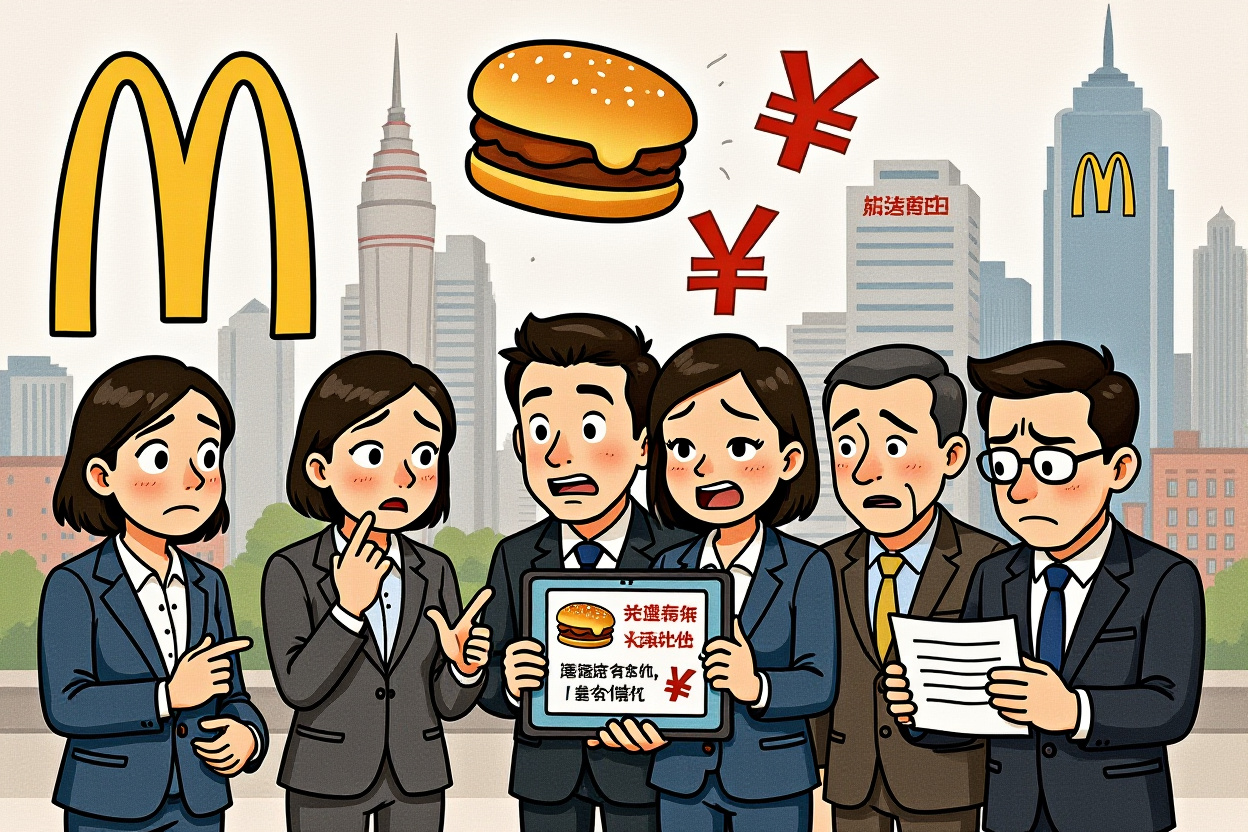
Executive Summary
The recent public relations debacle involving McDonald’s CEO Chris Kempczinski (克里斯·坎普钦斯基) is more than a viral moment—it signals deeper operational and brand challenges for the fast-food giant, particularly in the critical Chinese market. This incident underscores a growing McDonald’s trust crisis that could influence investor sentiment and strategic decisions. Key takeaways include:
- The CEO’s performative tasting video triggered global ridicule, exacerbating perceptions of corporate inauthenticity and damaging brand equity.
- McDonald’s faces mounting financial pressures globally, including inflationary cost surges and a decline in value perception among consumers.
- In China, aggressive expansion plans collide with fierce competition from local brands and evolving consumer preferences, threatening profitability.
- Food safety incidents and leadership missteps contribute to a erosion of trust, posing long-term risks for revenue growth and market positioning.
- Investors must monitor how McDonald’s navigates this trust crisis through strategic pivots, especially in balancing global scale with local market agility.
The Viral Bite That Shook the Golden Arches
In early March 2026, what was intended as a routine global product launch for McDonald’s swiftly unraveled into a full-blown public relations catastrophe. A meticulously produced video featuring CEO Chris Kempczinski (克里斯·坎普钦斯基) promoting the new “Grand Arch” burger backfired spectacularly, igniting a firestorm across social media platforms worldwide. The core of the controversy lay in Kempczinski’s hesitant, symbolic bite—a mere nibble that viewers derided as a “flesh wound” to the burger—exposing a palpable disconnect between corporate leadership and consumer expectations.
This episode is not an isolated gaffe but a symptom of a broader McDonald’s trust crisis. For a brand built on consistency and mass appeal, the CEO’s awkward demeanor and clinical reference to the burger as a “product” rather than food resonated as deeply inauthentic. In an era where transparency and genuineness are prized, such missteps can rapidly translate into tangible financial repercussions, shaking investor confidence in the company’s narrative.
Deconstructing the PR Disaster
The less-than-one-minute video became a masterclass in how not to execute influencer marketing—even when the influencer is the CEO. Kempczinski, after praising the new offering, struggled to take a bite, eventually managing only a small taste from the edge. Social media users were quick to pounce, with comments ranging from “He looks like he’s never seen a burger before” to comparisons with a 2024 video where he appeared to chew only twice before cutting away. The visual contrasted starkly with the enthusiastic endorsement that followed, fueling speculation that the food was discarded off-camera.
Competitors wasted no time capitalizing on the blunder. Burger King’s North America President Tom Curtis promptly released a video of himself heartily devouring a Whopper, sauce smeared on his face—a deliberate, gritty counterpoint to McDonald’s polished and perceived disingenuous presentation. This opportunistic marketing highlighted the vulnerability of McDonald’s brand image and underscored the intense scrutiny facing its leadership.
The CEO’s Profile and the Perception Gap
Chris Kempczinski (克里斯·坎普钦斯基) is a seasoned executive with an impressive resume, including a Harvard MBA and stints at Procter & Gamble and PepsiCo. He took the helm in 2019 following the ouster of his predecessor. However, his elite background and lean, marathon-runner physique—contrasting with the calorie-dense products he promotes—have inadvertently fostered an image of detachment. As one American netizen pointedly observed, “He just doesn’t look like someone who enjoys Mickey D’s.” This perception gap exacerbates the McDonald’s trust crisis, making recovery from such incidents more challenging.
Global Headwinds: Financial Strain and Eroding Trust
Beyond the viral video, McDonald’s is grappling with significant operational and financial challenges that compound its trust issues. The company reported its first global comparable sales decline since 2020 in 2024, with net profit dipping 3%. Soaring inflation has driven up ingredient and labor costs, forcing menu price increases that have alienated budget-conscious consumers. Management has acknowledged a shrinking “value leadership” advantage, prompting a strategic pivot toward value menus, like the $5 meal deal, in 2025.
While this value strategy yielded a 4% rise in total revenue and net profit in 2025, it is a defensive move in a tough economic climate. More critically, the brand’s trust has been battered by food safety incidents, such as a severe E. coli outbreak linked to McDonald’s in the U.S. in October 2024, which resulted in hospitalizations and one fatality. As Kempczinski lamented in a shareholder letter, some days make it feel like “McDonald’s is the lead story in every major newscast.” Rebuilding consumer confidence is a paramount, long-term challenge directly tied to the company’s financial health.
Data Points Highlighting the Pressure
- 2024 Financials: Global comparable sales fell, net profit down 3% year-over-year.
- 2025 Recovery: Value initiatives spurred a 4% increase in both total revenue and net profit.
- Store Count: Over 45,000 restaurants globally as of end-2025.
- Cost Pressures: High inflation continues to squeeze margins, testing pricing power.
The China Crucible: Growth Engine or Competitive Quagmire?
For McDonald’s, the Chinese market represents its largest growth opportunity and its most formidable battlefield, where the global trust crisis intersects with local dynamics. The company has ambitious plans, aiming to open approximately 1,000 new outlets in 2026 on its path to 10,000 stores in China by 2028. With over 7,700 restaurants in mainland China by the end of 2025, the region is critical for global expansion. However, this growth is pursued amidst brutal competition and shifting consumer tastes that threaten to undermine the very trust the brand seeks to cultivate.
Local Rivals and the Battle for Value
McDonald’s no longer enjoys a duopoly with KFC in the Western fast-food space. Domestic players have risen forcefully: Wallace (华莱士) operates nearly 20,000 stores nationwide, while Tastien (塔斯汀) has gained traction with its localized “hand-stretched dough” concept. These brands often undercut on price, offering so-called “poor ghost meals” that appeal to cost-sensitive consumers. This intense competition pressures McDonald’s to defend its market share while maintaining profitability, a delicate balance that tests its operational efficiency and brand loyalty.
As McDonald’s expands into lower-tier cities, its renowned supply chain and management systems face new stresses. Rationalizing consumption trends mean single-store efficiency is paramount. Unlike KFC, which has explored sub-brands like “Ken Yue Coffee” to optimize resource sharing, McDonald’s must find ways to scale rapidly without compromising quality or margins. The McDonald’s trust crisis in China is thus twofold: maintaining consumer trust in food safety and value, while assuring investors of sustainable growth amidst cutthroat competition.
Strategic Implications for Investors
The Chinese market’s complexity requires McDonald’s to execute a nuanced strategy. Key factors to watch include:
- Same-Store Sales Growth (SSSG): Monitoring performance in existing stores versus new openings to gauge brand health.
- Localization Efforts: Success in adapting menus and marketing to Chinese preferences without diluting the core brand.
- Supply Chain Resilience: Ability to manage costs and ensure consistency across a vast and diverse geography.
- Digital Integration: Leveraging partnerships with platforms like Meituan (美团) and Alibaba’s (阿里巴巴集团) Ele.me for delivery and loyalty programs.
Investor Perspectives: Navigating the Fallout of the Trust Crisis
The CEO’s tasting fiasco and the underlying operational challenges present a multifaceted risk profile for investors, particularly those with exposure to Chinese consumer stocks. The McDonald’s trust crisis is a case study in how brand equity—a key intangible asset—can be rapidly eroded by missteps, impacting valuation. For institutional investors and fund managers, assessing McDonald’s requires looking beyond quarterly earnings to longer-term brand health and competitive positioning.
Analysts point to several critical indicators: customer traffic trends, margin stability in the face of cost inflation, and success in value-menu adoption. Moreover, the company’s ability to innovate and respond to local competitors in China will be a significant determinant of its Asian growth narrative. As one industry expert noted, “In China, trust is currency. A brand that loses it, even temporarily, cedes ground to hungry rivals who are ready to pounce.”
Market Data and Regulatory Context
Investors should also consider the broader regulatory environment in China, where authorities like the State Administration for Market Regulation (国家市场监督管理总局) closely monitor food safety and advertising claims. Any lapse by McDonald’s could trigger regulatory scrutiny, fines, or operational disruptions, further impacting the stock. The company’s expansion pace must align with stringent local regulations, adding another layer of complexity to its growth story.
Synthesizing the Path Forward for the Golden Arches
The symbolic bite by CEO Chris Kempczinski (克里斯·坎普钦斯基) has illuminated profound challenges facing McDonald’s globally and in its pivotal Chinese market. The incident is a stark reminder that in today’s hyper-connected world, leadership authenticity is inseparable from brand trust. For McDonald’s, addressing this trust crisis requires a concerted, multi-pronged approach: reinforcing value propositions to retain cost-sensitive customers, doubling down on food safety protocols, and ensuring marketing resonates with genuine consumer engagement.
In China, the path is even steeper. Success hinges on balancing aggressive store growth with operational excellence, fending off local competitors through smart localization, and continuously earning consumer trust. For investors, the key is to monitor execution on these fronts—watch for improvements in comparable sales, margin trends, and market share metrics in China. The coming quarters will be critical in determining whether McDonald’s can transform this PR stumble into a catalyst for renewed strategic clarity and sustainable growth.
As you assess opportunities in the consumer and restaurant sectors, consider how brand resilience and local market agility are priced into valuations. Stay informed on McDonald’s strategic updates and China market dynamics to make informed investment decisions. The McDonald’s trust crisis is more than a fleeting news cycle; it’s a litmus test for corporate adaptability in an evolving global landscape.