



Executive Summary
This analysis delves into the cascading effects of Middle Eastern airspace closures, triggered by regional conflict, on Chinese travelers and capital markets.
- Market Disruption: The sudden closure of airspace around Dubai, a critical global aviation hub, has caused severe flight cancellations and operational chaos for airlines serving the China-UAE route, directly impacting related equities.
- Price Surge & Consumer Impact: Stranded passengers face exorbitant last-minute ticket prices, with premium cabin fares soaring to nearly 54,000 yuan, highlighting acute supply-demand imbalances and risks for tourism-reliant economies.
- Geopolitical Risk Premium: The event serves as a stark case study in how geopolitical instability can instantly paralyze international travel and logistics, forcing investors to reassess risk in aviation and tourism sectors with exposure to volatile regions.
- Recovery Timeline Uncertainty: Experts note that even with a ceasefire, restoring full flight schedules is a complex process contingent on safety reassurances, aircraft repositioning, and governmental coordination, prolonging market uncertainty.
The High-Stakes Scramble to Escape Dubai
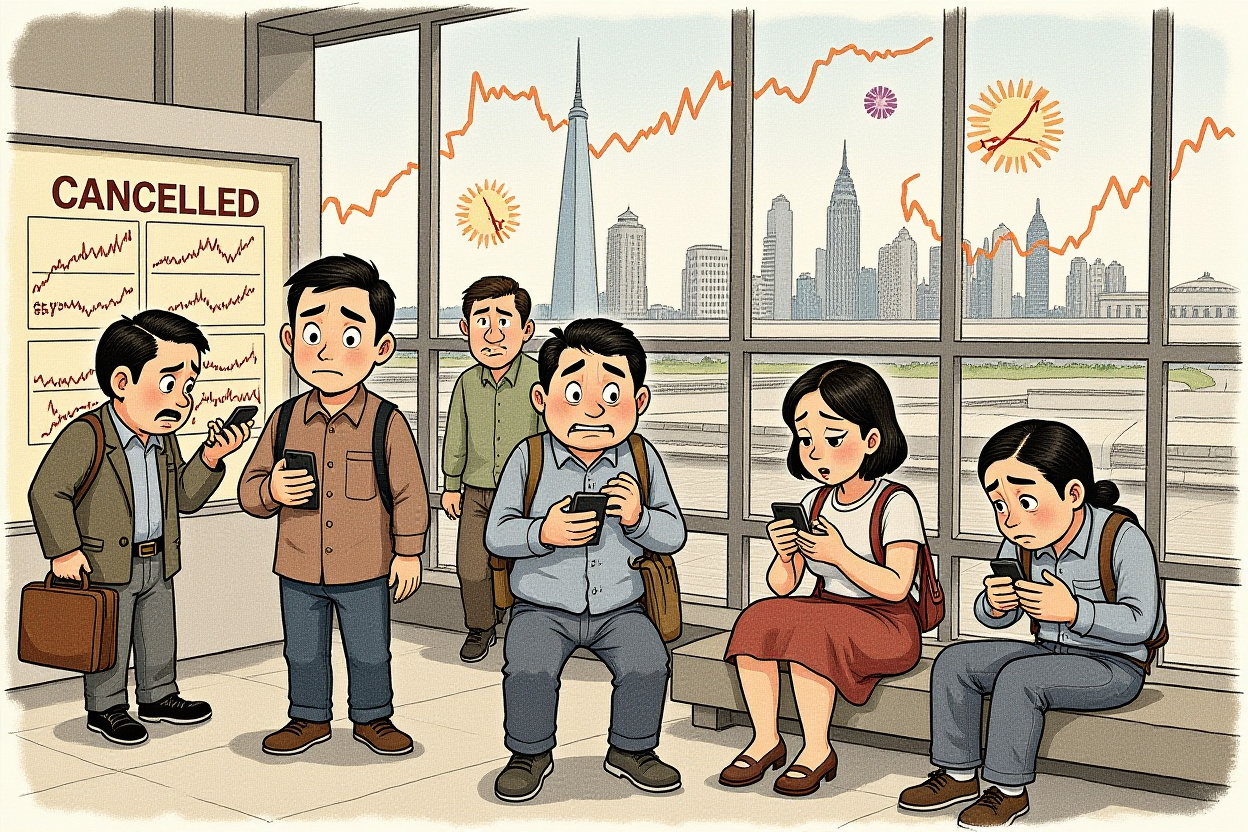
The ordeal of Liu Yi (刘怡), a Chinese tourist, encapsulates the sudden terror and financial strain inflicted upon travelers caught in a geopolitical crossfire. Arriving in Dubai on February 27 for what was meant to be a leisure trip, her plans disintegrated just one day later with the sound of explosions and air raid sirens. Forced to shelter in a hotel garage and later confined indoors, her tourist experience morphed into one of anxiety and desperation to return home. Her story, and that of many other stranded Chinese travelers in Dubai, is not merely a travel anecdote but a live demonstration of systemic risk materializing in a key global transit hub.
The core of her struggle was a relentless cycle of booking and cancellation. Before finally securing a 54,000 yuan first-class ticket—a price reflecting sheer scarcity and dire need—Liu Yi endured the frustration of seven consecutive flight cancellations after attempting to book over a dozen times. This experience was mirrored across Dubai International Airport (DXB), where confusion reigned. Passengers reported being advised not to proceed to the airport even with a ticket, absent explicit confirmation from the airline, a testament to the fluid and dangerous operational environment.
A Hub Paralyzed by Perimeter Conflict
Dubai’s predicament is geographically ironic. As Professor Guo Jia (郭佳) of Guangwai Nanguo Business College explains, while Dubai itself is not a direct combatant, it found itself trapped in a "circle" of closed airspace. Neighboring countries, many hosting military assets, shut their sovereign skies for security, effectively creating an impassable aerial blockade around the Persian Gulf. "How does Dubai fly out? Flights are continuous; you can’t just fly over the top," Guo noted. This rendered one of the world’s busiest international airports, which handled 92.3 million passengers in 2024, suddenly isolated.
The economic stakes are immense. Official data from March 2025 showed 200 weekly round-trip flights between mainland China and the UAE, connecting 13 Chinese cities. Dubai’s tourism economy, which welcomed over 18.7 million visitors in 2024, is heavily reliant on this connectivity. The paralysis of this route delivers an immediate shock not just to stranded individuals but to the hospitality, retail, and aviation service sectors in Dubai that depend on Chinese tourist spending.
Navigating a Broken Market: Sky-High Fares and "Curved" Routes Home
With standard commercial operations severely curtailed, a frantic and skewed market for escape routes emerged. Data from travel platform Ctrip (携程) on March 6 laid bare the extreme disequilibrium. A direct economy-class ticket from Dubai to Haikou was listed at over 15,000 yuan, while all economy seats on a Dubai-to-Beijing flight for the following day were sold out, with business and first-class fares approaching 50,000 yuan. In stark contrast, one-way tickets from China to Dubai during the same period remained below 3,000 yuan, highlighting the completely asymmetric demand.
Faced with dead ends on direct routes, stranded travelers like Zhao Zhi (赵志)—who had previously fled Afghanistan—resorted to extraordinary ingenuity and complex itineraries. After six days of frustration, Zhao developed automated scripts to scour booking websites, eventually securing a multi-leg journey via Kuala Lumpur to Shenzhen. Social media platforms became makeshift forums for sharing viable "curve return" (曲线回国) paths, such as "Dubai-Oman-Dhaka-Kunming-Shanghai" or "Dubai-Ho Chi Minh City-Guangzhou." These lengthy, expensive workarounds underscore the breakdown of efficient global aviation networks and the personal cost of geopolitical disruption.
The Psychological Toll of the Unknown
Beyond the financial hit, travelers emphasized a profound psychological burden. Liu Yi reported lasting anxiety, jumping at sounds resembling aircraft even after returning to Beijing. Zhao Zhi described the environment as one of "facing the unknown," a sentiment echoed by many who felt trapped with no clear timeline for resolution. The intermittent air raid alerts, sometimes arriving in the middle of the night, sustained a state of high alert and stress, transforming a commercial hub into a place of perceived vulnerability for foreign visitors.
Aviation Industry in Crisis: Operational and Financial Fallout
For airlines, the closures presented an immediate operational and financial crisis. Major carriers like Emirates, Dubai’s home-based airline, were forced to enact limited flight schedules. In a statement, Emirates announced it would operate a reduced timetable until March 7, prioritizing earlier-booked passengers for repatriation flights and explicitly warning others not to come to the airport. This period of suspended operations directly impacts revenue, complicates crew scheduling, and disrupts carefully planned aircraft rotations across global networks.
Civil aviation expert Lin Zhijie (林智杰) pointed out the broader ripple effects: "As a key international aviation transit hub, Dubai occupies an important position in Asia-Europe and Asia-Africa routes. Therefore, this suspension has not only significantly affected transit passengers but also directly led to tight capacity on current China-Europe routes." This secondary effect amplifies the disruption, causing ticket price inflation and availability issues on routes far beyond the Middle East, squeezing both business and leisure travel across continents.
The Long Road to Recovery
Restoring normal operations is not a simple flip of a switch. Experts agree that even after airspace reopens, a return to full schedules requires time. Airlines must reposition aircraft and crew, rebuild flight timetables, and obtain renewed safety clearances. Professor Guo Jia suggested that the initial, limited resumption of flights—such as Air China’s flight to Riyadh on March 5—likely resulted from diplomatic back-channel communications providing non-public safety assurances during a temporary "evacuation window." Lin Zhijie offered a cautious timeline: "If the situation stabilizes within a week or two, recovery can be relatively fast… the core prerequisite is the safety of the airspace and whether the airport has normal operational capability." The reported interception action and explosions near Dubai airport on March 7, however, underscored the fragile and ongoing nature of the security threat.
Investment Implications: Pricing Geopolitical Risk in Travel and Aviation
For institutional investors and market analysts, the plight of stranded Chinese travelers in Dubai is a concentrated lesson in event-driven risk. Publicly listed Chinese airlines, travel agencies, and online travel platforms (OTAs) with significant exposure to the China-UAE and China-Europe corridors face immediate earnings pressure from refunds, lost bookings, and operational inefficiencies. The volatility in these equities in the days following the crisis likely reflects a rapid repricing of this risk.
More broadly, the event reinforces the need for a "geopolitical risk premium" in valuations for sectors like aviation, tourism, and hospitality. Markets must now factor in the potential for sudden, complete operational halts in regions perceived as stable commercial hubs but located in complex geopolitical neighborhoods. The resilience of business models is tested not by average conditions, but by these tail-risk events. Investors may scrutinize airline network concentration, corporate hedging strategies for fuel and forex amidst crisis, and the adequacy of contingency planning.
A Catalyst for Diversification and Hedging?
This crisis may accelerate existing trends. Corporations with large travel budgets may reinforce policies favoring virtual meetings over long-haul trips to volatile regions. Travel insurers will reassess policy terms and pricing for areas with latent conflict risk. For the investment community, it highlights the value of diversification—both in travel route networks for airlines and in investment portfolios away from over-concentration in sectors hyper-sensitive to regional instability. The sharp price action in last-minute tickets also demonstrates the potential for extreme demand inelasticity in crisis scenarios, a factor relevant for related futures and options markets.
Navigating the New Normal in Global Mobility
The saga of the stranded Chinese travelers in Dubai transcends a headline. It is a multi-faceted event with clear lessons for consumers, corporations, and capital markets. It demonstrates how swiftly modern, interconnected travel systems can fracture, transforming a luxury destination into a locus of anxiety and expensive escape. For the aviation industry, it is a stress test on operational flexibility and crisis communication. For investors, it is a live case study in how geopolitical shocks transmit directly into financial performance and asset prices.
The gradual, tentative resumption of flights offers hope, but the underlying volatility in the region remains. The experience underscores that in today’s world, travel and investment in internationally connected sectors are inextricably linked to the stability of global commons like international airspace. Moving forward, robust risk assessment must account not only for a destination’s internal stability but for the stability of the aerial pathways that lead to it. For market participants, maintaining a vigilant, informed perspective on these interconnected risks is no longer optional—it is essential for prudent capital allocation and strategic planning in an uncertain world.