



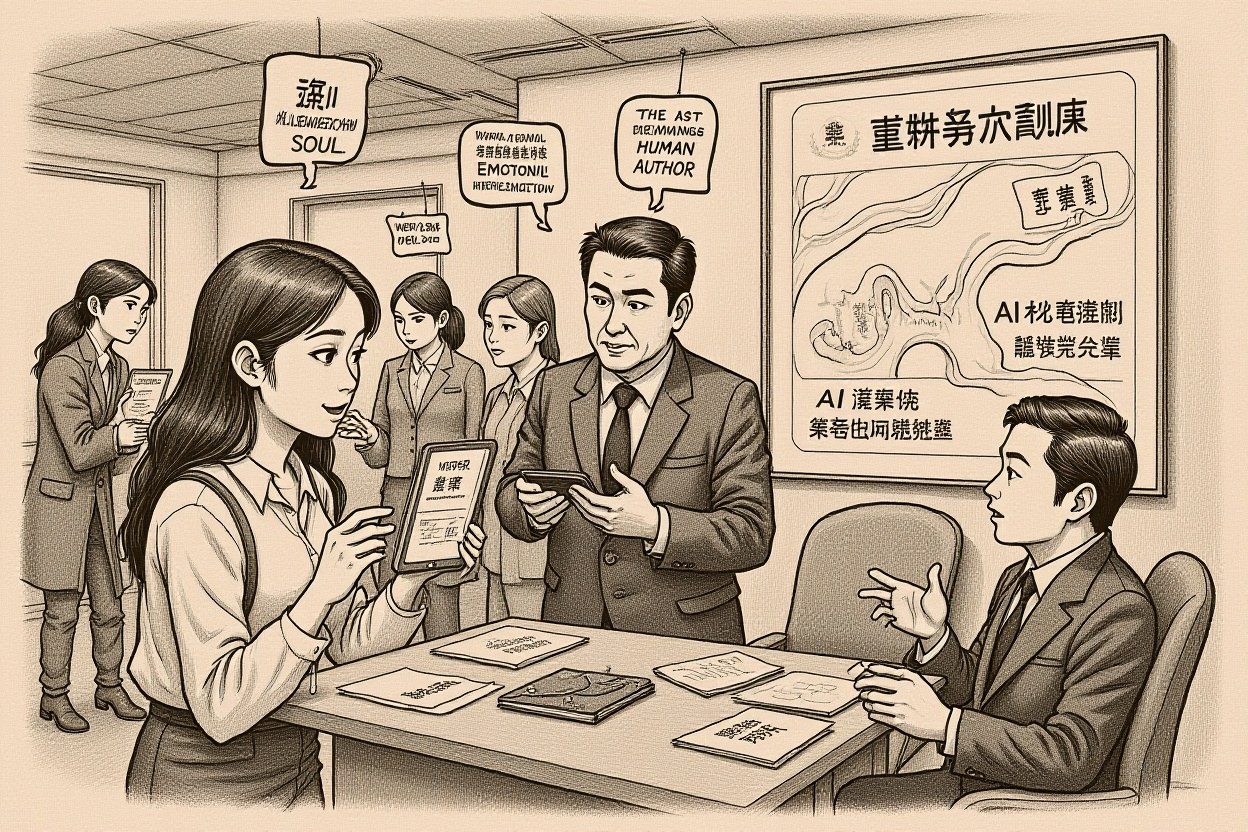
The promise of quick riches is a potent lure. On Chinese social media, posts with titles like “28-year-old AI writer, how to earn over 10,000 yuan per month” and “How to write a million-word novel in less than a day using AI” routinely rack up tens of thousands of likes and comments. This burgeoning hype cycle paints a picture of a new gold rush in China’s massive web novel industry, fueled by generative artificial intelligence. Yet, beneath the surface of this algorithmic storytelling revolution lies a fierce debate about quality, authenticity, and the very soul of creative work—often described in China as lacking “人味儿” (rén wèir), or “human flavor.” For institutional investors and market analysts watching China’s digital content sector, this clash between soulless scale and human-driven soul is reshaping business models, platform strategies, and the valuation of creative IP.
How Generative AI is Industrializing Web Fiction Production
The traditional metrics of success for a web novelist in China—relentless daily output, consistent quality, and an almost superhuman work ethic—are being radically redefined by AI. The emergence of powerful large language models has introduced a new competitor into the arena: one that never sleeps, never suffers writer’s block, and can produce text at an industrial scale.
The Relentless Pace of Algorithmic Authors
Mao Zhihui (毛志慧), vice chairman of the Jiangxi Online Writers Association, knows the grind intimately. Since 2014, he has authored over 16 million characters. He recalls when producing 8,000 to 9,000 words daily was considered exceptional. “Now, in the increasingly competitive environment of web literature, many authors break through 10,000 words per day, even reaching 20,000,” he notes. However, this human feat of endurance pales next to AI’s capabilities. “AI is ‘competing’ on word count, generating tens of thousands of words in just a few minutes. This efficiency is akin to industrial production,” Mao Zhihui adds. This shift in the production frontier is the first major pressure point introduced by AI into the web novel ecosystem, challenging the fundamental economics of content creation.
Platforms and the Flood of AI-Generated Content
The impact is already visible at the platform level. Tomato Novel (番茄小说), a major free-to-read platform, experienced a surge in new book listings—a phenomenon known as “首秀” (shǒuxiù, debut)—shortly after the capabilities of AI models advanced last year. Industry data suggests the platform’s daily debut count ballooned from a few hundred to easily surpassing 5,000 across the entire site within a month. This deluge of AI-generated submissions has forced a response. Editors like Qiao Huan (乔欢) report that 20-30% of the hundreds of submissions she receives weekly now show clear signs of AI polishing or generation. Her platform employs AI detection tools, rejecting works with AI content ratios exceeding 40% and even blacklisting authors and clawing back payments for egregious cases. This technological arms race between generation and detection is a critical operational and cost factor for platforms.
The Core Critique: Why AI Web Novels Lack “Soul”
Efficiency alone does not guarantee reader engagement or commercial success. The most persistent and damning critique of AI-generated fiction is that it lacks the essential “human touch”—the emotional depth, creative spark, and narrative coherence that comes from lived experience and intentional craft. This absence of soul is the primary barrier to AI’s wholesale adoption by discerning platforms and readers.
Beyond the First 20,000 Words: The Logic Breakdown
Experienced authors and editors point to fundamental weaknesses in AI’s narrative capabilities. Mao Zhihui explains that while AI can churn out passable text for short stories, its utility collapses over longer narratives. “Once my instructions exceed two hundred thousand characters, its logical analysis starts making errors. The plot generated later often doesn’t match up with earlier content, even containing obvious flaws,” he states. This inability to maintain complex, long-form narrative coherence is a significant technical limitation for serialized web novels, which often run for millions of words. The output becomes a patchwork of predictable tropes without a beating heart, failing to deliver the emotional payoff readers crave.
The Voice of Literary Authority: AI as Tool, Not Creator
This sentiment is echoed at the highest levels of literature. Nobel laureate Mo Yan (莫言) experimented with AI poetry and concluded that while AI excels at information retrieval and mimicking style, it lacks genuine thought and creativity. He emphasized that AI cannot replace true literary creation, which is rooted in real-life experience, and that writers must remain in the dominant position, using AI as an assistant, not a master. This philosophical stance underpins the cautious approach of legacy platforms. Hu Huijuan (胡慧娟), vice president of Beijing Jinjiang Original Network Technology Co., Ltd. (the operator of Jinjiang Literature City 晋江文学城), bluntly states that AI-generated web novels “lack the authentic expression of human emotion and wisdom, unable to evoke tremors in the reader’s soul.” For platforms like Jinjiang, which built their brand on authentic creator communities, preserving this human soul is a core business value.
Platform Strategies: Navigating the AI Content Onslaught
China’s web novel platforms are not a monolith; they are adopting starkly different strategies in response to the AI wave. Their choices—between embracing low-cost volume or defending human-centric quality—will define their market positioning and, ultimately, their appeal to investors seeking sustainable growth versus short-term traffic spikes.
The Volume Play: Tomato Novel’s Pragmatic Approach
Platforms like Tomato Novel, which operate on a vast, ad-supported free-reader model, initially appeared more receptive to the volume AI can provide. However, they have faced backlash. Last year, Tomato Novel sparked controversy by quietly adding an “AI Training Supplement” to its author agreements, allowing the platform to use authors’ works to train its own AI models. Authors revolted, seeing it as turning their work into “fertilizer” for the machines that might replace them. The platform was forced to add an opt-out clause. This incident highlights the precarious balance platforms must strike between leveraging AI for operational advantage and maintaining trust with their creator ecosystem—their most valuable asset.
The Quality Defense: Jinjiang’s Conservative Stance
In contrast, Jinjiang Literature City has taken a deliberately conservative and regulatory approach. As early as 2025, it updated its reporting center with specific clauses on AI-assisted writing and issued trial guidelines. The platform strictly defines permissible assistance into two categories: textual (e.g., proofreading, polishing) and creative (e.g., naming characters, summarizing plot points), explicitly forbidding AI from generating narrative plots or detailed chapter outlines. “For a long time, we will not consider introducing AI tools directly into the creative field,” states Hu Huijuan. Even if Jinjiang develops its own AI, it will be reserved for back-end tasks like content review. This strategy doubles down on Jinjiang’s brand equity as a home for original, high-engagement human storytelling, betting that readers will pay a premium for authentic soul over synthetic scale.
The Future Market: AI as “Pre-Made Meal” or Creative Partner?
The trajectory of AI in web literature is not predetermined. Market participants hold divergent views on whether AI will remain a tool for generating low-quality “pre-made meals” or evolve into a genuine collaborative partner that augments human creativity.
The Pre-Made Meal Analogy and Reader Taste
Editor Qiao Huan offers a telling analogy: reading an AI-generated novel is like “tasting a dish and immediately realizing it’s not freshly cooked by a chef, but a pre-made meal produced on an assembly line.” The core issue is that AI, trained on existing corpus data, excels at producing the statistically “correct” next word, leading to competent but profoundly derivative and mediocre work. It struggles with the innovation that defines breakout hits. As Mao Zhihui observes, reader tastes are a “never-satisfied beast,” constantly demanding new tropes and styles. AI currently regurgitates yesterday’s trends, like the long-dead “废物退婚流” (waste退婚, good-for-nothing engagement cancellation trope), failing to drive the cultural evolution that keeps the industry dynamic.
Divergent Visions: Replacement vs. Augmentation
Entrepreneurs like Tang Aiping (唐爱平), founder of the automated fiction platform “Tangku,” are bullish on replacement. He believes that as AI evolves into a true AI Agent, it will surpass human authors in various aspects and could generate creative inspiration within three to four years. This vision aligns with a volume-driven, trend-chasing model. Conversely, scholars like Xu Miaomiao (许苗苗), director of the Capital Normal University Online Literature and Art Research Center, offer a more nuanced prediction. She argues that while AI may not siphon off top authors or famous IPs, it could flood the market with “mediocre but infinitely productive” content, dramatically increasing competition for new human authors and potentially altering the industry’s profit models if it successfully captures reader attention. The most apocalyptic vision comes from sci-fi author Liu Cixin (刘慈欣), who has publicly stated that AI will likely replace a significant proportion of human literary creation in the future, with the outcome in 10 or 20 years remaining unknown.
The battle for the soul of China’s web novel industry is a microcosm of a larger conflict between automation and authenticity. For investors and analysts, the key metrics extend beyond monthly active users and submission volume. They must now assess platform governance—AI detection capabilities, creator ecosystem health, and content quality safeguards. Platforms betting on human soul, like Jinjiang, are making a long-term play for IP depth and reader loyalty, while those leveraging AI for scale are chasing traffic efficiency. The market is likely to segment, with a “pre-made meal” tier of AI-generated content coexisting with a premium tier of human-authored stories. The winners will be those who can either master the economics of synthetic content at scale or who can convincingly champion and monetize the irreplaceable value of the human touch. As the technology evolves, the most compelling investment narratives may center on hybrid models where AI augments human creativity without supplanting it, preserving the vital spark—the “人味儿”—that truly captivates audiences and builds lasting cultural value.