



Executive Summary
– Fenqile’s (分期乐) mini-loans, often marketed with low monthly payments, conceal exorbitant interest rates and hidden fees, leading borrowers to repay nearly double the principal, as seen in the case of Ms. Chen (陈女士).– Despite regulatory crackdowns, the platform continues to target students and young consumers, with aggressive marketing and violent debt collection practices raising serious ethical and legal concerns.– New guidelines from the People’s Bank of China (中国人民银行) and the National Financial Regulatory Administration (国家金融监督管理总局) aim to cap loan costs at 24% annualized, but enforcement gaps allow platforms to maintain high profitability through opaque fee structures.– This case underscores systemic risks in China’s fintech sector, potentially impacting investor confidence in companies like Lexin Group (乐信集团) and prompting calls for stricter oversight and enhanced consumer protection measures.
The Allure and Peril of Easy Credit in Modern China
As Chinese consumers navigate financial pressures during festive seasons or daily expenses, platforms like Fenqile (分期乐) lure them with promises of effortless credit through so-called ‘mini-loans’. These small-amount, long-tenure loans are marketed as a convenient solution, but beneath the glossy fintech exterior, they often conceal a debt trap that can drain young borrowers dry. The recent viral case of a borrower needing to repay 26,859 yuan for a 13,674 yuan loan has thrust Fenqile’s practices into the spotlight, revealing how these mini-loans are pushing consumers to the brink. With regulatory scrutiny intensifying, the sustainability of this business model is now in question, posing significant implications for investors in Chinese equity markets. This deep dive explores the mechanics, risks, and regulatory landscape surrounding these high-interest mini-loans.
The Opaque Cost Structure of Mini-Loans
Fenqile’s (分期乐) mini-loans are designed to appear affordable, but a closer look reveals a complex web of fees that escalates costs to alarming levels. The platform’s marketing emphasizes low daily interest rates and high credit limits, yet the actual comprehensive annual percentage rate (APR) often approaches or exceeds the regulatory red line.
Case Study: Ms. Chen’s Debt Spiral
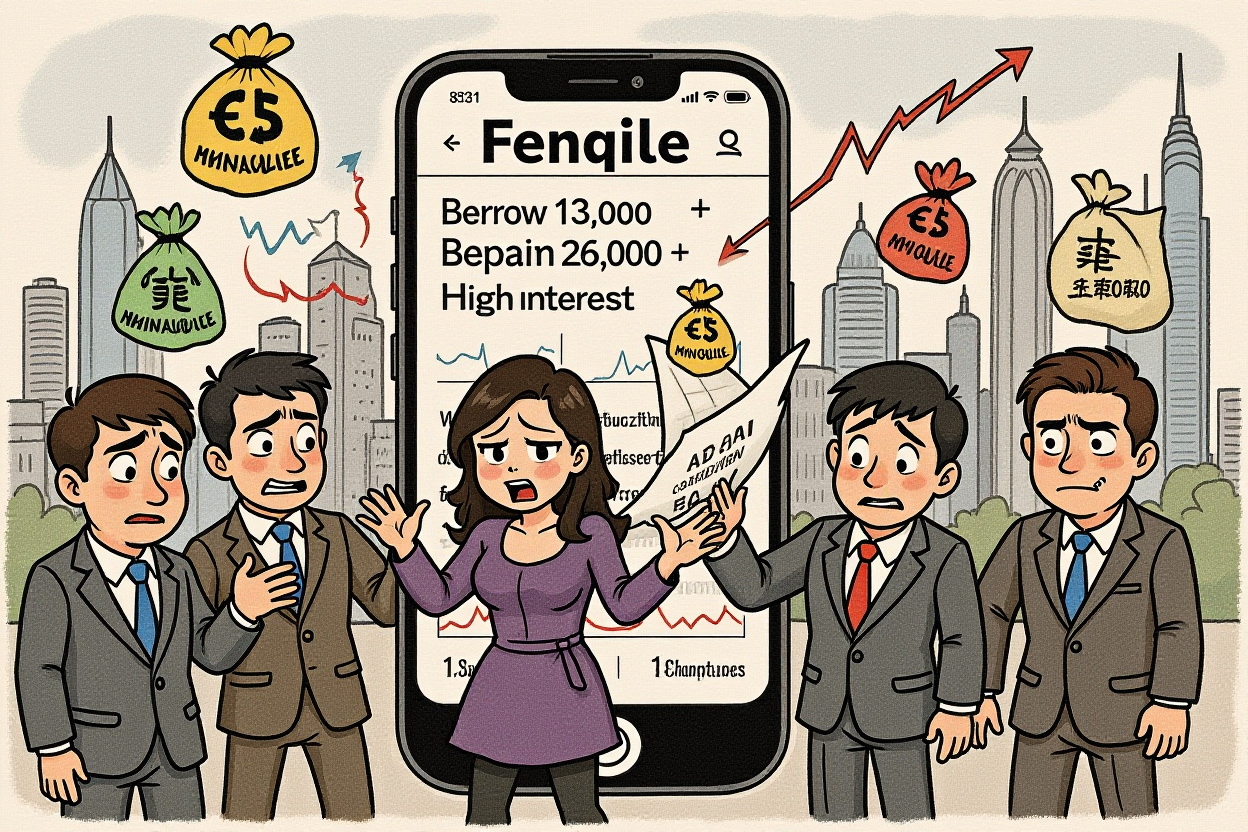
The plight of Ms. Chen (陈女士) exemplifies the dangers. During her university years, she took out five loans totaling 13,674 yuan from Fenqile for everyday expenses, including a 400 yuan purchase stretched over 36 installments. The loans carried stated annual interest rates between 32.08% and 35.90%. Promoters highlighted ‘low interest’ and ‘monthly payments as low as 18.23 yuan’, but the long tenure compounded costs. By 2022, overwhelmed, she defaulted. Now, after over 1000 days of delinquency, Fenqile demands 26,859 yuan—nearly double the principal. This case underscores how mini-loans, through extended terms and high rates, create a snowball effect, burying borrowers under unsustainable debt.
Hidden Fees and Regulatory Gaps
Beyond stated interest, borrowers face a barrage of obscured charges. On the Black Cat Complaint Platform (黑猫投诉平台), over 160,000 complaints target Fenqile for unauthorized fees like membership, guarantee, and credit assessment costs, which inflate the comprehensive borrowing cost toward 36%. For instance, one borrower from Zhejiang reported a 10,300 yuan loan at a 6% contract rate should have cost 10,643 yuan over 12 months, but actual repayments totaled 12,425.4 yuan—an extra 1,782 yuan. Similarly, a borrower from Sichuan was charged 1,102.14 yuan in undisclosed guarantee fees on a loan. These practices violate transparency principles outlined in China’s consumer protection frameworks. Despite new rules from the People’s Bank of China (中国人民银行) and the National Financial Regulatory Administration (国家金融监督管理总局) capping comprehensive costs at 24% annualized and aiming to align with 4x the Loan Prime Rate (LPR) by 2027, enforcement remains patchy, allowing platforms to exploit loopholes.
Targeting the Vulnerable: Students and Young Consumers
Fenqile’s (分期乐) growth is inextricably linked to targeting students, a demographic often financially inexperienced but eager for consumption. Although regulatory crackdowns on ‘campus loans’ (校园贷) began in 2016, evidence suggests the platform has not fully abandoned these practices, raising ethical alarms.
Lingering ‘Campus Loan’ Practices
Lexin Group (乐信集团), Fenqile’s parent company founded by Xiao Wenjie (肖文杰), built its empire by providing credit to university students. Today, despite rebranding as a fintech leader, complaints persist. On the Black Cat platform, 922 complaints specifically mention ‘campus loans’, with users alleging that Fenqile promoters actively solicit on university grounds, even setting up booths. This targeting of students, who may lack stable income, exacerbates debt risks and contradicts China’s efforts to protect young borrowers from predatory lending.
Aggressive Marketing and Data Privacy Concerns
The mini-loan model relies on aggressive digital marketing that downplays risks. Fenqile’s app and mini-programs entice users with slogans like ‘borrow up to 200,000 yuan with rates as low as 8% annually’. However, upon application, users must consent to extensive data collection, including ID photos, bank details, income information, and facial recognition data. The privacy policy permits sharing this sensitive information with third parties like payment partners and credit enhancers. This data pipeline not only fuels targeted lending but also enables intrusive debt collection. Numerous complaints describe violent tactics—harassing borrowers’ families, friends, and even employers—which have led to psychological distress, as seen in Ms. Chen’s case where debt collectors notified her entire social circle.
Regulatory Scrutiny and Compliance Challenges
Chinese authorities are tightening the noose on high-cost lending, but the transition poses challenges for platforms reliant on mini-loans for profitability. The evolving regulatory framework aims to protect consumers while maintaining financial stability.
New Guidelines on Loan Costs
In December 2025, the People’s Bank of China (中国人民银行) and the National Financial Regulatory Administration (国家金融监督管理总局) jointly issued the ‘Guidance on Comprehensive Financing Cost Management for Small Loan Companies’, explicitly prohibiting new loans with comprehensive costs exceeding 24% annualized. By 2027, all new loans should ideally be within 4 times the 1-year LPR (currently around 3.45%, implying a cap near 13.8%). The rules also mandate that local financial regulators correct violations, halt new lending, and incorporate oversight into dynamic credit reporting systems from 2026 onward. This directive directly challenges Fenqile’s business model, which thrives on costs nearing 36%.
Enforcement and Industry Response
Despite the guidelines, compliance is uneven. Platforms like Fenqile may adjust by introducing new fee structures or shifting to partnerships with licensed institutions, such as Shanghai Bank (上海银行), to obscure true costs. The case of Ms. Chen highlights the gap between regulation and reality; even with rules in place, borrowers struggle to obtain relief. Authorities must enhance monitoring, perhaps through technologies like blockchain for transparent loan tracking, to ensure adherence. For investors, this regulatory uncertainty introduces volatility, as fintech stocks may face downgrades if profitability is squeezed by stricter enforcement.
The Business Model Behind Fenqile and Lexin
Understanding the economic drivers of mini-loans requires examining the corporate structure and historical context of Lexin Group (乐信集团), the Nasdaq-listed entity behind Fenqile.
From Campus Loans to Fintech Giant
Founded in 2013 by Xiao Wenjie (肖文杰), Lexin pioneered online installment shopping in China, initially gaining traction by financing smartphone purchases for students. Its rapid scale—reaching trillion-yuan transaction volumes—was fueled by this controversial foundation. After the 2016 campus loan crackdown, Lexin rebranded, expanded its product suite, and went public in 2017, positioning itself as a legitimate fintech player. However, its core revenue still hinges on credit services facilitated through Fenqile, which operates under Jiangxi-based JI’an Fenqile Network Small Loan Co., Ltd. (吉安市分期乐网络小额贷款有限公司). This reliance on high-margin mini-loans makes it vulnerable to regulatory shifts.
Profitability vs. Ethical Lending
Lexin’s financial reports often highlight user growth and transaction volume, but underlying metrics reveal dependence on interest income and fees from loans. The mini-loan model, with its extended tenures and hidden charges, boosts net interest margins but at the cost of consumer welfare. As regulators push for lower costs, Lexin may need to innovate toward safer products, such as balance-transfer services or lower-rate instalment plans, to sustain growth. For global investors, this necessitates a careful analysis of Lexin’s adaptation strategies and compliance risks, especially given its listing on a U.S. exchange subject to scrutiny over ESG (Environmental, Social, and Governance) factors.
Market Implications and Investor Perspectives
The controversies surrounding Fenqile’s mini-loans extend beyond consumer harm to broader market stability. As China’s fintech sector matures, these issues influence investment decisions and regulatory priorities.
Risks for Chinese Fintech Stocks
Companies like Lexin face heightened reputational and operational risks. If enforcement of cost caps intensifies, profitability could decline, impacting stock valuations. Moreover, consumer backlash and potential lawsuits—as seen with the surge in complaints—may lead to regulatory penalties or restrictions. Investors should monitor key indicators:– Compliance with the 24% cost cap and progress toward LPR-based limits.– Changes in fee structures and transparency in disclosures.– User retention and default rates, which could signal deteriorating loan quality.
Global Investor Considerations
For international fund managers and institutional investors, Chinese fintech equities offer growth potential but require due diligence on governance. The mini-loan saga underscores the importance of:– Assessing management’s commitment to ethical lending, beyond regulatory minima.– Evaluating partnerships with licensed financial institutions for stability.– Considering macroeconomic factors, such as youth unemployment and consumption trends, that affect loan demand. Platforms that proactively align with regulatory goals may emerge as long-term winners, while those resisting change could face sell-offs.
Navigating the Future of Consumer Credit in China
The case of Fenqile’s mini-loans reveals a critical juncture in China’s financial landscape. While digital lending enhances accessibility, predatory practices threaten consumer trust and market integrity. Regulatory efforts to cap costs and protect vulnerable groups are steps in the right direction, but effective implementation is key. For borrowers, vigilance is essential—scrutinizing loan terms, avoiding unnecessary debt, and utilizing official complaint channels like the Black Cat platform can mitigate risks. For investors, a cautious approach is warranted; prioritize companies with transparent practices and robust compliance frameworks. As China refines its fintech ecosystem, the evolution of mini-loans will serve as a bellwether for sustainable growth. Stakeholders must collaborate to foster a responsible credit environment that balances innovation with protection, ensuring that financial technology truly serves society without draining its future.