



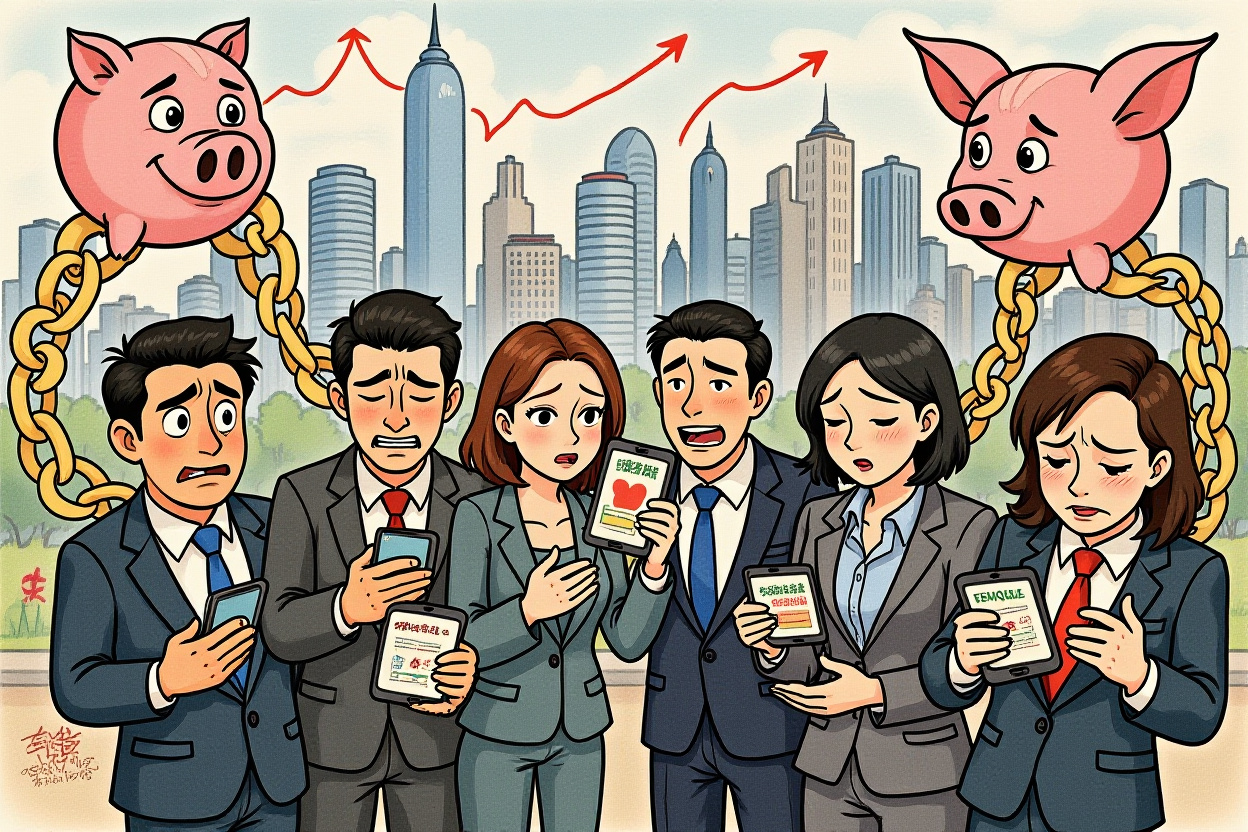
With the Lunar New Year festivities demanding generous red envelopes and family travel, many young Chinese find their wallets stretched thin. Platforms like Fenqile (分期乐) are quick to offer a solution, recently advertising credit limit boosts up to 50,000 yuan for users to ‘withdraw cash for the holidays.’ Yet, for a growing number of borrowers, this supposed lifeline has become a crushing financial burden, transforming modest loans into unmanageable debts through opaque fees and sky-high effective interest rates. The case of a borrower needing to repay 26,859 yuan on a 13,674 yuan loan has thrown a harsh spotlight on the predatory practices lurking beneath the veneer of China’s fintech revolution, exposing a systemic debt trap for the nation’s youth.
Executive Summary
- A borrower’s case of repaying nearly double her principal on Fenqile highlights effective Annual Percentage Rates (APRs) pushing the 36% legal ceiling, despite a new regulatory cap of 24%.
- The ‘mini-loan’ model uses small monthly payments and extended tenors (e.g., 36 months for a 400 yuan loan) to mask the true, snowballing cost of debt.
- Platforms are accused of layering on hidden fees—membership, guarantee, credit assessment—to inflate costs after contract signing, often buried in lengthy electronic agreements.
- Despite regulatory bans, evidence suggests lending to students and aggressive, privacy-violating collection tactics persist, pointing to deep-rooted compliance issues.
- The situation underscores the critical need for borrower financial literacy and rigorous enforcement of China’s evolving consumer lending regulations.
The Anatomy of a Modern Debt Trap
The recent public outcry centers on a borrower, Ms. Chen, who took out five loans totaling 13,674 yuan between 2020 and 2021 while in university. Lured by promises of ‘low interest’ and ‘monthly payments as low as 18.23 yuan,’ she was unaware of the long-term consequences. The loans, with tenors stretching to 36 months, carried stated annual rates between 32.08% and 35.90%. After ceasing payments in August 2022 due to inability to repay, her debt, compounded by penalties, ballooned to a demand for 26,859 yuan—a near 100% increase on the principal. This case is a textbook example of how the debt trap mechanism works: accessible credit with manageable minimum payments that, over excessively long periods, accumulate staggering total interest.
Dissecting the Snowball: Ms. Chen’s Five Loans
The structure of Ms. Chen’s loans reveals the platform’s strategy. A 400 yuan consumption loan spread over 36 months is emblematic of the ‘mini-loan’ approach—trivializing debt by making even tiny sums payable over years. Her loan portfolio included:
- 6,800 yuan (36-month tenor)
- 1,000 yuan (24-month tenor)
- 3,500 yuan (36-month tenor)
- 400 yuan (36-month tenor)
- 1,974 yuan (12-month tenor)
This practice, combined with APRs at the regulatory limit, ensures the platform’s profitability while maximizing the borrower’s long-term financial burden, creating a classic debt trap scenario.
Opaque Fees and the 36% APR Ceiling
While platforms advertise ‘annual rates as low as 8%,’ the reality for borrowers is often far different. The effective cost is frequently inflated by a multitude of ancillary fees added after the initial contract. This opacity directly contradicts China’s tightening regulatory framework. In December 2025, the People’s Bank of China (中国人民银行) and the National Financial Regulatory Administration (国家金融监督管理总局) jointly issued the ‘Guidance on the Management of Comprehensive Financing Costs for Micro-loan Companies,’ explicitly forbidding new loans with a comprehensive annualized cost exceeding 24%.
The directive mandates that all newly issued loans must, in principle, fall within four times the one-year Loan Prime Rate (LPR) by the end of 2027. However, platforms appear to navigate these rules by disaggregating costs. On the Black Cat Complaint platform (黑猫投诉), a consumer rights portal, over 160,000 complaints are lodged against Fenqile. Users consistently allege being charged mysterious membership fees, guarantee fees, and credit assessment fees, which collectively push the true borrowing cost toward the 36% mark.
Documented Cases of Cost Obfuscation
Investigative reports provide concrete evidence. China Consumer journal (中国消费者) documented cases where the actual repayment sum vastly exceeded the amount calculated based on the contract’s stated interest rate. For instance:
- A borrower from Hangzhou took a 10,300 yuan loan at a 6% stated annual rate for 12 months. The contractual repayment should have been 10,643 yuan, but bank records show total repayments of 12,425.4 yuan—an overcharge of approximately 1,782 yuan.
- Another borrower from Sichuan Liangshan was charged a 1,102.14 yuan ‘guarantee fee’ on two loans without clear prior disclosure, fees hidden within lengthy electronic agreements.
These practices highlight a critical gap: platforms often fail to prominently disclose all fees, service details, and pricing rationale beyond the principal and stated annual rate during the application process, effectively camouflaging the true debt trap.
A Legacy of Campus Lending and Aggressive Collections
Fenqile’s operator, JI’an Fenqile Network Micro-loan Co., Ltd. (吉安市分期乐网络小额贷款有限公司), is ultimately controlled by Nasdaq-listed Lexin Fintech Holdings Ltd. (乐信集团). The group’s founder, Xiao Wenjie (肖文杰), built the business on the back of ‘Fenqile,’ which pioneered installment e-commerce in China. Its early, rapid growth was significantly fueled by providing credit to university students—a controversial ‘campus loan’ (校园贷) model that regulators cracked down on in 2016.
Although Lexin subsequently rebranded as a fintech company and listed in 2017, evidence suggests the platform has not fully shed its past. Searching ‘Fenqile campus loan’ on the Black Cat platform still yields 922 complaints. Users report borrowing while still students, and even promotional activities for loans occurring on university campuses. This indicates a potential ongoing violation of regulations prohibiting targeted lending to students.
The Collection Machinery: Harassment and Privacy Invasion
More than 20,000 complaints reference violent collection tactics. Borrowers describe being subjected to information bombardment, verbal abuse, and the notorious practice of ‘blasting the communication list’ (爆通讯录), where collectors contact the borrower’s family, friends, and even employers to exert pressure. For Ms. Chen, this harassment led to severe psychological distress, as her entire social circle was informed of her debt.
This aggressive collection is facilitated by the extensive personal data collected upon application. An investigation by Economic Information Daily (经济参考报) found that Fenqile’s software, upon user agreement, collects dozens of data points including ID photos, bank card info, income details, facial biometrics, and location data. The platform’s privacy policy states this sensitive information may be ‘shared’ with third-party merchants, payment partners, clearing banks, and credit enhancement agencies, creating significant privacy risks from the moment one clicks ‘agree.’
Regulatory Crossroads and the Borrower’s Dilemma
The Chinese regulatory landscape for consumer finance is clearly evolving, with the 24% cap representing a major step. However, the persistence of these high-cost lending practices points to challenges in enforcement and the adaptability of platform business models. The fundamental conflict lies in the profitability of serving subprime or young borrowers with small-ticket loans. To make such lending viable, platforms are incentivized to extend tenors and add fees, directly creating the conditions for a debt trap.
For international investors monitoring Chinese fintech, these issues present both regulatory and reputational risks. Companies that rely on blurred cost disclosures and high effective APRs may face sustained regulatory scrutiny, operational disruption from enforcement actions, and long-term brand damage as consumer awareness grows.
Navigating the Lending Landscape: A Call for Vigilance
The saga of Fenqile and similar ‘mini-loan’ platforms serves as a stark warning for young borrowers and a critical case study for regulators and market observers. The combination of psychological pricing (tiny monthly payments), opaque fee structures, and aggressive data-driven collections forms a powerful engine for generating profit from consumer debt distress. While regulations are tightening, the onus remains heavily on individuals to exercise extreme caution.
Before engaging with any digital lender, scrutinize the total cost of credit. Look beyond the monthly payment and advertised rate; calculate the total repayment amount as a multiple of the principal. Be wary of excessively long tenors for small amounts. Read the fine print regarding all potential fees. Most importantly, understand that easy credit today can very quickly translate into a debilitating financial debt trap tomorrow. For sustainable market health, robust enforcement of transparency rules and cost caps must be paired with a concerted effort to improve financial literacy, ensuring consumers are equipped to make informed decisions and avoid the pitfalls of deceptive lending.