



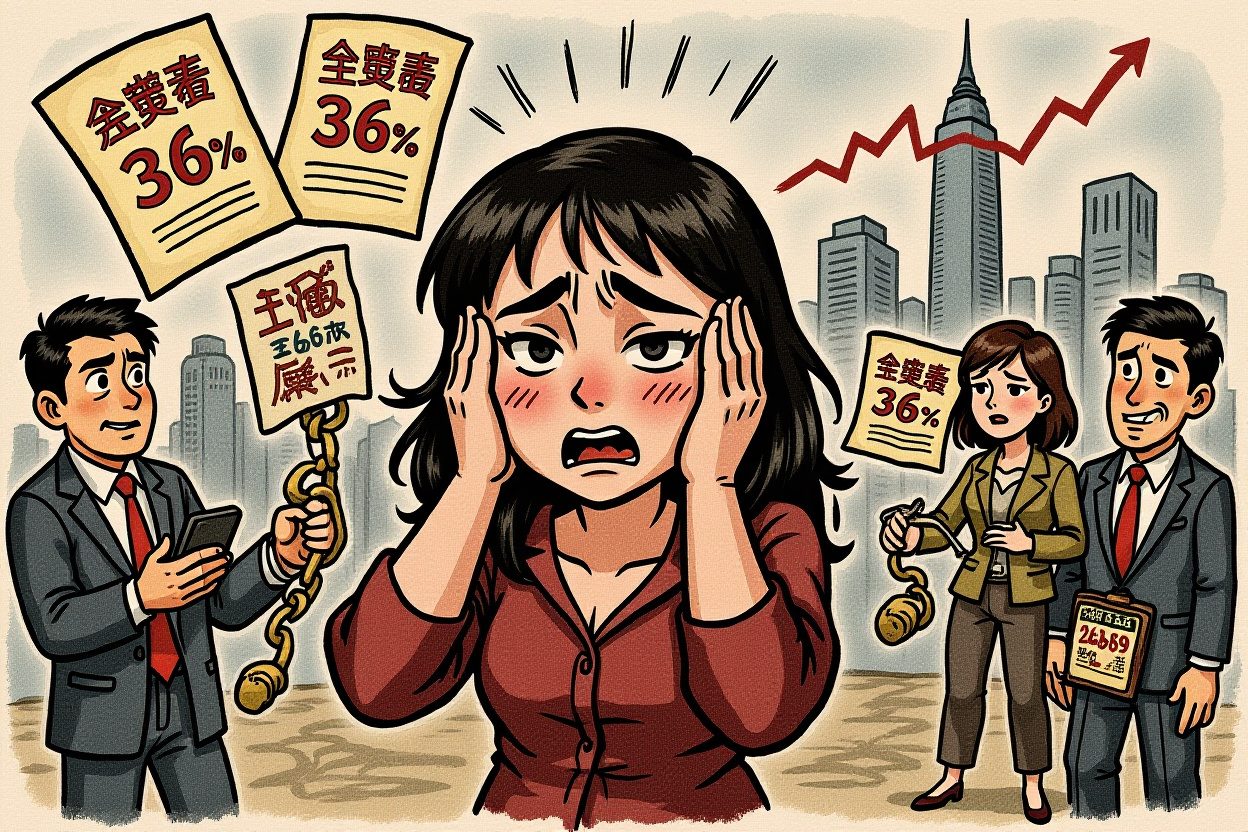
Executive Summary: Key Takeaways on the Mini-Loan Crisis
Before diving into the details, here are the critical insights from our investigation into the mini-loan phenomenon in China:
– Mini-loans, often marketed with low monthly payments, conceal effective annualized interest rates that can approach 36%, doubling borrowers’ debt through extended repayment terms and hidden fees.
– Despite regulatory directives capping comprehensive financing costs at 24%, platforms like Fenqile (分期乐) employ opaque charge structures to skirt rules, highlighting enforcement challenges.
– The business model retains deep ties to controversial campus lending practices, with ongoing reports of aggressive debt collection and privacy violations targeting students and young adults.
– Consumer complaints on platforms like Black Cat exceed 160,000, underscoring systemic issues with transparency and ethical lending in China’s fintech sector.
– Investors and regulators must prioritize scrutiny of these practices as China tightens oversight, with implications for financial stability and consumer protection.
Hook: The Viral Case Exposing Mini-Loan Dangers
As Lunar New Year pressures mount for young Chinese to fund celebrations and gifts, the temptation of easy credit through mini-loans has never been stronger. Yet, behind the glossy promises of platforms like Fenqile (分期乐), a harsh reality unfolds: borrowers like Ms. Chen (陈女士) find themselves repaying nearly double their principal, trapped in a cycle of debt exacerbated by aggressive collection tactics. This case, which recently trended on Weibo, underscores how mini-loans are systematically draining the financial health of a generation, raising urgent questions about regulatory oversight and ethical lending in China’s rapidly evolving fintech landscape.
The Alarming Case of Ms. Chen: A Snapshot of Mini-Loan Predicaments
The story of Ms. Chen (陈女士) epitomizes the perils of mini-loans. During her university years, she turned to Fenqile (分期乐) for small, seemingly manageable loans, only to see her debt balloon uncontrollably.
Debt Doubled: From 13,674 Yuan to 26,859 Yuan
Between 2020 and 2021, Ms. Chen accumulated five loans totaling 13,674 yuan, including one for a mere 400 yuan stretched over 36 months. The advertised allure was low monthly payments—as little as 18.23 yuan—but the annualized interest rates ranged from 32.08% to 35.90%. By February 2024, her total repayment demand had soared to 26,859 yuan, nearly twice the principal. This stark doubling of debt illustrates how mini-loans leverage extended terms to mask exorbitant costs, pushing borrowers toward financial ruin.
Psychological Toll and Aggressive Debt Collection
After ceasing payments in August 2022 due to inability to repay, Ms. Chen faced over 1,000 days of delinquency. Debt collectors harassed her family, friends, and even her spouse, broadcasting her financial woes across her social circle. The psychological strain led to reported depression, highlighting how mini-loan practices extend beyond economics to inflict severe personal harm. Such tactics are commonplace, with Fenqile (分期乐) facing numerous complaints about violent collection methods.
Deconstructing the Mini-Loan Model: How Fees and Terms Inflate Debt
Mini-loans, characterized by small amounts and long repayment periods, create an illusion of affordability while ensnaring borrowers in a debt snowball. Platforms like Fenqile (分期乐) master this model, but at what cost to consumers?
The Illusion of Low Monthly Payments
On its surface, Fenqile (分期乐) promotes accessibility: its mini-loan offers promise up to 200,000 yuan in credit with annual rates as low as 8%. However, these figures are deceptive. By stretching repayments over 36 months or more, the cumulative interest and fees escalate dramatically. For instance, a 400-yuan loan over 36 months might seem trivial monthly, but at a 35% rate, it becomes a significant burden. This strategy preys on behavioral biases, encouraging impulsive borrowing without full cost comprehension.
Hidden Charges: Membership, Guarantee, and Assessment Fees
Transparency is a major issue. Beyond stated interest, borrowers face nebulous fees—membership, guarantee, and credit assessment charges—that inflate effective costs. On the Black Cat投诉平台 (Black Cat Complaint Platform), over 160,000 complaints target Fenqile (分期乐) for such practices. One user noted on February 12, 2024, that their comprehensive annualized rate hit 36%,远超24%红线 (far exceeding the 24% red line), with fees obscuring the true lender. Another complaint from January 20, 2024, cited 1,450 yuan in hidden credit assessment fees. Cases from The中国消费者 (China Consumer) magazine reveal discrepancies: a borrower in Zhejiang repaid 12,425.4 yuan on a 10,300-yuan loan,超出约1,782元 (exceeding by about 1,782 yuan), despite a contract rate of 6%. Similarly, a borrower in Sichuan was charged 1,102.14 yuan in担保费 (guarantee fees) without clear disclosure, buried in冗长的电子协议 (lengthy electronic agreements).
Regulatory Frameworks and Compliance Gaps
China’s regulators have moved to curb predatory lending, but mini-loan platforms often navigate loopholes, testing the limits of enforcement.
PBOC and NFRA’s 24% Cap Directive
In December 2025, the中国人民银行 (People’s Bank of China) and国家金融监督管理总局 (National Financial Regulatory Administration) jointly issued the《小额贷款公司综合融资成本管理工作指引》 (Guidance on the Management of Comprehensive Financing Costs for Micro-Loan Companies), mandating that new loans not exceed 24% in annualized comprehensive costs. By 2027, all new loans must fall within four times the one-year贷款市场报价利率 (Loan Prime Rate, LPR). From 2026, violations will trigger corrective actions, halted lending, and credit reporting implications. However, this directive faces implementation hurdles, as platforms retroactively apply fees to sidestep caps.
Enforcement Challenges and Platform Evasion Tactics
Despite rules, mini-loan operators like Fenqile (分期乐) continue pushing boundaries. By labeling extra costs as service fees rather than interest, they maintain effective rates near 36%, the legal上限 (upper limit) for private lending. The platform’s partnership with持牌机构 (licensed institutions) like上海银行 (Bank of Shanghai) adds a veneer of legitimacy, but oversight remains fragmented. Regulatory bodies must enhance monitoring of fee structures and ensure transparent disclosure, as current practices undermine consumer trust and market integrity.
Fenqile’s Controversial Legacy: From Campus Loans to Financial Tech
The roots of Fenqile (分期乐) trace back to校园贷 (campus loan) controversies, a history that continues to shadow its operations today.
Lexin Group’s Origins and Rapid Growth
Fenqile (分期乐) is operated by吉安市分期乐网络小额贷款有限公司 (Ji’an Fenqile Network Micro-Loan Co., Ltd.), backed by the纳斯达克 (Nasdaq)-listed乐信集团 (Lexin Group). Founded in 2013 by肖文杰 (Xiao Wenjie), Lexin pioneered分期购物电商 (installment shopping e-commerce) in China, leveraging student loans for early expansion. After regulatory crackdowns on campus lending in 2016, Lexin rebranded as a fintech firm and went public in 2017. However, its transformation is incomplete, with mini-loans still accessible to students.
Persistent Ties to Student Lending and Associated Risks
Searching Black Cat for校园贷 (campus loan) and Fenqile (分期乐) yields 922 complaints, indicating ongoing student targeting. Reports detail promoters operating on campuses and摆摊 (setting up stalls) to recruit borrowers. This persistence exacerbates risks, as young, inexperienced borrowers are more vulnerable to debt traps. Moreover, over 20,000 complaints cite暴力催收 (violent debt collection), including harassment of family, colleagues, and even village heads. The经济参考报 (Economic Reference Report) investigation found that Fenqile (分期乐) collects extensive personal data—from ID photos to location info—and shares it with third parties like增信机构 (credit enhancement agencies), compounding privacy concerns.
Consumer Protection and Data Privacy Concerns
The mini-loan ecosystem extends beyond interest rates to encompass data exploitation and consent issues, raising alarms for consumer rights.
Opaque Contract Terms and Informed Consent
Borrowers often click同意 (agree) without understanding the full terms. Fenqile (分期乐)隐私政策 (privacy policy)允许 (permits) sharing of sensitive data with numerous entities, from payment partners to industry groups. This lack of salient disclosure violates principles of informed consent, as seen in cases where担保费 (guarantee fees) were hidden. The中国消费者 (China Consumer) emphasizes that platforms fail to clearly present非本金利率外的任何其他费用 (any fees beyond principal and interest), leaving consumers powerless from the outset.
Data Sharing Practices and Privacy Infringements
Data collection is pervasive: Fenqile (分期乐) accesses数十项个人信息 (dozens of personal information points), including人脸信息 (facial recognition data) and收入信息 (income details). This data fuels targeted lending and collection efforts, but also risks breaches and misuse. With China’s evolving个人信息保护法 (Personal Information Protection Law), platforms must justify data usage, yet mini-loan operators often prioritize profit over privacy, as highlighted in the经济参考报 (Economic Reference Report) findings. Consumers trapped in mini-loan debts thus face dual threats: financial depletion and privacy erosion.
Synthesis and Forward-Looking Market Guidance
The mini-loan crisis underscores systemic vulnerabilities in China’s fintech sector. For investors, this signals regulatory risks that could impact valuations of companies like Lexin Group, especially as enforcement tightens. Institutional players should assess exposure to high-interest lending models and advocate for ethical standards. Consumers must exercise caution, scrutinizing terms and reporting violations to authorities like the国家金融监督管理总局 (National Financial Regulatory Administration). Regulators need to bolster on-the-ground inspections and close fee loopholes to align practices with the 24% cap. Ultimately, sustainable growth in Chinese equities hinges on transparent, consumer-centric innovations—not predatory mini-loans that drain young wealth. As this market evolves, stakeholders must prioritize financial literacy and robust oversight to prevent further exploitation.