



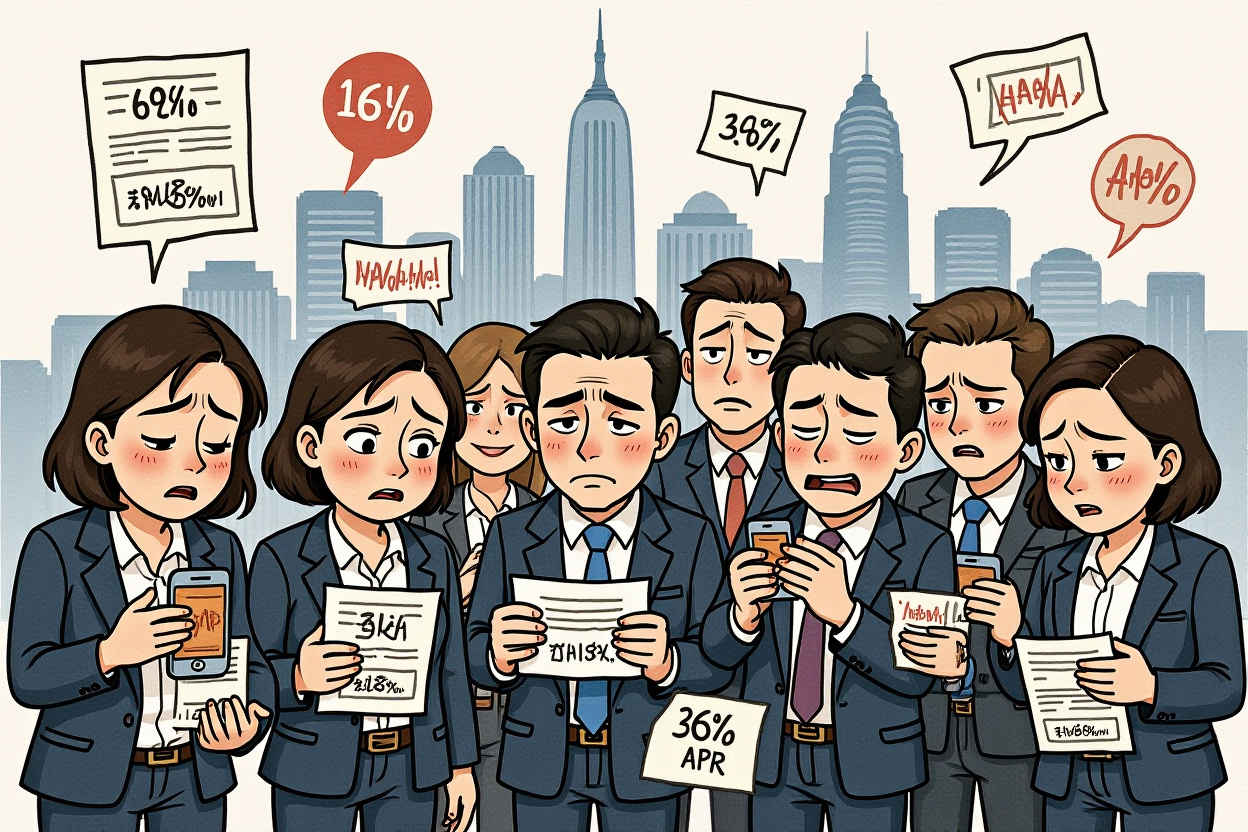
Executive Summary: Key Takeaways on the Mini Loan Crisis
– Fenqile, operated by Lexin Group, offers mini loans with effective annual interest rates up to 36%, leading borrowers to repay double their principal, exemplifying a severe mini loan debt trap.
– New regulatory guidelines from the People’s Bank of China (中国人民银行) and National Financial Regulatory Administration cap loan costs at 24%, but enforcement gaps allow platforms to hide fees, posing compliance risks.
– The platform’s roots in controversial campus lending persist, with ongoing reports of aggressive marketing to students and violent debt collection, raising ethical and legal concerns.
– For investors, this highlights systemic vulnerabilities in China’s consumer finance sector, potentially impacting fintech valuations and regulatory scrutiny on companies like Nasdaq-listed Lexin.
– Data privacy issues abound, as Fenqile collects and shares extensive personal information, adding to consumer protection challenges in the digital lending space.
The Looming Shadow Over Chinese New Year Celebrations
As Chinese families prepare for Lunar New Year festivities, the pressure to gift red envelopes and fund vacations clashes with tightening budgets. For many young adults, this financial strain has opened the door to seemingly convenient solutions like mini loans. Platforms such as Fenqile (分期乐) have capitalized on this demand, offering quick cash with promises of low rates and easy repayments. However, beneath the glossy facade of financial technology lies a troubling reality: a pervasive mini loan debt trap that is systematically draining the resources of China’s youth. This issue not only affects individual borrowers but also signals broader risks for investors monitoring China’s volatile fintech landscape. The recent viral case of a borrower repaying 26,000 yuan on a 13,000 yuan loan has thrust Fenqile into the spotlight, revealing how these products can escalate into financial nightmares.
Deconstructing the Mini Loan Debt Trap: How Small Loans Lead to Big Problems
The core of Fenqile’s business model revolves around mini loans—small, short-term credits marketed as accessible solutions for everyday needs. Yet, these loans often morph into debilitating debts through complex fee structures and extended terms.
A Harrowing Case Study: From 13,000 Yuan to 26,000 Yuan in Debt
Consider the experience of Ms. Chen, a university student who fell into the mini loan debt trap six years ago. She borrowed five separate loans from Fenqile totaling 13,674 yuan, including one for as little as 400 yuan stretched over 36 months. The sales pitches emphasized low monthly payments, such as 18.23 yuan, but obscured the annual percentage rates (APRs) ranging from 32.08% to 35.90%. By 2022, overwhelmed by repayments, she defaulted, and after over 1,000 days of delinquency, her total owed ballooned to 26,859 yuan—nearly double the principal. This case exemplifies how mini loans, through prolonged durations and high interest, ensnare borrowers in a cycle of compounding debt. Aggressive debt collectors exacerbated her plight by contacting her family and friends, leading to severe psychological distress and highlighting the human cost of these practices.
The Hidden Mechanics: Fees, Terms, and Snowballing Costs
Fenqile’s platform initially advertises attractive terms, like annual rates as low as 8% and daily interest starting at 2.2 yuan per 10,000 yuan borrowed. However, users frequently report unexpected charges that inflate the true cost of borrowing. Common add-ons include:
– Membership fees: Recurring payments for premium services that borrowers may not fully understand.
– Guarantee fees: Costs for third-party insurance or credit enhancement, often buried in lengthy electronic agreements.
– Credit assessment fees: Charges for evaluating borrower risk, which can significantly increase the effective APR.
For instance, a borrower from Sichuan province complained that Fenqile deducted 1,102.14 yuan in guarantee fees from two loans of 49,880 yuan each without clear disclosure. These opaque practices push the comprehensive borrowing cost toward the 36% ceiling, far exceeding the regulatory red line of 24%. The mini loan debt trap is thus engineered through a combination of enticing entry points and concealed financial burdens, making it difficult for consumers to escape once committed.
Regulatory Crackdown: New Rules and Persistent Loopholes
Chinese authorities are increasingly vigilant about curbing predatory lending, but gaps remain that allow platforms like Fenqile to operate at the edge of compliance.
Recent Guidelines from the PBOC and NFRA
In December 2025, the People’s Bank of China (中国人民银行) and the National Financial Regulatory Administration (国家金融监督管理总局) jointly issued the “Guidelines for the Management of Comprehensive Financing Costs of Small Loan Companies.” This directive explicitly prohibits new loans with comprehensive costs exceeding 24% APR and mandates that by the end of 2027, all new loans should align with four times the one-year Loan Prime Rate (LPR). From 2026 onward, local financial regulators are empowered to correct violations, halt new lending, and integrate oversight into dynamic credit reporting systems. These measures aim to protect consumers from the mini loan debt trap by setting clear cost boundaries. However, the transition period allows companies to continue high-rate lending temporarily, creating a window for potential abuse.
Evasion Tactics and Enforcement Challenges
Despite regulatory pressures, Fenqile and similar platforms employ sophisticated strategies to maintain profitability. They often structure loans with nominal interest rates below 24% but layer on additional fees to reach effective APRs of 35% or higher. For example, a borrower from Hangzhou reported a contract stating a 6% annual rate on a 10,300 yuan loan, but bank statements revealed actual repayments totaling 12,425.40 yuan—an extra 1,782 yuan in hidden costs. This discrepancy underscores how platforms exploit information asymmetry and complex contracts to sidestep regulations. Moreover, the decentralization of enforcement across local authorities can lead to inconsistent application, allowing companies to continue practices that contribute to the mini loan debt trap in less scrutinized regions.
Fenqile’s Controversial Evolution: From Campus Roots to Fintech Aspirations
Understanding Fenqile’s history is crucial to assessing its current risks. The platform’s parent company, Lexin Group (乐信集团), has navigated a turbulent path from a startup focused on student lending to a Nasdaq-listed fintech firm.
Founding and Growth: The Campus Loan Legacy
Lexin Group was founded in 2013 by Xiao Wenjie (肖文杰), who launched Fenqile as China’s first installment shopping e-commerce platform. Its early growth was fueled by targeting university students with easy credit for purchases like smartphones, rapidly scaling to trillion-yuan transaction volumes. This reliance on campus lending drew regulatory ire, especially after 2016 when authorities cracked down on unethical student loan practices. In response, Lexin rebranded as a broader fintech entity, distancing itself from the campus loan label and achieving a U.S. IPO in 2017. However, the mini loan debt trap mechanisms pioneered during this era persist, as Fenqile continues to attract young, inexperienced borrowers with limited financial literacy.
Ongoing Ties to Student Borrowing
Evidence suggests that Fenqile has not fully shed its campus-oriented approach. On consumer complaint platforms like Black Cat, over 922 reports cite “campus loans” in relation to Fenqile, with users alleging that promotional agents still operate on university grounds. Some borrowers recount being students when they took out loans, and marketing materials are tailored to appeal to youthful demographics. This enduring connection raises red flags about compliance with regulations prohibiting loans to underage or financially vulnerable students. For investors, it indicates that Lexin’s business model may remain reliant on high-risk segments, amplifying exposure to regulatory penalties and reputational damage from the mini loan debt trap.
Consumer Backlash: A Tide of Complaints and Ethical Breaches
The sheer volume of grievances against Fenqile paints a grim picture of its operational practices, spanning from aggressive collections to data privacy violations.
Violent Debt Collection and Psychological Harm
Over 20,000 complaints on Black Cat detail instances of Fenqile’s debt collectors employing intimidation tactics. Borrowers report harassment of family members, colleagues, and even village leaders, with threats and public shaming used to coerce repayment. Ms. Chen’s experience of having her social circle informed about her debt is a common theme, leading to anxiety, depression, and social isolation. Such methods not only violate ethical standards but may also contravene Chinese laws on debt collection practices. The psychological toll exacerbates the mini loan debt trap, trapping individuals in a cycle of stress and financial dependency that hinders their ability to recover economically.
Data Privacy Risks and Information Exploitation
Fenqile’s privacy policies reveal extensive data collection, including names, ID photos, bank details, income information, facial recognition data, and location history. This information is shared with third parties such as merchants, payment processors, banks, and credit enhancers, often without explicit user consent. A report by the Economic Reference News (经济参考报) highlighted that users who agree to Fenqile’s terms unknowingly surrender control over their personal data, which can be used for cross-marketing or sold to other entities. This lack of transparency compounds the risks of the mini loan debt trap, as borrowers’ sensitive information becomes a commodity in the broader fintech ecosystem, potentially leading to identity theft or further financial exploitation.
Investment Implications: Navigating Risks in China’s Fintech Sector
For institutional investors and fund managers focused on Chinese equities, the mini loan debt trap phenomenon presents both challenges and opportunities. The issues surrounding Fenqile signal broader trends that could impact market valuations and regulatory landscapes.
Direct Risks to Lexin Group and Its Stock Performance
As the operator of Fenqile, Lexin Group (listed on Nasdaq under LX) faces significant headwinds. Regulatory tightening could force a reduction in interest rates, squeezing profit margins derived from high-cost loans. Additionally, potential lawsuits or fines for non-compliance with new cost caps may dent earnings. The stock has already shown volatility in response to news about lending practices, and sustained negative publicity could erode investor confidence. Monitoring Lexin’s adaptation to regulations—such as whether it can lower costs without sacrificing growth—is essential for assessing its long-term viability. The mini loan debt trap scandal underscores the fragility of business models reliant on opaque pricing and vulnerable consumer segments.
Broader Sectoral Impact and Regulatory Ripple Effects
The crackdown on mini loans is part of a larger regulatory push to sanitize China’s consumer finance industry. Other players, such as Ant Group’s Huabei (花呗) and JD.com’s Baitiao (白条), may face similar scrutiny, leading to industry-wide repricing of risk. Investors should watch for:
– Increased compliance costs across the fintech sector, potentially reducing profitability.
– Consolidation among smaller lenders unable to meet new standards, creating opportunities for larger, well-capitalized firms.
– Shifts in consumer behavior toward more regulated financial products, affecting demand for mini loans.
By understanding these dynamics, investors can better position portfolios to mitigate risks associated with the mini loan debt trap. Diversifying into companies with stronger compliance records or those focusing on lower-cost credit solutions may offer safer exposure to China’s growing digital finance market.
Synthesizing Insights for a Prudent Path Forward
The mini loan debt trap epitomized by Fenqile reveals deep-seated issues in China’s rapid fintech expansion. While these loans offer short-term relief, they often lead to long-term financial devastation for young borrowers, compounded by aggressive collection and data privacy breaches. Regulatory frameworks are evolving to address these abuses, but enforcement gaps and corporate evasion tactics persist, creating a volatile environment for both consumers and investors. For market participants, this underscores the importance of due diligence beyond surface-level metrics, focusing on ethical practices and regulatory adherence in fintech investments.
Moving forward, investors should prioritize companies with transparent pricing models, robust consumer protection measures, and proactive compliance with upcoming cost caps. Engaging with regulatory developments, such as the PBOC’s guidelines, can provide early warning signals for sectoral shifts. Additionally, advocating for stronger data privacy laws and ethical lending standards can contribute to a more sustainable financial ecosystem. By recognizing the mini loan debt trap as a systemic risk, rather than an isolated incident, professionals can make informed decisions that balance profit motives with social responsibility, ensuring resilience in China’s dynamic equity markets.