



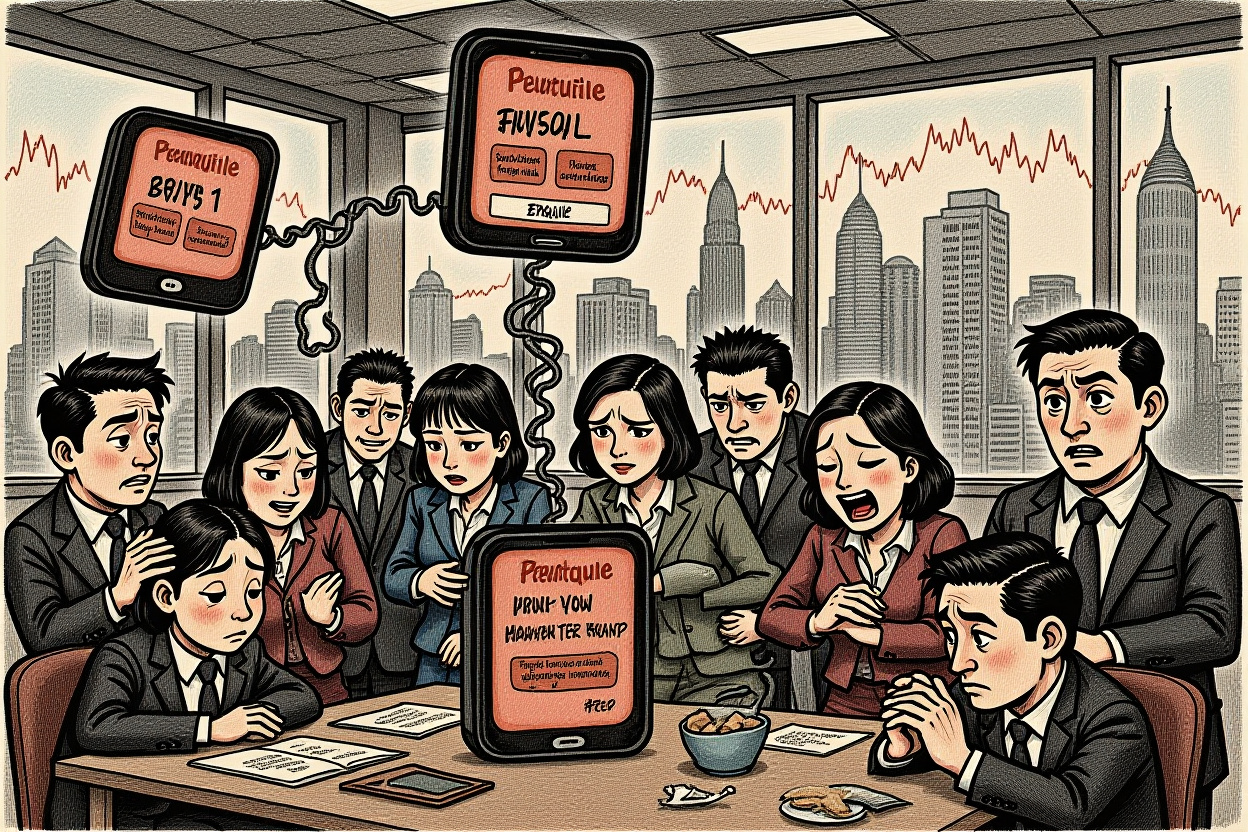
Executive Summary
Before diving into the details, here are the key takeaways from this analysis of China’s burgeoning mini-loan sector:
- Platforms like Fenqile (分期乐) are leveraging opaque fee structures and extended repayment terms to push effective annualized borrowing costs to the regulatory ceiling of 36%, far exceeding stated rates and trapping young consumers in debt cycles.
- Despite regulatory directives from the People’s Bank of China (PBOC) and the National Financial Regulatory Administration (NFRA) capping comprehensive financing costs at 24%, enforcement remains inconsistent, allowing platforms to use hidden charges to maintain profitability.
- The business model remains intrinsically linked to controversial campus lending practices, with evidence suggesting ongoing targeting of students despite public pivots towards ‘fintech’ branding.
- Aggressive data collection and sharing practices, coupled with pervasive harassment from third-party collection agencies, create significant privacy and ethical risks beyond the financial burden.
- For international investors, these practices pose material ESG (Environmental, Social, and Governance) and regulatory risks for companies like Nasdaq-listed Lexin Fintech Holdings (乐信集团), requiring enhanced due diligence on consumer protection metrics.
The Alluring Mirage of Instant Credit
The promise is seductively simple: access to funds within minutes, with manageable monthly payments that fit a tight budget. For millions of young Chinese consumers facing seasonal cash crunches, social pressures, or simply the desire for immediate gratification, digital lending platforms offer a seemingly painless solution. This is the world of mini-loans—small-ticket, high-frequency credit products designed for the smartphone generation. However, beneath the glossy interface of apps like Fenqile lies a complex and often predatory machinery that systematically transfers wealth from vulnerable borrowers to platform coffers. The recent viral case of a borrower required to repay 26,859 yuan on an original loan of 13,674 yuan from Fenqile is not an anomaly but a symptom of a systemic issue within China’s consumer finance landscape. For global investors monitoring Chinese equity markets, understanding the dynamics, risks, and regulatory trajectory of this sector is crucial for assessing the sustainability of business models in the fintech space.
Deconstructing the 13,000 to 26,000 Repayment Shock
The case that ignited public fury involves a borrower, Ms. Chen, who took out five separate loans between 2020 and 2021 while in university. The loans, ranging from 400 yuan to 6,800 yuan, were stretched over periods of 12 to 36 months. The platform’s marketing highlighted ‘low monthly payments’ as low as 18.23 yuan, obscuring the staggering cumulative cost. With stated annual percentage rates (APRs) between 32.08% and 35.90%, the total repayment obligation ballooned to nearly double the principal. This exemplifies the core mechanism of the mini-loan trap: by extending the loan tenure, platforms make individual installments appear negligible while using high interest rates to maximize total interest paid over the life of the loan. When Ms. Chen defaulted after struggling with repayments, she faced over 1,000 days of delinquency and intense collection harassment that impacted her mental health and personal relationships. This pattern is repeated across thousands of complaints, painting a picture of a business model built on financial distress.
Opaque Pricing and the Regulatory Arbitrage Game
A central pillar of the mini-loan industry’s profitability is the deliberate lack of transparency in pricing. While platforms advertise enticing ‘headline’ rates—Fenqile’s current promotion boasts rates ‘as low as 8%’—the reality for most borrowers is a labyrinth of附加费 (additional fees). These can include会员费 (membership fees),担保费 (guarantee fees),信用评估费 (credit assessment fees), and service charges, all of which are baked into the repayment schedule but often disclosed in fine print or complex electronic agreements. This practice directly challenges regulatory efforts to protect consumers. In December 2025, the PBOC and NFRA jointly issued the ‘Guidance on the Management of Comprehensive Financing Costs for Microfinance Companies,’ explicitly prohibiting new loans with a comprehensive annualized cost exceeding 24%. The guidance mandates that by the end of 2027, all new loans should, in principle, have costs within four times the one-year Loan Prime Rate (LPR).
Navigating the 24% Interest Rate Cap
The regulatory intent is clear: to curb usurious lending. However, the gap between policy and on-the-ground execution is where mini-loan platforms operate. The term ‘comprehensive financing cost’ is key; it encompasses all expenses borne by the borrower, not just the stated interest. Platforms argue that various fees are for distinct services, thus not purely interest, creating a gray area for enforcement. Data from the Black Cat Complaint Platform (黑猫投诉平台), a major consumer rights portal, underscores the scale of the issue. Over 160,000 complaints are logged against Fenqile, with a significant portion alleging disguised interest through ancillary fees that push effective APRs to the legal maximum of 36%. For instance, one complainant in February 2026 noted a comprehensive APR of 36% and challenged the platform to disclose the actual funder to facilitate regulatory action. Another from January 2026 cited a ‘credit assessment fee’ of 1,450 yuan that materially increased the loan’s cost. These tactics highlight the ongoing cat-and-mouse game between regulators seeking to stabilize the consumer credit market and platforms driven by shareholder returns.
The Unshakable Legacy of Campus Lending
To comprehend the present state of mini-loans, one must examine their origins. Fenqile’s operator, Lexin Fintech Holdings, traces its roots to 2013 and founder Xiao Wenjie (肖文杰). The company’s early growth was fueled by providing分期 (installment) services for electronics, primarily targeting college students—a demographic with limited income but high consumption desire. This era of ‘校园贷’ (campus loans) was infamous for predatory practices and led to a regulatory crackdown in 2016. Lexin subsequently rebranded, expanded its partner network to include licensed institutions like Shanghai Bank (上海银行), and went public on Nasdaq in 2017. Despite this corporate evolution, evidence suggests the foundational customer acquisition strategy persists. Searches for ‘分期乐 校园贷’ (Fenqile campus loans) on the Black Cat platform yield 922 complaints, with users recounting promotions within university campuses and loans obtained while still enrolled. This continued association with student lending poses significant reputational and compliance risks, especially as Chinese authorities maintain a firm stance against unauthorized lending to undergraduates.
From Data Harvesting to Harassment: The Complete Control Chain
The mini-loan ecosystem extends far beyond the initial loan disbursement. The journey often begins with extensive data extraction. As reported by Economic Information Daily (经济参考报), using the Fenqile app requires consent to collect dozens of personal data points, including ID photos, bank details, income information, facial biometrics, and location data. This information is then共享 (shared) with a wide array of third parties, from payment processors and clearing banks to credit enhancement agencies. This data trove becomes particularly potent in the collection phase. Over 20,000 complaints reference aggressive, often abusive collection tactics. Borrowers report having their通讯录 (contact lists) accessed, leading to harassment of family, friends, and even colleagues. This ‘爆通讯录’ (blasting the contact list) strategy creates immense social pressure and shame, coercing repayment. The transition from a seamless digital application to pervasive real-world harassment illustrates the totalizing control these platforms can exert over a borrower’s financial and personal life.
Market Implications for Domestic and International Stakeholders
The controversies surrounding mini-loans are not merely social issues; they have direct ramifications for financial markets and investment decisions. For Lexin Fintech Holdings, whose stock performance is tied to the growth and profitability of its Fenqile platform, these practices represent a double-edged sword. While they drive revenue—the platform has facilitated over a trillion yuan in transactions—they also attract escalating regulatory scrutiny, potential fines, and brand damage. International institutional investors evaluating Chinese fintech equities must now factor in ‘conduct risk’ alongside traditional financial metrics. The sector’s exposure to tightening regulations on consumer protection, data privacy (under laws like the Personal Information Protection Law), and interest rate caps could compress margins and necessitate costly business model overhauls. Furthermore, the social backlash and media exposés can trigger volatility, as seen with the recent微博 (Weibo)热搜 (hot search) trend that brought Fenqile’s practices to national attention.
The ESG Lens on High-Interest Lending
Increasingly, global asset managers apply stringent ESG criteria to their portfolios. The mini-loan business model, with its links to over-indebtedness, predatory targeting of youth, and aggressive collection, scores poorly on social (‘S’) governance. Investors concerned with sustainable finance may begin to divest or engage with companies to demand reform. This creates a potential valuation discount for firms reliant on such practices. Proactive investors might look for signals of genuine transformation, such as voluntary adoption of lower rate caps, enhanced fee transparency, independent audits of collection practices, and robust financial literacy programs for borrowers. The long-term viability of China’s consumer fintech sector may depend on its ability to align with broader societal goals of financial inclusion and stability, rather than extraction.
Forging a Path Towards Responsible Credit
The current mini-loan predicament underscores a critical juncture for China’s consumer finance industry. The demand for small-ticket credit among young, digitally-native consumers is genuine and growing. The challenge is to meet this demand without exploiting it. A multi-stakeholder approach is required to steer the sector towards sustainability. Regulators must move from issuing guidance to ensuring robust enforcement, leveraging technology to monitor real-time lending data and penalizing violations swiftly and significantly. The local financial supervision bureaus, tasked with overseeing small loan companies, need enhanced resources and mandates. For platforms, the writing is on the wall: business models built on regulatory arbitrage and information asymmetry are untenable in the long run. Investment in genuine risk-based pricing, transparent disclosure—where all costs are presented in a clear, standardized format like an Schumer Box—and ethical collection partnerships is not just compliant but commercially prudent.
Empowering the Borrower: Financial Literacy as a Defense
Ultimately, the most potent defense against predatory mini-loans is an informed borrower. Financial education initiatives, potentially mandated as part of the licensing for lenders, can help young consumers understand concepts like APR, compound interest, and the long-term cost of debt. Schools, community organizations, and even platforms themselves have a role to play in promoting responsible borrowing. Consumers should be encouraged to shop around, read contracts meticulously, and utilize official channels like the 12378 banking and insurance consumer rights hotline to report irregularities. The era of blindly clicking ‘同意’ (agree) on dense user agreements must end.
Synthesizing the Risks and Charting a Course
The investigation into Fenqile and the broader mini-loan industry reveals a sector at a crossroads. The allure of easy credit masks a reality of crushing debt burdens, privacy invasions, and systemic risks. For the young borrowers caught in this trap, the path forward involves seeking responsible debt counseling and understanding their rights under new regulations. For regulators in China, the task is to close enforcement gaps and ensure that the spirit of consumer protection laws matches their application. For global investors and fund managers analyzing Chinese equities, this saga is a stark reminder that surface-level growth metrics in fintech can obscure underlying conduct risks that may unravel quickly. Due diligence must now extend deeper into customer treatment analytics and regulatory adherence. The call to action is clear: all market participants must advocate for and transition towards a consumer credit ecosystem where transparency is paramount, fairness is guaranteed, and financial technology truly empowers rather than impoverishes. The sustainability of China’s vibrant digital economy may well depend on it.