



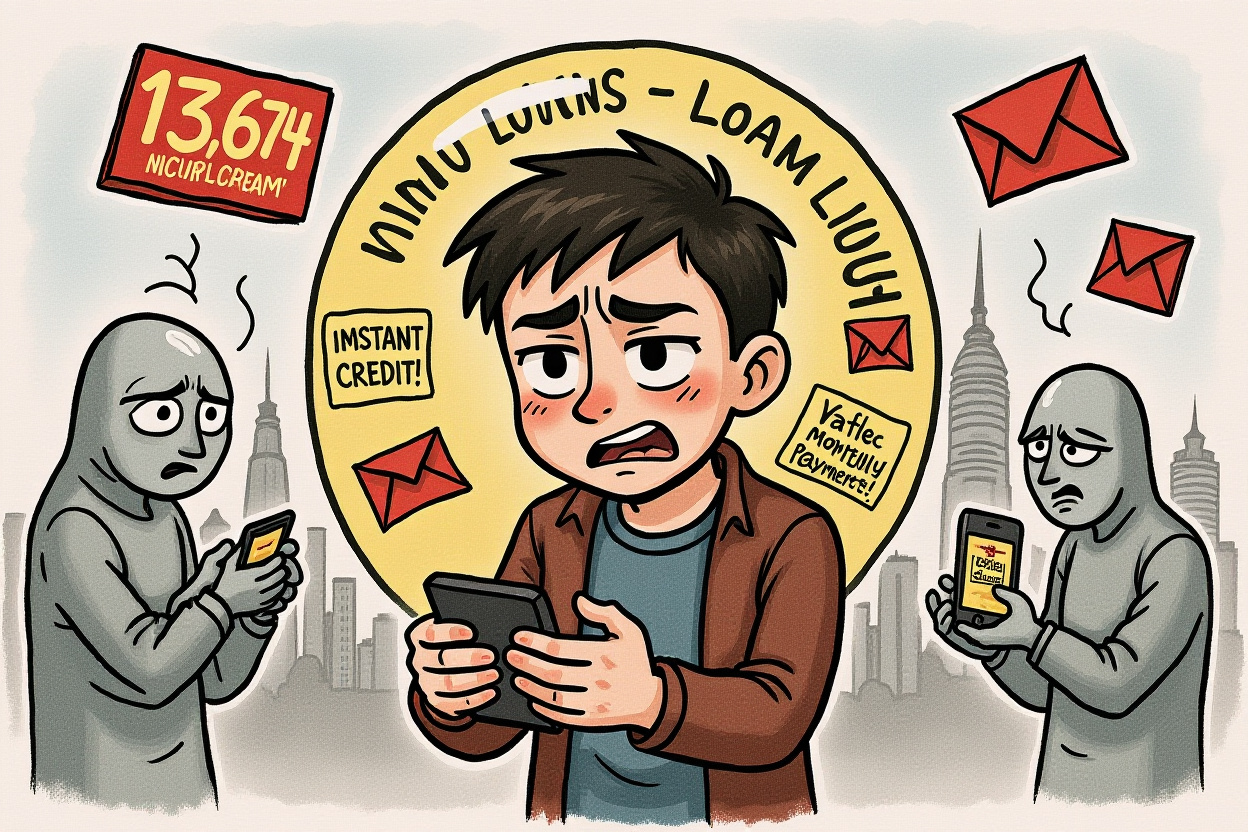
As the Lunar New Year approached, millions of young Chinese faced the familiar pressure of holiday expenses—red envelopes for parents, gifts for relatives, family trips. For many, the solution appeared in the form of a tempting pop-up ad: “Instant credit boost! Up to 50,000 RMB!” This is the world of China’s ‘mini-loans,’ a sector promising quick financial relief but often delivering a long-term debt trap. The case of a borrower who took out 13,674 yuan only to owe 26,859 yuan has ignited a firestorm, putting platforms like Fenqile (分期乐) under intense scrutiny and highlighting a systemic issue where accessible credit masks exorbitant costs. This deep dive explores how these ‘mini-loans’ operate, the regulatory landscape, and their profound impact on China’s young financial consumers.
Executive Summary: Key Takeaways on China’s Mini-Loan Crisis
Before delving into the details, here are the critical insights for investors and regulators:
– Sky-High Effective Costs: Many ‘mini-loan’ products, through layered fees and extended terms, push effective annualized interest rates to the legal ceiling of 36%, far exceeding new regulatory guidelines aimed at capping costs at 24%.
– Targeting the Vulnerable: Platforms continue to target students and young adults with limited financial literacy, using low monthly payment promises to obscure the true long-term cost of debt, a practice reminiscent of the banned ‘campus loan’ era.
– Opacity as a Business Model: A core issue is the lack of transparent, upfront disclosure of all fees—including service,担保费 (guarantee fees), and会员费 (membership fees)—which inflate borrowing costs beyond the stated interest rate.
– Regulatory Arms Race: While authorities like the People’s Bank of China (中国人民银行) and the National Financial Regulatory Administration (国家金融监督管理总局) have introduced stricter rules, enforcement remains patchy, and platforms innovate new fee structures to maintain profitability.
– Broader Market Implications: The sustainability of this business model is in question. Widespread consumer backlash and potential regulatory crackdowns pose significant reputational and operational risks for listed entities like Lexin Fintech Group (乐信集团), affecting investor sentiment in the Chinese fintech sector.
The Allure and Bitter Reality of Mini-Loans
The promise is seductively simple: a small amount of money, spread over many months, with a seemingly manageable monthly payment. This is the fundamental appeal of the ‘mini-loan.’ Platforms like Fenqile masterfully market this accessibility. Their apps and mini-programs within WeChat (微信) boast headlines like “Borrow up to 200,000 RMB, annual interest as low as 8%” or “Only 2.2 RMB per day for a 10,000 yuan loan.” For a young person facing a cash shortfall, the click is almost reflexive.
How the Debt Snowball Begins
The mechanism, however, is designed for escalation. A borrower might start with a 400 yuan purchase for daily necessities, opting for a 36-installment plan because the monthly payment appears trivial. The platform then offers credit line increases, encouraging further borrowing. Each new loan comes with its own term and rate, often at the higher end of the permissible scale. Before long, as in the now-viral case of Ms. Chen, a borrower can have multiple active loans with varying terms. Her five loans between 2020 and 2021, totaling 13,674 yuan, carried annual percentage rates (APRs) between 32.08% and 35.90%. The extended terms, some as long as 36 months, mean interest compounds over a very long period, causing the total repayment obligation to balloon far beyond the principal. This is the essence of the mini-loan trap: the dilution of cost perception over time leads to a catastrophic accumulation of debt.
Deconstructing the Opaque Cost Structure
If the stated interest rate were the full story, the math would be clear, though still costly. The greater danger lies in the additional, often-hidden fees that are bundled into these products. The contractual interest rate is frequently just the starting point for calculating the borrower’s total cost.
Hidden Fees: The ‘Other’ Costs of Borrowing
Complaints on platforms like the Black Cat Complaint (黑猫投诉) platform, where over 160,000 grievances are logged against Fenqile, consistently cite unexplained charges. These include:
– Credit Assessment Fees: Charges for evaluating borrower risk, sometimes applied repeatedly.
– Guarantee Fees (担保费): Premiums paid to third-party guarantors, which the borrower funds but may not be clearly informed about during the application process.
– Platform Service or Membership Fees: Regular charges for account maintenance or access to credit, separate from interest.
A reported case from The Chinese Consumer (中国消费者) illustrates this perfectly. A borrower from Hangzhou took a loan for 10,300 yuan at a contract-specified annual rate of 6%. Based on that rate, total repayment should have been 10,643 yuan. Bank records showed actual monthly payments of 1,034.78 yuan, leading to a total repayment of 12,425.4 yuan—an overpayment of approximately 1,782 yuan attributable to undisclosed fees. This pattern turns a nominal single-digit interest loan into a high-cost product, pushing the effective APR toward 36%. The lack of prominent disclosure violates the spirit, if not the letter, of consumer protection regulations set by bodies like the State Administration for Market Regulation (国家市场监督管理总局).
The Regulatory Tightrope: Rules, Gaps, and Enforcement
Chinese regulators are acutely aware of the risks posed by high-cost consumer lending. On December 19, 2025, the People’s Bank of China (中国人民银行) and the National Financial Regulatory Administration (国家金融监督管理总局) jointly issued the Guidance on the Management of Comprehensive Financing Costs for Micro-Loan Companies (小额贷款公司综合融资成本管理工作指引). This directive explicitly forbids new loans with a comprehensive annualized cost exceeding 24%. Furthermore, it mandates that, in principle, all new loans must see their costs reduced to within four times the one-year Loan Prime Rate (LPR) by the end of 2027. For context, with the 1-year LPR currently at 3.45%, the four-time ceiling would be 13.8%.
The Challenge of On-the-Ground Compliance
Despite this clear regulatory intent, enforcement is a monumental challenge. The guidance states that from 2026, local financial supervision authorities should “correct immediately, stop new lending, and incorporate into dynamic credit reporting management” for loans over 24%. However, the definition of “comprehensive financing cost” leaves room for interpretation. Platforms argue that certain fees are for third-party services and not part of the interest. Moreover, the存量 (existing stock) of loans issued before the rules pose a massive problem. Borrowers like Ms. Chen, who took loans years ago, remain trapped under the old, higher rates. The regulator’s push for platforms to assist borrowers in “negotiating” reductions on these old loans has had mixed results, often placing the burden of initiative on the already-distressed borrower. This gap between policy announcement and practical relief for millions is where the mini-loan business continues to thrive.
The Unshakeable Legacy of Campus Lending
To understand the current predicament, one must look at the origins of companies like Lexin Fintech Group. Its flagship platform, Fenqile, was founded in 2013 by entrepreneur Xiao Wenjie (肖文杰). It grew explosively by positioning itself as China’s pioneer in installment shopping e-commerce, famously selling its first smartphone on credit. Its primary growth engine in the early years was lending to university students—the lucrative but ethically fraught “campus loan” (校园贷) market.
From Campus to Mainstream: A Persistent Target Demographic
After regulatory bans on specific campus lending practices in 2016 and 2017, Lexin rebranded, went public on Nasdaq in 2017, and pivoted to serving “credit consumption groups.” However, evidence suggests the user base remains overwhelmingly young. Searches for “Fenqile campus loan” on complaint platforms still yield hundreds of results. Users report that promotional personnel for these mini-loan products actively operate on or near university campuses, and individuals attest to taking out loans while still enrolled as students. The product design—small amounts, long tenures, easy approval—remains perfectly tailored to the financial profile and impulsivity of a young adult. While the label has changed, the target has not, raising serious questions about whether the industry has truly reformed or merely refined its approach to a vulnerable demographic.
Privacy Erosion and the Trauma of Aggressive Collections
The borrower’s ordeal often does not end with signing a burdensome contract. The business model is underpinned by extensive data collection and, when repayments falter, aggressive recovery tactics.
From Data Harvesting to Harassment
Upon application, users grant platforms permission to collect a staggering array of personal information. As reported by Economic Reference News (经济参考报), this includes ID cards, bank details, income data, facial recognition biometrics, location, and contact lists. This data is often shared with a wide network of third parties, including payment processors, clearing banks, and credit enhancement agencies, as outlined in dense privacy policies few users read.
When loans become delinquent, this data becomes a weapon. The most common complaint, with over 20,000 mentions on Black Cat, involves “暴力催收 (violent debt collection)” and “爆通讯录 (blasting the contact list).” Collectors, or automated systems, contact not only the borrower but also their family, friends, colleagues, and even employers, divulging debt details and applying social pressure. For Ms. Chen, this harassment lasted over 1,000 days of delinquency, leading to severe depression and social isolation. This practice, while increasingly regulated, remains a standard industry recovery tool, turning a financial problem into a profound personal and psychological crisis.
Navigating the Future: Risks, Responsibilities, and Investor Implications
The mini-loan sector stands at a crossroads. The current model, reliant on high effective yields from a financially fragile segment of the population, faces mounting pressures from all sides.
For consumers, the path forward requires extreme caution. Young borrowers must be educated to look beyond the monthly payment and calculate the total cost of borrowing, including all fees. They should utilize official channels like the 12378 banking and insurance consumer complaint hotline to report non-compliant practices.
For regulators, the task is to accelerate and tighten enforcement. Closing loopholes in fee disclosure, rigorously defining “comprehensive cost,” and holding both lending platforms and their partner funding banks accountable are essential steps. The China Banking and Insurance Regulatory Commission (CBIRC) (中国银行保险监督管理委员会) has shown willingness to act, but consistency across all provinces is key.
For investors in Chinese fintech, this is a critical ESG (Environmental, Social, and Governance) and operational risk factor. Companies like Lexin that built their empires on high-margin consumer credit must transparently demonstrate how they are transitioning their portfolios to comply with the 24% and eventual 4x LPR caps. Failure to do so could result in severe regulatory penalties, loss of licensing, and irreversible brand damage. The sustainability of their earnings growth is directly tied to their ability to innovate responsibly within a stricter regulatory framework.
The story of borrowing 13,000 yuan to repay 26,000 is not an anomaly; it is a symptom of a systemic issue in China’s consumer finance landscape. While credit access is vital for economic growth, it must not come at the cost of crippling a generation with debt. As scrutiny intensifies, the evolution of the mini-loan industry will serve as a key indicator of China’s commitment to building a fairer and more sustainable financial ecosystem for all its citizens.