



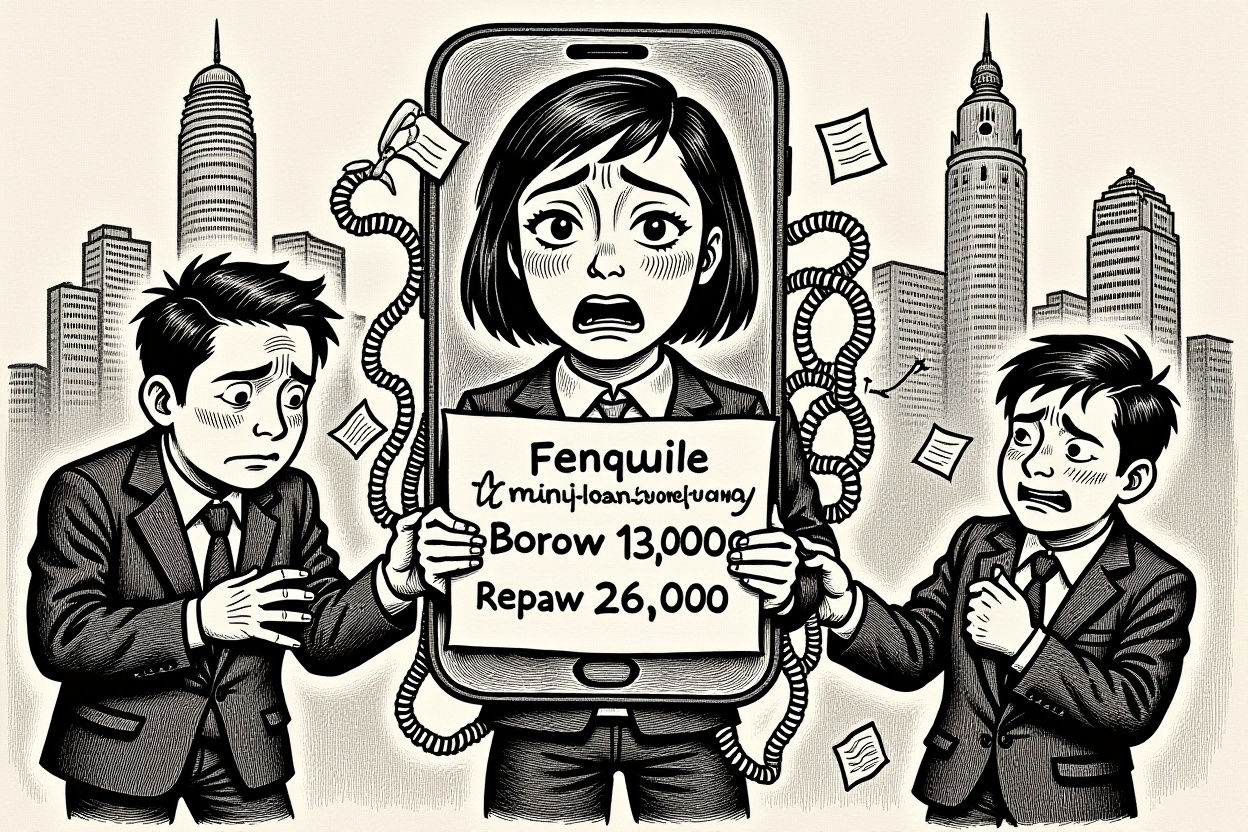
As Lunar New Year pressures mount, platforms like Fenqile (分期乐) dangle higher credit limits, but the seductive promise of ‘mini-loans’ masks a perilous reality where borrowers can end up repaying double what they borrowed. This deep dive examines the mechanisms, regulatory challenges, and broader market consequences of these high-cost credit products targeting China’s youth.
– Borrowers like Ms. Chen face effective APRs nearing 36%, repaying nearly double their principal due to opaque fees and extended loan tenures marketed as ‘affordable.’
– New 2025 regulatory guidelines cap comprehensive financing costs at 24%, but enforcement loopholes and hidden charges allow platforms to maintain profitability at the legal limit.
– Fenqile’s operator, Lexin Fintech Holdings Ltd. (乐信集团), retains ties to its controversial origins in campus lending, with thousands of complaints alleging ongoing targeting of students and violent debt collection.
– Investors in Chinese fintech must weigh sustainability risks as regulatory scrutiny intensifies, potentially compressing margins for lenders reliant on high-interest mini-loans.
The landscape of consumer credit in China is undergoing a seismic shift. On one side, regulatory authorities are pushing for greater transparency and affordability. On the other, financial technology platforms continue to profit from complex loan products that burden unsophisticated borrowers. The case of Fenqile, a leading online lending platform, encapsulates this tension, revealing how ‘mini-loans’—small-amount, long-term credit—can evolve from a lifeline into a debt trap. For global investors and market participants, understanding these dynamics is crucial for assessing risks in China’s vibrant yet volatile consumer finance sector.
The Mechanics of a Debt Trap: Opaque Fees and Snowballing Costs
At their core, mini-loans are designed to appear manageable. By stretching small loan amounts over exceptionally long periods, platforms advertise minuscule monthly payments. However, this structure exponentially increases total interest paid, often pushing the comprehensive annualized cost to the regulatory ceiling of 36%.
A Case Study in Exponential Debt
The experience of Ms. Chen, widely reported in February 2025, is tragically illustrative. While a university student, she took out five loans totaling 13,674 yuan on the Fenqile platform between 2020 and 2021. One loan was for a mere 400 yuan, divided over 36 months. The advertised ‘low interest’ and ‘monthly payment as low as 18.23 yuan’ belied the true cost: APRs ranging from 32.08% to 35.90%. By the time she sought to settle her debts, the total repayment demanded had ballooned to 26,859 yuan—approximately 196% of the principal borrowed. After ceasing payments in August 2022, she endured over 1,000 days of delinquency, coupled with intense psychological pressure from debt collectors who contacted her family and social circle. This case is not an isolated incident but a template for how mini-loans operate.
Regulatory Red Lines and Creative Compliance
In December 2025, the People’s Bank of China (中国人民银行) and the National Financial Regulatory Administration (国家金融监督管理总局) jointly issued the ‘Guidelines for the Management of Comprehensive Financing Costs of Small Loan Companies.’ These rules explicitly forbid new loans with a comprehensive annualized cost exceeding 24% and mandate that, in principle, all new lending must align with a cap of four times the one-year Loan Prime Rate (LPR) by the end of 2027. The guidelines state that from 2026 onward, local financial regulators must immediately correct violations, halt new lending, and incorporate dynamic credit reporting management for costs above 24%. Despite this, platforms navigate these limits by layering on fees—membership, guarantee, and credit assessment charges—that are not always prominently disclosed, effectively maintaining yields at the 36% threshold. The Black Cat Complaint Platform (黑猫投诉平台) hosts over 160,000 complaints against Fenqile, many citing these undisclosed costs that inflate the true price of credit.
The Unshakable Legacy: From Campus Loans to Mainstream Fintech
The mini-loan business model is deeply intertwined with the controversial history of campus lending in China. Fenqile’s operational entity is Jishan Fenqile Network Small Loan Co., Ltd. (吉安市分期乐网络小额贷款有限公司), headquartered in Jiangxi. Its ultimate parent is the NASDAQ-listed Lexin Fintech Holdings Ltd., founded by entrepreneur Xiao Wenjie (肖文杰).
Origins in a Banned Practice
Lexin’s foundational growth was fueled by providing credit to university students, a practice that regulators cracked down on in 2016 due to widespread predatory lending and collection abuses. While the company has since rebranded as a broader fintech service provider for ‘credit consumers,’ evidence suggests the ties to student lending remain. A search for ‘Fenqile campus loan’ on the Black Cat platform still yields 922 complaints. Users report that promotion personnel actively market loans on university campuses, and over 20,000 complaints detail violent collection tactics, including harassing phone calls to borrowers’ relatives, colleagues, and even local village officials.
Data Privacy: The Hidden Cost of Convenience
The financial cost is only one facet of the borrower’s burden. To access these mini-loans, users must grant extensive permissions. As reported by the Economic Reference Report (经济参考报), Fenqile’s software, upon user agreement, collects dozens of personal data points: ID card photos, bank card information, industry and occupation details, income data, facial recognition biometrics, residential address, and real-time location. This sensitive information is then shared with a range of third parties, including merchants, payment partners, clearing banks, and credit enhancement agencies, as outlined in the platform’s privacy policy. This creates a secondary vulnerability where loss of financial control is compounded by loss of data privacy.
Market Realities: Consumer Complaints and Platform Economics
The sheer volume of consumer grievances paints a clear picture of systemic issues within the mini-loan sector. These complaints offer critical due diligence signals for investors evaluating the sustainability of fintech business models.
A Pattern of Opaque Pricing
Reports from China Consumer Journal (中国消费者) detail numerous cases where actual repayments far exceeded contractually stated amounts. For example, a borrower from Hangzhou took a 10,300 yuan loan with a stated annual rate of 6% over 12 months. The contractual repayment should have been 10,643 yuan, but bank records showed monthly payments of 1,034.78 yuan, totaling 12,425.4 yuan—an overpayment of approximately 1,782 yuan. Similarly, a borrower from Sichuan’s Liangshan Prefecture was charged a 1,102.14 yuan ‘guarantee fee’ on two loans without clear prior disclosure, fees buried within lengthy electronic agreements. These practices highlight a critical lack of transparent, upfront cost disclosure that regulators are now aiming to eliminate.
The Investor Calculus: High Margins vs. Regulatory Risk
For listed entities like Lexin, the mini-loan segment has historically been a high-margin revenue stream. However, this profitability is now directly challenged by the regulatory push to lower comprehensive financing costs. The 2025 guidelines represent a clear directional shift, and while platforms may resist through fee reclassification in the short term, the long-term trend points towards compressed margins. Investors must assess whether these companies can successfully pivot to lower-cost, higher-volume models or develop alternative revenue streams to offset the impending drag from their core mini-loan products.
Regulatory Trajectory and Forward-Looking Implications
The tightening regulatory environment is not a blip but a sustained campaign to de-risk China’s consumer finance sector and protect vulnerable borrowers. The implications extend far beyond a single platform.
Enforcement as the Key Variable
The success of the new cost caps hinges on local financial regulators’ capacity and willingness to enforce them. Historical precedents show a gap between central policy pronouncements and ground-level implementation. However, the specific inclusion of measures like ‘halting new lending’ for violators and ‘dynamic credit reporting management’ suggests a more muscular approach. Investors should monitor quarterly financial reports from lenders like Lexin for signs of decreasing yield-on-assets or increasing provisions, which would signal effective enforcement taking hold.
Broader Sector Impact and Opportunities
The crackdown on mini-loans creates both risks and opportunities. Traditional banks and larger, more conservative fintech players with lower cost structures may benefit as regulatory arbitrage diminishes. Furthermore, the push for transparency could accelerate the adoption of open finance and standardized credit assessment models, rewarding platforms that compete on service and efficiency rather than opaque pricing. For the vast demographic of young, digitally-native consumers, this could eventually lead to a healthier, more sustainable credit ecosystem—but the transition period will likely be turbulent.
The saga of China’s mini-loans is a microcosm of the broader challenges in governing a fast-moving digital economy. While financial inclusion is a laudable goal, the current model exemplified by platforms like Fenqile too often crosses into exploitation. The evolving regulatory framework provides a clear mandate for change, but its ultimate effectiveness will depend on consistent enforcement and market adaptation. For young borrowers, the imperative is caution: scrutinize every fee, understand the true annualized cost, and consider alternatives before committing to long-term, high-cost debt. For institutional investors and fund managers, diligent scrutiny of lending practices, compliance histories, and adaptation strategies is no longer optional—it is essential for navigating the shifting sands of Chinese consumer finance. As supervision intensifies, the era of easy profits from exploitative mini-loans is closing, paving the way for a more responsible and stable market.