



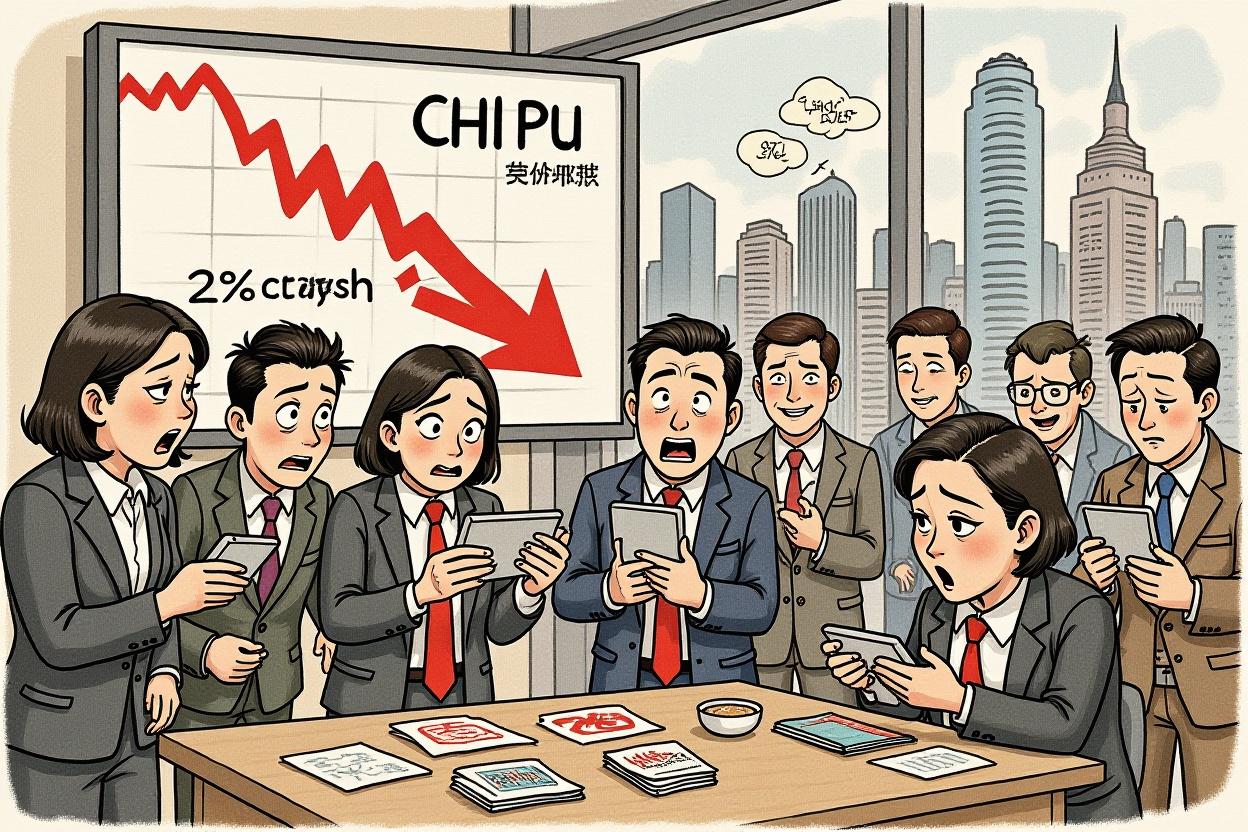
In a sharp reversal of fortune, shares of 智谱 (ZhiPu), celebrated as ‘the world’s first large model stock,’ nosedived more than 20% during Hong Kong trading, sending shockwaves through the region’s technology sector and prompting urgent questions about the sustainability of the blistering rally in Chinese artificial intelligence equities. This ZhiPu stock crash serves as a critical stress test for market sentiment, occurring after a parabolic ascent that saw the company’s valuation multiply over fivefold since its January debut. The sudden correction underscores the volatile interplay between groundbreaking technological promise and execution reality in China’s fiercely competitive AI landscape, where companies like ZhiPu and MINIMAX are racing to define the next generation of intelligent computing. For global investors tracking the Shenzhen and Hong Kong exchanges, understanding the drivers behind this plunge is essential for navigating the risks and opportunities in one of the world’s most dynamic capital markets.
Key Takeaways from the ZhiPu Stock Plunge:
– 智谱 (ZhiPu) witnessed a severe correction, with its Hong Kong-listed shares tumbling over 22% in a single session, erasing billions in market capitalization amid a broad sell-off in AI concept stocks.
– The decline is attributed primarily to profit-taking after an explosive 500%+ post-IPO rally and negative reaction to a public apology letter detailing operational stumbles in the rollout of its flagship GLM-5 model.
– 长江证券 (Changjiang Securities) analysis suggests the pullback may represent a healthy consolidation, with long-term investment thesis intact around China’s push for AI sovereignty and model capability breakthroughs.
– The event highlights growing pains for China’s AI champions, balancing rapid innovation with scalable infrastructure and customer experience, a critical factor for institutional investors.
– Investment opportunities are crystallizing around three core themes: new super application entrances, domestic foundational computing resources, and the ecosystem for AI agents.
The Sudden Plunge: A Minute-by-Minute Market Correction
On the Hong Kong trading floor, the mood shifted abruptly as 智谱 (ZhiPu) shares, which had been a stellar performer, began a rapid descent. The ZhiPu stock crash was not an isolated event; it dragged down the entire AI large-model sector, with peer MINIMAX also falling sharply. This section dissects the trading dynamics and immediate catalysts that triggered the sell-off.
Intraday Volatility and Closing Damage
The selling pressure was intense and sustained. At its worst point during the session, ZhiPu’s stock price was down over 25%, a breathtaking move for a large-cap name that had recently joined the ranks of Hong Kong’s most valuable technology firms. By the market close, the loss was cemented at 22.76%, while MINIMAX settled 13.35% lower. The trading volume was exceptionally heavy, indicating a broad-based exit by both retail and institutional holders who had ridden the stock’s meteoric rise. This volatility reflects the heightened sensitivity of AI equities to any perceived misstep, especially after such a steep run-up. The ZhiPu stock crash immediately became the top-trending financial topic across Asian trading terminals, forcing portfolio managers to reassess risk exposures across the sector.
Immediate Catalysts: Profit-Taking Meets Operational Transparency
Market analysts uniformly pointed to two intertwined factors. First, and most predominantly, was simple profit-taking. Following its IPO at 116.2 Hong Kong dollars on January 8, ZhiPu’s stock had skyrocketed to 725 HKD by February 20—a gain of 524% in just over a month. Such parabolic moves inevitably attract speculative capital, and a portion of that ‘hot money’ chose to lock in gains, creating a powerful wave of selling. Second, and more fundamentally, was the company’s own communication. On the evening of February 21, ZhiPu published an open ‘apology letter’ regarding its GLM Coding Plan. The letter admitted to three key errors in the GLM-5 model launch: insufficient transparency in rules, an overly slow grayscale release节奏, and a poorly designed upgrade mechanism for existing users. This rare display of corporate mea culpa, while potentially strengthening long-term trust, was interpreted by the market as a sign of operational growing pains at a critical juncture, applying additional downward pressure on the stock price during the ZhiPu stock crash.
ZhiPu AI: From Academic Lab to Wall Street Darling
To comprehend the magnitude of both the rally and the crash, one must understand ZhiPu’s origins and its position at the forefront of China’s national AI strategy. The company is not a typical startup; it is a deep-tech phenomenon born from the nation’s premier academic institution.
Founding and Technological Pedigree
智谱 (ZhiPu) was founded in 2019 as a commercialization vehicle for research from Tsinghua University’s Computer Science Knowledge Engineering Laboratory. This heritage provided it with a formidable moat: full-stack, in-house research and development capabilities spanning underlying algorithms, pre-training frameworks, and adaptation to domestic hardware. The company’s mission is audacious—to develop large models that match or surpass human-level abilities in language, reasoning, vision, hearing, and tool use. Its core innovation is the GLM (General Language Model) architecture, a novel pre-training framework based on auto-regressive blank filling that claims superior results in robustness, controllability, and mitigating hallucinations. Crucially, the model has been optimized for over 40 types of Chinese-made chips, aligning perfectly with Beijing’s technological self-reliance goals.
Breakthrough Models and Soaring Market Adoption
The commercial and technical validation came with the 2025 launch of its flagship GLM-4.5/4.6 models. These models natively integrated reasoning, coding, and intelligent agent capabilities for the first time, propelling ZhiPu to top rankings in 12 authoritative benchmarks—first in China and first among global open-source models. On OpenRouter, a global ‘model supermarket’ that reflects real-world usage, GLM-4.5/4.6 consistently ranked in the global top 10 for API calls, with its paid API revenue reportedly surpassing the sum of all other domestic Chinese models. Today, the GLM series is deployed across vital industries including public governance, industrial manufacturing, energy, finance, and education, boasting a developer and customer base exceeding 2.7 million. This rapid adoption fueled the investor euphoria that preceded the recent ZhiPu stock crash.
The GLM-5 Rollout: Ambition Collides with Execution Reality
The immediate precursor to the stock’s volatility was the much-anticipated launch of GLM-5 on February 12. The model was touted as a generational leap, but its deployment revealed the challenges of scaling cutting-edge AI infrastructure under intense market scrutiny.
A Model Designed to Change Programming Paradigms
智谱 (ZhiPu) introduced GLM-5 as a pivotal model engineered to shift programming from ‘Vibe Coding’ to ‘Agentic Engineering’—meaning from writing snippets of code to completing entire complex software engineering tasks. The company claimed GLM-5 achieved state-of-the-art (SOTA) open-source performance in coding and agent capabilities, with real-world usability approaching that of the elite Claude Opus 4.5 model from Anthropic. It excelled at complex system engineering and long-sequence agent tasks. In the authoritative Artificial Analysis benchmark, GLM-5 ranked fourth globally and first among open-source models. The technical report released on February 22 detailed innovations like sparse attention to reduce inference costs and a novel asynchronous reinforcement learning infrastructure to improve training efficiency. These advancements solidified ZhiPu’s technical reputation but also raised the execution bar impossibly high.
The Apology Letter: A Deep Dive into the Stumbling Blocks
The celebratory tone surrounding GLM-5 was quickly tempered by the apology letter. ZhiPu candidly explained that post-launch traffic ‘far exceeded expectations,’ and its infrastructure scaling ‘failed to keep pace.’ This forced the company to ration access to GLM-5, releasing it sequentially to user tiers: Max users first, then Pro users, and finally Lite users after the Lunar New Year holiday. Pro users, even with access, might face throttling during peak loads. Crucially, ZhiPu offered refunds to affected Lite and Pro users. For investors, this letter transformed the narrative from unbridled growth to managed scaling. It highlighted the capital-intensive nature of running large AI models and the operational risks that can trigger a sudden ZhiPu stock crash, even for a company with superior technology. It serves as a case study for investors in Chinese tech: brilliance in R&D must be matched by excellence in operations and customer communication.
Valuation in Hyperdrive: Deconstructing the Pre-Crash Rally
The vertigo-inducing rally that made the subsequent ZhiPu stock crash possible was a spectacle of modern market dynamics, blending nationalist tech pride, speculative fervor, and genuine disruptive potential.
A Meteoric Ascent Post-IPO
The numbers are staggering. From its IPO price of 116.2 HKD, ZhiPu’s stock closed at 725 HKD on February 20, the first trading day after the Lunar New Year holiday, marking a one-day jump of over 40% and a total gain of 524%. This surge catapulted its market capitalization past 320 billion Hong Kong dollars. The rally was directly turbocharged by the GLM-5 announcement on February 12, which alone spurred a 28.68% single-day gain. This trajectory turned ZhiPu and MINIMAX—which listed on consecutive days in January—into the poster children of a renewed bull market for Chinese AI equities, attracting global capital eager for exposure to the next potential global AI leader.
Investor Psychology and Market Sentiment
The rally was driven by a powerful confluence of factors. Firstly, the narrative of China developing AI models that rival the best from the U.S. (like those from OpenAI and Anthropic) resonated deeply with both domestic and international investors betting on technological multipolarity. Secondly, the tangible metrics—top benchmark rankings, surging API revenue, and massive developer adoption—provided fundamental justification beyond mere speculation. Thirdly, the sequential model releases (GLM-4.5/4.6 to GLM-5) demonstrated rapid iteration and capability expansion, convincing the market of a durable competitive edge. This created a feedback loop where rising prices attracted more attention, which in turn drove prices higher, setting the stage for a sharp correction when sentiment eventually soured, culminating in the dramatic ZhiPu stock crash.
Broader Implications for China’s AI Equity Landscape
The ripple effects from the ZhiPu stock crash extend far beyond a single company’s share price. It offers critical insights into the maturation of China’s AI sector and the evolving investment framework for institutional players.
Analyst Insights: Reading the Signals with Changjiang Securities
In a comprehensive note, 长江证券 (Changjiang Securities) provided crucial context. They argued that the powerful rallies in ZhiPu and MINIMAX were fundamentally rooted in a pivotal market shift: Chinese large models have entered the ‘era of demand.’ The core driver is a virtuous cycle where improved model capabilities unlock new application scenarios, which drives real demand and revenue, generating more data to further refine the models. The analysts identified two key inflection points: Chinese models are closing the practical utility gap with top global models like Claude Opus, and this capability enhancement is beginning to materially expand revenue potential. Their analysis suggests the recent ZhiPu stock crash may be a pause in a longer-term secular trend rather than its end.
Three Strategic Investment Themes Emerge
长江证券 (Changjiang Securities) delineated three concrete investment avenues for capital allocators looking beyond the immediate volatility:
– New Super Entrances: As model capabilities like those in GLM-5 mature, they will power entirely new application platforms and user interfaces, creating the next generation of software giants.
– Domestic Foundational Resources: The entire stack, from domestic AI chips (like those from 华为海思 (Huawei HiSilicon)) to cloud infrastructure, becomes critically valuable. ZhiPu’s optimization for over 40 local chips underscores this theme.
– AI Agent Ecosystems: The shift from ‘Vibe Coding’ to ‘Agentic Engineering’ means the tools, platforms, and services that enable AI agents to operate autonomously will see explosive growth. This is where the true productivity gains from models like GLM-5 will be monetized.
The firm concluded that future valuations will hinge on market share, noting that Chinese models are already a high-value, cost-effective choice globally in coding applications. As domestic market volume grows and overseas share increases, the upside for leading Chinese model providers remains substantial, even after a significant ZhiPu stock crash.
Synthesis and Forward-Looking Market Guidance
The dramatic plunge in ZhiPu’s share price is a multifaceted event that encapsulates the promises and perils of investing in frontier technology markets. It was triggered by a predictable technical correction after a parabolic rise and amplified by operational transparency that, while commendable, reminded the market of the real-world challenges of scaling AI. For sophisticated investors, this ZhiPu stock crash is not a signal to exit the Chinese AI narrative but to engage with it more discerningly. The long-term thesis around China’s determined push for AI sovereignty, backed by deep academic talent, vast data pools, and strategic government support, remains intact. However, the event underscores the necessity of rigorous due diligence that looks beyond benchmark scores to assess operational scalability, customer retention, and path to profitability. The investment opportunities are shifting from broad-sector bets to targeted themes: the companies building the new AI-native super apps, those providing the underlying domestic compute power, and the enablers of the AI agent economy. As the dust settles from this correction, the market’s focus will return to execution, sustainable growth, and the relentless pace of innovation. Investors should use this period of volatility to recalibrate portfolios, emphasizing companies with not just technological brilliance but also demonstrated operational maturity and clear competitive moats in the unfolding story of Chinese artificial intelligence.