



A Stark Warning on the Horizon
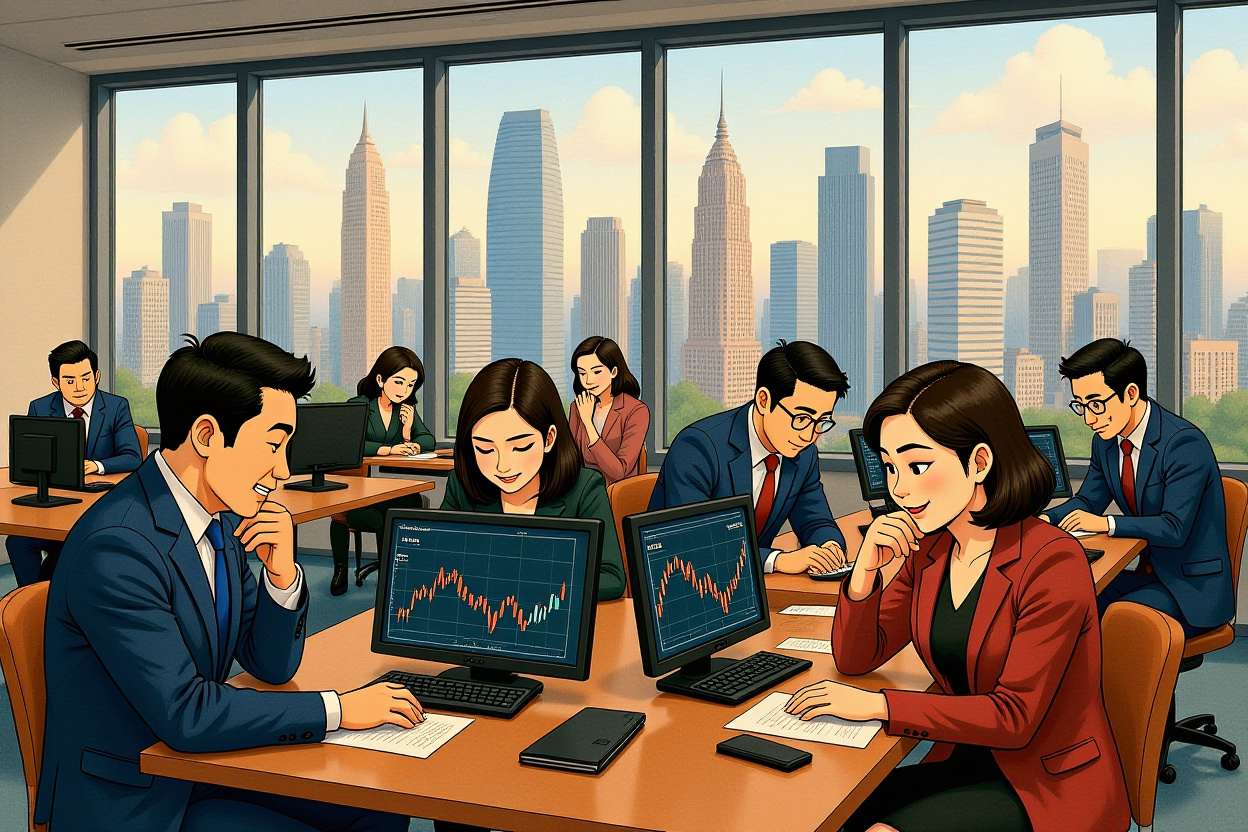
Nassim Nicholas Taleb, author of The Black Swan, recently issued a succinct, chilling prophecy: “All professions invented in the 20th century are susceptible to AI.” For many, this may sound like familiar alarmism. After years of hype, where is the promised wave of white-collar unemployment? Yet, a deeper look reveals that the most profound economic shock of our generation is not merely coming; its early tremors are already being documented by serious institutions. The very foundation of modern professional work—the cognitive, symbol-manipulating jobs that defined the 20th century—sits squarely in the crosshairs of artificial intelligence. This shift represents not just technological change but a fundamental reversal of historical progress, with seismic implications for investors and professionals engaged with the world’s second-largest economy.
Key Takeaways:
– A historical reversal is underway: AI is dismantling the most recently developed human skills (abstract cognition) first, while older physical skills remain more secure.
– A dangerous knowledge gap exists between the public’s view of AI as a chatbot and the reality of autonomous “AI agents” that can plan and execute complex tasks.
– The threat is structural, not cyclical: jobs eliminated by AI-driven workflows are not coming back after a recession, leading to permanent displacement.
– Policy tools and economic models are failing to grasp the speed and scale of this disruption, creating a systemic preparedness crisis.
– For China’s vast professional class and the investors exposed to it, understanding this cognitive vulnerability is the first step toward adaptation and resilience.
The Credible Alarm: Serious Media Sounds the Siren
To those who believe the AI threat is exaggerated, consider the source. The Atlantic, a 167-year-old publication of record, recently published a trio of deep-dive articles in rapid succession, each painting an increasingly grim picture of AI’s impact on the professional workforce. This concentrated focus from a serious media outlet is itself a powerful signal.
The first article, “America Isn’t Ready for AI’s Impact on Jobs,” argued that all traditional economic and political buffers are failing. The second, “AI Agents Are Poised to Swamp America,” detailed the explosive rise of tools that act not as simple chatbots but as autonomous digital workers. The most recent, “The Worst-Case Scenario for White-Collar Workers,” presented stark data: college graduates now make up a quarter of the unemployed in the US, a historic high, while high school graduates are finding work faster—an unprecedented inversion.
This editorial shift is significant. It moves beyond speculative fear to reporting on observable, early-stage economic indicators. The message is clear: the disruption to professions invented in the 20th century is not science fiction; it is entering the realm of documented economic trend.
Beyond Chatbots: The Rise of the AI Agent
The core of the misunderstanding lies in the tools. Most professionals’ experience with AI is limited to conversational models like ChatGPT—useful for drafting emails or brainstorming, but ultimately a passive tool. However, a parallel universe exists within tech circles centered on “AI agents.” These are not query-response systems. They are software entities with agency: give one a high-level goal (e.g., “build a competitor to this project management software”), and it will autonomously decompose the task, search the web, write code, run tests, and debug errors, working for hours without human intervention.
As Anthropic employee Boris Power described watching their coding agent, Claude: “It started having its own ideas and is actively proposing what to build.” When computers can autonomously use computers, the cognitive barriers and prestigious degrees that defined white-collar superiority become precarious. Software engineering, with its binary right-or-wrong outcomes, is the perfect testing ground—Anthropic reports 90% of its internal code is now AI-generated. The gap between these two realities—the public’s perception and the engineer’s reality—is a chasm that will close with brutal force as agentic tools democratize.
The Great Reversal: Why White-Collar Work Is Fundamentally Vulnerable
This vulnerability stems from a historical irony. Human skill development followed a long arc: from physical prowess and spatial awareness (ancient hunting, farming), to tool-based precision manufacturing (the Industrial Revolution), and finally to the manipulation of abstract symbols and information (the 20th-century “white-collar” revolution). AI’s path of conquest is reversing this order.
The most ancient skills—plumbing, electrical work, skilled repair—are deeply embodied. They require nuanced physical feedback, tactile judgment, and adaptation to unpredictable real-world environments, making them difficult and expensive to automate. Conversely, the professions invented in the 20th century—financial analysis, legal document review, middle management, marketing copywriting—are fundamentally about processing, classifying, and transmitting information. This is the native domain of large language models and AI agents. Human cognition honed over decades of education is being systematically replicated in silicon in a fraction of the time.
The End of “Womblike Security”
For half a century, educated white-collar workers enjoyed what The Atlantic‘s Annie Lowrey termed a “womblike security” in the labor market. Economic downturns hit manufacturing; globalization offshore blue-collar jobs. The professional class was largely insulated. That era is ending. The data shows this safety net is fraying first for those with bachelor’s degrees.
This crisis is more perilous than past blue-collar displacement for two key reasons. First, it triggers structural, not cyclical, unemployment. A laid-off factory worker might be rehired when demand rebounds. A position eliminated because an AI workflow is more profitable is gone forever. Second, social safety nets and political will were never designed to catch a falling professional middle class en masse. The resulting drop in consumer spending from such a cohort could trigger a severe deflationary spiral, impacting entire economies.
The Calm Before the Storm: Systemic Failure to Acknowledge the Threat
The apparent lack of a massive unemployment wave today is misleading. It reflects systemic failures in measurement, corporate strategy, and governance, not a lack of underlying risk.
Economists Driving by Rearview Mirror
Mainstream economics is poorly equipped for this disruption. Economists rely on lagging historical data and tend to analogize AI to past general-purpose technologies like electricity, assuming a slow, decades-long adoption. As Anton Korinek, a University of Virginia economist who advises AI labs, notes, this is flawed logic: “Machines used to be stupid, so it took a long time to deploy them… Now they are smarter than us. They can deploy themselves.” AI integration often requires just an API connection, not a physical factory rebuild. Korinek reveals that those closest to the technology, within labs like Anthropic, often share a sense of foreboding, not hype.
The Corporate Silence and “Labor Hoarding”
In early 2025, CEOs like Dario Amodei of Anthropic and Jim Farley of Ford openly discussed AI eliminating vast swaths of white-collar jobs. That conversation has largely gone silent. This is not a change of heart but a strategic pause. Major corporations are likely in a phase of “labor hoarding,” experimenting with AI integration behind the scenes while maintaining existing headcount. The bottleneck is often legacy IT systems. Once integration with these systems is seamless, the rationale for retaining many roles will evaporate. The uniform refusal of major corporate and AI company executives to comment on this topic for recent reports is a telling silence.
Policy Tools Built for the Wrong Problem
The political system is failing to respond. The dominant policy toolkit—unemployment insurance, worker retraining, monetary stimulus—assumes temporary, cyclical unemployment. AI drives permanent, structural displacement. The record for large-scale retraining programs is poor, often showing negative returns. The Silicon Valley-favored solution of Universal Basic Income (UBI) presents a dystopian risk of creating a permanently subsidized, disengaged class and faces fierce political resistance over funding. As former UK Deputy Prime Minister Nick Clegg warned, the required pace of change may “far outstrip their apparent capacity to deliver,” threatening the stability of democratic systems themselves.
Global Implications: Why China’s Professional Class Is Equally at Risk
The belief that this is solely a Western phenomenon is a dangerous illusion. AI is software; it does not respect borders. The narrative of white-collar security may be even more deeply ingrained in China’s rising professional culture, making the cognitive shift more jarring. The same forces are at play: a vast cohort of professionals engaged in information intermediation, analysis, and coordination—precisely the tasks AI agents are rapidly learning to master.
For international investors and fund managers analyzing Chinese equities, this adds a critical, non-financial layer of risk assessment. Companies heavily reliant on large armies of mid-level analysts, coordinators, or content producers may face not just efficiency gains but existential business model pressure. Sectors like outsourcing, business process services, and even segments of financial analysis are on the front line. The valuation of firms may increasingly hinge on their adoption of agentic AI to displace human labor costs, not just their top-line growth.
The New Dividing Line: Cognitive Awareness Over Credentials
The most important divide emerging globally is not between degrees or industries, but between those who understand the capabilities of agentic AI and those who do not. This knowledge gap will determine professional and investment survival. The question for every professional and analyst is no longer “What can AI do?” but “What can an AI agent do autonomously?”
Navigating the Reversal: A Strategic Path Forward
The “Reverse Historical Development Law” of AI displacement provides the clue to a defensive strategy. If professions invented in the 20th century are most vulnerable, individuals and businesses must look to the skills that preceded and will outlast them.
The survival strategy involves a dual movement:
– Downward into Physical Reality: Cultivate skills that involve complex physical interaction, high-touch emotional intelligence, or craft that defies standardization. Think skilled trades, advanced caregiving, or bespoke creative arts. These leverage millions of years of human evolutionary intelligence that AI cannot easily replicate.
– Upward into Meta-Command: Do not compete with AI on speed of analysis or code generation. Instead, learn to command it. Develop the high-level judgment, aesthetic taste, strategic foresight, and ethical reasoning required to set goals for teams of AI agents. The premium shifts from being the best spreadsheet operator to being the best orchestrator of intelligent, automated systems.
For businesses and investors, the mandate is clear. Scrutinize portfolio companies and business models for over-reliance on human-executed information processing. Prioritize firms that are proactively and intelligently integrating agentic AI, not just experimenting with chatbots. Recognize that the greatest investment opportunities may lie in companies building the infrastructure for this new age of automation or providing solutions for the societal transition it will force.
The twilight of the white-collar era is not a distant forecast. It is a present-day process, masked by systemic lag and cognitive dissonance. The professions that defined the last century are being hollowed out by a force that reverses the very arc of human labor history. For professionals in China and worldwide, and for the global investors watching them, the time for awareness and strategic adaptation is now. The storm is no longer on the horizon; it is making landfall, and the instruments we used to measure the weather are becoming obsolete. To ignore this is to risk being swept away by the greatest economic tide of the 21st century.