



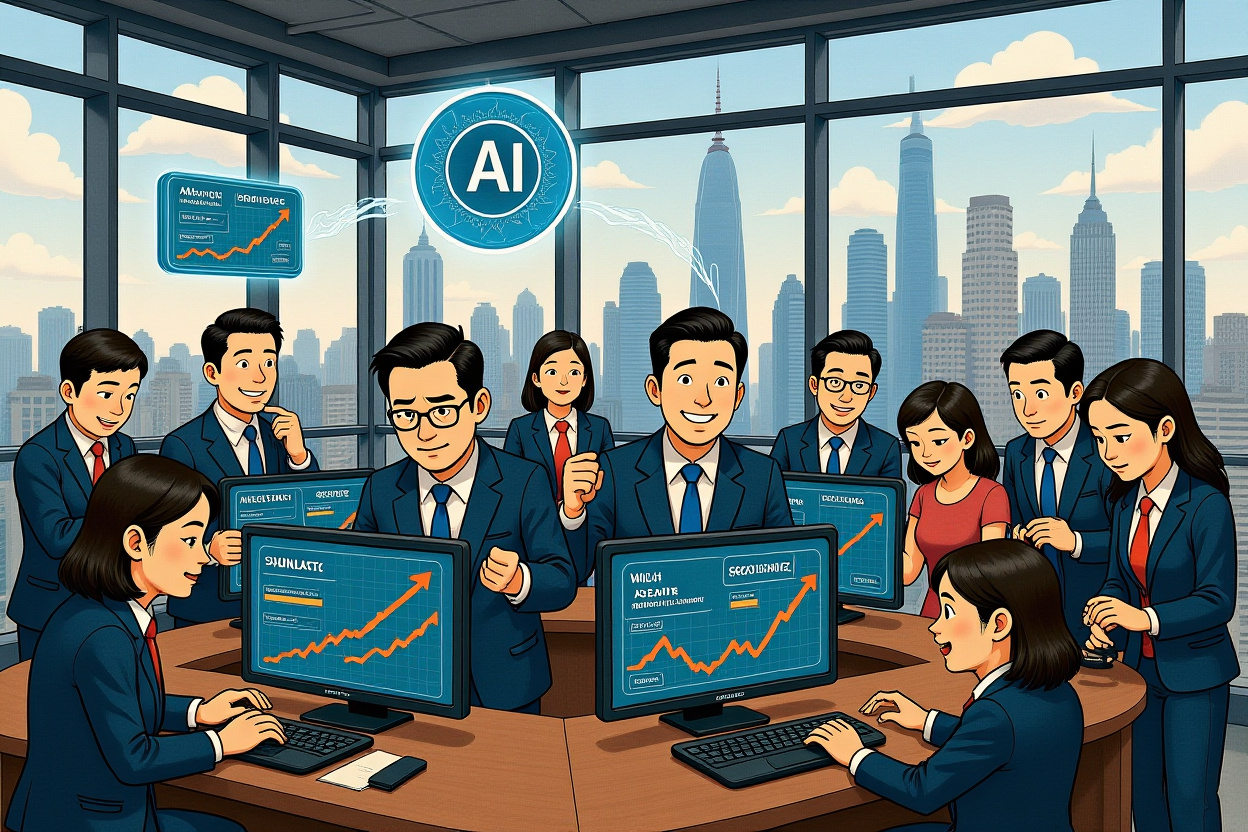
Executive Summary
– AI is dismantling professions in reverse chronological order, with 20th-century white-collar jobs being the most vulnerable due to their reliance on abstract information processing.
– A growing divide exists between public perception of AI as simple chatbots and the reality of autonomous AI agents capable of replacing entire workflows without human intervention.
– Economic indicators and expert warnings suggest a looming structural unemployment crisis, exacerbated by systemic failures in policy, corporate silence, and outdated economic models.
– The impact is borderless, affecting global markets including China, where the myth of white-collar security is deeply entrenched but increasingly fragile.
– Survival strategies involve pivoting to AI-resistant physical skills or ascending to roles that command and oversee AI systems, necessitating a fundamental shift in career planning.
The Unseen Storm: AI’s Gathering Threat to Modern Professions
When Nassim Taleb (纳西姆·塔勒布), author of The Black Swan, recently tweeted that “all occupations invented in the 20th century are doomed to be impacted by AI,” it resonated with a chilling prediction made a year prior by an insightful observer. This perspective introduces a core concept: AI’s impact on 20th-century professions follows an inverse historical law. Skills that emerged most recently—those sophisticated, abstract cognitive tasks born in the last century—are paradoxically the first in line for automation. While many dismiss this as alarmist, given the muted immediate effects, a deeper analysis reveals that the tremors are already being felt. For financial professionals and institutional investors monitoring Chinese equity markets, this shift isn’t merely speculative; it’s a fundamental force that will reshape corporate structures, productivity metrics, and ultimately, market valuations. The focus on AI’s impact on 20th-century professions is not a distant forecast but a present-day reality with profound economic ramifications.
The Alarm Bells Are Ringing: Serious Media Warns of AI Job Displacement
The Atlantic’s Triple Warning
The notion that AI threats are overstated is swiftly dismantled by the concerted warnings from established media. The Atlantic, a venerable publication founded in 1857, has recently published a trio of in-depth articles sounding the alarm. First, “The U.S. Isn’t Ready for AI’s Impact on Jobs” by Josh Tyrangiel argues that all societal buffers—political, economic, and social—are ill-equipped for the coming shock. Second, Lila Shroff’s “AI Agents Are Storming America” details how autonomous AI tools are enabling rapid software development, destabilizing traditional tech jobs. Third, Annie Lowrey’s “The Worst-Case Scenario for White-Collar Workers” presents stark data: bachelor’s degree holders now constitute a quarter of the unemployed in the U.S., a historic high, while high school graduates are finding jobs faster. This concentrated editorial focus from a serious institution is a clear signal that AI’s impact on white-collar work is transitioning from theory to observable trend.
Beyond Hype: A Structural Shift
The Atlantic’s reversal from skepticism to urgency underscores that this isn’t mere hype. As Lowrey notes, white-collar workers have long enjoyed a “womblike security,” shielded from economic downturns that primarily affected blue-collar sectors. That security is evaporating. The jobs at risk are not cyclical but structural; once AI workflows are optimized, those positions may vanish permanently. For investors, this signals potential upheaval in sectors heavily reliant on knowledge work, from financial services to tech, with implications for labor costs, operational efficiency, and long-term business models.
The Great Divide: Two Parallel AI Universes
Chatbots vs. Autonomous Agents
A critical misunderstanding fuels complacency: most people experience AI through consumer chatbots like ChatGPT, which assist with emails or simple queries. However, a parallel universe exists where AI agents—autonomous digital workers—are revolutionizing productivity. Unlike passive chatbots, agents exhibit “agentic” behavior: given a broad goal, they independently decompose tasks, search the web, write and test code, and collaborate with other AIs. Boris Cherny of Anthropic described Claude Code as beginning to “have its own ideas and proactively propose what to build.” This leap from tool to colleague—or soon, supervisor—represents a quantum shift in capability.The Productivity Chasm
This divide has tangible consequences. Engineers and early adopters can now delegate complex projects to multiple agents, compressing months of work into days. For instance, Anthropic reports that 90% of its internal code is now AI-generated. Meanwhile, the broader workforce remains unaware, creating a dangerous knowledge gap. When these agent tools inevitably democratize, the merger of these two universes will be abrupt and disruptive. For business leaders, bridging this cognitive gap is urgent; understanding AI’s true potential is no longer optional but a competitive necessity to avoid being blindsided by more agile rivals.Historical Reversal: Why White-Collar Jobs Are Sitting Ducks
The Inverse Evolution Law
The author’s “AI替代的逆向历史演化定律” (AI’s Reverse Historical Evolution Law) posits that AI targets skills in opposite order to human development. Human civilization progressed from physical labor (agriculture) to tool-based manufacturing (industry) to abstract symbol manipulation (information work). AI, however, excels at the latter first. The most ancient skills—like plumbing, electrical work, or hairdressing—involve complex physical interaction and embodied cognition, making them resilient. In contrast, 20th-century inventions such as financial analysis, legal drafting, and middle management are essentially information processing tasks, which AI can replicate with superior speed and accuracy.Data-Backed Vulnerability
Empirical evidence supports this. Lowrey’s article highlights that in the U.S., jobs easily automated by AI are seeing unemployment spikes, while trades remain secure. This reversal means that the massive investment in higher education for cognitive skills is becoming a liability. For Chinese markets, this is particularly poignant; the cultural emphasis on white-collar prestige through degrees may soon clash with economic reality. As AI’s impact on 20th-century professions accelerates, industries like finance, law, and administration in China face unprecedented restructuring risks, affecting everything from employment rates to consumer spending patterns.The Calm Before the Storm: Systemic Blind Spots and Elite Denial
Economists’ Rearview Mirror
Why hasn’t mass unemployment materialized yet? A key reason is the lag in economic measurement. As noted in The Atlantic, economists like Chicago Fed President Austan Goolsbee admit they are “constrained by the numbers,” which show no clear erosion yet. However, Anton Korinek, an economist at the University of Virginia, criticizes this approach, stating that economists are “driving by looking in the rearview mirror.” AI differs from past technologies because it’s intelligent and self-propagating; it doesn’t require physical infrastructure overhaul, just API integration. Korinek, who advises Anthropic, reveals that even AI insiders feel fear, not hype, underscoring the technology’s disruptive potential.Corporate Silence and Political Inertia
Initially, CEOs like Dario Amodei of Anthropic and Jim Farley of Ford openly predicted AI would eliminate swathes of white-collar jobs. Now, they’ve gone silent—a strategic move during “labor hoarding,” where companies retain workers while integrating AI behind the scenes. Once legacy systems are bridged, layoffs may be swift. Politically, as former UK Deputy Prime Minister Nick Clegg warns, democratic governments are unprepared for the pace of change. In China, regulatory bodies like the China Securities Regulatory Commission (CSRC) may face similar challenges in balancing innovation with social stability. The systemic failure to address AI’s impact on 20th-century professions leaves markets exposed to sudden shocks.Borderless Impact: AI’s Global Threat to Professions
No Sanctuary in National Borders
Some may dismiss this as a Western issue, but AI is software—it respects no borders. China, with its rapid tech adoption and deep-seated belief in white-collar security, is equally vulnerable. The cognitive divide is global; those unaware of agent-level AI tools risk being marginalized. For international investors, this means that Chinese tech giants like Tencent and Alibaba may drive efficiency gains through AI, but also face social and regulatory pressures from displacement. The myth of safety is pervasive, yet the underlying forces of AI’s impact on 20th-century professions are universal, demanding a coordinated global response.Chinese Market Specifics
In China, where professions like data entry, basic analysis, and administrative roles have boomed, AI automation could hit hard. The lack of a robust social safety net compared to some Western economies might exacerbate the pain. Moreover, as Chinese companies like Baidu and SenseTime advance in AI, they contribute to both the problem and the solution. Investors must monitor how Chinese policy, perhaps through initiatives like the Ministry of Industry and Information Technology (MIIT) guidelines, adapts to mitigate workforce transitions while fostering innovation.Surviving the AI Onslaught: Strategies for the Future
Downward Rooting: Embracing the Physical
Given the inverse law, one survival path is to regress to AI-resistant domains. This includes skilled trades (e.g., HVAC technicians, chefs) or roles demanding high emotional intelligence and human connection (e.g., therapists, senior care providers). These jobs require physical presence and nuanced judgment that AI cannot easily replicate. For professionals, this might mean reskilling away from purely cognitive tasks toward hands-on or interpersonal services.Upward Command: Becoming AI Orchestrators
The alternative is to ascend the value chain. Since AI agents are becoming the world’s smartest and cheapest labor, competing on tasks like coding or report-writing is futile. Instead, cultivate skills in strategic decision-making, complex negotiation, and ethical oversight—areas where human judgment remains paramount. For example, financial analysts might shift from crunching numbers to interpreting AI-generated insights and making high-stakes investment calls. This aligns with the need for leaders who can harness AI’s impact on 20th-century professions to drive innovation rather than be consumed by it.Actionable Steps for Professionals
– Audit Your Role: Identify tasks in your job that are repetitive and information-based; these are prime for automation.– Invest in Continuous Learning: Focus on skills like critical thinking, creativity, and physical dexterity that complement AI.
– Leverage AI Tools: Start experimenting with advanced AI agents to understand their capabilities and integrate them into your workflow.
– Monitor Regulatory Developments: Stay informed about policies from bodies like the National Development and Reform Commission (NDRC) in China that could affect AI deployment and labor markets.
Navigating the New Reality
The convergence of warnings from figures like Nassim Taleb and data from sources like The Atlantic paints a clear picture: AI’s impact on 20th-century professions is not a distant threat but an unfolding reality. The historical reversal means that our most modern skills are the most perishable, with white-collar jobs at the epicenter. Systemic failures in economics, corporate transparency, and governance are masking the imminent shock, but the indicators—from productivity anomalies to silent CEOs—are undeniable. For the global business community, especially those engaged in Chinese equities, this demands vigilance. Markets will be reshaped by AI-driven efficiency gains, but also by the social and economic turbulence of displacement. The call to action is urgent: embrace adaptation, whether by grounding in physical reality or ascending to command AI. The storm is already at sea; pretending it won’t reach shore is the gravest error. Prepare, pivot, and participate in shaping a future where human ingenuity partners with artificial intelligence, rather than being supplanted by it.