



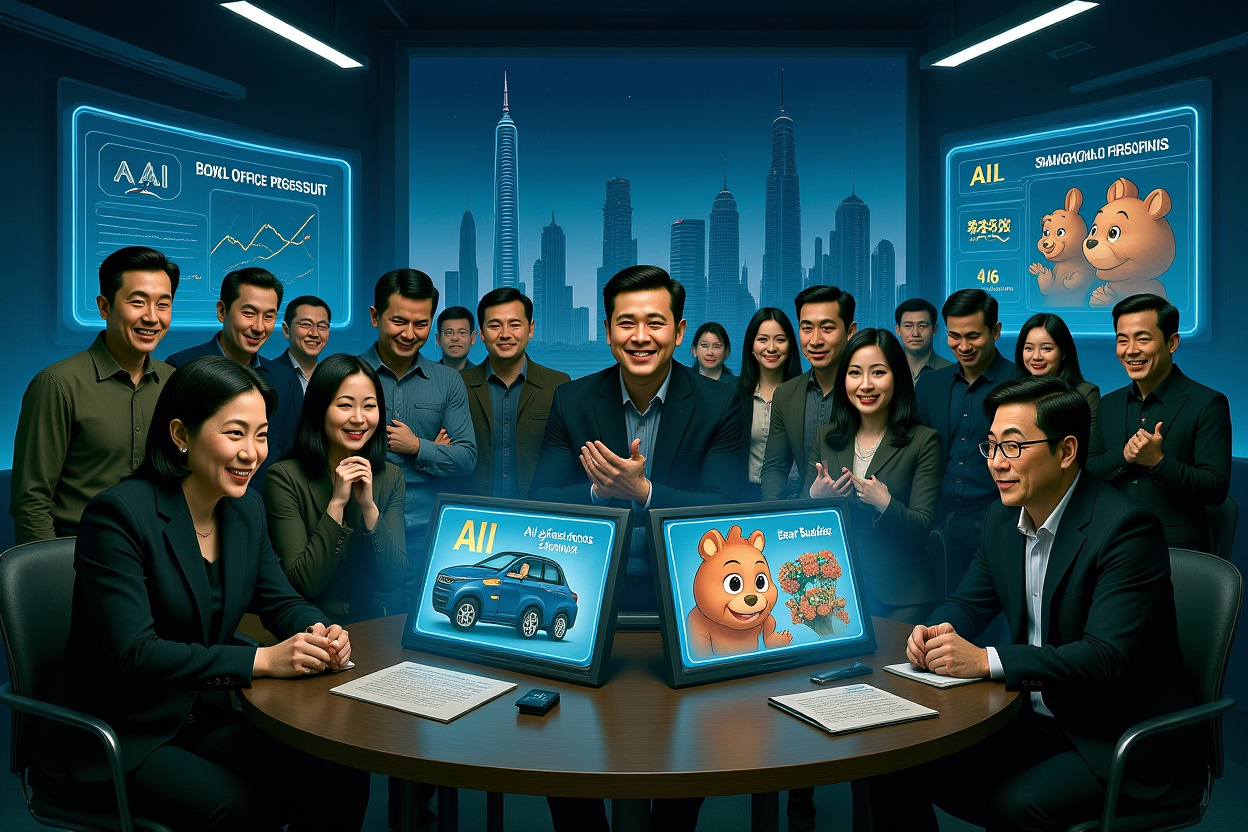
Executive Summary: Key Takeaways from the AI-Driven Film Season
The 2026 Chinese Spring Festival film season has become a battleground for AI innovation, with profound implications for the entertainment sector and related technology stocks. Here are the critical insights:
– AI integration, particularly in special effects and production efficiency, propelled films like Pegasus 3 (飞驰人生3) to box office dominance, with investments exceeding 1.5 billion RMB in AI特效 (AI special effects).
– Technology giants including Alibaba (阿里巴巴), ByteDance (字节跳动), and Tencent (腾讯) are aggressively deploying AI models like Alibaba Qianwen (阿里千问) and ByteDance Doubao (字节豆包), reducing film production costs by 70-90% and compressing timelines from weeks to days.
– Despite technological advancements, films with weak narratives, such as Starry River into Dreams (星河入梦), underperformed, underscoring that AI cannot replace compelling storytelling and human creativity.
– Regulatory challenges are emerging, with the National Radio and Television Administration (国家广播电视总局) cracking down on copyright infringements from “AI modifications” (AI魔改), highlighting ethical and legal risks in AI-powered content creation.
– This Spring Festival AI film revolution marks a strategic pivot for tech firms in the B2B market, offering new investment avenues in Chinese equities tied to media, technology, and intellectual property.
The Invisible Winners: AI as Co-Director in China’s Box Office Race
The 2026 Spring Festival season featured eight films, the highest number in five years, but the competition extended beyond star power to algorithmic prowess. This Spring Festival AI film revolution has created a new class of winners: production houses and service providers that leveraged AI for cost savings and enhanced quality.
According to Maoyan Professional Edition (猫眼专业版) data, the total box office (including pre-sales) surpassed 36 billion RMB by February 20, with Pegasus 3, Silent Awakening (惊蛰无声), and Bear Buddies: Year of the Bear (熊出没·年年有熊) leading the charts. These successes demonstrate that AI is no longer a novelty but a core component of commercial filmmaking in China.
Box Office Leaders and Their AI Edge
Pegasus 3, the top-grossing film with nearly 1.8 billion RMB, utilized a dedicated 150 million RMB AI fund to simulate car crashes with microsecond accuracy. By machine-learning millions of real accident datasets, the film achieved unprecedented visual realism, a key factor in its appeal. Similarly, Enlight Media (光线传媒) reported that AI rendering engines slashed production time for animated scenes from weeks to 72 hours, optimizing budgets and accelerating release schedules.
Other films carved niches with targeted AI applications. Silent Awakening incorporated AI face-swapping (AI换脸) and quantum communication themes, grossing over 560 million RMB and spotlighting AI script optimization teams. Bear Buddies: Year of the Bear used AI to refine animation rendering and facial expressions, helping the franchise reach the top five in Chinese series film history. Meanwhile, Dart Man: Wind in the Desert (镖人:风起大漠) adopted a “AI为辅、内容为王” (AI as supplement, content as king) approach, using AI only for post-production editing, which preserved authentic stunts and garnered positive word-of-mouth.
The Backend Revolution: AI in Production and Marketing
Behind the scenes, AI is driving an industrial overhaul. ByteDance’s Seedance 2.0 model, as noted in its technical whitepaper, reduced the cost of a 2-minute sci-fi short from tens of thousands of RMB to just 330.6 RMB. Chinese Online (中文在线) reported that AI slashed short drama costs by 70-90%, with production cycles shrinking to days and viewership exceeding 500 million.
In marketing, AI enables hyper-targeted campaigns. Instead of broad promotions, studios now use AI to generate tailored trailers—cyberpunk styles for younger audiences,温情向 (warm-hearted) versions for families. Caixin Securities (财信证券) research indicates this model provided low-cost, high-conversion marketing support for films like Pegasus 3, enhancing box office predictability.
When AI Falls Short: The Limitations of Technology in Storytelling
While AI fueled successes, it also exposed vulnerabilities. The Spring Festival AI film revolution is not a panacea; films that prioritized technical spectacle over substance struggled, revealing that audience engagement hinges on emotional resonance, not just innovation.
Box Office Failures Despite AI Investment
Starry River into Dreams employed AI to craft customizable dream sequences with diverse visual styles, but it became the only holiday release to fail crossing 100 million RMB in three days. Industry analysts attribute this to a hollow plot that AI could not salvage. Similarly, some films suffered from stiff AI face-swaps or lifeless渲染 (rendering), losing the “human touch” that connects with viewers.
This underscores a critical lesson: AI can attract viewers through精准推送 (precision推送), but retention depends on quality content. As one producer noted, “AI tools from Alibaba Qianwen or ByteDance Doubao drive traffic, but without a good story, that traffic evaporates.” Films like Pegasus 3 and Dart Man: Wind in the Desert succeeded by using AI to enhance, not replace, their core narratives.
The Irreplaceable Human Element in Creative Industries
AI currently lacks the intuition for emotional depth and narrative innovation. In the Spring Festival AI film revolution, the most praised aspects—character development, thematic depth—remained human-driven. This highlights a bifurcation: AI excels in efficiency and scale, but human creativity defines artistic value. For investors, this means backing companies that balance technological adoption with content excellence, as pure tech plays may face audience backlash.
Regulatory and Ethical Challenges in the AI Cinema Era
The rapid adoption of AI in film has sparked copyright and ethical concerns, prompting government intervention. These issues could impact market stability and investment risks in Chinese technology and media stocks.
Copyright Issues and “AI Modifications”
In early 2026, “AI modifications” videos proliferated, using AI to alter classic films with低俗 (vulgar) or distorted content, eroding cultural integrity. Some creators employed AI to “一键洗稿” (one-click plagiarize) popular short dramas, generating high-similarity content for profit. This poses legal risks, including violations of肖像权 (portrait rights) and改编权 (adaptation rights), potentially leading to lawsuits that could affect company valuations.
Government Crackdowns and Industry Standards
The National Radio and Television Administration (国家广播电视总局) has launched专项治理行动 (special governance actions) to clean up违规内容 (non-compliant content). This regulatory scrutiny signals a tightening environment for AI applications in media. For instance, unauthorized use of明星形象 (celebrity images) via AI could result in fines or content bans, affecting production timelines and revenue. Investors should monitor these developments, as they may influence the risk profiles of firms heavily invested in AI content generation.
The Bigger Battle: Tech Giants’ Strategic Moves in the B2B Market
This Spring Festival AI film revolution is not just about films; it’s a proxy war among technology behemoths for dominance in the business-to-business sector. Their investments are reshaping supply chains and creating new opportunities for institutional investors.
Investments from Alibaba, ByteDance, and Tencent
Alibaba (阿里巴巴) has integrated its Qianwen model into film marketing and scenario planning, while ByteDance (字节跳动) leverages Seedance for production efficiency. Tencent (腾讯) is also rolling out flagship AI models, offering 3 billion RMB in user incentives to capture market mindshare. These moves are part of a broader strategy to monetize AI tools in entertainment, with potential spillovers into gaming, advertising, and virtual reality.
For film companies, AI adoption has shifted from optional to essential, altering cost structures and creating dependencies. Short-term, this boosts box office certainty for top films; long-term, it may concentrate power among tech-savvy studios, potentially marginalizing smaller players without access to advanced AI.
Long-term Implications for the Film Industry and Investors
The Spring Festival AI film revolution signals a maturation of China’s film industry, where technology drives scalability. However, as AI tools become ubiquitous, competitive advantage will increasingly hinge on unique content. This presents a dual opportunity: investing in AI infrastructure providers like rendering service firms, and in content creators with strong intellectual property. For global investors, Chinese equities in the technology and media sectors offer exposure to this transformative trend, but due diligence on content quality and regulatory compliance is crucial.
Synthesizing the AI-Driven Film Landscape
The 2026 Spring Festival season has demonstrated that AI is a powerful enabler but not a silver bullet. Films that merged AI with compelling narratives, like Pegasus 3, reaped financial rewards, while those over-relying on technology faltered. The involvement of giants like Alibaba and ByteDance underscores AI’s strategic role in China’s digital economy, with implications for cost reduction, market expansion, and innovation.
Looking ahead, the Spring Festival AI film revolution will likely accelerate, with AI penetrating scriptwriting, distribution, and even real-time audience analytics. However, challenges around ethics, copyright, and content homogenization require careful navigation. For business professionals and investors, this evolution offers actionable insights: prioritize companies with balanced AI-content strategies, monitor regulatory shifts from bodies like the National Radio and Television Administration, and consider the long-term value of storytelling in an automated world. As the market evolves, those who adapt to both technological and creative demands will lead the next wave of growth in Chinese cinema and beyond.