



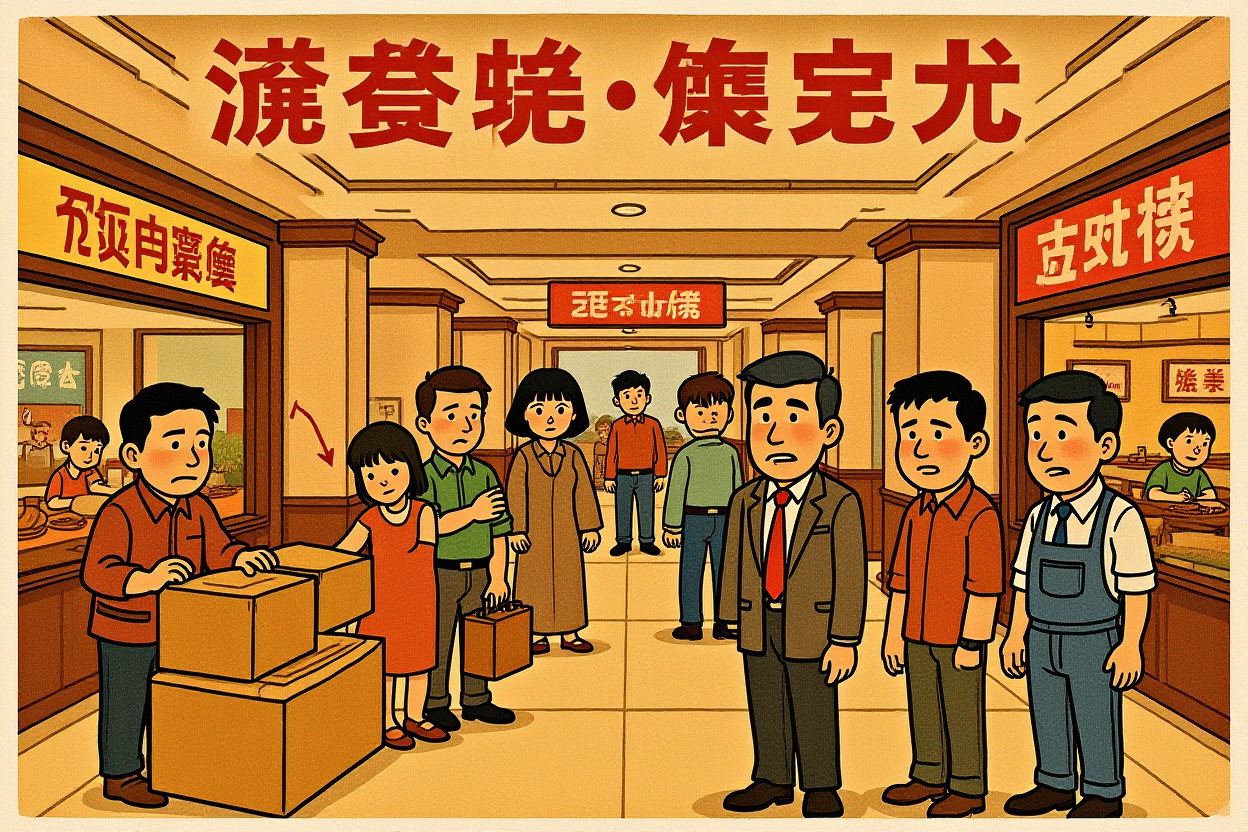
Executive Summary
This article delves into the accelerating trend of restaurant closures and relocations from Chinese shopping malls, a phenomenon driven by structural shifts in consumer behavior and commercial real estate. Key takeaways include:
– Over one-third of Chinese malls are experiencing net store closures, with footfall declining by up to 40% year-over-year in some regions, signaling a peak in mall traffic and rising vacancy rates.
– Restaurant operators face a brutal cost-benefit squeeze as rents remain high despite falling customer numbers, forcing many small to mid-sized brands to exit malls, especially in tier-1 and tier-2 cities.
– Industry experts, such as Shou Wenbin (寿文彬), founder of Zhisheng Catering Brand Strategy Consulting, predict that this mall exodus and value system reshuffle will persist for at least two more years before stabilizing.
– Opportunities exist in basement-level mall spaces (B1/B2 floors) and lower-tier cities, where rents are lower, competition is less intense, and consumer purchasing power is growing.
– This trend reflects broader challenges in China’s commercial real estate sector, with implications for equity investors in retail, hospitality, and property development stocks on exchanges like the Shanghai and Shenzhen Stock Exchanges.
The Accelerating Flight: Why Restaurants Are Abandoning Malls En Masse
The once-thriving symbiosis between shopping malls and餐饮店 (catering outlets) in China is unraveling at a rapid pace. From成都 (Chengdu) to青岛 (Qingdao), eateries are shuttering their mall locations, driven by a perfect storm of declining profitability and shifting consumer preferences. This mall exodus and value system reshuffle is not a fleeting blip but a structural recalibration that could redefine the landscape for years to come. For international investors monitoring Chinese equities, understanding this trend is crucial, as it impacts sectors from consumer discretionary to real estate investment trusts (REITs).
Take the case of Xiao Zhao (小昭), a火锅店 (hot pot restaurant) owner in Chengdu’s Damofang mall. After investing nearly 3 million yuan, he was forced to close after 18 months of sustained losses due to low foot traffic. Similarly, Pei Li (裴丽), who ran a儿童餐厅 (children’s restaurant) in Heilongjiang’s凯德广场 (CapitaLand Mall), relocated to a nearby商业街 (commercial street) after failed negotiations for a second location, citing dwindling mall popularity. These stories are emblematic of a broader wave, with brands like银棠·新中餐 (Yintang · New Chinese Cuisine) in Qingdao and宽炉烤肉 (Kuanlu Barbecue) in西安 (Xi’an) withdrawing from multiple mall sites. The underlying drivers point to a systemic mall exodus and value system reshuffle that demands closer examination.
Plummeting Footfall and Stubborn Rents: The Unsustainable Equation
Data from the 2022-2024购物中心开关店研究报告 (2022-2024 Shopping Center Switch Store Research Report) reveals that 34.9% of malls had more store closures than openings in 2024, indicating that over a third are becoming emptier. This trend is exacerbated by a saturation of retail space; according to the 2025中国商业地产市场年报 (2025 China Commercial Real Estate Market Annual Report), there are nearly 6,900购物中心 (shopping centers) over 30,000 square meters nationwide. With malls proliferating—where once one mall served a 3-kilometer radius, now three might compete—foot traffic is diluted, severely impacting restaurant客流 (customer flow). For instance,湖南 (Hunan) province reported a 40% year-over-year drop in mall footfall by late 2024, with餐饮门店闭店率 (restaurant closure rates) exceeding 30%.
Compounding this, mall rents have not adjusted proportionally. China’s real estate index system data shows that in 2024, the average rent for百MALL商铺 (top-tier mall shops) was over 27 yuan per square meter per day, a mere 0.06% decrease from the previous year. This rigidity makes the math untenable for restaurateurs. As one owner in上海白玉兰广场 (Shanghai Magnolia Plaza) calculated, covering 220,000 yuan in annual rent requires daily revenue of 12,200 yuan—a tall order with fewer customers. This mismatch underscores why the mall exodus and value system reshuffle is intensifying, as operators seek more viable locations.
Architectural Obsolescence and Homogeneous Offerings
Many Chinese malls, built during the 1990s boom, suffer from outdated designs that fail to captivate modern consumers. Traditional layouts—with美妆 (cosmetics) on the first floor,服装 (apparel) on middle levels, and餐饮 (dining) relegated to upper floors—hinder synergy between dining and entertainment, reducing overall appeal. Moreover,招商 (tenant recruitment) often leads to homogenization, with malls featuring identical brands like海底捞 (Haidilao) or西塔老太太 (Xita Old Lady), creating a repetitive experience that drives customers away. A资深商业地产相关人士 (veteran commercial real estate insider) notes that this triggers a恶性循环 (vicious cycle):空铺 (vacant stores) increase, malls lower entry barriers to fill space, attracting unsuitable tenants that further degrade the experience and accelerate the mall exodus and value system reshuffle.
The Brutal Reshuffle: Market Forces and Expert Projections
This turmoil is more than a temporary downturn; it represents a fundamental reevaluation of how餐饮店 (catering outlets) and商场 (malls) interact. Shou Wenbin (寿文彬), of智胜餐饮品牌战略咨询 (Zhisheng Catering Brand Strategy Consulting), argues that mall流量 (traffic) has peaked, leaving中小餐饮商家 (small and medium-sized餐饮 businesses) with little bargaining power. He forecasts at least two more years of hardship before any recovery, emphasizing that this period will involve a painful mall exodus and value system reshuffle. For equity market participants, this signals potential volatility in stocks tied to mall operators and restaurant chains, necessitating a reassessment of growth narratives in earnings reports.
The dynamics mirror earlier shifts in街边商铺 (street-side shops), where high rents collapsed after malls diverted客流 (customer flow). Now, malls themselves face a similar reckoning. As寿文彬 (Shou Wenbin) explains, “没有人流就会被迫降价,这是市场供需决定的 (Without foot traffic, prices are forced down, determined by market supply and demand).” This value system reshuffle is evident in cities like广州 (Guangzhou) and深圳 (Shenzhen), where mall餐饮店 (dining outlets) are struggling as consumers seek novelty elsewhere. Investors should monitor how companies like华润万象生活 (China Resources Mixc Lifestyle) or万达商业 (Wanda Commercial) adapt their portfolios to these pressures.
Case Studies: The Human Cost of the Exodus
Real-world examples highlight the severity of this reshuffle. In成都大魔方 (Chengdu Damofang), planned tenants like烤匠 (Kaorong) withdrew after seeing predecessors like老孙家羊肉泡馍 (Lao Sunjia Lamb Paomo) exit, deterring others like Guo Chen (郭晨) from opening. This cascade effect fuels空置率 (vacancy rates), with malls reluctant to cut rents due to operational fixed costs. For餐饮老板 (restaurant owners), the decision to leave often comes after months of亏损 (losses), as seen with银棠·新中餐 (Yintang · New Chinese Cuisine), which closed three mall locations in青岛崂山金狮广场 (Qingdao Laoshan Golden Lion Plaza) and other sites. These stories reinforce that the mall exodus and value system reshuffle is a data-driven reality, not mere anecdote.
Navigating the Crisis: Strategic Opportunities Amidst the Chaos
While the outlook seems bleak, savvy operators are identifying pockets of opportunity within this mall exodus and value system reshuffle. The key lies in “下沉 (sinking down)”—both literally and figuratively—to more sustainable models. For investors, this could mean targeting firms that pivot effectively, potentially yielding gains in a turbulent market.
Basement-Level Revitalization: The B1/B2 Floor Phenomenon
Increasingly,餐饮品牌 (catering brands) are moving to basement levels (B1/B2) of malls, where rents are 65-80% lower than upper floors, according to戴德梁行 (Cushman & Wakefield) data. Brands like烤匠 (Kaorong) in北京合生汇 (Beijing Hopson One) and祐禾 (Youhe) in朝阳合生汇 (Chaoyang Hopson One) have leveraged these spaces for higher foot traffic, often linked to地铁 (subway) stations. This creates a “通勤-就餐-购物 (commute-dine-shop)”闭环 (closed loop), enhancing customer触点 (touchpoints). For instance,海底捞 (Haidilao) has opened new outlets in mall basements, tapping into steady commuter flows. This strategic下沉 (sinking) mitigates rent burdens while accessing reliable客流 (traffic), illustrating a tactical adaptation in the value system reshuffle.
Expansion into Lower-Tier Cities: The Untapped Frontier
Another avenue is geographical下沉 (sinking) into县城 (county-level cities) and下沉市场 (lower-tier markets), where商场 (malls) remain稀缺资源 (scarce resources). In江苏东台吾悦广场 (Jiangsu Dongtai Wuyue Plaza),日均客流量 (average daily footfall) hit 60,000 during holiday peaks, with brands like麦当劳 (McDonald’s) and霸王茶姬 (Bawang Chaji) thriving. Similarly,江苏启东 (Jiangsu Qidong) malls saw茶饮店 (beverage shops) like古茗 (Guming) queueing hundreds of customers daily. These markets boast growing购买力 (purchasing power) and less competition, offering a time window for expansion. As连锁餐饮品牌 (chain restaurant brands) like西塔老太太 (Xita Old Lady) venture here, they benefit from标准化 (standardized) mall environments, driving a双向奔赴 (mutual奔赴) between developers and operators. This shift is critical for equity investors eyeing growth in consumer stocks beyond megacities.
Regulatory and Economic Implications for Chinese Equity Markets
This mall exodus and value system reshuffle does not occur in a vacuum; it intersects with broader economic trends and regulatory frameworks that shape investment decisions. For professionals tracking the上海证券交易所 (Shanghai Stock Exchange) and深圳证券交易所 (Shenzhen Stock Exchange), understanding these linkages is vital for portfolio management.
Commercial Real Estate Dynamics and Policy Responses
The struggles of mall operators reflect challenges in China’s商业地产 (commercial real estate) sector, which has seen oversupply and slowing demand post-pandemic. Regulatory bodies like the中国人民银行 (People’s Bank of China) and国家发改委 (National Development and Reform Commission) have implemented measures to stabilize property markets, but malls face unique pressures from e-commerce and experiential消费 (consumption) shifts. Data from中国房地产指数系统 (China Real Estate Index System) indicates minimal rent declines, suggesting that market corrections are overdue. Investors should watch for policy signals that could affect REITs or mall-backed securities, as this reshuffle may trigger write-downs or restructuring in companies like凯德集团 (CapitaLand Group) or华润置地 (China Resources Land).
Impact on Restaurant and Retail Equities
Publicly traded餐饮企业 (catering enterprises), such as海底捞国际控股 (Haidilao International Holding) or九毛九 (Jiumaojiu), may face margin pressures from mall closures, but could also gain from cost-saving moves to basement spaces or下沉市场 (lower-tier markets). Similarly, mall operators like新城控股 (Seazen Holdings) might see stock volatility if vacancy rates rise. Analysts should scrutinize quarterly reports for disclosures on store networks and rental income, as the mall exodus and value system reshuffle could influence earnings projections. For example, if brands like宽炉烤肉 (Kuanlu Barbecue) shift to street locations, it might signal a broader de-risking from mall依赖 (dependence), affecting sector valuations.
Strategic Takeaways for Global Investors and Industry Stakeholders
As the mall exodus and value system reshuffle unfolds, stakeholders must adapt to survive and thrive. This requires a nuanced approach, blending on-ground insights with macro-economic analysis.
For Restaurant Chains and Private Equity Backers
Operators should prioritize unit economics over expansion, focusing on locations with proven foot traffic and reasonable rents. Diversifying into外卖 (delivery) or hybrid models can offset mall risks. Investors in私募股权 (private equity) funds targeting Chinese F&B should assess management teams’ agility in navigating this reshuffle, favoring those with robust下沉市场 (lower-tier market) strategies. Quotes from experts like寿文彬 (Shou Wenbin) underscore the need for patience: “未来2年左右,商场餐饮店的生存状况依旧艰难 (For the next two years or so, the survival of mall餐饮店 will remain difficult).” This timeline suggests that near-term investments should be cautious, with a focus on long-term value reconstruction.
For Mall Developers and Real Estate Investors
Mall operators must innovate beyond traditional layouts, perhaps integrating娱乐业态 (entertainment formats) with dining to enhance体验价值 (experience value). Reducing reliance on rigid rental models and offering revenue-sharing agreements could attract tenants. For real estate investors, due diligence should include vacancy trends and tenant diversification in mall portfolios. The ongoing reshuffle may present buying opportunities in distressed assets, but only for those with expertise in repositioning properties. Monitoring reports from戴德梁行 (Cushman & Wakefield) or仲量联行 (JLL) can provide data-driven insights into these shifts.
Synthesis and Forward-Looking Guidance
The mass departure of restaurants from Chinese malls is a symptom of deeper structural changes, encapsulating a mall exodus and value system reshuffle that will likely persist for two more years. Key drivers—declining footfall, high rents, and homogeneous offerings—are forcing a recalibration across the餐饮 (catering) and商业地产 (commercial real estate) sectors. However, opportunities exist in basement-level spaces and lower-tier cities, where demand outpaces supply. For international investors, this trend highlights the importance of granular market analysis in Chinese equities, particularly in consumer and real estate segments. As the reshuffle progresses, stakeholders who embrace flexibility and innovation will be best positioned to capitalize on the eventual recovery. To stay ahead, subscribe to our insights on Yuan Trends for ongoing coverage of China’s dynamic capital markets, and consider consulting with experts to tailor your investment strategy to these evolving dynamics.