



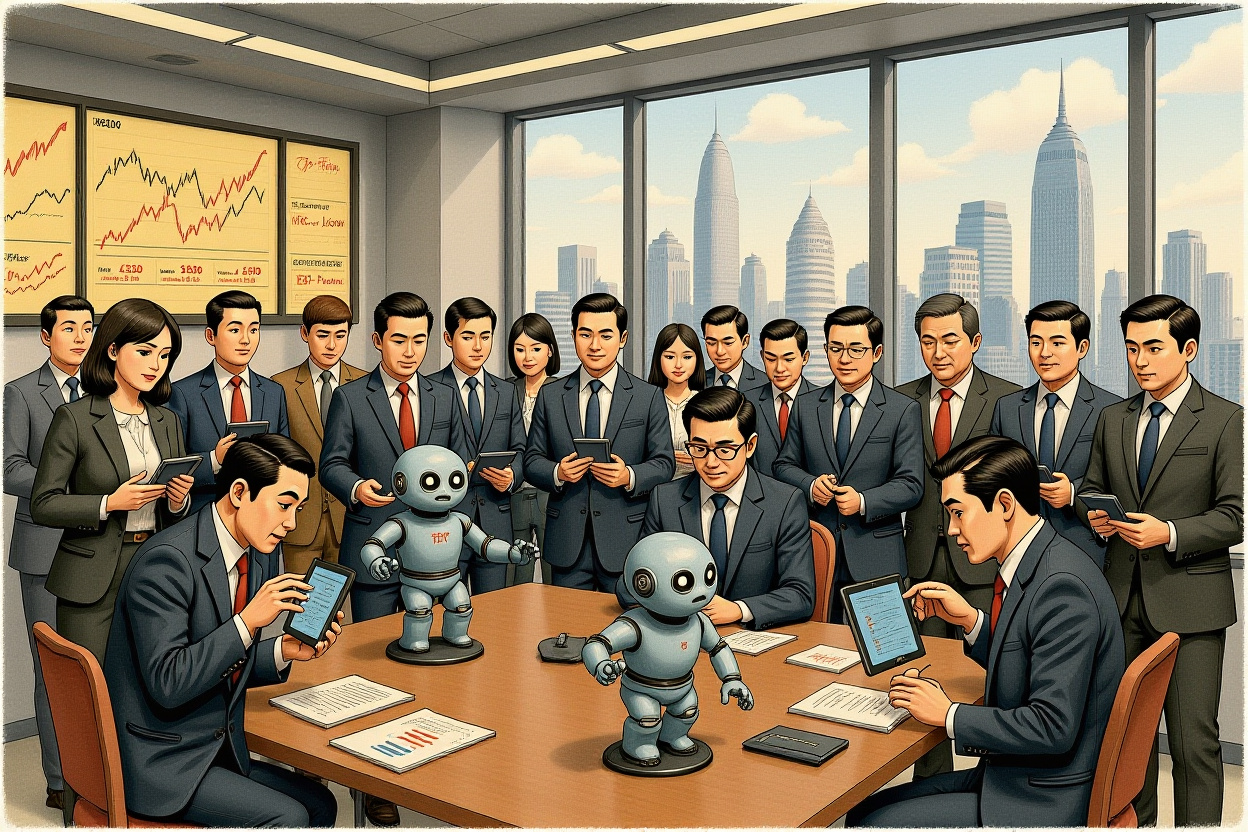
The spectacle of China’s annual Spring Festival Gala (春晚), a cultural institution watched by hundreds of millions, has often mirrored the nation’s technological aspirations. This year, the broadcast transcended mere entertainment, evolving into a powerful, real-time showcase for the country’s humanoid robotics industry. Dubbed the ‘Mechanical Spring Festival Gala’ by viewers and analysts alike, the four-hour extravaganza featured robots performing martial arts, interacting in comedy skits, and dancing in synchronized formations. For global investors monitoring Chinese equities, this was far more than a technological display; it was a potent symbol of commercial viability and a catalyst for a distinct pre-holiday capital rotation. While festive cheer filled the air, sophisticated money was making deliberate moves, shifting from broad artificial intelligence themes toward the tangible, hardware-focused promise of robotics, as evidenced by significant inflows into dedicated exchange-traded funds (ETFs). This convergence of mass-media spectacle and institutional capital flows offers a compelling case study on narrative-driven investment trends within China’s dynamic markets.
Executive Summary: Key Market Takeaways
- The 2024 Spring Festival Gala’s extensive use of humanoid robots served as a mass-market validation event, boosting investor confidence in the sector’s near-term visibility and commercial potential.
- In the week preceding the Lunar New Year holiday, robotics-themed ETFs absorbed approximately ¥2.58 billion ($358 million) in net inflows, highlighting a targeted move by capital.
- This inflow contrasted with net outflows from broader AI-themed ETFs during the same period, suggesting a strategic rotation within the technology sector toward more concrete, industrial applications.
- Major brokerages, including 国元证券 (Guoyuan Securities) and 西南证券 (Southwest Securities), published notes directly linking the Gala’s display to accelerated industry maturation, framing 2026 as a potential inflection point for scaled applications.
- Investors are advised to differentiate between short-term sentiment driven by the ‘Mechanical Spring Festival Gala’ effect and long-term value based on supply chain capabilities, order visibility, and sustainable cost reduction pathways.
The Stage Is Set: A ‘Mechanical Spring Festival Gala’ Unveils Robot Readiness
The Lunar New Year’s Eve broadcast has long been a coveted platform for demonstrating national progress. This year, the narrative was unequivocally robotic. Unlike previous years where robots made cursory appearances, the 2024 Gala integrated them fundamentally into its artistic core. Humanoid robots from companies like 宇树科技 (Unitree Robotics), 银河通用, and 松延动力 were not passive props but active participants in complex choreography and interactive performances. This shift from ‘walk-on’ roles to central stage players sent a clear signal about the advancing mobility, dexterity, and software integration of these machines.
The immediate reaction on Chinese social media was a blend of awe and wry financial commentary. Users joked about watching a ‘documentary on the rotation of the humanoid robot sector’ and speculated whether Gala producers had invested in robotics stocks. One common sentiment, paraphrased across platforms, was relief: “Investors who bought robot stocks before the holiday can finally breathe a sigh of relief.” This public sentiment underscores how deeply market narratives are intertwined with public cultural events in China. The ‘Mechanical Spring Festival Gala’ provided a vivid, emotionally resonant proof-of-concept that research reports alone could not match.
From Narrative to Capital: Pre-Holiday ETF Flows Tell the Story
While the Gala aired on February 18th, the smart money had already begun positioning itself. Analysis of fund flows in the final trading week before the holiday (February 9-13) reveals a decisive move. According to Wind data, the 13 ETFs in the market with direct exposure to the robotics theme collectively saw net inflows of approximately ¥2.577 billion. This trend was not marginal; it was led by industry giants.
- 华夏中证机器人ETF (ChinaAMC CSI Robotics ETF): Led the pack with a single-week net inflow of ¥1.433 billion.
- 易方达国证机器人产业ETF (E Fund CNI Robotics Industry ETF): Attracted ¥662 million in new capital.
- 天弘中证机器人ETF (TH CSI Robotics ETF) & 景顺长城国证机器人产业ETF (Invesco Great Wall CNI Robotics Industry ETF): Both also secured inflows exceeding ¥100 million each.
Extending the timeline to the entire month of February up to the holiday further solidifies the trend. The ChinaAMC CSI Robotics ETF grew by ¥1.667 billion, bringing its total scale to around ¥26.72 billion, while the E Fund ETF expanded by ¥1.122 billion to ¥17.81 billion. This accumulation in the face of a general pre-holiday market lull—where many investors typically cash out—speaks to a strong, conviction-driven bid for robotics exposure.
The Great AI Rotation: Capital Migrates from Concept to Implementation
The most telling aspect of the pre-Gala capital movement was its selectivity. While robotics ETFs were gathering inflows, a concurrent net outflow of about ¥600 million was observed from broader, more generalized artificial intelligence-themed ETFs. Products managed by major firms like 富国 (Fullgoal), 博时 (Bosera), 华宝 (Hwabao), and 广发 (GF Fund) all recorded outflows. This divergence within the technology super-cycle is critical for investors to understand.
It signals a market moving from pricing vast, foundational AI potential toward rewarding specific, tangible applications with visible roadmaps. As one public fund equity investor quipped, their social media feeds before the holiday were filled not just with festive greetings but with debates on humanoid robot allocations. The core question was: “Is this wave about promotional hype, or a reaffirmation of a long-term industrial trend?” The ETF flow data suggests a growing cohort of institutional investors leaning toward the latter interpretation, using the ‘Mechanical Spring Festival Gala’ as a confirmation signal to reallocate within the tech stack.
A Fund Manager’s Perspective: Beyond the Hype
To attribute the flows solely to Gala excitement would be an oversimplification. A public fund manager specializing in technology manufacturing provided deeper context. “We moderately increased robotics-related positions before the holiday, but not simply because ‘they were going to be on the Gala,'” the manager explained. “It was a decision based on industrial rhythm and relative valuation. Since the start of the year, some AI infrastructure plays had seen significant gains, partially pricing in near-term expectations. Meanwhile, certain segments within the robotics chain are accelerating in terms of orders and technical progress, yet their stock prices remain in a relative catch-up phase. The Gala simply provided a very intuitive symbol—it gave a vivid picture to a story previously confined to research reports.” This view frames the ‘Mechanical Spring Festival Gala’ as a catalyst that amplified an existing, fundamentals-based re-rating thesis.
Wall Street’s Take: How Brokerages Framed the ‘Mechanical Spring Festival Gala’
The investment thesis was actively constructed in the weeks leading up to the event. Major Chinese brokerages published a flurry of research notes in January and early February focusing on the humanoid robot industry, setting the stage for the Gala’s impact. Their post-Gala analyses directly connected the spectacle to investment logic.
国元证券 (Guoyuan Securities) was particularly direct, stating in a report that “2026 is likely to become the year of humanoid robot application.” They argued that the robots’ return to the Gala was not merely a publicity stunt but an external manifestation of improved product design and application maturity. The real beneficiaries, they noted, would be companies capable of achieving scalable mass production and continuous cost reduction along the supply chain.
西南证券 (Southwest Securities) focused on the thematic significance, writing that the Gala represented an upgrade of “technology + art,” integrating “intelligent tech manufacturing” into stage design and content creation to enrich the cultural experience. They framed it as a demonstration of China’s advancing technological prowess.
华金证券 (Huajin Securities) took a more stock-specific approach. They postulated that repeated appearances on a stage as prominent as the Spring Festival Gala would gradually increase public exposure and accelerate commercial development. Noting the technological commonality between many humanoid robot components and the automotive industry, they recommended attention on automakers like 小鹏汽车 (XPeng), 小米集团 (Xiaomi, which is launching its own robot), 赛力斯 (Seres), and 长安汽车 (Changan Automobile), which possess both the ‘brain’ (software/AI) and hardware iteration capabilities.
A Note of Caution: Navigating the Sentiment Cycle
Amid the optimism, measured voices urged perspective. Technology sectors are notoriously prone to hype cycles, where narratives can inflate expectations beyond near-term deliverability. A sell-side analyst specializing in TMT (Technology, Media, Telecom) offered a sobering view: “The valuation of some companies in the robotics industry chain is already at a relatively high historical percentile. The sentiment premium brought by the Gala, if combined with post-holiday short-term capital flows, could amplify volatility after the initial positive news is digested.” The analyst emphasized that for investors with a long-term horizon, patience for concrete industrial data is more valuable than chasing the peak of narrative noise. This caution highlights the dual nature of events like the ‘Mechanical Spring Festival Gala’—they are powerful accelerants, but the underlying investment thesis must stand on its own beyond the spotlight.
Strategic Implications for Global Investors in Chinese Equities
The phenomenon surrounding this ‘Mechanical Spring Festival Gala’ offers several critical lessons for international fund managers and institutional investors. First, it underscores the unique role of state-media spectacles in validating and accelerating technology adoption narratives in China, creating investable momentum. Second, the ETF flow data provides a clear, quantifiable signal of how domestic institutional capital is positioning itself within the tech landscape, favoring robotics as a distinct and prioritized sub-theme.
For investors looking to participate, a nuanced approach is required. The sheer breadth of the robotics chain—from core components like reducers and servo motors to sensors, actuators, and AI operating systems—means stock-picking is crucial. The brokerages’ focus on companies with automotive industry overlap, such as 汇川技术 (Inovance Tech) for servo systems or 绿的谐波 (Leader Harmonious Drive) for reducers, points to a pragmatic search for firms with proven manufacturing scale and cost discipline.
Beyond the Event: Monitoring the Follow-Through
The true test of this investment theme will unfold in the quarters following the ‘Mechanical Spring Festival Gala’. Key indicators to watch include quarterly order books for robotics component suppliers, policy developments from ministries like the Ministry of Industry and Information Technology (MIIT) regarding industry support, and progress reports from leading integrators like 优必选 (Ubtech) and the aforementioned Gala participants. The market will shift from valuing potential to valuing contracts, margins, and shipment volumes. The Gala’s role was to compress the market education timeline; now, companies must deliver on the promise it broadcast to the world.
The convergence of a cultural milestone like the Spring Festival Gala with precise capital market movements is a hallmark of China’s modern financial ecosystem. The ‘Mechanical Spring Festival Gala’ was more than a show; it was a macroeconomic signal dressed as entertainment. It catalyzed a discernible rotation of capital from the ethereal promise of general AI toward the grounded, mechanical promise of robots—a sector where China’s manufacturing muscle and policy support converge. For global investors, the event serves as a powerful reminder to watch not just economic data and policy documents, but also the symbols and stories that capture the national imagination. The immediate takeaway is clear: a significant segment of the market has voted with its capital, betting that the robots dancing on stage are precursors to those soon working in factories, warehouses, and homes. The prudent investor’s task now is to scrutinize the supply chain behind the spectacle, separating the companies building a sustainable future from those merely enjoying a moment in the limelight.