



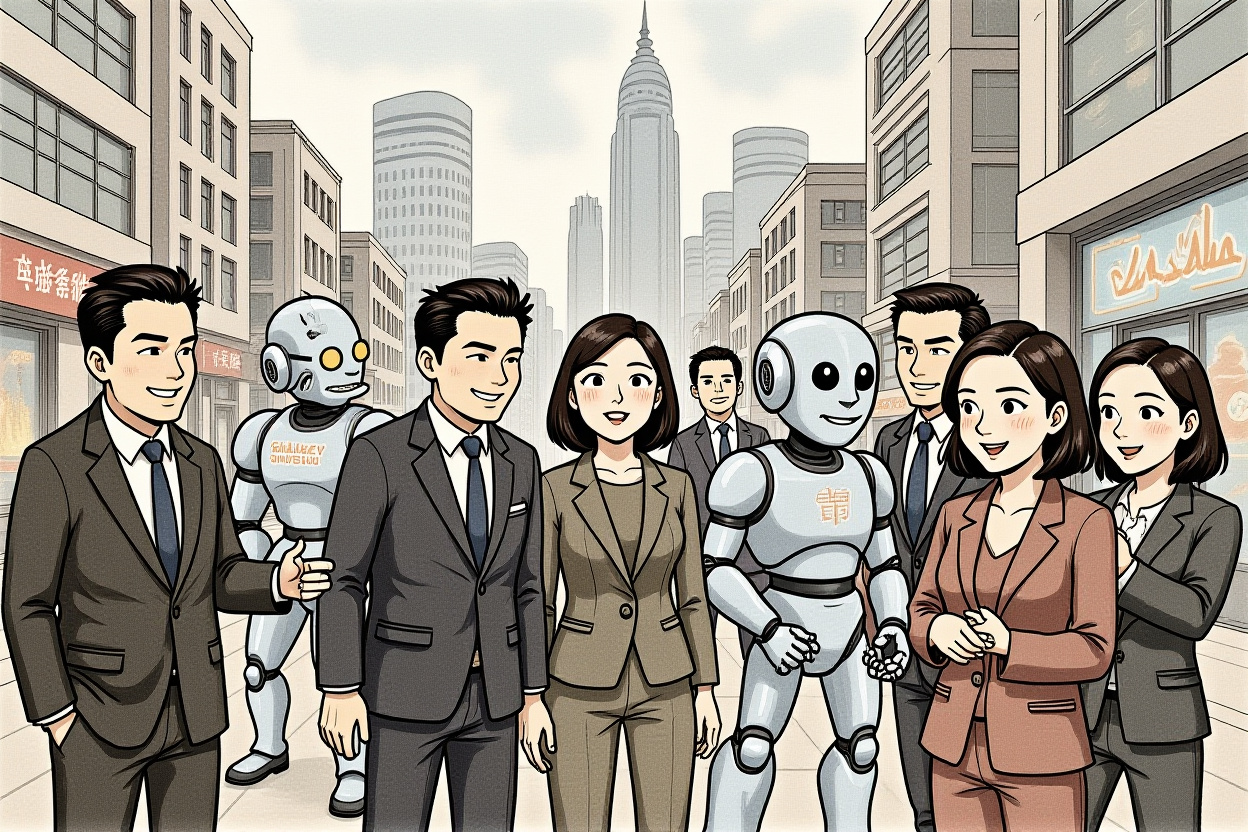
Executive Summary: Key Takeaways from the Gala Showcase
– The 2026 CCTV Spring Festival Gala featured four leading embodied AI companies—Magic Atom (魔法原子), Galaxy Universal (银河通用), Yushu Technology (宇树科技), and Songyan Power (松延动力)—in a coordinated display, marking the industry’s debut on a national stage.
– This event underscores a critical transition for embodied AI, moving from laboratory demonstrations and viral performances toward practical applications in industrial, commercial, and domestic settings.
– According to IDC projections, China’s embodied AI robot user spending is forecast to reach $770 billion by 2030, with a compound annual growth rate of 94%, highlighting immense market potential.
– Post-Gala, the sector faces three core challenges: ensuring reliability in structured factory environments, adapting to dynamic commercial spaces, and achieving safety and affordability for home use.
– 2026 is emerging as an inflection point, where success metrics shift from fundraising and media hype to tangible customer orders, scalable revenue models, and ecosystem integration.
The Spring Festival Gala: A Premier Stage for Embodied AI
The CCTV Spring Festival Gala has long served as a barometer for technological trends in China, capturing the attention of millions. In 2026, this cultural phenomenon transformed into the ultimate proving ground for embodied AI, where humanoid robots took center stage not merely as novelties but as heralds of a new industrial era. This showcase represents a strategic move to normalize robotics in public consciousness and validate domestic innovation. For investors and industry watchers, the Gala’s role extends beyond entertainment—it is a litmus test for commercial viability and technological maturity in the embodied AI space.
The 2026 Showcase: Four Companies Take Center Stage
At the 2026 Spring Festival Gala, four domestic embodied AI firms made their collective debut, each contributing to segments that highlighted their capabilities. Yushu Technology (宇树科技), building on its breakout performance in 2025, partnered with the Henan Tagou Martial Arts School for a martial arts routine titled “武 BOT,” demonstrating precision and coordination. Songyan Power (松延动力) appeared in a comedy sketch with actors Cai Ming and Wang Tianfang, showcasing interactive abilities. Magic Atom (魔法原子) supported a musical performance called “智造未来,” while Galaxy Universal (银河通用) featured in a micro-film with celebrities Shen Teng and Ma Li. This coordinated appearance, dubbed a “集团军” or group army deployment, signifies a maturation of the sector, moving from isolated prototypes to a cohesive industry front.
Decoding the Titles: Strategic Positioning Revealed
A subtle yet telling detail from the Gala was the varied official titles assigned to each company. Yushu Technology was termed the “Spring Festival Gala Robot Partner,” Songyan Power the “Spring Festival Gala Humanoid Robot Partner,” Magic Atom the “Spring Festival Gala Intelligent Robot Strategic Partner,” and Galaxy Universal the “Spring Festival Gala Designated Embodied Large Model Robot.” These distinctions reflect deeper strategic divergences in technical pathways, product forms, and market positioning. For instance, Galaxy Universal’s emphasis on “embodied large model” hints at integration with advanced AI algorithms, whereas Yushu Technology’s broader “robot” label may indicate a focus on general-purpose mobility. Understanding these nuances is crucial for stakeholders assessing competitive advantages and investment opportunities in embodied AI.
Beyond the Spotlight: The Real Test for Embodied AI
As the Gala’s lights dim, the embodied AI industry confronts a stark reality: performance on stage does not equate to performance in the real world. The sector must now navigate a series of rigorous challenges to transition from spectacle to substance. This phase is where true differentiation occurs, separating companies poised for growth from those likely to falter. Embodied AI’s journey from concept to commercialization hinges on overcoming practical hurdles that demand robustness, adaptability, and cost-effectiveness.
The Industrial Challenge: Reliability in Factory Settings
The first and most immediate barrier is penetrating industrial environments. Factories represent a lucrative market for embodied AI, with applications in sorting, assembly, loading, inspection, and transportation—areas plagued by labor shortages. However, industrial settings offer no room for error; they require machines that operate with near-perfect reliability, low maintenance costs, and continuous uptime. A robot that stumbles on stage might be forgiven, but a malfunction on a production line can lead to significant financial losses. Companies like Yushu Technology and Songyan Power must demonstrate that their systems can withstand harsh conditions, such as extreme temperatures, dust, and repetitive tasks, without frequent failures. Success here depends on rigorous testing beyond controlled labs, as highlighted by industry reports on robotic reliability in manufacturing (link to relevant studies on industrial automation standards).
The Commercial Hurdle: Adapting to Dynamic Environments
Beyond factories, embodied AI must prove itself in commercial spaces like supermarkets, warehouses, hotels, and hospitals. These settings are inherently unstructured, featuring unpredictable human traffic, obstacles, and varied tasks. Robots need not only to move but to perceive, reason, avoid collisions, and interact meaningfully. For example, a robot that performed a scripted interaction at the Gala may struggle when faced with a sudden crowd surge or a customer’s ambiguous query in a retail store. This demands advanced sensor fusion, real-time decision-making, and natural language processing capabilities. Companies investing in these areas, such as Magic Atom with its focus on interactive performances, must scale their AI models to handle real-world complexity. Case studies from early adopters in logistics, like JD.com’s (京东) warehouse robots, offer insights into the scalability challenges for embodied AI in commerce.
The Road to Commercialization: From Performance to Profitability
The ultimate goal for embodied AI is not just technical prowess but sustainable business models. As the industry moves past the Gala’s hype, the focus shifts to generating real revenue, securing repeat customers, and achieving economies of scale. This requires a multifaceted approach involving product iteration, supply chain optimization, and ecosystem partnerships. Without tangible orders and profit margins, even the most dazzling robotic displays remain financially untenable.
Scaling from Labs to Mass Production
A critical step is transitioning from bespoke prototypes to mass-producible units. The four Gala participants must address manufacturing bottlenecks, such as sourcing components, ensuring quality control, and reducing costs. For instance, humanoid robots often rely on expensive actuators and sensors, which can prohibit widespread adoption. Strategies like modular design, as seen in Yushu Technology’s platforms, and partnerships with electronics manufacturers can help drive down prices. Additionally, software standardization—through open-source frameworks or industry alliances—can accelerate deployment. The China Robotics Industry Alliance (中国机器人产业联盟) has been advocating for such standards to foster interoperability and reduce development overhead.
The Capital and Ecosystem Imperative
Funding remains vital, but the nature of investment is evolving. Previously, embodied AI startups competed for venture capital based on demo reels and technological promises. Post-Gala, investors are increasingly scrutinizing metrics like customer acquisition costs, lifetime value, and path to profitability. Companies must balance R&D expenditures with revenue-generating projects, perhaps through pilot programs with industrial clients or government-backed initiatives. Moreover, building a robust ecosystem—encompassing developers, integrators, and service providers—is essential for creating sticky solutions. Galaxy Universal’s emphasis on large models could attract software partners, while Songyan Power’s focus on humanoid forms might align with entertainment and education sectors. The role of government policies, such as those from the Ministry of Industry and Information Technology (工业和信息化部), in providing subsidies or procurement opportunities cannot be overlooked.
Market Projections and the Global Context
The embodied AI sector in China is not operating in a vacuum; it is part of a global race dominated by players like the United States and Japan. Understanding domestic growth trajectories within this international framework is key for investors seeking comparative advantages. China’s unique market dynamics, including its manufacturing base and digital infrastructure, offer distinct opportunities for scaling embodied AI solutions.
IDC Forecasts and Growth Trajectories
According to IDC data, China’s embodied AI robot user spending is projected to skyrocket to $770 billion by 2030, with a compound annual growth rate of 94%. This explosive growth is driven by factors such as aging demographics, rising labor costs, and government support for smart manufacturing under initiatives like “Made in China 2025” (中国制造2025). The Gala showcase acts as a catalyst, boosting public awareness and potentially accelerating adoption curves. However, these projections assume successful navigation of the aforementioned challenges. For reference, IDC’s full report on embodied AI trends can be accessed here (link to IDC publication on robotics forecasts).
China’s Position in the Global Robotics Race
Globally, embodied AI is a battleground with firms like Boston Dynamics and Tesla making strides. China’s approach, as evidenced by the Gala, emphasizes rapid iteration and cost competitiveness. Companies like Yushu Technology are already exporting robots, indicating early international traction. Yet, gaps remain in core technologies, such as high-precision motors or advanced AI chips, where reliance on imports poses risks. The Chinese government’s push for self-sufficiency in critical technologies, through policies like the “14th Five-Year Plan” (十四五规划), could bolster domestic innovation. Investors should monitor how embodied AI firms leverage state support to close these gaps and capture market share both at home and abroad.
Synthesizing Insights and Forward Guidance
The 2026 Spring Festival Gala has undeniably elevated embodied AI into the mainstream, but it is merely the opening act. The real drama unfolds in the months and years ahead, as companies pivot from showmanship to scalability. Key takeaways include the importance of reliability in industrial applications, the need for adaptive intelligence in commercial settings, and the long-term vision of affordable home robots. For institutional investors and corporate executives, this translates into a nuanced investment thesis: back firms with clear paths to revenue, robust supply chains, and strategic partnerships.
As the industry enters this decisive phase, stakeholders are advised to track quarterly order books, partnership announcements, and regulatory developments. Engaging with embodied AI requires a balanced view of technological potential and practical constraints. The call to action is clear: move beyond the spectacle and delve into the operational metrics that will define winners in this high-stakes arena. By doing so, you can position yourself at the forefront of one of the most transformative sectors in modern technology.